Standard Chartered CEO: All Money Will Go Digital, All Transactions On Blockchain

bitcoinistPublicado em 2025-11-04Última atualização em 2025-11-04

Resumo

Standard Chartered CEO Bill Winters expects every transaction to one day run on blockchain, calling it a "complete rewiring" of...

Trusted Editorial content, reviewed by leading industry experts and seasoned editors. Ad Disclosure

Standard Chartered CEO Bill Winters expects every transaction to one day run on blockchain, calling it a “complete rewiring” of global finance.

Standard Chartered CEO Believes Blockchain Will Host All Money Eventually

As reported by CNBC, Bill Winters talked about the future of finance and Hong Kong’s role in the global digital assets space at a Hong Kong FinTech Week panel on Monday. “Our belief, which I think is shared by the leadership of Hong Kong, is that pretty much all transactions will settle on blockchains eventually, and that all money will be digital,” said the Standard Chartered CEO.

The comment comes as there has been a push toward digital ledger tokenization around the world. Payments giant SWIFT, for example, is developing a blockchain-based ledger, as announced in September.

Tokenization of an asset creates a digital copy of it that can be traded on the blockchain. Last year, Hong Kong launched a project to test the application of tokenization in real-life business scenarios, with Standard Chartered as a participant.

Standard Chartered is a British bank that operates around the world, including Hong Kong. The institution, designated as a Global Systemically Important Bank (G-SIB) by the Financial Stability Board (FSB), has been growing its presence in the digital assets space recently.

Earlier this year, the bank became the first of its stature to launch a spot Bitcoin and Ethereum trading desk for institutional clients. It has also formed a joint venture with Animoca Brands and Hong Kong Telecom (HKT) to obtain a stablecoin license from the Hong Kong Monetary Authority (HKMA).

Stablecoins represent a prominent example of tokenization, acting as blockchain counterparts to fiat currencies. Standard Chartered is planning to launch an asset of this kind based on the Hong Kong Dollar (HKD).

The current tokenized assets may only be the beginning if the prediction from the bank’s CEO about all money eventually becoming digital is to go by. “Think about what that means: a complete rewiring of the financial system,” noted Winters.

Bitcoin Has Taken A 3% Hit During The Past Day

Bitcoin has kicked off the new week with another retrace as its price is back down to the $107,500 mark. The chart below shows how the cryptocurrency’s trend has looked recently.

Bitcoin Price Chart
The price of the asset seems to have plunged over the last 24 hours | Source: BTCUSDT on TradingView

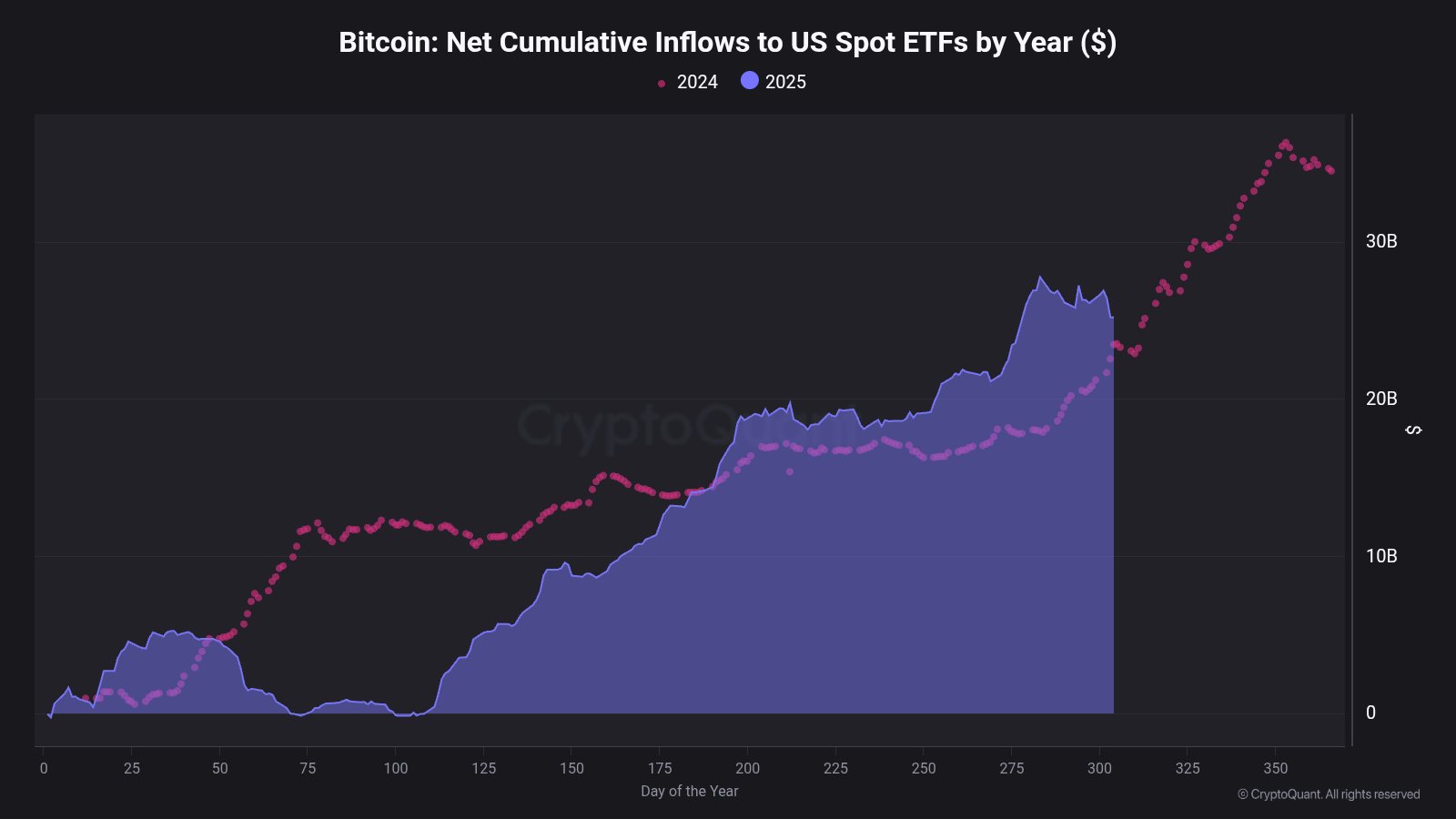
Despite the recent bearish wave, however, Bitcoin is still outperforming in 2024 in terms of the spot exchange-traded fund (ETF) inflows. As CryptoQuant community analyst Maartunn has pointed out in an X post, 2025 is ahead of 2024 in year-to-date inflows.
Bitcoin ETF Inflows

How the cumulative spot ETF inflows have compared between the two years | Source: @JA_Maartun on X

At this point last year, US Bitcoin spot ETFs registered around $22.5 billion in cumulative inflows. The same metric for 2025 is now sitting at $25.18 billion.

Featured image from Dall-E, CryptoQuant.com, chart from TradingView.com
Editorial Process for bitcoinist is centered on delivering thoroughly researched, accurate, and unbiased content. We uphold strict sourcing standards, and each page undergoes diligent review by our team of top technology experts and seasoned editors. This process ensures the integrity, relevance, and value of our content for our readers.

Keshav is a Physics graduate who has been employed as a writer with Bitcoinist since June 2021. He is passionate about writing and through the years, he has gained experience working in a variety of niches. Keshav holds an active interest in the cryptocurrency market, with on-chain analysis being an area he particularly likes to research and write about.

Leituras Relacionadas

Hefei 30 Billion for 1 Trillion: The First Year of Equity Finance, Who Can Copy This Assignment

In July 2026, Hefei’s state-owned assets system reaped over 1 trillion RMB in floating gains from the IPO of ChangXin Memory—a return stemming from a cumulative investment of less than 30 billion RMB over the preceding decade. This marks a prominent case of China’s emerging “equity-based fiscal model,” where local governments act as long-term industrial investors rather than relying solely on land sales. The story traces back to 2016, when Zhu Yiming, founder of Gigadevice and later ChangXin, sought funding for a domestic DRAM chip project amid high risks and intense international competition. Hefei, despite its limited fiscal resources, committed to the venture. Over the next ten years, ChangXin accumulated over 36 billion RMB in losses, yet Hefei’s state capital persisted, providing continuous funding and “nanny-style” support while building a surrounding industrial cluster. This approach—now termed the “Hefei Model”—originated earlier with the city’s 2008 decision to pause subway construction to invest in BOE’s struggling LCD panel production line. That bet later spurred a display industry ecosystem in Anhui. Similarly, ChangXin’s eventual profitability in 2026, driven by AI-driven demand for memory chips, validated Hefei’s patience. The model reflects a strategic shift in Chinese local public finance: from land-revenue dependence to nurturing strategic industries through equity participation, leveraging state capital to attract private investment, and ultimately securing long-term fiscal and industrial benefits. However, replicating Hefei’s success is challenging. It requires exceptional political continuity across administrations, professionalized state-capital management teams, precise timing in catching industry cycles, and the resilience to endure prolonged losses without withdrawing—factors not easily copied through policy documents or study tours. Beyond the headline financial gains, Hefei’s deeper achievement lies in cultivating a robust semiconductor cluster, with over 450 upstream and downstream firms and a sevenfold increase in integrated circuit industry output from 2016 to 2025. While the equity-fiscal concept is spreading, the patience, expertise, and historical contingencies behind Hefei’s execution remain its distinctive, hard-to-replicate core.

marsbitHá 23m

Hefei 30 Billion for 1 Trillion: The First Year of Equity Finance, Who Can Copy This Assignment

marsbitHá 23m

Trading

Spot
活动图片