Key Takeaways
- Stream Finance reported $93 million in losses due to an external fund manager.
- The DeFi protocol has frozen $160 million in user deposits and halted all transactions.
- It’s the second major DeFi collapse in 48 hours, following Balancer’s $100 million breach.
Just one day after Balancer lost over $100 million in a hack, Stream Finance, a major yield-focused DeFi protocol, disclosed a $93 million loss tied to one of its external fund managers.
The exploit forced Stream Finance to suspend all deposits and withdrawals while freezing $160 million in user funds.
For a protocol that built its reputation on efficiency and transparency, this marks its biggest crisis yet.
Why Did XUSD Stablecoin Depeg?
Stream Finance’s in-house stablecoin, XUSD, didn’t take long to react.
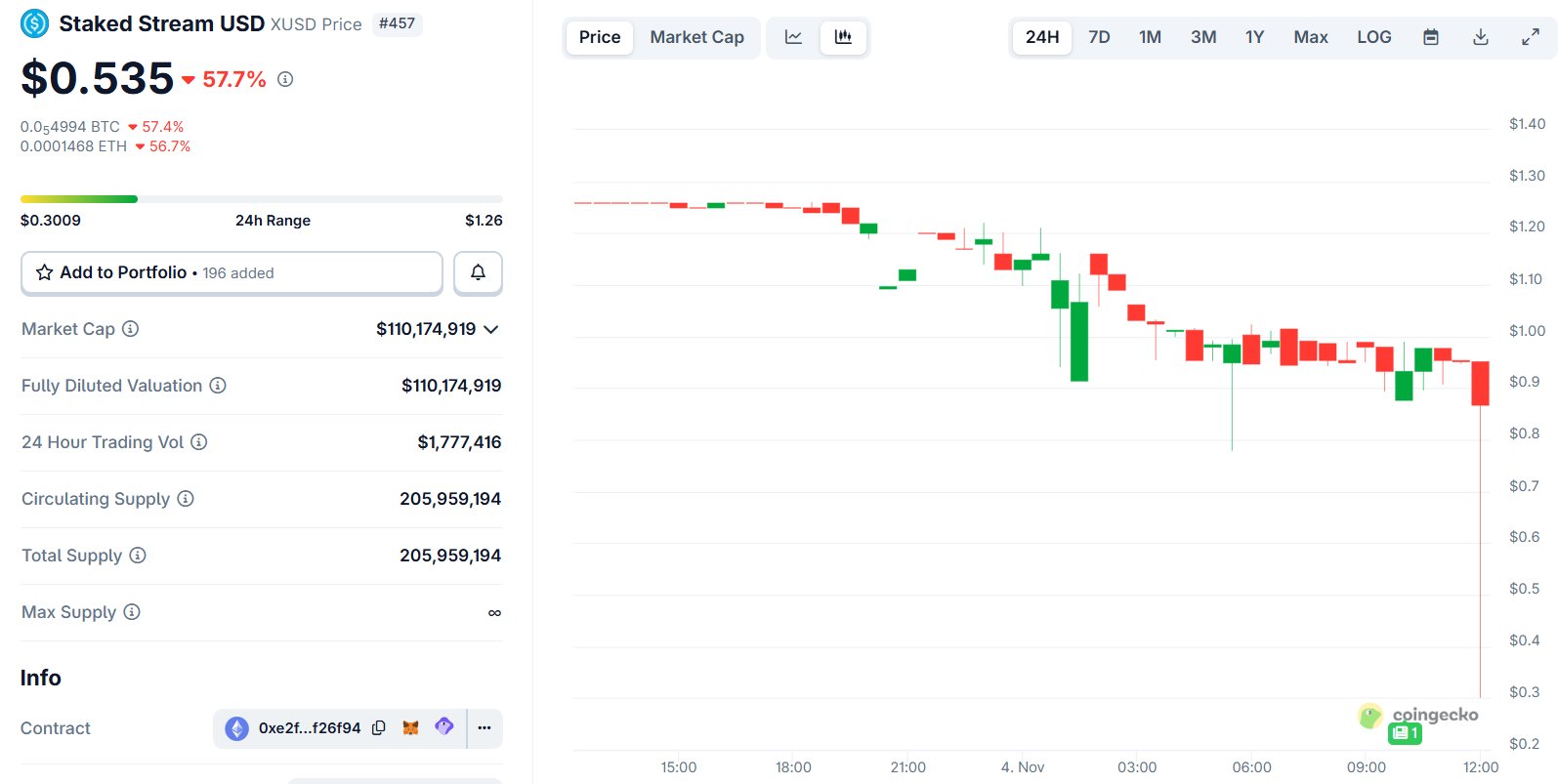
Within hours of the announcement , the XUSD stablecoin collapsed from its $1 peg to as low as $0.43, triggering mass panic and liquidations across DeFi platforms.
The protocol confirmed that its legal team, led by Perkins Coie LLP partners Keith Miller and Joseph Cutler, had been engaged to conduct a forensic investigation into the losses.
“We are actively withdrawing all liquid assets and expect this process to be completed in the near term,” Stream Finance said in a post, promising regular updates to maintain full transparency.
On-chain data shows Stream Finance’s total value locked (TVL) at around $520 million, backed by approximately $160 million in user deposits.
The platform had attracted users with its capital-efficient model, allowing them to deposit USDC, receive XUSD, and earn yields of up to 12% through leveraged farming strategies across more than 50 liquidity pools.
But that very leverage, estimated at four times exposure, may have been its undoing.
Cracks in the System
Concerns about Stream Finance’s accounting had already surfaced days before the collapse, when analysts noticed a discrepancy between its reported TVL and DeFiLlama data.
The difference hinted at potential mismanagement — or worse, hidden leverage.
Community sleuths on X speculated that the fund manager may have used customer deposits to purchase and farm risky assets, amplifying exposure through rehypothecation.
When prices fell, those leveraged positions likely imploded, leaving the protocol unable to meet its obligations.
No on-chain evidence of a hack has surfaced so far, suggesting the problem may stem from human error, poor risk controls, or unauthorized trades rather than an external exploit.
Déjà Vu for DeFi
Stream Finance’s implosion comes amid renewed skepticism about DeFi’s long-promised transparency.
While decentralization is a core principle, many protocols still rely on opaque fund management structures that operate like traditional hedge funds — without the oversight.
This latest failure follows a pattern that played out throughout the last bull cycle, when major crypto lenders and DeFi platforms collapsed under leveraged exposure and volatile yield-farming bets.
Just a day earlier, Balancer suffered a massive breach worth over $110 million, adding to the sense that DeFi is once again facing a credibility crisis.
For investors, the fallout is both financial and philosophical: a reminder that “trustless finance” still demands a leap of faith.