Уинн предупредил о падении курса криптовалют в первую неделю ноября

cryptonews.ruPublicado em 2025-11-02Última atualização em 2025-11-03

Трейдер Джеймс Уинн, поставивший рекорд по сумме открытой позиции на покупку биткоинов, полагает, что первая неделя ноября будет трудной для рынка криптовалют.

«Умные деньги» уходят с рынка цифровых активов перед началом торговли акциями, как и прогнозировалось. Держитесь крепче. Эта неделя станет испытанием для всех нас. В особенности это касается богатых частных инвесторов.

Максимальный страх, боль и паника давно назрели. Все эти «новые деньги», вошедшие на крипторынок, ещё пороху не нюхали. Пора их испытать на прочность, — написал Уинн.

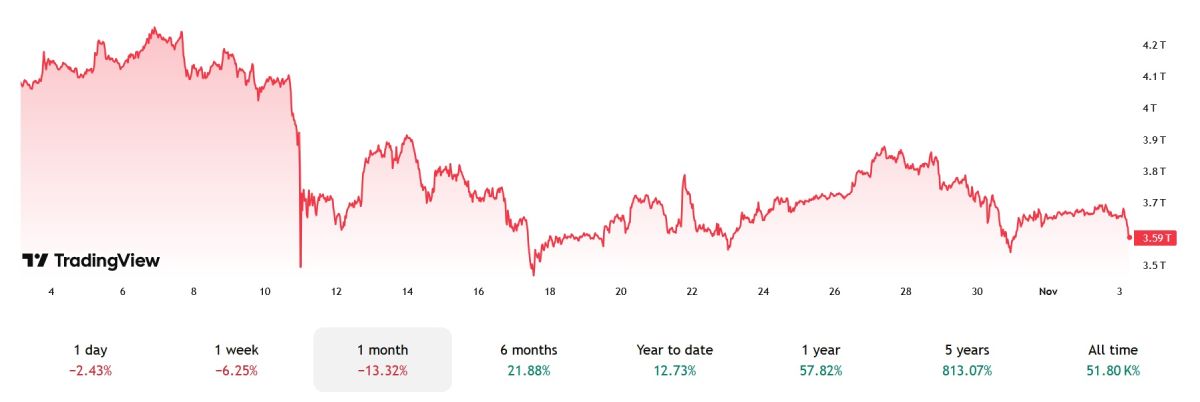
Джеймс не лукавит, когда говорит об оттоке капитала с рынка цифровых активов. За последние сутки стоимость всех выпущенных виртуальных валют снизилась на 2,43%, а за неделю падение составило 6,25%. Тем временем индекс S&P 500, отслеживающий курс акций предприятий, повысился с 27 октября на 1,01%. Продолжение этого тренда можно объяснить уменьшением ключевой ставки в США до минимального показателя за последние три года на уровне 3,75-4%.
crypto-market-cap-3-november

Изменение рыночной капитализации криптовалют

На ротацию капитала обратил внимание и экономист Питер Шифф. По его словам, по сравнению с пиковыми показателями, зафиксированными в январе 2025 года, индекс NASDAQ 100 и курс золота увеличились на 18% и 42% соответственно, а цена биткоина упала на 14,37% от исторического максимума, достигнутого на отметке $126,272 в октябре. Шифф считает, что это сигнализирует о продолжении медвежьего тренда на рынке BTC, который утянет за собой вниз остальные виртуальные валюты.


Leituras Relacionadas

Zuckerberg Begins Betting on Prediction Markets, While Asian Countries Still View Them as Gambling

Mark Zuckerberg is backing prediction markets, with Meta developing its own app "Arena," signaling major tech validation. This industry now sees over $14 billion in monthly volume. These markets function as binary contracts (payout $1 if an event occurs, $0 if not), with trading prices reflecting real-time event probabilities. Results are settled by oracles. Prediction markets originated from informal political betting and academic experiments like the Iowa Electronic Markets. Their core mechanism relies on "skin in the game"—participants risk their own money, making aggregated information more reliable than polls or expert opinions. They have proven accurate in forecasting areas like monetary policy, elections, and market events. While Western markets are integrating them into regulated financial systems, many Asian jurisdictions still classify them as gambling, leading to regulatory divergence. This stance creates three major issues for Asia: regulatory arbitrage and capital outflow, loss of informational sovereignty as valuable social data accumulates offshore, and a lack of user protection within a formal framework. The article argues that Asia's focus should shift from blocking these markets to responsibly harnessing the data they generate within a regulated system. The current avoidance of discussion cedes leadership and advantages to foreign entities.

Foresight NewsHá 8m

Zuckerberg Begins Betting on Prediction Markets, While Asian Countries Still View Them as Gambling

Foresight NewsHá 8m

Beyond Private Keys: From Wallets and L2 to Supply Chains, How to Guard the Security Perimeter of Web3?

Beyond Private Keys: Securing Web3's Expanding Attack Surface from Wallets to L2s and Supply Chains The crypto space faced a wave of security incidents in June, with over $75 million lost across 40 major attacks. These breaches highlighted risks beyond private key theft, exposing vulnerabilities across the entire user interaction chain. Wallet security was compromised not through stolen seed phrases, but via a critical flaw in the Cardano wallet SecondFi's signing implementation. This bug allowed attackers to potentially derive private keys from publicly visible signature data, emphasizing that wallet security depends on correct cryptographic implementation, ideally in open-source, auditable code. Layer-2 networks also revealed complex trust chain risks. Attacks on legacy Aztec deployments exploited inconsistencies in proof systems, showing that a valid zero-knowledge proof is only as secure as its underlying rules. Another attack on Taiko's SGX-based prover stemmed from a leaked signing key and inadequate verification checks. Furthermore, a technical glitch halted Base's block production, underscoring that L2 security encompasses network availability and reliable user exit paths as much as asset safety. Finally, the Polymarket incident demonstrated that even audited smart contracts are not immune. A compromised third-party supplier led to a malicious script being injected into the platform's frontend, resulting in user fund losses. This "supply chain attack" shows that the security of the entire interaction path—from the webpage to the wallet signature—is critical. The conclusion is clear: Web3 security now involves safeguarding the entire journey from transaction intent to on-chain settlement. Users must adopt layered security habits: isolating long-term holdings, using dedicated wallets for daily interactions, scrutinizing transaction details before signing, and managing authorizations cautiously. Defense must evolve from protecting a single point (the private key) to securing a complete chain of interactions.

marsbitHá 1h

Beyond Private Keys: From Wallets and L2 to Supply Chains, How to Guard the Security Perimeter of Web3?

marsbitHá 1h

Robinhood Chain Goes Viral in One Week: Memes Drive Traffic, Stablecoins Support TVL

Robinhood Chain, an Arbitrum-based Layer 2 network launched on July 1st, experienced explosive growth in its first week. While meme coin hype drove user activity, stablecoin deposits fueled its surge in Total Value Locked (TVL). The chain's rapid adoption was driven by multiple factors. CEO Vlad Tenev reversed his initial stance, endorsing the chain for meme coins despite its original focus on Real-World Assets (RWA). The integration of the popular Solana-based launchpad Pump.fun significantly lowered the barrier for meme trading. Furthermore, the prediction market application World announced a migration from Solana to Robinhood Chain. Meme coin mania, led by tokens like CASHCAT, generated massive trading volume, with daily active addresses skyrocketing from near zero to hundreds of thousands. However, the primary driver of the chain's TVL, which soared past $234 million, was a major institutional deposit. Ethena injected approximately $50 million in stablecoins into the Morpho lending protocol, which underpins Robinhood's Earn product, accounting for the bulk of locked value. This highlights two concurrent narratives: retail-driven meme speculation boosting transactions, and institutional stablecoin deposits building foundational liquidity. In contrast, the chain's flagship RWA offerings, like tokenized stocks, remain a minor part of the ecosystem at around $12.8 million. The first week demonstrates a path where speculative trading and yield-seeking capital provide initial momentum, while the core RWA vision is still in early development.

Foresight NewsHá 1h

Robinhood Chain Goes Viral in One Week: Memes Drive Traffic, Stablecoins Support TVL

Foresight NewsHá 1h

Trading

Spot
活动图片