First US Spot XRP ETF Set To Launch On November 13 Pending Nasdaq Approval

bitcoinistPublicado em 2025-10-31Última atualização em 2025-10-31

Resumo

Canary Funds has positioned what could become the first US spot XRP ETF to launch on November 13, after moving...

Trusted Editorial content, reviewed by leading industry experts and seasoned editors. Ad Disclosure

Canary Funds has positioned what could become the first US spot XRP ETF to launch on November 13, after moving its fund onto an accelerated legal track that limits the SEC’s ability to control timing.

The shift comes from a change in Canary’s updated S-1. As reported by Crypto In America host Eleanor Terrett, Canary “has filed an updated S-1 for its XRP spot ETF, removing the ‘delaying amendment’ that stops a registration from going auto-effective and gives the SEC control over timing.” Without that delaying amendment, the registration can become effective automatically after the 20-day statutory waiting period, unless the SEC actively intervenes.

Terrett says this puts Canary’s ETF on a concrete timeline: “This sets Canary’s XRP ETF up for a launch date of November 13, assuming the Nasdaq greenlights the 8-A filing.” The Form 8-A is what allows the product to actually list on Nasdaq and trade. That exchange approval is now the last operational step. If Nasdaq signs off and the SEC does not move to block or slow it, the fund can begin trading.

This approach is not theoretical. It is the same legal mechanism that was just used to push out spot crypto ETFs tied to Solana (SOL), Hedera (HBAR), and Litecoin (LTC) earlier this week, despite the US shutdown period. Terrett notes that both Bitwise and Canary relied on the 20-day waiting period “to go public during the shutdown,” in effect leveraging a moment when normal back-and-forth review is constrained.

Why November 13 Is Still Uncertain For A Spot XRP ETF

That shutdown dynamic is still relevant. Terrett cautions that “the government reopening could affect the timing, potentially moving it up if the filing is complete and the SEC is satisfied, or back if staff propose additional comments.” In other words, the November 13 date can move in either direction depending on how quickly the SEC re-engages, and whether it decides to press for changes.

There are also signals from the top of the agency. While not commenting directly on crypto ETFs, SEC Chair Paul Atkins “said yesterday he was pleased to see companies like MapLight using the 20-day statutory waiting period to go public during the shutdown,” praising the same legal pathway Canary is now invoking for XRP. Terrett frames that as meaningful because it suggests the agency is publicly acknowledging the legitimacy of going effective on the statutory clock rather than through negotiated timing.

That said, XRP is not Solana. Bloomberg’s senior ETF analyst Eric Balchunas noted that “XRP docs didn’t have the same comments back-and-forth with the SEC that Solana had,” adding “that was one reason issuers felt they were ready. But hey, worth a try I guess.”

The difference is important: Solana’s spot ETF filings went through iterative engagement with SEC staff before the US government shutdown which gave issuers confidence. With XRP, Canary is effectively stress-testing the process with less visible negotiated review.

That creates a binary outcome. If Nasdaq clears the 8-A and the SEC allows the auto-effective clock to run out without forcing new comments, the XRP fund could begin trading on November 13, establishing the first US spot ETF. If the SEC steps in, either by pushing additional comments onto the S-1 or pressuring the listing, that would mark a line: the Commission is willing to tolerate auto-effectiveness for certain assets, but not XRP — at least not yet.

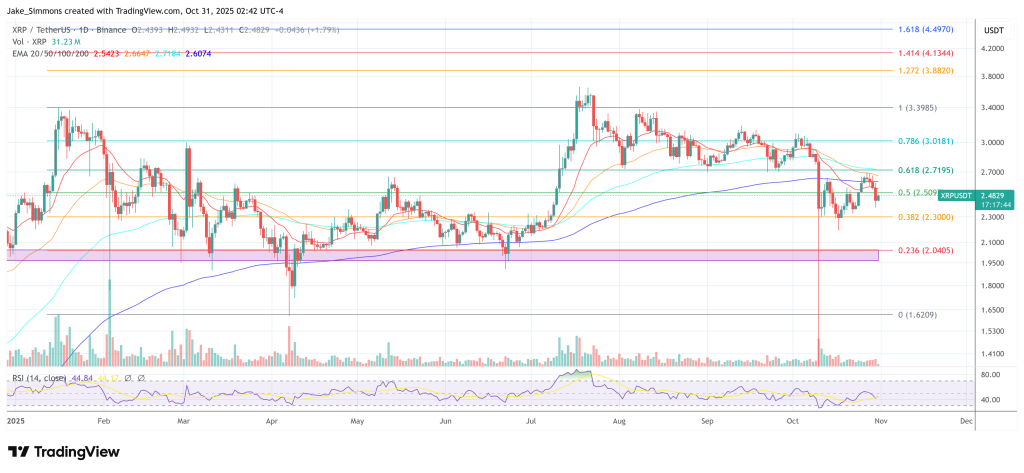
At press time, XRP traded at $2.48.
XRP price
XRP price, 1-day chart | Source: XRPUSDT on TradingView.com
Featured image created with DALL.E, chart from TradingView.com
Editorial Process for bitcoinist is centered on delivering thoroughly researched, accurate, and unbiased content. We uphold strict sourcing standards, and each page undergoes diligent review by our team of top technology experts and seasoned editors. This process ensures the integrity, relevance, and value of our content for our readers.

Jake Simmons has been a Bitcoin enthusiast since 2016. Ever since he heard about Bitcoin, he has been studying the topic every day and trying to share his knowledge with others. His goal is to contribute to Bitcoin's financial revolution, which will replace the fiat money system. Besides BTC and crypto, Jake studied Business Informatics at a university. After graduation in 2017, he has been working in the blockchain and crypto sector. You can follow Jake on Twitter at @realJakeSimmons.

Criptomoedas em alta

Leituras Relacionadas

Lei Jun Reports Xiaomi's Q2 Performance, Phone Premiumization Takes Effect, While Automotive and AI Continue 'Burning Cash'

Xiaomi released its Q2 2026 financial results, showing mixed performance. Total revenue was approximately 108.9 billion yuan, down 6.1% year-over-year, while adjusted net profit fell 42.6% to about 6.2 billion yuan. The company's core smartphone business saw a 7.5% decline in revenue to 42.1 billion yuan, primarily due to lower shipment volumes, partially offset by a record high average selling price (ASP) which rose 25.9%. Xiaomi's global smartphone market share held steady at third place. Its AIoT platform connected over 1.16 billion devices, a 17.4% increase. Despite pressures on traditional revenue streams, Xiaomi continues heavy investment in new growth areas. Its innovation segment, encompassing smart electric vehicles and AI, generated 24.9 billion yuan in revenue (up 17.1%), but reported an operating loss of 2.6 billion yuan. Capital expenditure for these businesses reached 2.4 billion yuan in Q2. Vehicle deliveries grew 28.2% to 104,199 units, with cumulative deliveries for the SU7 series surpassing 500,000 units by mid-August. The company also highlighted significant R&D spending of 9.2 billion yuan for the quarter. On the technology front, Xiaomi announced several AI and software developments, including the new Xiaomi HyperOS 4, the "Super Xiaoai 2.0" assistant, and advancements in its MiMo large language model and robotics platform. The company noted its first-generation self-developed chip, the Xuangjie O1, has surpassed one million units shipped across three products, with a new generation chip soon to be released. Management acknowledged that memory price increases impacted low-end phone sales more severely but expects the trend to moderate.

marsbitHá 19m

Lei Jun Reports Xiaomi's Q2 Performance, Phone Premiumization Takes Effect, While Automotive and AI Continue 'Burning Cash'

marsbitHá 19m

From Minting to Tape-Out: A First-Timer’s Guide to TapeOut

Title: From Mint to Tapeout: A First-Timer’s Guide to TapeOut **Summary:** This guide provides a risk-conscious, step-by-step introduction to TapeOut, a platform where users can mint logic components (NAND, LATCH) and use them to "tape out" on-chain circuits. It emphasizes a fundamental shift in mindset: instead of focusing first on prices or speculation, users should first understand how to use the platform's core functionality. The recommended path begins with preparation: use a separate, low-fund wallet on BNB Smart Chain for experimentation. The first step is to choose a "Processor"—the foundational unit for components and circuits—by examining its details (supply, mintage, creator) rather than chasing trends. If a Processor has remaining supply, users can mint a small number of components. The guide stresses that minting acquires specific components for a specific processor, not a generic asset. For sold-out Processors, trading occurs on an order book market. Users must carefully understand order prices, quantities, and the 1% fee, and always verify transactions on a block explorer. The core "play" experience is in the Canvas, where users can build and test logic circuits without a wallet. Before proceeding to tapeout—the irreversible, on-chain act of finalizing a circuit which consumes components—users must verify their design, component costs, and target processor. After taping out a circuit, the guide encourages users to interact with it, for example by calling its functions via BscScan's read contract feature, completing the "components -> circuit -> verification" loop. It concludes with critical safety checks to perform before any wallet signature, and cautions against misinterpreting demo pages (like the "on-chain BTC miner") as profit-generating services. The goal is to approach TapeOut as a hands-on lesson in on-chain logic, minimizing financial risk while learning its unique mechanics.

marsbitHá 53m

From Minting to Tape-Out: A First-Timer’s Guide to TapeOut

marsbitHá 53m

Wall Street Analyst Predicts SpaceX Stock Price Drop to $75

A Wall Street analyst from Phillip Securities, Glenn Tumm, has issued a "Sell" recommendation for SpaceX stock (SPCX), maintaining a 12-month price target of $75. This implies a potential 46.6% drop from the current price of $140.50. The bearish outlook is based on the company's significant capital expenditures, reliance on temporary cloud service contracts, and customer concentration in its AI services, suggesting a need for longer-term commitments to support its valuation. This stance contrasts sharply with the broader Wall Street consensus. An average of 31 analysts polled by TipRanks sets a 12-month price target of $232.35, implying 64% upside, with the highest forecast at $800 and the lowest at $75. The report follows SpaceX's impressive Q2 2026 results, where total revenue surged 92% year-over-year to $7.8 billion. Starlink subscriber count doubled to 12 million, driving communications revenue up 66% to $4.3 billion. AI-related revenue skyrocketed 247% to $2.6 billion, fueled by new cloud services and infrastructure deals. Despite the strong earnings, SPCX shares fell over 4% in the last 24 hours, reducing the company's market cap to $1.9 trillion. The stock had initially jumped over 17% post-earnings but faced resistance near $149. The analyst concludes that SpaceX's future trajectory hinges on securing more long-term contracts with its AI and Starlink customers. Success could validate Wall Street's bullish forecasts, while failure may render the recent stock rebound temporary.

cryptonews.ruHá 1h

Wall Street Analyst Predicts SpaceX Stock Price Drop to $75

cryptonews.ruHá 1h

Trading

Spot

Artigos em Destaque

O que é XRP 2.0

XRP 2.0: Uma Nova Fronteira no Landscape das Criptomoedas Introdução ao XRP 2.0 No reino em constante evolução das criptomoedas, novos projetos surgem continuamente, lutando por atenção e adoção. Uma dessas iniciativas promissoras é o XRP 2.0, um novo projeto de criptomoeda concebido para aproveitar a tecnologia de blockchain avançada e as metodologias de criptografia robustas. Embora o nome tenha paralelos com o XRP da Ripple, é crucial notar que o XRP 2.0 opera de forma independente, focando em melhorar a segurança das transações, a privacidade e a escalabilidade. À medida que o panorama financeiro digital abraça cada vez mais soluções descentralizadas, o XRP 2.0 visa contribuir de forma significativa para a web3 e a expansão global dos projetos de criptomoedas. O que é o XRP 2.0? No seu núcleo, o XRP 2.0 é um projeto de criptomoeda que visa criar um ecossistema de moeda digital seguro e descentralizado. Sua tecnologia fundamental integra princípios de blockchain sofisticados com técnicas de criptografia de ponta. O objetivo abrangente do XRP 2.0 é estabelecer-se como uma plataforma confiável e eficiente que possibilita a execução rápida de transações, priorizando a proteção de privacidade aprimorada para os seus usuários. O projeto é promovido como uma solução para muitas limitações enfrentadas pelas criptomoedas existentes, propondo um sistema que pode lidar com um volume maior de transações com velocidade e privacidade melhoradas. Esta versatilidade posiciona o XRP 2.0 como um concorrente significativo em um mercado repleto de várias moedas digitais. Quem é o Criador do XRP 2.0? A identidade do criador por trás do XRP 2.0 foi identificada como 'Wilbur.' No entanto, detalhes abrangentes sobre Wilbur ou a sua entidade associada permanecem elusivos. O anonimato de muitos criadores de criptomoedas não é um fenômeno incomum na indústria, muitas vezes concebido para manter um grau de privacidade e segurança. Quem são os Investidores do XRP 2.0? Até agora, informações específicas relacionadas às fundações ou organizações de investimento que apoiam o XRP 2.0 não estão disponíveis publicamente. No setor das criptomoedas, o apoio de investidores reputados pode influenciar significativamente a credibilidade e o sucesso de um projeto, no entanto, a transparência em relação aos apoiantes financeiros do XRP 2.0 não foi estabelecida. Como Funciona o XRP 2.0? O XRP 2.0 destaca-se por empregar uma combinação de tecnologia blockchain e algoritmos de criptografia avançados que asseguram transações seguras e descentralizadas. Sua estrutura inovadora inclui características únicas projetadas para fomentar o envolvimento dos usuários e ampliar as funcionalidades além das transações convencionais de criptomoedas. Entre essas características, o XRP 2.0 incorpora capacidades potenciadas por IA, como funcionalidades de texto-para-imagem e texto-para-fala. Estas adições são projetadas para melhorar a experiência interativa dos usuários, promovendo uma maior aplicabilidade em vários setores. Ao unir avanços tecnológicos com um design centrado no utilizador, o XRP 2.0 pretende captar a atenção de uma diversa gama de indivíduos e empresas que procuram integrar soluções de criptomoedas em suas estruturas operacionais. Cronologia do XRP 2.0 Compreender o XRP 2.0 requer examinar os marcos que definiram sua jornada até agora: 23 de Julho de 2023: O XRP 2.0 é apresentado como um novo projeto de criptomoeda, visando revolucionar as capacidades de transação seguras e descentralizadas no domínio do blockchain. 8 de Setembro de 2023: O lançamento de outro projeto, XRP20, ocorre, marcando o surgimento de um token ERC-20 na blockchain Ethereum que permanece não relacionado ao XRP 2.0. 13 de Novembro de 2023: O XRP Ledger passa por uma atualização significativa com o lançamento da versão 2.0.0 do software do servidor rippled. É importante notar que este desenvolvimento está desconectado do projeto de criptomoeda XRP 2.0. Pontos-chave sobre o XRP 2.0 Para destilar a essência do XRP 2.0, vários fatores críticos emergem: Características Únicas: A inclusão de características como texto-para-imagem e texto-para-fala potenciadas por IA diversifica ainda mais as aplicações potenciais do XRP 2.0. Tecnologia Blockchain: A estrutura utiliza mecanismos de blockchain avançados e protocolos de criptografia, assegurando um ambiente seguro e descentralizado para transações. Escalabilidade e Privacidade: O XRP 2.0 prioriza proteção de privacidade aprimorada nos processos de transação e a escalabilidade necessária para acomodar uma base de utilizadores crescente. Sem Afiliação com a Ripple: Importante, apesar do seu nome, o XRP 2.0 não tem qualquer lealdade ou colaboração com o XRP da Ripple, distinguindo sua estrutura operacional e objetivos dentro do ecossistema das criptomoedas. Conclusão O XRP 2.0 representa uma empreitada ambiciosa no domínio das criptomoedas, visando oferecer uma combinação de segurança, privacidade e eficiência em transações digitais. Ao integrar tecnologias sofisticadas e características amigáveis ao utilizador, o projeto propõe-se a ampliar os horizontes do que as criptomoedas podem alcançar na economia digital atual. Embora o anonimato do seu criador e a falta de investidores divulgados possam levantar questões para alguns, o foco do XRP 2.0 em funcionalidades avançadas e descentralização aumenta seu apelo num mercado de criptomoedas cada vez mais congestionado. À medida que o panorama das criptomoedas continua a evoluir, o XRP 2.0 pode ainda emergir como um jogador crucial na expansão de soluções de blockchain seguras e escaláveis.

237 Visualizações TotaisPublicado em {updateTime}Atualizado em 2024.12.03

O que é XRP 2.0

Como comprar XRP

Bem-vindo à HTX.com!Tornámos a compra de XRP (XRP) simples e conveniente.Segue o nosso guia passo a passo para iniciar a tua jornada no mundo das criptos.Passo 1: cria a tua conta HTXUtiliza o teu e-mail ou número de telefone para te inscreveres numa conta gratuita na HTX.Desfruta de um processo de inscrição sem complicações e desbloqueia todas as funcionalidades.Obter a minha contaPasso 2: vai para Comprar Cripto e escolhe o teu método de pagamentoCartão de crédito/débito: usa o teu visa ou mastercard para comprar XRP (XRP) instantaneamente.Saldo: usa os fundos da tua conta HTX para transacionar sem problemas.Terceiros: adicionamos métodos de pagamento populares, como Google Pay e Apple Pay, para aumentar a conveniência.P2P: transaciona diretamente com outros utilizadores na HTX.Mercado de balcão (OTC): oferecemos serviços personalizados e taxas de câmbio competitivas para os traders.Passo 3: armazena teu XRP (XRP)Depois de comprar o teu XRP (XRP), armazena-o na tua conta HTX.Alternativamente, podes enviá-lo para outro lugar através de transferência blockchain ou usá-lo para transacionar outras criptomoedas.Passo 4: transaciona XRP (XRP)Transaciona facilmente XRP (XRP) no mercado à vista da HTX.Acede simplesmente à tua conta, seleciona o teu par de trading, executa as tuas transações e monitoriza em tempo real.Oferecemos uma experiência de fácil utilização tanto para principiantes como para traders experientes.

1.9k Visualizações TotaisPublicado em {updateTime}Atualizado em 2026.06.02

Como comprar XRP

Discussões

Bem-vindo à Comunidade HTX. Aqui, pode manter-se informado sobre os mais recentes desenvolvimentos da plataforma e obter acesso a análises profissionais de mercado. As opiniões dos utilizadores sobre o preço de XRP (XRP) são apresentadas abaixo.

活动图片