Something ‘Very Big’ Is Coming To Cardano, Says Charles Hoskinson

bitcoinistPublicado em 2025-10-28Última atualização em 2025-10-28

Resumo

Cardano founder Charles Hoskinson says the network is on the cusp of a significant shift, reacting to news that an...

Trusted Editorial content, reviewed by leading industry experts and seasoned editors. Ad Disclosure

Cardano founder Charles Hoskinson says the network is on the cusp of a significant shift, reacting to news that an HTTP-402–based payments standard—known as “x402”—is being brought to Cardano and integrated with Masumi, an agent-to-agent protocol built atop the chain. “This is very big for Cardano,” Hoskinson wrote on X on October 27, in response to the demo announcement.

The catalyst is a proof-of-concept published by Masumi cofounder Patrick Tobler showing a live x402 “pay-to-access” flow that ends in an on-chain action: a memecoin mint on Cardano. Tobler framed it as a milestone en route to standardizing how autonomous agents and web services exchange value via APIs without log-ins or OAuth.

“x402 is coming to Cardano (and Masumi)! … The first x402 Proof-Of-Concept Memecoin Mint,” he posted, adding that users can try the demo with 2 USDM for payment and a small amount of ADA for fees—and stressing that the token itself is strictly a technical showcase with “0 future plans.”

What This Means For Cardano

In a series of follow-ups, Tobler described x402 as a revival of the web’s long-dormant HTTP 402 “Payment Required” status code, generalized for modern machine-to-machine commerce. “Built around the HTTP 402 status code, x402 enables users to pay for resources via API without registration, emails, OAuth, or complex signatures,” he wrote, noting that Coinbase developed the protocol and that it is integrated into Google’s Agent Payments Protocol (AP2).

The Masumi implementation pairs that transport-level payment primitive with smart-contract guarantees for identity, refunds, and decision logging—“turning Cardano into the financial backbone of the agent economy,” as he put it.

The demo itself makes the flow concrete. When a user hits the endpoint, the server responds with “402: Payment Required.” The front end prompts a connected Cardano wallet to construct the payment. The payment proof is then transmitted in the 402 header; the server relays it on-chain, waits for finality, and only then returns the protected resource—in this case, minting the demo memecoins. “Please note: This is NOT a real memecoin. It is ONLY a proof-of-concept intended to showcase the technology!” Tobler emphasized.

Context matters for why Hoskinson’s enthusiasm resonated. x402 has been positioned by Coinbase as an “internet-native payment protocol” for AI agents and APIs, with instant, stablecoin-settled micropayments and merchant tooling. Separately, Google introduced AP2 as an open agent-payments layer designed to support multiple rails—including stablecoins—and to standardize authorization and auditability for agentic commerce. An x402 integration at the chain and smart-contract level gives Cardano a clear line into that emerging stack.

The choice of USDM for the demo highlights another Cardano-specific ingredient: a fiat-backed USD stablecoin native to the network, launched by Moneta (formerly Mehen). USDM’s role in the x402 flow is straightforward—precise, low-friction settlement per request—while ADA remains necessary for network fees. For agent-to-agent use cases, the combination is pragmatic: deterministic fees plus dollar-denominated pricing.

Tobler said the team is now drafting the x402 standard for both Cardano and Masumi, and explicitly not limiting the spec to simple address-to-address transfers. “By not only doing Address-To-Address like most other blockchains do but actually writing the standard to work with the Masumi Smart Contract, we’re making our x402 implementation the most powerful one out there,” he wrote.

At press time, ADA traded at $0.6659.
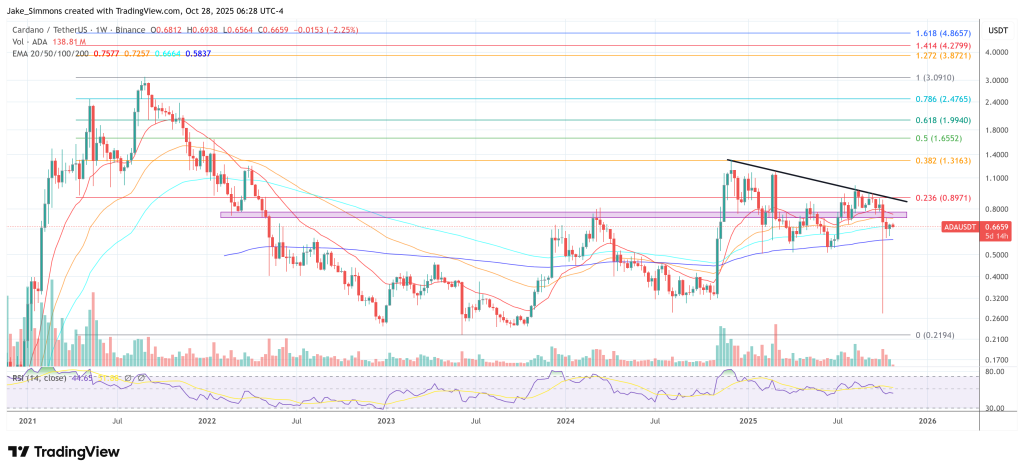
Cardano price
ADA remains below key resistance, 1-week chart | Source: ADAUSDT on TradingView.com
Featured image created with DALL.E, chart from TradingView.com
Editorial Process for bitcoinist is centered on delivering thoroughly researched, accurate, and unbiased content. We uphold strict sourcing standards, and each page undergoes diligent review by our team of top technology experts and seasoned editors. This process ensures the integrity, relevance, and value of our content for our readers.

Jake Simmons has been a Bitcoin enthusiast since 2016. Ever since he heard about Bitcoin, he has been studying the topic every day and trying to share his knowledge with others. His goal is to contribute to Bitcoin's financial revolution, which will replace the fiat money system. Besides BTC and crypto, Jake studied Business Informatics at a university. After graduation in 2017, he has been working in the blockchain and crypto sector. You can follow Jake on Twitter at @realJakeSimmons.

Leituras Relacionadas

DeFi Has Reached Its Most Dangerous Moment: The Real Vulnerabilities Are Not in the Code

DeFi in Peril: The Real Vulnerability Isn't in the Code April 2026 marked a paradigm shift in DeFi security, with over $625 million lost across 30 incidents—the worst month in crypto history by event count. Crucially, none of the major exploits (Drift Protocol: $285M, KelpDAO: $292M, Wasabi Protocol: $4.5M) resulted from smart contract vulnerabilities. Instead, failures occurred in the operational "plumbing": social engineering to compromise multi-signature councils, a single-point-of-failure 1-of-1 bridge validator, and stolen admin private keys. These events expose a fundamental misalignment: the industry's security model has long focused on code audits, while the actual attack surface has shifted to privileged access points and off-chain infrastructure. The article introduces the term "OpenFi" to describe this reality: permissionless, on-chain, yet operationally dependent on trusted third parties (admins, validators, oracles) at key junctures. The KelpDAO exploit vividly demonstrated asymmetric "contagion risk." A configuration error in a smaller protocol triggered a panic, causing approximately $13.2 billion in outflows from larger, unaffected protocols like Aave within 48 hours, as users fled uncertain collateral. The core dilemma is the double-edged sword of centralization. Operational levers like emergency councils (e.g., Arbitrum freezing stolen funds post-KelpDAO) enable crisis response but also create catastrophic attack surfaces if compromised (e.g., Drift). The path forward demands radical honesty: protocols must clearly disclose their trust assumptions, operational levers, and failure modes. The industry must treat operational security (key management, configurations, incident response) with the same rigor as code security. Survival depends on building systems whose risks can be understood, priced, and insured, moving beyond the outdated "code is law" mantra to a mature model of disclosed and managed trust.

链捕手Há 9h

DeFi Has Reached Its Most Dangerous Moment: The Real Vulnerabilities Are Not in the Code

链捕手Há 9h

Vitalik's Article Emphasizes Ethereum Must Be 'Amazing', But Foundation Is Not the Center

Vitalik Buterin has published a lengthy response to recent community criticism directed at the Ethereum Foundation (EF). Acknowledging a sense of "unease," he addresses concerns about the EF's strategic direction, its perceived disconnect from ETH's price performance, and calls for its reduced central role. Vitalik rejects the notion that the EF should be the central governing body of Ethereum, framing it instead as one "node with a clear mandate" among many within the ecosystem. He highlights the EF's limited ETH holdings (≈0.16% of supply) compared to other blockchain foundations and states it will no longer sell significant amounts of ETH. Its future focus will be on long-term, critical projects that align with Ethereum's core values of censorship-resistance and decentralization, which might not otherwise happen. A core argument is that Ethereum must be "amazing," but not by merely chasing higher transaction speeds at the cost of decentralization. He proposes focusing on the "CROPS" dimensions: creating a Cryptographically provable, Reliable, Open, Private, and Secure network. This includes pursuing goals like a formally verifiable, bug-free Ethereum client and minimizing protocol-level reliance on intermediaries. The article concludes by noting that while Vitalik clarifies the EF's refocused role, he does not directly address community suggestions for creating a new organization explicitly aligned with ETH's economic interests. This "alignment gap" is presented as a key challenge for Ethereum's future.

链捕手Há 9h

Vitalik's Article Emphasizes Ethereum Must Be 'Amazing', But Foundation Is Not the Center

链捕手Há 9h

Trading

Spot
Futuros

Artigos em Destaque

Como comprar ADA

Bem-vindo à HTX.com!Tornámos a compra de Cardano (ADA) simples e conveniente.Segue o nosso guia passo a passo para iniciar a tua jornada no mundo das criptos.Passo 1: cria a tua conta HTXUtiliza o teu e-mail ou número de telefone para te inscreveres numa conta gratuita na HTX.Desfruta de um processo de inscrição sem complicações e desbloqueia todas as funcionalidades.Obter a minha contaPasso 2: vai para Comprar Cripto e escolhe o teu método de pagamentoCartão de crédito/débito: usa o teu visa ou mastercard para comprar Cardano (ADA) instantaneamente.Saldo: usa os fundos da tua conta HTX para transacionar sem problemas.Terceiros: adicionamos métodos de pagamento populares, como Google Pay e Apple Pay, para aumentar a conveniência.P2P: transaciona diretamente com outros utilizadores na HTX.Mercado de balcão (OTC): oferecemos serviços personalizados e taxas de câmbio competitivas para os traders.Passo 3: armazena teu Cardano (ADA)Depois de comprar o teu Cardano (ADA), armazena-o na tua conta HTX.Alternativamente, podes enviá-lo para outro lugar através de transferência blockchain ou usá-lo para transacionar outras criptomoedas.Passo 4: transaciona Cardano (ADA)Transaciona facilmente Cardano (ADA) no mercado à vista da HTX.Acede simplesmente à tua conta, seleciona o teu par de trading, executa as tuas transações e monitoriza em tempo real.Oferecemos uma experiência de fácil utilização tanto para principiantes como para traders experientes.

1.2k Visualizações TotaisPublicado em {updateTime}Atualizado em 2025.03.21

Como comprar ADA

Discussões

Bem-vindo à Comunidade HTX. Aqui, pode manter-se informado sobre os mais recentes desenvolvimentos da plataforma e obter acesso a análises profissionais de mercado. As opiniões dos utilizadores sobre o preço de ADA (ADA) são apresentadas abaixo.

活动图片