Dogecoin: Will DOGE’s latest approach find a different result this time

AmbcryptoPublicado em 2022-07-05Última atualização em 2022-07-05

Resumo

DOGE faced a stiff area of resistance. If it can flip this area to demand, another 10% move upward could be likely.

Dogecoin [DOGE] was at a confusing place on the price charts in terms of trends. Higher timeframe bearishness was fighting against lower timeframe uptrends, and it was unclear whether Dogecoin can climb higher. In the event that it does, how much higher can the meme coin go?

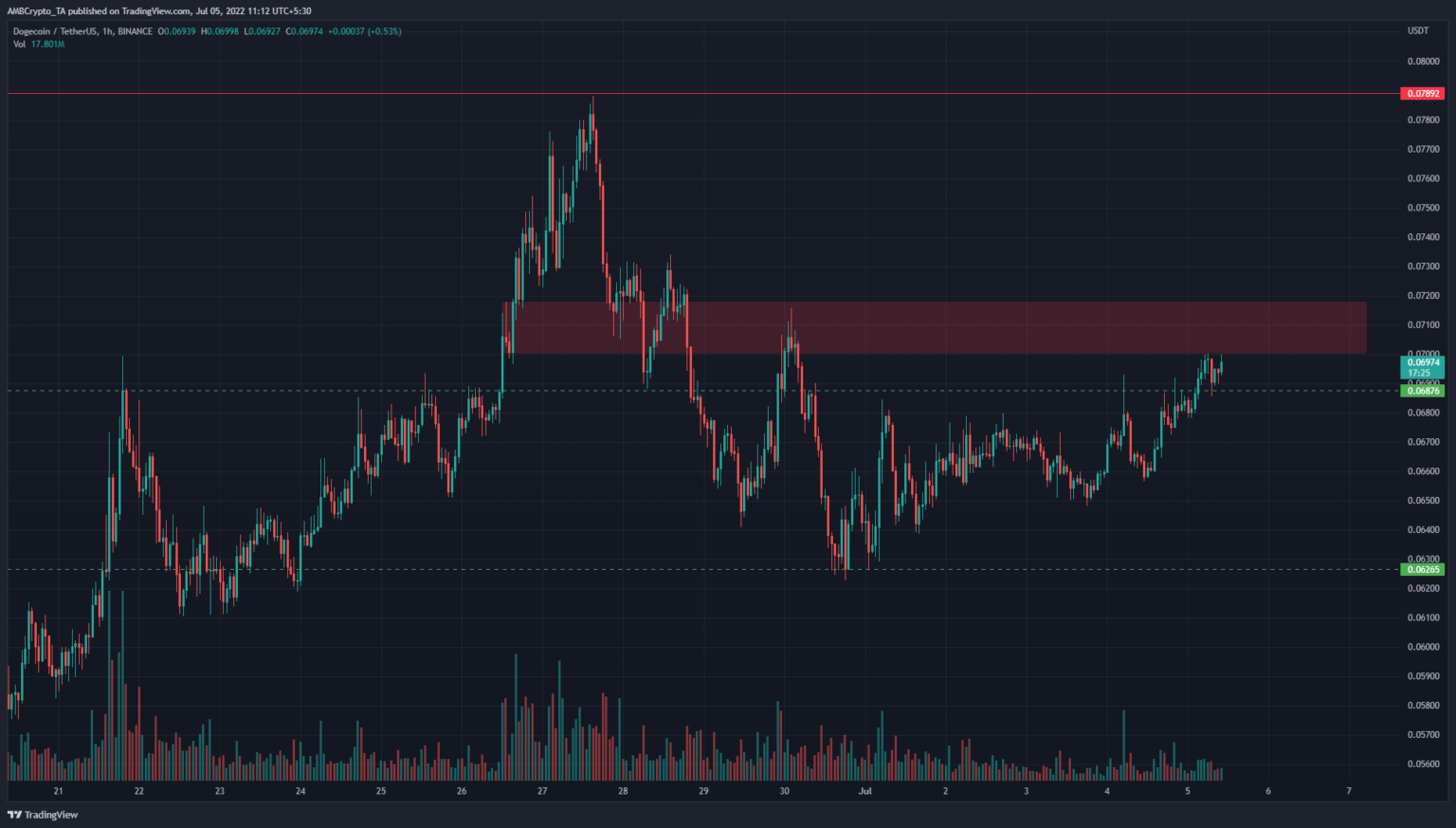
DOGE faced a stiff area of resistance at press time. If it can flip this area to demand, another 10% move upward could be likely.

DOGE- 1 Hour Chart
Source: DOGE/USDT on TradingView

In the past week, the price dipped from $0.078 to $0.062, but the support level at $0.062 was defended. This defense spurred a short-term upward move back to the resistance at $0.068 and $0.071.

The previous week, Dogecoin had made steady gains from the $0.051 mark. This suggested that the past two weeks have been bullish overall. However, the longer-term market structure was bearish, and the price has set a series of lower highs since last May.

The $0.07-$0.073 was marked on the charts (red box) as an area where the price saw bullish impetus eight days ago. At the time of writing, the price approached the same area from below. Hence, another rejection could be on the cards.

Rationale
Source: DOGE/USDT on TradingView

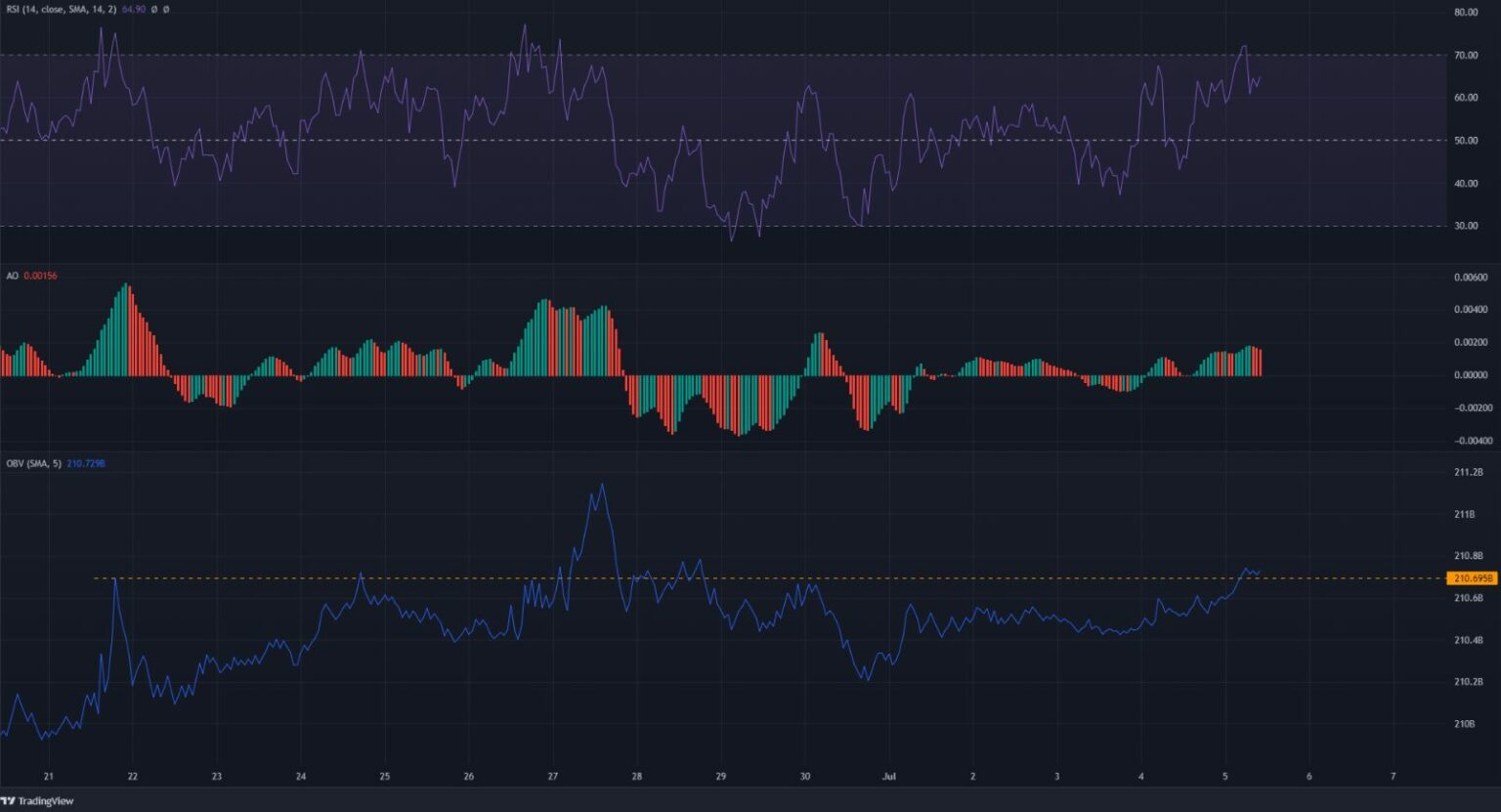
The indicators on the hourly chart showed bullish momentum. The Relative Strength Index (RSI) was above neutral 50 to show an upward trend. At the same time, the Awesome Oscillator (AO) was also above the zero line and has been over the past few days.

Combined with the higher lows that DOGE has formed since the retest of $0.062 support, the bias was bullish on the lower timeframes. The OBV was in a region of resistance as well. If it spiked upward once more to reflect strong buying pressure, it would be more likely that DOGE can break past the $0.073 resistance.

Conclusion

It must be remembered that even though Dogecoin showed bullishness on lower timeframes, the higher timeframe bias remained bearish. A move past $0.073 could be used as a buying opportunity targeting $0.078 as a take-profit.

However, it was unlikely that the long-term downtrend was reversed.

Leituras Relacionadas

Bitcoin Trading Strategy Breakdown: Celebrity Predictions and Classic Models All Fail, Only These Four Indicators Remain

Analysis of Bitcoin Trading Strategies: Why Celebrity Forecasts and Classic Models Fail, Leaving Only These Four Reliable Indicators This analysis examines the failure of common Bitcoin prediction methods and identifies four reliable indicators for constructing a trading strategy. The author reviewed all major BTC prediction approaches from 2017-2025, categorizing them into three groups: celebrity price targets (consistently over-optimistic), analytical models like Stock-to-Flow (broken post-2022), and on-chain signals. The key finding is that more data often creates confusion, not clarity. The strategy discards unreliable elements: celebrity predictions (incentivized to be extreme), pure models (invalidated by post-ETF market changes), and the Fear & Greed Index used alone (too many false signals). Four reliable indicators were selected: 1. **MVRV Z-Score:** Accurately identifies cycle bottoms when entering its green zone (e.g., 2018, 2020, 2022). Note: Its ability to call tops is now ineffective post-2024. 2. **SOPR (28-day MA):** Consistently signals bottoms when below 1.0, indicating holders are selling at a loss. 3. **ETF Net Flow:** A crucial post-2024 metric showing institutional momentum (e.g., sustained inflows = buying). 4. **Macro Liquidity (Fed policy & M2):** Sets the overall directional bias (e.g., bullish during easing cycles). The core strategy involves waiting for a multi-signal共振 (resonance). For example, a bottom signal requires MVRV in the green zone + SOPR < 1.0. A top signal requires overheated on-chain data + sustained ETF outflows. Macro policy sets the overall direction. The Fear & Greed Index is only used as a weighted confirmatory signal, never alone. Action is only taken when three or more indicators align. The author automated this into a monitoring system that sends Telegram alerts only when signals trigger. As of the article's date (April 15, 2026), the system showed a strong bottom signal: extreme fear (F&G=12), MVRV in the buy zone, and SOPR < 1.0. The only contrary signal was weak ETF flows. Historically, such triple on-chain共振 has preceded 100%+ returns. The conclusion emphasizes building a personal framework over relying on external predictions, allowing for iterative improvement and customization based on individual risk tolerance.

marsbitHá 2h

Bitcoin Trading Strategy Breakdown: Celebrity Predictions and Classic Models All Fail, Only These Four Indicators Remain

marsbitHá 2h

Trading

Spot
Futuros
活动图片