Ripple CTO Schwartz Revisits NSA Past And Satoshi Speculation

bitcoinistPublicado em 2025-10-24Última atualização em 2025-10-24

Resumo

Ripple chief technology officer David “JoelKatz” Schwartz has resurfaced a years-long thread of speculation around Bitcoin’s origins and his own...

Trusted Editorial content, reviewed by leading industry experts and seasoned editors. Ad Disclosure

Ripple chief technology officer David “JoelKatz” Schwartz has resurfaced a years-long thread of speculation around Bitcoin’s origins and his own pre-Ripple work with US government agencies, clarifying once again that he neither possessed “high level” intelligence nor claims special insight into Satoshi Nakamoto’s identity—while acknowledging that a US intelligence provenance for Bitcoin is “not a terrible theory.”

The renewed attention follows a fresh exchange on X on October 23, 2025, in which Schwartz responded to questions about prior employment and nondisclosure obligations—context that traces back to an October 24, 2022 thread where he weighed in on Satoshi debates and litigation risk tied to public claims about identity. “There is nothing defamatory about saying that Craig Wright is not Satoshi, just as there is nothing defamatory about saying that I am not Satoshi,” Schwartz wrote in 2022, adding, “There is nothing inherently wrong with not being Satoshi.”

In the same 2022 exchange, after community member @XRPcryptowolf joked “David Schwartz is Satoshi confirmed jk lol” and floated the notion that “Satoshi is really the CIA or NSA,” the Ripple CTO replied: “That’s not a terrible theory. If the NSA or the CIA happened to stumble on how to make bitcoin, it might make sense that they would implement and deploy it to eliminate the risk that someone hostile to the US would do it first and potentially made billions of dollars.”

Ripple CTO Shuts Down Satoshi Claims

The 2025 follow-ups drilled into Schwartz’s own past work and what, if anything, it implies. In response to a commenter’s claim—“Well, you’ve worked at the NSA, getting high level information, by your own words.” The Ripple CTO flatly rejected the characterization, indirectly doubling down that he isn’t (part of) Satoshi Nakamoto: “I never got anything even remotely resembling high level information. I had to certify that the thing I was working on would meet the NSA’s requirements without even being allowed to see most of them.”


He then shared vignettes about the compartmentalization he encountered. “One requirement that I was allowed to see was that you had to be able to stop it from processing classified data if you lost control over it. I was puzzled—if you lost control over it, by definition you can’t stop it, right? It was explained to me that that’s…” He also noted signage he wasn’t permitted to have explained: “They wouldn’t even tell me why there’s little signs all over the place (generally on entrances or containers) that can be set to ‘OPEN’ or ‘CLOSED’ and what ‘OPEN’ and ‘CLOSED’ mean on those signs.”

Schwartz further recounted how, at one point, he recognized the user interface of “one thing I worked on” not through briefings but “because late one night I happened to have the Discovery Channel on and saw our UI on a screen.” He clarified the lineage of that code: “To be precise, that was work I did (on the same core code) for NATO shortly before I adapted it for the NSA. I don’t remember how I found out what the NSA was using it for. I don’t think I should reveal the exact uses, but they’re pretty boring.”

Asked when his nondisclosure agreement would expire, he answered: “I have no idea. They didn’t let me keep a copy and I don’t remember—if I ever even knew. I just hope nobody really cares any more. Plus, I never really knew anything all that secret.”

The through-line between the 2022 and 2025 messages is clear: a willingness to treat state-origin hypotheses for Bitcoin as plausible without endorsing them. “There is nothing inherently wrong with not being Satoshi,” the Ripple CTO emphasized in 2022. By 2025, his clarifications around the nature of his NSA and NATO work add color but not conspiracy: process-driven engineering inside a tightly siloed environment, limited visibility into end use, and no privileged window into intelligence secrets.

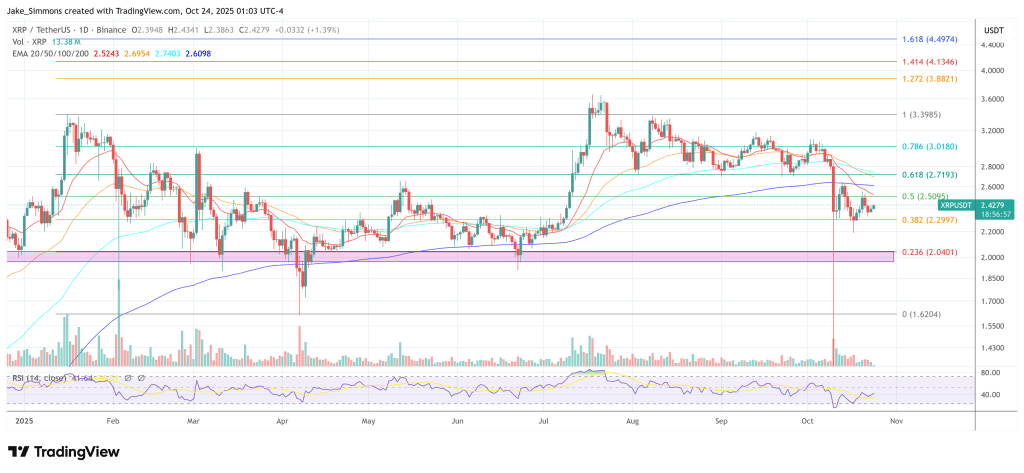
At press time, XRP traded at $2.42.
XRP price
XRP bulls face the 0.5 Fib, 1-day chart | Source: XRPUSDT on TradingView.com
Featured image created with DALL.E, chart from TradingView.com
Editorial Process for bitcoinist is centered on delivering thoroughly researched, accurate, and unbiased content. We uphold strict sourcing standards, and each page undergoes diligent review by our team of top technology experts and seasoned editors. This process ensures the integrity, relevance, and value of our content for our readers.

Jake Simmons has been a Bitcoin enthusiast since 2016. Ever since he heard about Bitcoin, he has been studying the topic every day and trying to share his knowledge with others. His goal is to contribute to Bitcoin's financial revolution, which will replace the fiat money system. Besides BTC and crypto, Jake studied Business Informatics at a university. After graduation in 2017, he has been working in the blockchain and crypto sector. You can follow Jake on Twitter at @realJakeSimmons.

Leituras Relacionadas

From Mining Pool to Mars: Why Is Wang Chun in the SpaceX Cockpit?

Title: From Mining Pool to Mars: Why Wang Chun is in the SpaceX Cockpit? When SpaceX announced that Wang Chun, co-founder of F2Pool, would command the first commercial crewed interplanetary mission, many were shocked. Why would a Bitcoin mining pool founder be on a Mars mission roster? However, understanding Wang Chun's journey over the past decade and the deepening ties between the crypto industry and SpaceX reveals this is not accidental, but an inevitable result of a new era taking shape. Today's Mars plan is no longer just a space engineering project; it is evolving into a civilization-upgrading experiment driven by global tech capital, AI, computing power, energy, and the crypto economy. Wang Chun stands precisely at the intersection of these forces. Part 1: From F2Pool to SpaceX – Wang Chun's Leap F2Pool, founded when Bitcoin was still niche, is one of the earliest large-scale mining pools and once held a significant share of global Bitcoin hash rate. Wang Chun belongs to the first generation of Chinese Bitcoin advocates and infrastructure builders—idealists and engineers who believed in a new value network independent of traditional finance. Miners like him built the hardware, energy, and computing power foundational to decentralized networks. This aligns with the long-term, high-engineering, future-oriented vision required for space civilization. Elon Musk’s space endeavors value such long-term builders over mere capital players, which explains Wang Chun's entry into the SpaceX ecosystem. Part 2: Why Crypto and SpaceX Are Growing Closer The core of global tech competition is shifting from internet applications to next-generation infrastructure. Both crypto and SpaceX are part of this. SpaceX's goal is to drastically reduce space access costs. If successful, it could enable orbital servers, space-based energy, global satellite internet, and Martian bases. These new frontiers will require new payment systems, value networks, and global financial architectures. Cryptocurrencies, inherently global and trustless, are poised to become key to off-planet economies. Moreover, crypto and SpaceX share a high-risk, long-termist ethos—believing in ambitious, world-changing goals despite early skepticism. Part 3: Human Spaceflight Enters the Commercial Era Space exploration, long dominated by state actors, is now being transformed by commercial entities like SpaceX. Wang Chun's involvement signifies that future deep-space participants may include not just career astronauts, but also entrepreneurs, engineers, and AI researchers. This mirrors the Age of Exploration, where commercial capital eventually drove global expansion. Wang Chun has emphasized that Mars colonization must not be delayed for future generations, countering a potential over-focus on nearer-term, commercial lunar projects. His presence symbolizes how new capital, technical communities, and idealists from the crypto world are now entering the interstellar age. In summary, the true significance is not an individual's journey to Mars, but the shift in the driving force of human civilization expansion from state machinery to tech companies, AI systems, and global technology capital. Wang Chun's path—from mining pool to Mars, from the Bitcoin network to starships—may be a preview of technological civilization's evolution in the coming decades.

marsbitHá 7h

From Mining Pool to Mars: Why Is Wang Chun in the SpaceX Cockpit?

marsbitHá 7h

Trading

Spot
Futuros
活动图片