Wall Street Behemoth With $1.8 Trillion Under Management Finally Dives Into Crypto

bitcoinistPublicado em 2025-10-24Última atualização em 2025-10-24

Resumo

T. Rowe Price, the US asset manager with $1.8 trillion in assets, has filed to launch its first crypto exchange-traded...

Trusted Editorial content, reviewed by leading industry experts and seasoned editors. Ad Disclosure

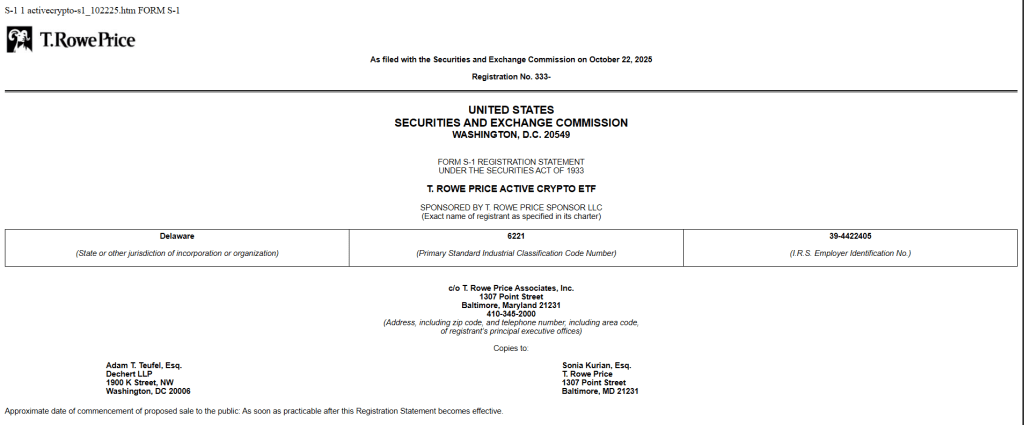
T. Rowe Price, the US asset manager with $1.8 trillion in assets, has filed to launch its first crypto exchange-traded fund, according to regulatory filings and market reports. The filing seeks registration with the US Securities and Exchange Commission for an actively managed product that would give investors exposure to a basket of digital tokens rather than a single coin.

Active Fund Aims For Multiple Coins

Based on reports, the proposed vehicle — referred to as the T. Rowe Price Active Crypto ETF — would normally hold five to 15 different cryptocurrencies. Bitcoin (BTC) and Ethereum (ETH) are expected to be on the eligible list, along with other top tokens such as Solana (SOL), XRP, Cardano (ADA) and Litecoin (LTC).

The filing describes an active approach: managers would select and weigh assets using valuation, momentum and fundamental analysis rather than simply tracking a passive benchmark.
A Different Kind Of Crypto ETF

Most recent US filings on Wall Street have focused on single-asset ETFs or passive funds that mirror an index. This product, by contrast, is framed as an actively managed, multi-asset fund. That distinction matters because active management gives the team flexibility to shift allocations over time, but it also introduces manager risk and typically higher fees.

The filing notes the intent to seek returns that beat the FTSE Crypto US Listed Index, though it stops short of promising any particular outcome.

Total crypto market cap currently at $3.63 trillion. Chart: TradingView

Wall Street: Regulatory Hurdles Remain

According to the filings, the request is now subject to the SEC’s review process. Approval is not guaranteed. Issues such as custody of digital assets, daily valuation, trading rules and operational safeguards are likely to be scrutinized by regulators before any listing is permitted.

What This Could Mean For Markets

Wall Street watchers say the move is significant because it signals that a large, long-standing manager is willing to offer regulated crypto exposure to mainstream clients. If the SEC approves the product, it could open another door for institutional and retail flows into a broader set of tokens, not just Bitcoin and Ethereum.

That said, the active structure could lead to different performance patterns compared with passive crypto ETFs, and investors would need to weigh the potential benefits against added costs and manager decisions.

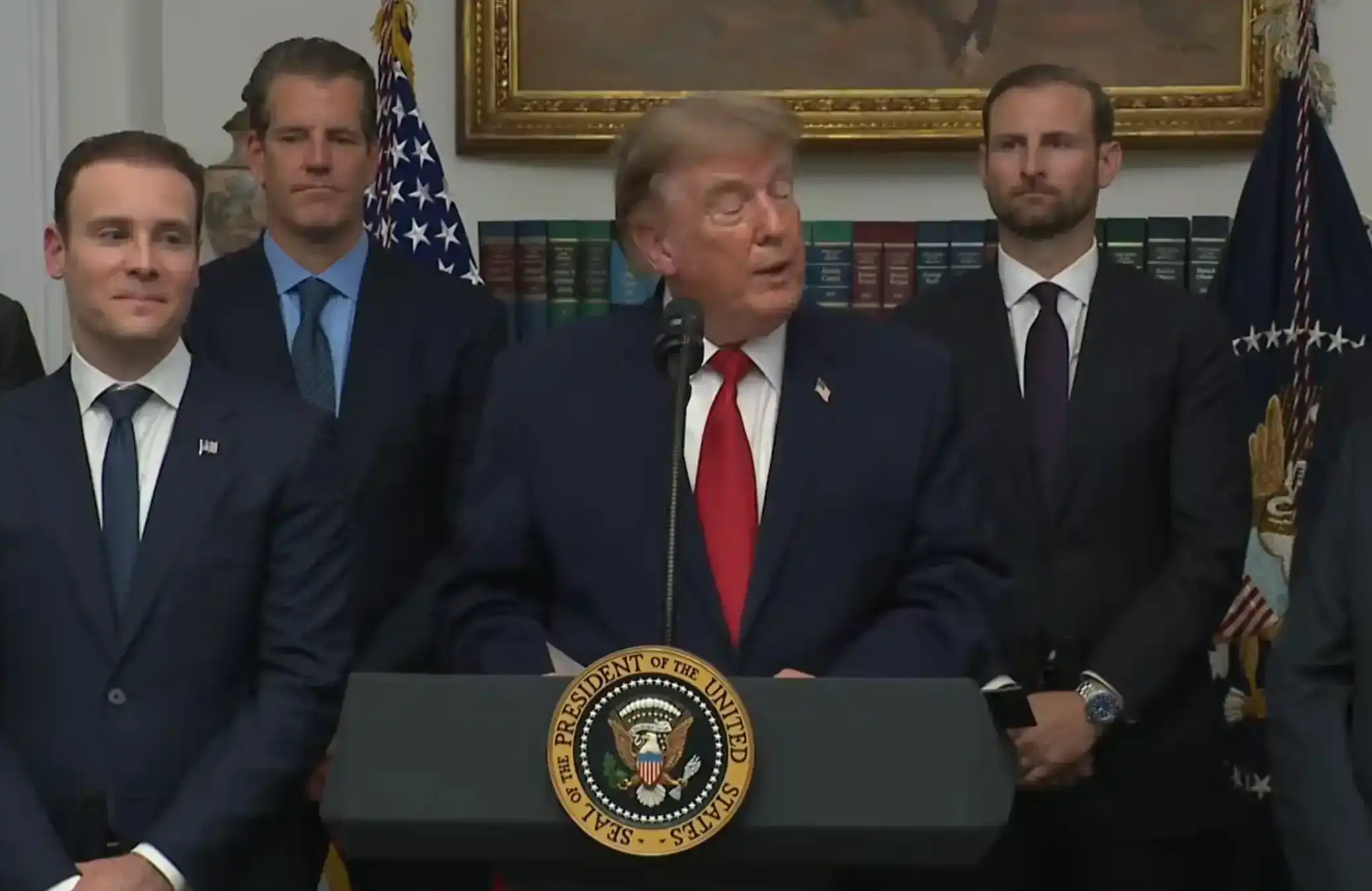
Featured image from Reddit – r/orioles, chart from TradingView

Editorial Process for bitcoinist is centered on delivering thoroughly researched, accurate, and unbiased content. We uphold strict sourcing standards, and each page undergoes diligent review by our team of top technology experts and seasoned editors. This process ensures the integrity, relevance, and value of our content for our readers.

Christian, a journalist and editor with leadership roles in Philippine and Canadian media, is fueled by his love for writing and cryptocurrency. Off-screen, he's a cook and cinephile who's constantly intrigued by the size of the universe.

Leituras Relacionadas

Wang Xing Is Happy, Wang Xingxing Is Not Necessarily

Yu Shu Technology's (Unitree) IPO on the STAR Market sparked discussions centered on wealth creation: the surge in founder Wang Xingxing's net worth, the substantial gains for early investors like Meituan's Wang Xing, and employee stock wealth. Yet, a key observation from the listing ceremony was the founder's calm demeanor, contrasting with the celebratory atmosphere. The article explores this divergence. For investor Wang Xing, the IPO represents a successful bet on embodied AI and robotics as the next foundational tech wave, with Meituan's stake now highly valuable. For founder Wang Xingxing, the milestone brings a new set of pressures. His company, now valued at ~341.8 billion yuan, must transition from proving technological feasibility (which it has done with its quadruped and humanoid robots) to delivering scalable commercial success. The market's high valuation is an advance payment for a future that Yu Shu must now build. Post-IPO, Yu Shu faces the critical challenge of moving beyond impressive demos to creating sustainable businesses. This means making robots reliable, affordable, and indispensable for both consumers and industrial clients, proving their real-world economic value. As the "first stock" in embodied AI on the STAR Market, Yu Shu also becomes a public benchmark for the entire industry, its performance influencing sector-wide expectations. Ultimately, while investors can celebrate realized gains, Wang Xingxing's work is just beginning. He must now manage a public company, meet heightened market expectations, and navigate the complex journey from innovative engineering to large-scale commercial execution. The IPO is a starting line, not a finish line.

marsbitHá 4m

Wang Xing Is Happy, Wang Xingxing Is Not Necessarily

marsbitHá 4m

U.S. Market Trend (August 20): U.S. Treasury Intervention Halts Stock Decline; Moderna's Cancer Vaccine Breakthrough Sparks 180% Surge

U.S. Stocks Rebound on Treasury Intervention; Moderna Soars 180% on Cancer Vaccine Breakthrough Key Points: • U.S. stocks ended a three-day decline, with the rebound driven primarily by the U.S. Treasury Department's move to significantly increase its long-term bond repurchase ceiling. This action briefly pushed the 30-year Treasury yield down by about 10 basis points, easing long-term interest rate pressures. • Despite this, the market faced a countervailing force from the hawkish July FOMC meeting minutes, which revealed broader support for potential rate hikes among officials due to lingering inflation concerns. • Moderna shares skyrocketed nearly 180% after announcing positive Phase 3 trial results for its personalized mRNA cancer vaccine in partnership with Merck, which also rose nearly 13%. This fueled a major rally in the healthcare sector. • Contrary to the broader market, the Philadelphia Semiconductor Index fell over 2%, highlighting persistent pressure on the AI hardware chain. Concerns include AI's potential inflationary impact and questions about application-side cash flows supporting high capital expenditures. • Commodities and cryptocurrencies rallied alongside the equity rebound, supported by a weaker dollar and lower long-term yields. Geopolitical risks continued to underpin oil prices. Outlook: Market focus shifts to whether long-term bond yields stabilize post-intervention, upcoming U.S. economic data (jobless claims, Philly Fed index), and the impact of SK Hynix's massive share buyback plan on the memory chip sector. The tech sector's full recovery remains contingent on the semiconductor index's performance.

marsbitHá 13m

U.S. Market Trend (August 20): U.S. Treasury Intervention Halts Stock Decline; Moderna's Cancer Vaccine Breakthrough Sparks 180% Surge

marsbitHá 13m

The 19 Must-Know Top Chinese and American Entrepreneurs Born After 2000 • The 21st-Century Successors Have Arrived

The 21st century's first generation of entrepreneurs, born in the 2000s, are already taking center stage. This analysis of publicly prominent founders reveals distinct trends between China and the U.S., shaped by their respective ecosystems. In China, young founders are heavily focused on giving AI a physical presence, tackling challenges in robotics and hardware. Examples include Huang Yi (RoboParty, humanoid robots), Qin Shentao (Yuanchen Taichu, embodied AI data infrastructure), and founders working on robotic hands, home cleaning robots, and computing power networks. Their paths often emerge from university labs and robotics competitions, prioritizing prototype demonstration, cost control, and manufacturing delivery. In contrast, their U.S. counterparts frequently leverage software, AI, and capital networks to rapidly reorganize digital services and information flows. Startups like Mercor (AI talent/data, reaching $10B revenue), Etched (AI chips), and various AI-powered SaaS tools for consumers and SMBs demonstrate a focus on user growth, subscription models, and global scalability. However, this velocity has also led to high-profile cases questioning business practices and credibility. The key differentiator for this generation is not merely youth, but the compressed early stage of venture creation. Access to open-source tools, AI models, mature supply chains, and willing venture capital allows them to bypass traditional career ladders. Yet, while technology lowers the barrier to product creation, it does not reduce the challenges of building a sustainable company—managing teams, ensuring reliable delivery, and establishing trust remain hard-earned skills. The article concludes that the true test for these founders will be the "second growth": evolving from product creators into responsible company leaders capable of sustained execution and organizational building. For established businesses, the rise of these fast-moving, technologically adept teams necessitates new strategies for collaboration, competition, and investment.

marsbitHá 18m

The 19 Must-Know Top Chinese and American Entrepreneurs Born After 2000 • The 21st-Century Successors Have Arrived

marsbitHá 18m

A Trillion-Dollar Consumer Credit Market Lacks Key Players

The trillion-dollar global consumer credit market remains largely untapped by blockchain technology. While projects like Pharos have rapidly attracted millions in stablecoin deposits for short-term consumer loans in emerging markets, they represent early attempts to bring this massive asset class on-chain. The core challenge isn't technical tokenization, but the "repackaging" of countless small, heterogeneous loans into standardized, investable products that digital asset funds can understand and price. Current approaches primarily change the *distribution* of capital—using stablecoins for settlement and smart contracts for transparency—but do not eliminate underlying credit risk. Several models are emerging: Pharos and Huma Finance/Tala focus on connecting high-yield emerging market loans to global crypto capital. Figure stands out by building full-stack, regulated infrastructure, securing AAA ratings for its securitizations and proving blockchain assets can meet traditional institutional standards. Conversely, Goldfinch's difficulties highlight that on-chain transparency cannot replace offline credit underwriting and collection capabilities. The article identifies a four-layer value chain: 1) loan origination, 2) credit structuring & securitization, 3) on-chain infrastructure, and 4) capital. The current gap is in the second layer—the mature capital markets expertise for structuring, rating, credit enhancement, and institutional distribution. This is the critical link needed to transform scattered loans into large-scale, trustworthy on-chain credit assets, bridging traditional finance's rigor with blockchain's new capital pools.

marsbitHá 53m

A Trillion-Dollar Consumer Credit Market Lacks Key Players

marsbitHá 53m

Trading

Spot
活动图片