FalconX Acquires 21Shares, Expanding Into Crypto ETFs Market

bitcoinistPublicado em 2025-10-23Última atualização em 2025-10-23

Resumo

FalconX has announced an acquisition of 21Shares, combining prime brokerage infrastructure with the world's largest crypto ETP platform. FalconX Pushes...

Trusted Editorial content, reviewed by leading industry experts and seasoned editors. Ad Disclosure

FalconX has announced an acquisition of 21Shares, combining prime brokerage infrastructure with the world’s largest crypto ETP platform.

FalconX Pushes Into Crypto ETFs & ETPs With 21Shares Acquisition

As announced in a press release, FalconX has agreed to acquire 21Shares. FalconX is an institutional crypto prime brokerage that provides large clients with deep global liquidity, derivatives, financing, custody, and settlement across digital asset markets. It has facilitated over $2 trillion in trading volume and hosts a global client base of more than 2,000 institutions.

Meanwhile, 21Shares is the largest issuer of crypto exchange-traded funds and products (ETFs/ETPs). ETFs/ETPs refer to investment vehicles that allow investors to gain exposure to an underlying asset without directly having to own it. When a trader invests into one of these vehicles, the provider buys and custodies the asset on their behalf.

Some investors may be wary of navigating crypto exchanges and wallets, so products like ETFs and ETPs provide for a more regulated means of investment into digital assets, in a mode that’s more familiar.

21Shares has 55 of these products listed currently, across which it manages over $11 billion in assets. With the acquisition, its asset management product development and distribution capabilities will be combined with FalconX’s institutional-grade infrastructure.

The press release noted:

Together, the two firms will accelerate the creation of tailored investment products that meet growing institutional and retail demand for regulated digital asset exposure.

While FalconX is acquiring 21Shares, the latter will continue to operate independently, with Russell Barlow, its current CEO, remaining in charge. Barlow will work closely with FalconX leadership to advance a shared vision for the digital asset ecosystem. “No changes to the construction or investment objectives of the existing 21shares ETPs (Europe) or ETFs (US) are planned,” said the press release.

In some other news, the Bitcoin derivatives landscape has been changing recently, as on-chain analytics firm Glassnode has highlighted in an X post. Previously, the Futures market was dominant, but now the Options market is beginning to rival it in terms of Open Interest.

The Open Interest here is naturally a measure of the total amount of positions related to the crypto that are currently open on all derivatives exchanges. First, here is a chart that shows the trend in this metric for the Futures market:
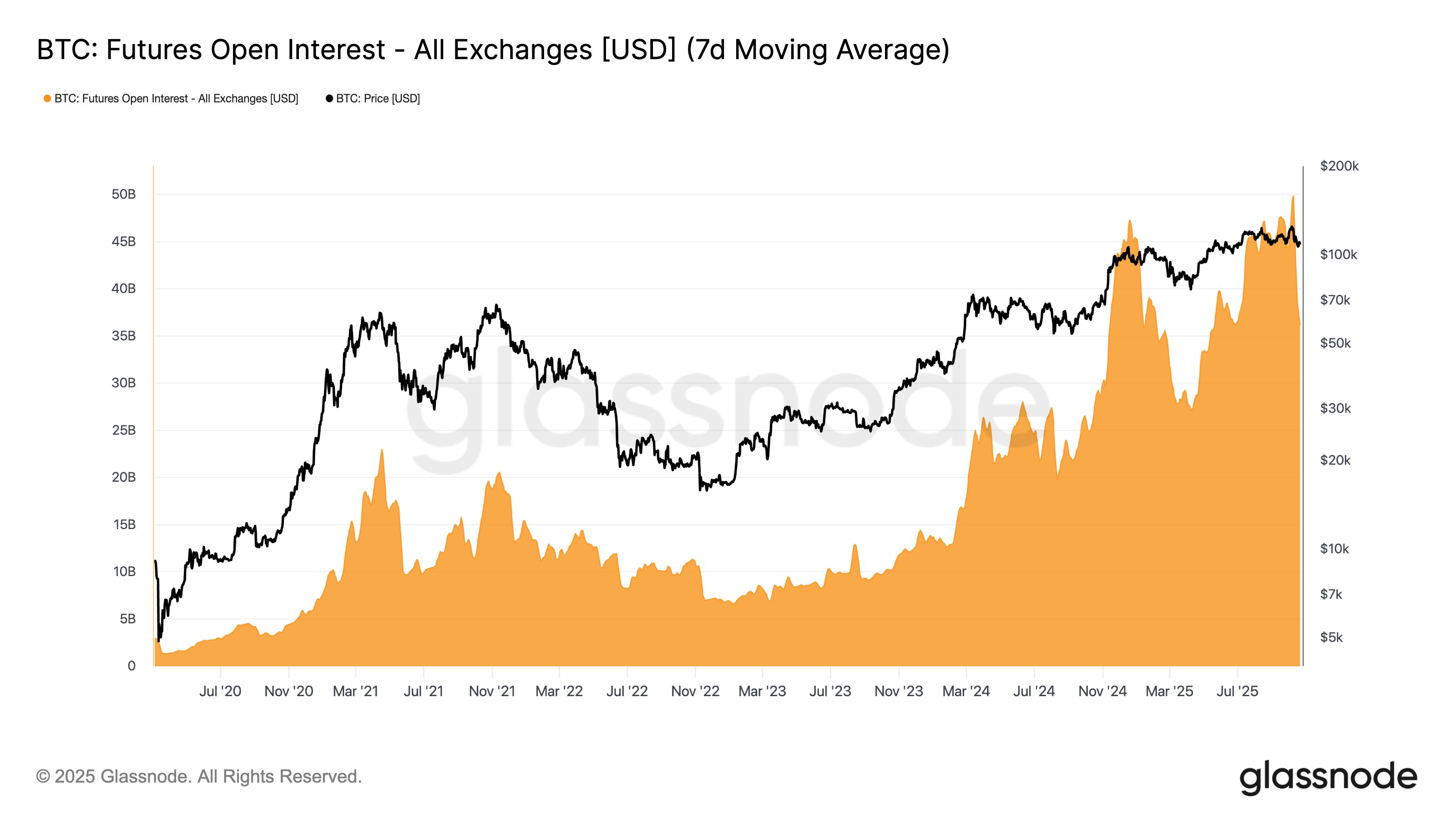
Bitcoin Futures OI

The value of the metric seems to have plunged in recent days | Source: Glassnode on X

As displayed in the above graph, the Bitcoin Futures Open Interest saw peaks above $20 billion in the 2021 bull market and recently reached a high of about $50 billion.

The Options Open Interest couldn’t even break $15 billion in the last cycle, but today its 7-day moving average (MA) value is floating around a new all-time high (ATH) of more than $55 billion.
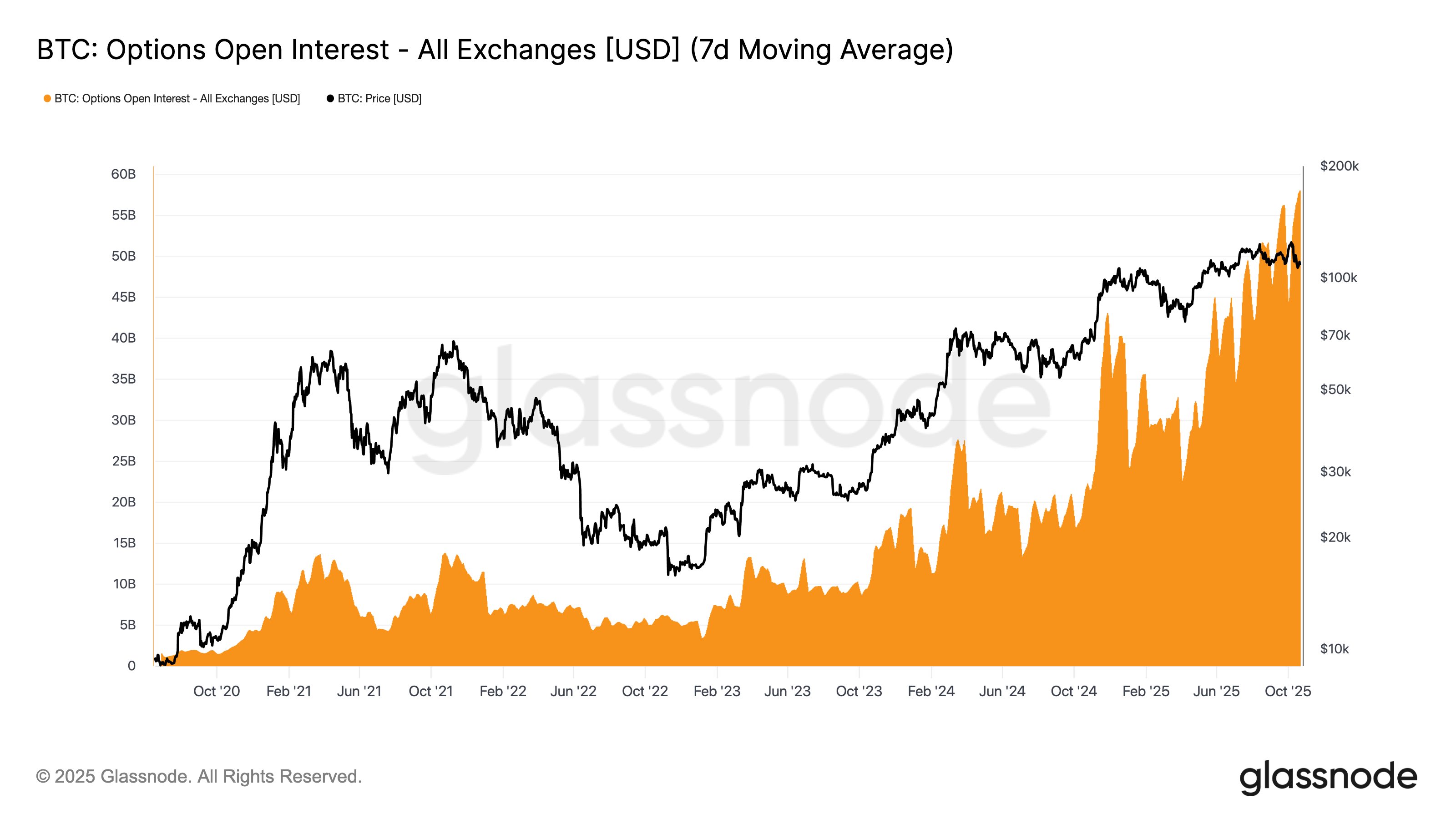
Bitcoin Options OI

How the BTC Options OI has changed since the last bull market | Source: Glassnode on X

As the analytics firm has explained,

Markets are shifting toward defined-risk and volatility strategies, meaning options flows, rather than futures liquidations, are becoming a more influential force in shaping price action.

Bitcoin Price

At the time of writing, Bitcoin is floating around $107,800, down over 4% in the last 24 hours.

Bitcoin Crypto Price Chart

Looks like the price of the crypto has retraced its latest recovery | Source: BTCUSDT on TradingView
Featured image from Dall-E, Glassnode.com, chart from TradingView.com
Editorial Process for bitcoinist is centered on delivering thoroughly researched, accurate, and unbiased content. We uphold strict sourcing standards, and each page undergoes diligent review by our team of top technology experts and seasoned editors. This process ensures the integrity, relevance, and value of our content for our readers.

Keshav is a Physics graduate who has been employed as a writer with Bitcoinist since June 2021. He is passionate about writing and through the years, he has gained experience working in a variety of niches. Keshav holds an active interest in the cryptocurrency market, with on-chain analysis being an area he particularly likes to research and write about.

Leituras Relacionadas

Agentized OS: It's Not About AI, It's About the Foundation

The Agentic OS: Beyond AI, It's About the Foundational Stack In 2026, major operating systems like Android, iOS, HarmonyOS, and Windows are entering the "Agentic" era, integrating proactive AI assistants deeply into the system layer. However, the real competition lies not in the flashy AI features showcased at events, but in the three-layer foundational stack that enables them: the system-level AI Runtime, proprietary/controllable chips, and the on-device/cloud model matrix. The AI Runtime acts as the central scheduler, managing model inference, resource allocation, and exposing capabilities to apps. Controllable chips (e.g., Apple Silicon, Google Tensor, Huawei Kirin) are crucial for deep hardware-software co-optimization, determining the efficiency and experience limits of on-device Agents. The on-device/cloud model matrix provides the "intelligence," with proprietary, chip-optimized small models (like Gemini Nano, Apple's ~3B model) handling daily tasks locally for low latency, privacy, and reliability, while cloud models tackle complex requests. Deep synergy between these three layers enables key Agent differentiators: ultra-low latency and power efficiency, genuine "on-device first" privacy, access to system-level personal context across apps, and reliable performance as a system service even offline. OS vendors with strong integration across this stack (like Apple, Google, and Huawei) build a deeper moat. Beyond this core stack, long-term competitiveness depends on variables like structured App integration (e.g., App Intents/AppFunctions) for reliable multi-step workflows, and robust privacy frameworks that build user trust. This shift towards Agentic OS extends beyond phones and PCs to IoT, cars, and XR glasses via existing multi-device ecosystems. The race is won not in a keynote, but through generations of meticulously co-developed chips, models, and system software.

marsbitHá 1h

Agentized OS: It's Not About AI, It's About the Foundation

marsbitHá 1h

Why Sam Altman's 'Water and Electricity Theory' Sparks Copyright Controversy

OpenAI CEO Sam Altman's recent statement that "intelligence will become a utility like electricity or water" has sparked significant controversy, primarily around copyright issues and the nature of AI development. While positioning AI as a utility serves as a compelling narrative for infrastructure investors, critics argue the analogy is flawed in three key areas. First, there's a fundamental "property gap." Traditional utilities like water and power create new, physical infrastructure from scratch. In contrast, major AI models are trained by reorganizing vast amounts of existing human-created content—books, articles, code, etc.—often scraped from the web without explicit permission or compensation to creators. This "free acquisition, paid resale" model is seen by many as ethically problematic. Second, there's a "pricing gap." True public utilities are typically regulated to ensure universal service with non-discriminatory, cost-plus pricing. AI's token-based pricing, however, involves significant price discrimination (e.g., output tokens costing much more than input tokens) and is designed for revenue maximization, not equitable access. Third, a "governance gap" exists. Utilities operate under public oversight, while AI pricing and development are currently controlled by a few private companies. Furthermore, the industry's own shift toward buying licensed training data (e.g., deals with Reddit or news publishers) undermines its previous legal reliance on "fair use" for freely scraped data. In conclusion, while AI is indeed becoming a foundational technology, calling it a public utility remains contentious. The title requires not just scale and a pay-per-use model, but also credible solutions for data provenance, equitable pricing, and public governance.

marsbitHá 1h

Why Sam Altman's 'Water and Electricity Theory' Sparks Copyright Controversy

marsbitHá 1h

Trading

Spot
Futuros
活动图片