Ripple CTO David Schwartz Joins Another Company In New Leadership Role

bitcoinistPublicado em 2025-10-21Última atualização em 2025-10-21

Resumo

Ripple’s longtime chief technologist David “JoelKatz” Schwartz has unveiled his first post-Ripple move, saying he will serve as a strategic...

Trusted Editorial content, reviewed by leading industry experts and seasoned editors. Ad Disclosure

Ripple’s longtime chief technologist David “JoelKatz” Schwartz has unveiled his first post-Ripple move, saying he will serve as a strategic advisor to Evernorth, an XRP-focused vehicle led by former Ripple executive Asheesh Birla. “XRP community – I promised I’d have an update on my next adventure soon right? Well here’s the start: I’ll be a strategic advisor to Evernorth, helmed by my friend Asheesh Birla,” Schwartz wrote, adding that Evernorth was founded “as a regulated, scalable investment vehicle to tap into opportunities for XRP in DeFi and capital markets, extending the entire XRP ecosystem.” He closed with: “I’m excited to get started!”

The Old Ripple Connection

Schwartz’s announcement arrived alongside Evernorth’s own reveal that it has signed a business combination agreement with Armada Acquisition Corp II to go public on Nasdaq. The combined company is “expected to trade on Nasdaq under the ticker symbol ‘XRPN,’ subject to the satisfaction of the listing requirements,” with more than $1 billion in gross proceeds targeted, including a $200 million commitment from Japan’s SBI. The release says net proceeds will primarily fund open-market XRP purchases, positioning Evernorth as “the largest public XRP treasury company.”

The Birla–Schwartz connection is longstanding. Birla joined Ripple in 2013 and rose to become General Manager of RippleNet, the company’s cross-border payments business, before moving to the company’s board in 2022. On the day he stepped back from his “day job”, Birla wrote: “After ~9 amazing years I’ve decided to wrap up my day job at Ripple. Luckily, I’m not going far as I join the Board of Directors.” In announcing Evernorth this week, Birla said he will step down from Ripple’s board to lead the new venture.

Schwartz’s advisory role at Evernorth intersects with his own transition out of Ripple’s C-suite. Earlier this month, he disclosed that he will step down as Ripple’s Chief Technology Officer at year-end after more than a decade in the role, moving to Ripple’s board and remaining active in the XRP Ledger community. He revealed that he wants to spend more time with family while “not going away from the XRP community.”

Evernorth’s capital-markets blueprint is expansive. The company plans to use its war chest to accumulate XRP and to “actively grow XRP per share over time” by lending to institutions, providing market liquidity and deploying capital into XRP-based DeFi strategies.

The press release outlines complementary ecosystem initiatives—running XRPL validators, using Ripple’s RLUSD stablecoin as an on-ramp to XRP DeFi, and supporting projects across payments, capital markets and tokenized assets—framing Evernorth as both a treasury vehicle and a development catalyst. The company says Ripple will participate as a strategic investor, and that Ripple executives Brad Garlinghouse, Stuart Alderoty and David Schwartz are expected to serve as strategic advisors while Evernorth maintains independent governance.

For XRP’s institutional storyline, the architecture matters. By targeting an exchange listing under “XRPN” and explicitly eschewing a passive ETF wrapper, Evernorth positions itself as an active, yield-generating public company with a balance sheet anchored in XRP. If the deal secures shareholder and regulatory approvals, the parties are aiming to close in the first quarter of 2026, converting non-redeemed AACI Class A shares one-for-one into Evernorth shares at closing.

Schwartz’s phrasing—“here’s the start”—reads like a deliberate tell that his Evernorth role is only the first of multiple XRP-aligned ventures he plans to take on following his CTO transition. He has already confirmed he will remain engaged with XRPL and Ripple at the board level; today’s advisory post adds a capital-markets dimension to that presence.

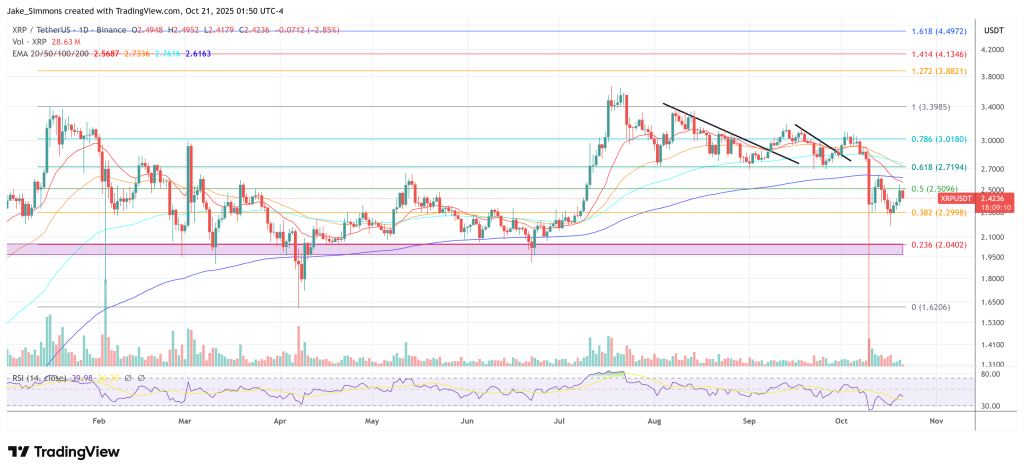
At press time, XRP traded at $2.42.
XRP price
XRP price, 1-day chart | Source: XRPUSDT on TradingView.com
Featured image from YouTube, chart from TradingView.com
Editorial Process for bitcoinist is centered on delivering thoroughly researched, accurate, and unbiased content. We uphold strict sourcing standards, and each page undergoes diligent review by our team of top technology experts and seasoned editors. This process ensures the integrity, relevance, and value of our content for our readers.

Jake Simmons has been a Bitcoin enthusiast since 2016. Ever since he heard about Bitcoin, he has been studying the topic every day and trying to share his knowledge with others. His goal is to contribute to Bitcoin's financial revolution, which will replace the fiat money system. Besides BTC and crypto, Jake studied Business Informatics at a university. After graduation in 2017, he has been working in the blockchain and crypto sector. You can follow Jake on Twitter at @realJakeSimmons.

Leituras Relacionadas

Retail Investors' 'Lead Brother' Serenity vs. Newly Minted Stock God Leopold: How Are the Two Top Hunters Mining AI's 'Physical Limits'?

The article profiles two prominent figures, Serenity and Leopold Aschenbrenner, who are gaining attention for their unconventional investment strategies focused on the physical constraints of the AI boom, moving beyond mainstream software narratives. Serenity, an anonymous online trader, advocates a "shiso leaf" theory. He targets small-cap companies with monopolies on critical, overlooked components in the AI hardware supply chain, such as specific semiconductor materials. His deep, technical analysis of bottlenecks in areas like co-packaged optics (CPO) has reportedly yielded massive returns, though his anonymity and focus on illiquid micro-cap stocks pose significant risks for followers. Leopold Aschenbrenner, a former OpenAI researcher, founded a multi-billion dollar hedge fund. His macro thesis argues that physical infrastructure—power grids, land, data centers—is the true bottleneck for AI growth, lagging far behind chip production. Consequently, his fund employs an infrastructure arbitrage strategy: heavily investing in storage and compute infrastructure companies while placing massive bearish bets (put options) against major semiconductor stocks, betting their valuations will correct as physical constraints become apparent. While their methods differ—Serenity drills into microscopic supply chain details, while Leopold takes a macroscopic, infrastructure-focused view—both share a core belief: the real power and investment alpha in the AI era lie in controlling scarce physical resources, not just software. The article concludes by noting the inherent risks in both approaches, such as liquidity issues for micro-caps and timing risks for macro bets, but suggests they signal a broader market re-evaluation of AI's foundational assets.

marsbitHá 3h

Retail Investors' 'Lead Brother' Serenity vs. Newly Minted Stock God Leopold: How Are the Two Top Hunters Mining AI's 'Physical Limits'?

marsbitHá 3h

Who Will Make Money in the Age of Agents?

In the Agents era of blockchain, traditional value capture theories face challenges. The "Fat Protocol" theory, dominant since 2016, suggested protocols capture most value as their tokens are essential for network use. However, the proliferation of interchangeable L1s, L2s, and modular layers has eroded protocol scarcity and pricing power. Conversely, the "Fat App" theory posits that applications capturing user relationships (like wallets and exchanges) become the primary value layer by controlling distribution and transaction flows. This aligns with the current "Great Repricing" cycle. Agents disrupt this logic. As software users, they lack brand loyalty, prioritize cost and efficiency, and switch between platforms seamlessly. This undermines the front-end UX moats that "Fat Apps" rely on. The article explores several potential futures: 1. **Headless Applications:** Current leading apps could strip their front-ends and become backend API infrastructure for Agents, preserving their role. 2. **Protocol Resurgence:** If integration becomes trivial, Agents might bypass aggregators and interact directly with protocols, reviving "Fat Protocol" dynamics. 3. **Pricing Power Collapse:** Agents' rational, frictionless routing could commoditize the entire stack, compressing margins toward cost and leaving little profit for intermediaries. 4. **Unprecedented Activity:** Agents may enable new, high-frequency, machine-to-machine economic activities, expanding the total value pie even if margins are thin. 5. **A New, Unnamed Model:** Historically, major tech shifts (like the internet's attention economy) create unforeseen business models. The Agents era may spawn entirely new ways to capture value. The most likely outcome is a coexistence where "Fat Apps" continue to serve human users valuing UX, while a separate, Agent-driven economy emerges governed by different rules—where loyalty is based on factors like liquidity, latency, and settlement guarantees rather than brand.

marsbitHá 4h

Who Will Make Money in the Age of Agents?

marsbitHá 4h

Trading

Spot
Futuros
活动图片