Florida’s Crypto Bill Gets A Second Life—But Will It Work This Time?

bitcoinistPublicado em 2025-10-17Última atualização em 2025-10-18

Resumo

Florida Representative Webster Barnaby has filed House Bill 183, a reopened attempt to let state officials put public money into...

Trusted Editorial content, reviewed by leading industry experts and seasoned editors. Ad Disclosure

Florida Representative Webster Barnaby has filed House Bill 183, a reopened attempt to let state officials put public money into digital assets, including Bitcoin and crypto exchange-traded products.

According to the Florida Senate bill text, the proposal would let the Chief Financial Officer and the State Board of Administration manage investments in a range of tokenized holdings and set rules for how those holdings must be kept.

What The Bill Would Allow

Based on reports, HB 183 would permit up to 10% of certain public funds to be invested in “digital assets” and exchange-traded products.

The measure names possible sources such as the General Revenue Fund, the Budget Stabilization Fund, and trust funds, and it would allow the Florida Retirement System Trust Fund to allocate a similar share. Reports also say the bill broadens an earlier Bitcoin-only effort to cover tokenized securities, ETFs, and even NFTs.
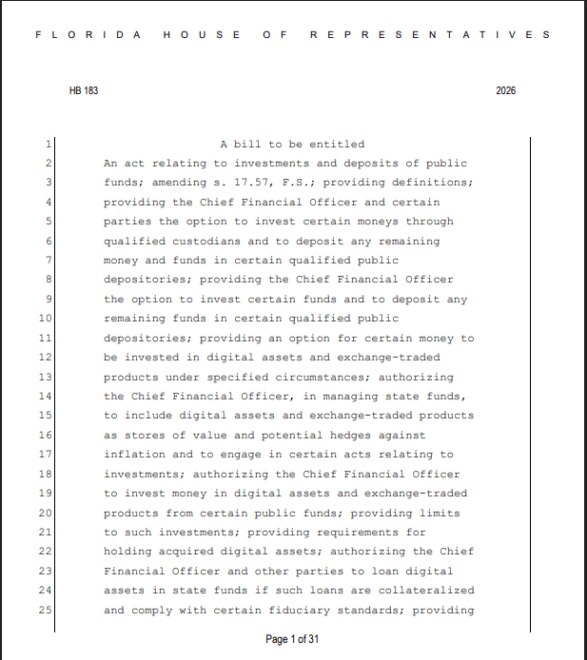
New bill introduced by Florida Rep. Webster Barnaby on Wednesday.

Safeguards And Custody Rules

According to the bill language and summaries, the proposal does not leave custody loose. It lays out specific holding and custody standards, allows assets to be kept by qualified custodians or held through exchange-traded products, and permits lending only when collateralized and consistent with fiduciary duties.

It would also require that any taxes or fees paid in crypto be converted into US currency before being credited to state accounts. Those measures are framed as guardrails to limit direct risk to state coffers.

Where The Bill Came From And What Failed Before

This move follows an earlier effort that focused on Bitcoin and failed to pass committee. Reports have disclosed that the prior proposal collapsed in June, pushing the sponsor to file a broader, rewritten bill this month.

The new text is being read as a softer, more flexible take on the same idea — one that aims to give officials different routes to hold exposure while spelling out limits.

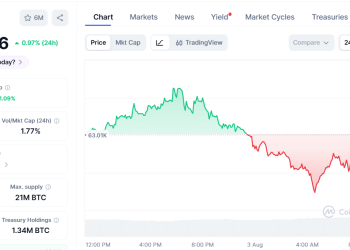
Total crypto market cap currently at $3.5 trillion. Chart: TradingView

Stablecoin Measures Filed Alongside Investment Bill

State filings show Rep. Barnaby also introduced House Bill 175 to clarify rules for stablecoin issuers.

According to the bill page and media summaries, qualifying stablecoin issuers would need full collateral backing in US dollars or Treasury securities and public audits at least once a month, and some licensing requirements could be narrowed for those that meet the standards.

The aim appears to be creating a clear, state-level framework for certain payment-focused stablecoins.

Featured image from Playa Largo Ocean Residences, chart from TradingView

Editorial Process for bitcoinist is centered on delivering thoroughly researched, accurate, and unbiased content. We uphold strict sourcing standards, and each page undergoes diligent review by our team of top technology experts and seasoned editors. This process ensures the integrity, relevance, and value of our content for our readers.

Christian, a journalist and editor with leadership roles in Philippine and Canadian media, is fueled by his love for writing and cryptocurrency. Off-screen, he's a cook and cinephile who's constantly intrigued by the size of the universe.

Leituras Relacionadas

547 Million OP Tokens Transferred from User Airdrop to Ecosystem Fund: DAO Voting Becoming Sham Democracy

An Optimism governance vote approved the controversial transfer of 546.9 million OP tokens (12.7% of total supply, ~24% of circulating supply) from the remaining "User Airdrop" allocation to the Foundation-controlled "Strategic Ecosystem Fund." The vote passed with a decisive 849,000 OP vote from "Test in Prod," a core development team fully funded by the Optimism Collective, cast just 17 minutes before the deadline. The Foundation argued that broad user airdrops are ineffective for the current institutional expansion phase and that the funds are needed as a flexible "war chest" to secure enterprise clients like Bitpanda and Dunamu. Critics, including L2BEAT and researcher Polynya, opposed the move. They cited the Foundation's overly broad mandate, a lack of clear link to token holder interests, insufficient assessment of past ecosystem fund expenditures (~686M OP spent), and the rewriting of the original distribution promise made to users. The incident highlights deeper governance concerns beyond low voter turnout. It raises questions about the independence of votes from entities financially dependent on the Foundation and the ethical limits of DAO governance—specifically, whether a majority vote can legitimately redefine foundational promises and minority expectations. The move signals a shift from community-focused airdrops to enterprise-driven strategy, eroding user trust amid OP's significant price decline.

marsbitHá 16m

547 Million OP Tokens Transferred from User Airdrop to Ecosystem Fund: DAO Voting Becoming Sham Democracy

marsbitHá 16m

The Impact of Treasury Buybacks Lasts Only 24 Hours? Beston: We Have Many Tools, Just Wait and See

U.S. Treasury Secretary Besant, addressing market concerns on August 20, signaled that the Treasury's toolkit for intervening in the bond market is far from exhausted. This follows the previous day's announcement to double the size of long-term Treasury buyback operations to at least $40 billion per session, a move that only briefly lowered yields before they climbed again. Besant dismissed the short-lived market reaction as "noise," asserting that yields do not reflect underlying economic fundamentals, especially for illiquid 30-year bonds. He revealed that President Trump has tasked him with leading a new fiscal consolidation plan, expected to be announced soon, aimed at addressing high long-term borrowing costs. Concurrently, Besant announced a press conference for the following Monday to detail aggressive U.S. economic actions against Iran, suggesting that maximum economic pressure could reduce the likelihood of large-scale military conflict. On other topics, Besant reiterated a strong dollar policy, expressed confusion over a recent oil price surge (which he expects U.S. actions will curb), and noted that AI investment prospects are making corporations largely insensitive to yield levels when issuing debt, as they anticipate future productivity gains. Market analysts remain skeptical that Treasury operations alone can durably alter the trajectory of long-term yields, which are driven by broader concerns over fiscal deficits, debt supply, and inflation.

marsbitHá 1h

The Impact of Treasury Buybacks Lasts Only 24 Hours? Beston: We Have Many Tools, Just Wait and See

marsbitHá 1h

Trading

Spot
活动图片