Ripple Just Embedded XRP Into The World’s Treasury Plumbing, Experts Explain

bitcoinistPublicado em 2025-10-17Última atualização em 2025-10-17

Resumo

Ripple’s agreement to acquire GTreasury has triggered a sharp, technically informed reaction on X, where several long-time market observers argue...

Trusted Editorial content, reviewed by leading industry experts and seasoned editors. Ad Disclosure

Ripple’s agreement to acquire GTreasury has triggered a sharp, technically informed reaction on X, where several long-time market observers argue the deal quietly routes XRP and Ripple’s stablecoin ambitions into the center of corporate finance. Their case rests on where GTreasury sits in the value chain, what it already connects to, and how Ripple can insert settlement choices—XRP or RLUSD—without forcing enterprises to change screens, ERPs, or bank relationships.

Why The GTreasury Deal Is Massive For Ripple And XRP

“I am pretty sure no one in crypto Twitter even understands what this is,” wrote developer Vincent Van Code (@vincent_vancode), before laying out why the plumbing matters. “GTreasury provides software that enables mainly large, multinational corporations [to] handle payments, liquidity, cash flow etc. The software links into banking and payment systems such as SWIFT, and is ISO20022 compliant.”

In other words, GTreasury is not a speculative bet on future rails; it is an orchestration layer that already standardizes and routes cash, messages, and risk data between a corporate’s bank portals, payment networks, and ERP.

Van Code’s key implication is distribution, not hype: “So this acquisition along with Hidden Roads and Standard Custody and Trust, allows Ripple to introduce digital assets into the $100T Treasury market. Ripple doesn’t need to ‘sell’ XRP to the big corporates, that is just part of the plumbing. The SaaS and UI doesn’t change, it just means Ripple progressively rolls out faster, more efficient rails. That’s the game.”

That line of thinking is echoed by Ray Fuentes (@RayFuentesIO), who argues the strategic shortcut is not merely technical but also legal and compliance-oriented. “Once this deal clears with GTreasury, Ripple will own a treasury platform already live in the SWIFT-interoperability lane. Translation: no building SWIFT integrations from scratch—there’s a legal, technical, and compliant path in place. HUGE win for enterprise adoption. #XRP.”

The point is less about a headline-grabbing re-architecture and more about a low-friction insertion into flows that already pass audit, security, and regulatory muster. If the bank and ERP adapters are in place, new settlement options can be exposed as toggles rather than rebuilds.

What Ripple Gets From The Acquisition

Wrathof Kahneman (@WKahneman) expands the distribution map and the product surface area by situating GTreasury in its historical and technical context. “They have ~40 years integrating w/ 800+ banks worldwide. They integrate directly with major ERP systems like SAP, Oracle, & NetSuite, and connects to leading banks like JPMorgan, Goldman Sachs, Bank of America, Wells Fargo, and PNC.”

That list matters because corporate treasurers don’t buy ledgers or tokens; they buy time-tested connectivity that won’t break cash positioning, FX hedging, pooling, and reconciliation. The argument is that once Ripple owns the connectivity fabric and the user interface, it can surface settlement paths—on-ledger via XRP, on-chain via RLUSD, or status quo—behind an unchanged workflow.

This is also why @WKahneman frames the deal as “Direct access to the corporate global money movement. With this Ripple can bring #RLUSD & #XRP settlement options into existing treasury workflows. A co could move funds across subsidiaries, currencies, or counterparties instantly, w/ changing software or banks. It’s the last mile for corporate finance.”

The operative phrase is “existing treasury workflows.” Treasurers remain inside SAP, Oracle, or NetSuite, while GTreasury orchestrates bank messages and payments. If Ripple can slot XRPL or RLUSD as routable options under that orchestration, the adoption barrier becomes a policy decision, not a systems project.

The Long-Term Plan

The purchasing pattern that led here is not incidental. @WKahneman tallies the stack: “Metaco – $250 million (2023) / Hidden Road – $1.25 billion / Rail – $200 million / GTreasury – $1 billion. Ripple has spent ~$3b building a complete corporate finance stack. They can offer every layer between a corporate CFO’s dashboard and on-chain settlement.”

Framed this way, Metaco covers custody and tokenization controls; Hidden Road adds institutional execution and collateral plumbing across venues; Rail supplies stablecoin payment orchestration; GTreasury becomes the corporate command console with bank and ERP integrations.

This in turn raises the question most readers leap to: how, exactly, does this touch XRP? @WKahneman does not over-promise but draws the strategic circle: “I know, I know,… ‘but what about XRP?’ I will leave it to you to consider what the implications are for a company that was built around the XRPL becoming embedded in corporate finance while holding 40% of the XRP supply. It’s important market penetration.”

The assertion is not that XRP becomes mandatory; it is that XRP becomes native—present at the point of decision inside treasury workflows where speed, pre-funding, and FX paths are calculated. If the “bridge asset” case is ever to be tested at scale, it will not be via retail speculation but via the quiet default settings of treasury middleware.

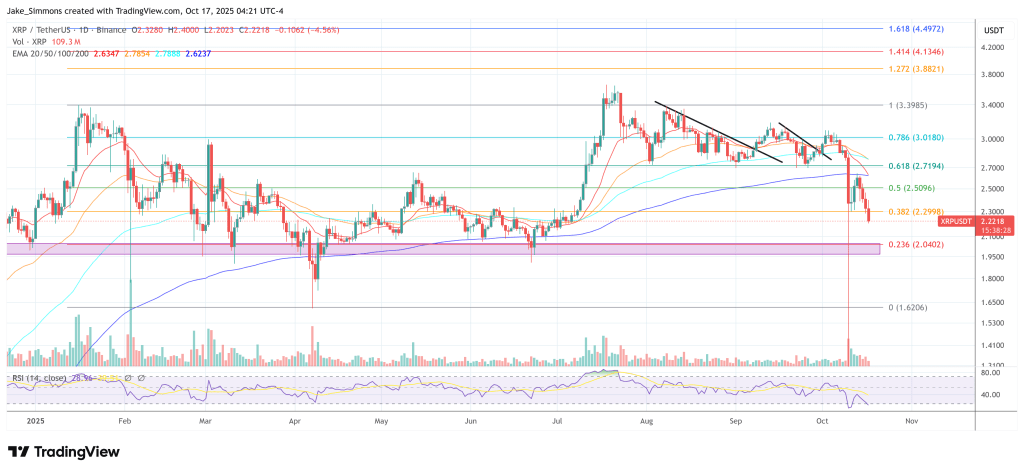
At press time, XRP traded at $2.22.
XRP price
XRP drops below the 0.382 Fib, 1-day chart | Source: XRPUSDT on TradingView.com
Featured image created with DALL.E, chart from TradingView.com
Editorial Process for bitcoinist is centered on delivering thoroughly researched, accurate, and unbiased content. We uphold strict sourcing standards, and each page undergoes diligent review by our team of top technology experts and seasoned editors. This process ensures the integrity, relevance, and value of our content for our readers.

Jake Simmons has been a Bitcoin enthusiast since 2016. Ever since he heard about Bitcoin, he has been studying the topic every day and trying to share his knowledge with others. His goal is to contribute to Bitcoin's financial revolution, which will replace the fiat money system. Besides BTC and crypto, Jake studied Business Informatics at a university. After graduation in 2017, he has been working in the blockchain and crypto sector. You can follow Jake on Twitter at @realJakeSimmons.

Leituras Relacionadas

Top Audit Guru Alerts: All DeFi is Unsafe, Withdraw Now!

Leading DeFi security auditor and OpenZeppelin founder Manuel Aráoz has issued a stark warning, declaring all DeFi protocols unsafe and advising the withdrawal of funds, even from established platforms like Aave and MakerDAO. This warning stems from the rapidly growing threat posed by AI-powered hacking tools. Aráoz highlights that AI agents can now identify and exploit smart contract vulnerabilities in minutes, a task that previously took expert teams weeks. This creates a critical asymmetry: defenders must patch every flaw, while attackers need only find one. Recent months have seen a surge in high-profile exploits, with billions lost in April and May alone across protocols like Drift Protocol, Kelp DAO, and THORChain. The acceleration is attributed to AI's ability to perform rapid code scanning, generate automated attack scripts, and even orchestrate social engineering and infrastructure attacks faster than human defenders can respond. The article cites Anthropic's powerful new AI model, Mythos, which demonstrated such proficiency in finding zero-day vulnerabilities that its public release was delayed over security concerns. This evolution fundamentally disrupts DeFi's risk-reward calculus. With yields on reliable protocols falling to single digits, users now face the potential of 100% capital loss for minimal returns. Aráoz's conclusion is that for most users, withdrawing funds to secure wallets is the most rational risk-management choice in the current landscape.

Odaily星球日报Há 5m

Top Audit Guru Alerts: All DeFi is Unsafe, Withdraw Now!

Odaily星球日报Há 5m

Behind Changxin Technology, Stands a Group of A-Share Companies

Changxin Technology, a leading Chinese DRAM (Dynamic Random Access Memory) manufacturer, has passed the review by the STAR Market listing committee, moving closer to an IPO. The company, seeking to raise 29.5 billion yuan, is the first to utilize the new "pre-review mechanism" on the STAR Market, expediting its approval process within five months. As China's largest and most technologically advanced integrated DRAM company, Changxin has achieved mass production of mainstream DDR5 and LPDDR5X products. It holds the fourth-largest global market share and ranks first in China, though it still trails behind industry leaders Samsung, SK Hynix, and Micron in areas like HBM technology. The company reported its first annual profit in 2025, with net profit surging to 24.762 billion yuan in Q1 2026, driven by booming AI-related demand. The IPO has drawn significant market attention due to Changxin's extensive and prestigious shareholder base. This includes state-backed funds like the National Integrated Circuit Industry Investment Fund II, industrial partner GigaDevice, internet giants (Xiaomi, Alibaba, Tencent), and several securities firms and A-share listed companies such as InfoMotion, Shangfeng Cement, and Hefei Urban Construction, which stand to benefit from the listing. The company's founder, Zhu Yiming, a pivotal figure in China's semiconductor industry who also founded GigaDevice, has committed to an unprecedented long-term lock-up of his shares and a massive personal equity incentive plan worth an estimated over 20 billion yuan for employees, excluding himself, upon listing.

marsbitHá 37m

Behind Changxin Technology, Stands a Group of A-Share Companies

marsbitHá 37m

When Vitalik Stops Blogging to Write Sci-Fi

Vitalik Buterin, founder of Ethereum, has announced a pause in his long-form technical blogging to instead write a science fiction novel exploring decentralized governance. The story, set in a fictional nation called Veridia, follows a member of a governance body that uses complex systems like quadratic voting, privacy-preserving audits, and AI-assisted decision-making to guide society through incentive structures rather than outright bans. This creative shift comes at a pivotal moment for the Ethereum ecosystem. The Ethereum Foundation has seen significant internal upheaval in 2026, with at least nine core contributors, including key protocol leaders, departing. Just days before his announcement, Vitalik published a statement addressing this turbulence, framing the Foundation as a "smaller ship" that will now focus on core principles like censorship resistance and security, while moving from a growth-oriented to a sustainability-focused organization. The novel's themes directly mirror Vitalik's long-standing technical interests in governance mechanisms. Community reactions are mixed: some see it as a thoughtful exploration of ideas through narrative, while others view the timing—amidst core team departures and a significant drop in ETH's price—as pointedly symbolic. The move is also interpreted as a personal transition, signaling Vitalik's evolving role from a central executive figure to one of many decentralized thought leaders within the Ethereum ecosystem.

marsbitHá 1h

When Vitalik Stops Blogging to Write Sci-Fi

marsbitHá 1h

Trading

Spot
Futuros

Artigos em Destaque

O que é XRP 2.0

XRP 2.0: Uma Nova Fronteira no Landscape das Criptomoedas Introdução ao XRP 2.0 No reino em constante evolução das criptomoedas, novos projetos surgem continuamente, lutando por atenção e adoção. Uma dessas iniciativas promissoras é o XRP 2.0, um novo projeto de criptomoeda concebido para aproveitar a tecnologia de blockchain avançada e as metodologias de criptografia robustas. Embora o nome tenha paralelos com o XRP da Ripple, é crucial notar que o XRP 2.0 opera de forma independente, focando em melhorar a segurança das transações, a privacidade e a escalabilidade. À medida que o panorama financeiro digital abraça cada vez mais soluções descentralizadas, o XRP 2.0 visa contribuir de forma significativa para a web3 e a expansão global dos projetos de criptomoedas. O que é o XRP 2.0? No seu núcleo, o XRP 2.0 é um projeto de criptomoeda que visa criar um ecossistema de moeda digital seguro e descentralizado. Sua tecnologia fundamental integra princípios de blockchain sofisticados com técnicas de criptografia de ponta. O objetivo abrangente do XRP 2.0 é estabelecer-se como uma plataforma confiável e eficiente que possibilita a execução rápida de transações, priorizando a proteção de privacidade aprimorada para os seus usuários. O projeto é promovido como uma solução para muitas limitações enfrentadas pelas criptomoedas existentes, propondo um sistema que pode lidar com um volume maior de transações com velocidade e privacidade melhoradas. Esta versatilidade posiciona o XRP 2.0 como um concorrente significativo em um mercado repleto de várias moedas digitais. Quem é o Criador do XRP 2.0? A identidade do criador por trás do XRP 2.0 foi identificada como 'Wilbur.' No entanto, detalhes abrangentes sobre Wilbur ou a sua entidade associada permanecem elusivos. O anonimato de muitos criadores de criptomoedas não é um fenômeno incomum na indústria, muitas vezes concebido para manter um grau de privacidade e segurança. Quem são os Investidores do XRP 2.0? Até agora, informações específicas relacionadas às fundações ou organizações de investimento que apoiam o XRP 2.0 não estão disponíveis publicamente. No setor das criptomoedas, o apoio de investidores reputados pode influenciar significativamente a credibilidade e o sucesso de um projeto, no entanto, a transparência em relação aos apoiantes financeiros do XRP 2.0 não foi estabelecida. Como Funciona o XRP 2.0? O XRP 2.0 destaca-se por empregar uma combinação de tecnologia blockchain e algoritmos de criptografia avançados que asseguram transações seguras e descentralizadas. Sua estrutura inovadora inclui características únicas projetadas para fomentar o envolvimento dos usuários e ampliar as funcionalidades além das transações convencionais de criptomoedas. Entre essas características, o XRP 2.0 incorpora capacidades potenciadas por IA, como funcionalidades de texto-para-imagem e texto-para-fala. Estas adições são projetadas para melhorar a experiência interativa dos usuários, promovendo uma maior aplicabilidade em vários setores. Ao unir avanços tecnológicos com um design centrado no utilizador, o XRP 2.0 pretende captar a atenção de uma diversa gama de indivíduos e empresas que procuram integrar soluções de criptomoedas em suas estruturas operacionais. Cronologia do XRP 2.0 Compreender o XRP 2.0 requer examinar os marcos que definiram sua jornada até agora: 23 de Julho de 2023: O XRP 2.0 é apresentado como um novo projeto de criptomoeda, visando revolucionar as capacidades de transação seguras e descentralizadas no domínio do blockchain. 8 de Setembro de 2023: O lançamento de outro projeto, XRP20, ocorre, marcando o surgimento de um token ERC-20 na blockchain Ethereum que permanece não relacionado ao XRP 2.0. 13 de Novembro de 2023: O XRP Ledger passa por uma atualização significativa com o lançamento da versão 2.0.0 do software do servidor rippled. É importante notar que este desenvolvimento está desconectado do projeto de criptomoeda XRP 2.0. Pontos-chave sobre o XRP 2.0 Para destilar a essência do XRP 2.0, vários fatores críticos emergem: Características Únicas: A inclusão de características como texto-para-imagem e texto-para-fala potenciadas por IA diversifica ainda mais as aplicações potenciais do XRP 2.0. Tecnologia Blockchain: A estrutura utiliza mecanismos de blockchain avançados e protocolos de criptografia, assegurando um ambiente seguro e descentralizado para transações. Escalabilidade e Privacidade: O XRP 2.0 prioriza proteção de privacidade aprimorada nos processos de transação e a escalabilidade necessária para acomodar uma base de utilizadores crescente. Sem Afiliação com a Ripple: Importante, apesar do seu nome, o XRP 2.0 não tem qualquer lealdade ou colaboração com o XRP da Ripple, distinguindo sua estrutura operacional e objetivos dentro do ecossistema das criptomoedas. Conclusão O XRP 2.0 representa uma empreitada ambiciosa no domínio das criptomoedas, visando oferecer uma combinação de segurança, privacidade e eficiência em transações digitais. Ao integrar tecnologias sofisticadas e características amigáveis ao utilizador, o projeto propõe-se a ampliar os horizontes do que as criptomoedas podem alcançar na economia digital atual. Embora o anonimato do seu criador e a falta de investidores divulgados possam levantar questões para alguns, o foco do XRP 2.0 em funcionalidades avançadas e descentralização aumenta seu apelo num mercado de criptomoedas cada vez mais congestionado. À medida que o panorama das criptomoedas continua a evoluir, o XRP 2.0 pode ainda emergir como um jogador crucial na expansão de soluções de blockchain seguras e escaláveis.

99 Visualizações TotaisPublicado em {updateTime}Atualizado em 2024.12.03

O que é XRP 2.0

Como comprar XRP

Bem-vindo à HTX.com!Tornámos a compra de XRP (XRP) simples e conveniente.Segue o nosso guia passo a passo para iniciar a tua jornada no mundo das criptos.Passo 1: cria a tua conta HTXUtiliza o teu e-mail ou número de telefone para te inscreveres numa conta gratuita na HTX.Desfruta de um processo de inscrição sem complicações e desbloqueia todas as funcionalidades.Obter a minha contaPasso 2: vai para Comprar Cripto e escolhe o teu método de pagamentoCartão de crédito/débito: usa o teu visa ou mastercard para comprar XRP (XRP) instantaneamente.Saldo: usa os fundos da tua conta HTX para transacionar sem problemas.Terceiros: adicionamos métodos de pagamento populares, como Google Pay e Apple Pay, para aumentar a conveniência.P2P: transaciona diretamente com outros utilizadores na HTX.Mercado de balcão (OTC): oferecemos serviços personalizados e taxas de câmbio competitivas para os traders.Passo 3: armazena teu XRP (XRP)Depois de comprar o teu XRP (XRP), armazena-o na tua conta HTX.Alternativamente, podes enviá-lo para outro lugar através de transferência blockchain ou usá-lo para transacionar outras criptomoedas.Passo 4: transaciona XRP (XRP)Transaciona facilmente XRP (XRP) no mercado à vista da HTX.Acede simplesmente à tua conta, seleciona o teu par de trading, executa as tuas transações e monitoriza em tempo real.Oferecemos uma experiência de fácil utilização tanto para principiantes como para traders experientes.

1.6k Visualizações TotaisPublicado em {updateTime}Atualizado em 2025.03.21

Como comprar XRP

Discussões

Bem-vindo à Comunidade HTX. Aqui, pode manter-se informado sobre os mais recentes desenvolvimentos da plataforma e obter acesso a análises profissionais de mercado. As opiniões dos utilizadores sobre o preço de XRP (XRP) são apresentadas abaixo.

活动图片