Trump Says China Tariffs “Will Not Stand” Amid Crypto Market Crash

TheCryptoTimesPublicado em 2025-10-17Última atualização em 2025-10-17

U.S. President Donald Trump said on Friday that the 100% tariffs on China will not stand, just a week after announcing them. 

During an interview on FOX Business, the president said “No,” when asked if the tariffs would remain. He said that the U.S. and China “will be fine.” 

Meanwhile, this announcement is coming just as the crypto market crashed today, with Bitcoin plunging to an intraday low of $105k amid global fear. Trump also confirmed he will meet Chinese President Xi Jinping in two weeks and that the two sides still aim for a fair deal.

This remark brought brief relief to traders as Bitcoin, the largest cryptocurrency in the world, bounced from below $105k to around $106k shortly after his statement. Currently, the token is trading for $106,686, according to CoinMarketCap.

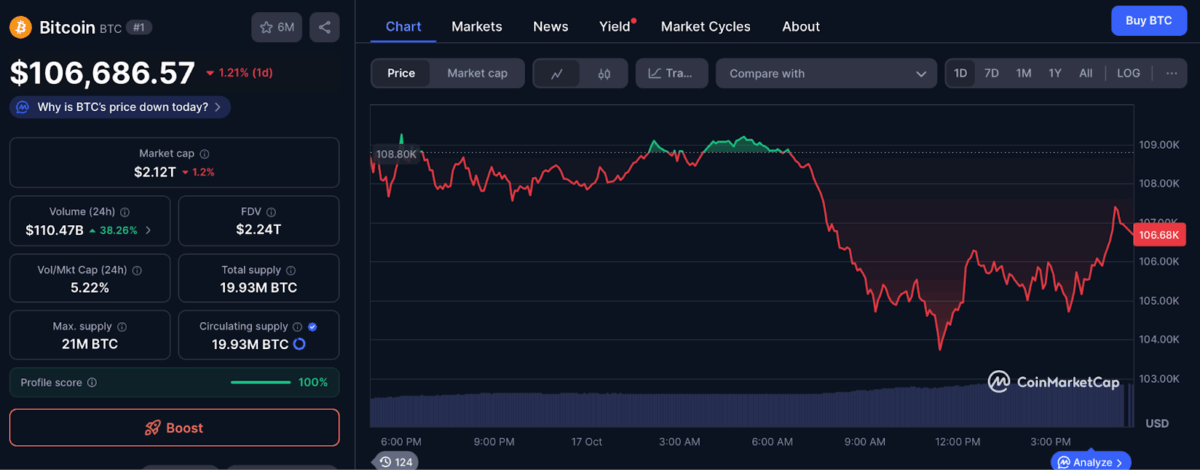
Image 51Image 51
Bitcoin Price Chart | Source: CoinMarketCap

Trump admitted the tariffs were unsustainable but maintained they were meant to push China toward fair trade terms. The quick reversal signals a softer tone in U.S.–China relations after days of tense headlines. 

The market turmoil began last Friday when Trump first announced the 100% tariffs, resulting in the largest crypto liquidation in months. Nearly $19 billion in value vanished as Bitcoin dropped to around $104,000, according to a report from The Crypto Times.  

According to Polymarket, there is now a 72% chance that Bitcoin could drop below $100,000 before the end of the year. Still, some see opportunity amid the chaos. For instance, BitMEX co-founder Arthur Hayes called Bitcoin “on sale,” encouraging traders to “buy the dip” if banking stress leads to new bailouts.

Also Read: Bitcoin Holding Companies Rise 40% in 3 Months: Bitwise


Mobile Only ImageMobile Only Image

Leituras Relacionadas

Morgan Stanley Research Report Analysis: Treasury's Repurchase Scale Doubles, The Logic for a Steepening Yield Curve Remains Unchanged

Morgan Stanley report: US Treasury doubles long-term bond buyback size, steepening yield curve thesis intact. The US Treasury will double the size of its regular liquidity support buyback operations for 10-20 year and 20-30 year bonds to at least $4 billion per operation starting Sept 9. Morgan Stanley views this move, the first adjustment outside a quarterly refunding window since the program's May 2024 launch, as a more important signal than the buybacks themselves. The Treasury is signaling close attention to long-end yield dynamics, using the tool to buy time ahead of the November refunding where it could cut long-term issuance. The report argues recent long-end yield rises and curve steepening are driven not by supply/deficit concerns but by repricing of energy prices and central bank policy paths. Analysis of cash Treasury vs. swap spreads shows no clear pattern consistent with dominant supply worries. The action echoes a November 2023 "supply surprise" that briefly flattened the curve. MS maintains its recommendation to steepen the 7s30s curve, targeting a 100 bps spread vs. ~71 bps currently. It believes fundamentals—cooling inflation, weaker-than-expected labor data, and potential downward revision of the Fed's terminal rate—will ultimately drive markets, supporting further steepening. In FX, MS strategists note the move was interpreted as a mild tool to curb USD strength. A refocus on USD policy could lead to further weakness, particularly against CHF, with EUR/USD potentially rising toward 1.2150.

marsbitHá 17m

Morgan Stanley Research Report Analysis: Treasury's Repurchase Scale Doubles, The Logic for a Steepening Yield Curve Remains Unchanged

marsbitHá 17m

Kaito Revives 'Talk-to-Earn' Economy, But Many Are Hesitant to Install the New Plugin

Kaito AI has launched a new browser extension called Kaito Pulse, aiming to integrate users' discussions on X (formerly Twitter) with their on-chain activities and social influence to build a new "attention + behavior verification" scoring system. The plugin displays users' public trading positions from platforms like Polymarket directly on the X timeline, allowing others to assess if their statements align with their actual market behavior. This move is seen as reviving "influence-to-earn" incentives. However, the launch sparked significant privacy concerns. Critics, including an analysis by "Ultra," allege the extension collects extensive data, such as device fingerprints (via GPU, hardware info), X user behavior (browsing paths, clicks), and may access sensitive data from third-party accounts (e.g., ChatGPT, trading platforms). This raised debates about trading privacy for verified influence. In response, Kaito founder Yu Hu stated the design follows data minimization principles, aiming to generate verification proofs without collecting or storing raw user data, using technologies like zkTLS. He acknowledged some permission descriptions could be misleading and promised improvements. The controversy highlights a core dilemma for social finance (SocialFi) platforms: as fake engagement and AI content grow, more user data is needed to verify genuine influence, but this risks encroaching on user privacy and trust.

marsbitHá 18m

Kaito Revives 'Talk-to-Earn' Economy, But Many Are Hesitant to Install the New Plugin

marsbitHá 18m

Kaito Reboots 'Talk-to-Earn Economy', but Many Are Hesitant to Install the New Plugin

Kaito AI has launched a new browser extension called Kaito Pulse, aiming to revitalize what the community terms the "talk-to-earn" or "social-fi" economy on X (formerly Twitter). The plugin displays users' on-chain trading activity, such as positions from platforms like Polymarket, directly within the X timeline. This aims to create a new "attention + behavior verification" system, shifting focus from who generates the most discussion to whose discussions are backed by credible, verifiable actions. However, the launch quickly sparked significant privacy concerns within the crypto community. Critics, led by an analysis from user "Ultra," allege the extension's code enables deep data collection. This includes potential device fingerprinting (using GPU, hardware, and audio data), tracking of X user behavior (browsing paths, clicks, engagement), and verification processes that could access sensitive data from third-party accounts like ChatGPT, Claude, and trading platforms. The debate centers on whether such extensive verification is necessary to combat fake engagement and AI-generated content, or if it constitutes an unacceptable privacy sacrifice. In response, Kaito founder Yu Hu stated the design follows data minimization principles. He claimed Kaito Pulse does not collect or store users' raw data but instead uses verification techniques, including zkTLS, to generate proofs of identity or behavior without exposing the underlying information. Yu Hu acknowledged that some permission descriptions could be misleading and promised improvements in future versions. The controversy highlights a core dilemma for social-fi projects: platforms need more user data to distinguish real influence from artificial hype, but users must decide how much privacy they are willing to trade for potential rewards and ranking within these new incentive systems.

Odaily星球日报Há 38m

Kaito Reboots 'Talk-to-Earn Economy', but Many Are Hesitant to Install the New Plugin

Odaily星球日报Há 38m

After Two and a Half Years of Entrepreneurship and Full AI Adoption, the Company Has Actually Become More 'Traditional'

"After 2.5 years of running my company, achieving near 100% AI adoption with Agents in roles like finance, HR, and operations, we've paradoxically become more 'traditional.' We learned that establishing a thick AI middle layer creates bottlenecks. Instead, we advocate for a 'thin platform, thick frontline' model, empowering employees closest to problems to use AI tools themselves, fostering ownership and initiative. The true foundation isn't the AI models, but the unique data and context a company accumulates—our most vital, irreplaceable asset, requiring diligent governance. As AI handles repetitive, describable tasks, human roles revert to their core: building genuine relationships, trust, and brand reputation through authentic communication, which AI cannot accelerate. A critical question is where the time saved by AI goes. It must be returned—to clients, to creative work, to employees' own lives—rather than just fueling higher output demands. For managers, AI strips away execution-focused busywork, exposing the necessity to define clear goals, make tough judgments, and take ultimate responsibility. Onboarding newcomers presents a challenge: while AI can generate 80% solutions instantly, we must deliberately design paths for them to develop judgment, understand context, and safely learn from mistakes. Ultimately, AI's organizational value isn't about replacing people but removing unnecessary friction, allowing more meaningful human connection. The real test of an 'AI-era' company isn't its tech stack, but how it treats people: delegating creative power, returning saved time, fostering growth, and upholding accountability. The core luxury and purpose of our work remains authentic human relationships."

marsbitHá 47m

After Two and a Half Years of Entrepreneurship and Full AI Adoption, the Company Has Actually Become More 'Traditional'

marsbitHá 47m

Trading

Spot
活动图片