BlackRock Plans Tokenization as IBIT Surpasses $100B in AUM and $HYPER’s Presale Reaches $23.9M

bitcoinistPublicado em 2025-10-17Última atualização em 2025-10-17

Resumo

Quick Facts: 1️⃣ BlackRock’s spot Bitcoin ETF IBIT surpassed $100B less than two years after its release on January 11,...

Trusted Editorial content, reviewed by leading industry experts and seasoned editors. Ad Disclosure

Quick Facts:

1️⃣ BlackRock’s spot Bitcoin ETF IBIT surpassed $100B less than two years after its release on January 11, 2024.
2️⃣ Larry Fink announced a long-term plan to tokenize all assets, from funds to stocks and cash.
3️⃣ Fink argues that bubbles don’t impact long-term investors and that time in the market outweighs opportunistic buy-ins.
4️⃣ Bitcoin’s Layer 2 project, Bitcoin Hyper ($HYPER) reaches $23.9M in presale and eyes a Q1 2026 release.

BlackRock’s spot Bitcoin ETF (IBIT) just surpassed $100B in assets under management (AUM), which prompted CEO Larry Fink to announce the company’s tokenization plans.

Fink made the comments during a CNBC interview, where he said:

I do believe we’re just at the beginning of tokenization of all assets, from real estate to equities to bonds, across the board.

Larry Fink, CNBC Interview

This comes over a year and a half after BlackRock launched its first tokenized fund, BUIDL, on the Ethereum network by partnering with Securitize.

In the official press release, Securitize’s co-founder and CEO, Carlos Domingo, said that BUIDL proves that tokenization is essentially unstoppable and that it will transform the capital market.
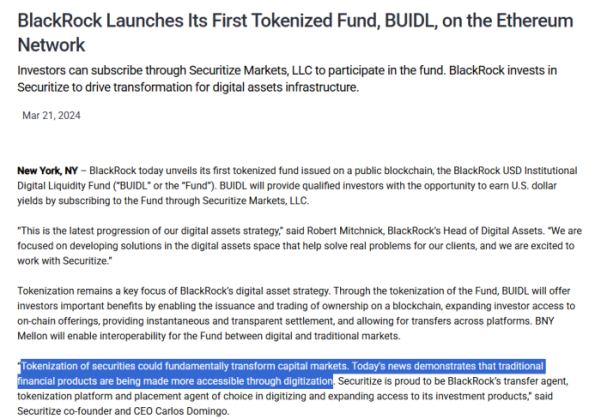
The official press release announcing BUIDL and showcasing Carlos Domingo’s comments.

With over $1T in AUM, BlackRock’s decision to invest in tokenization tech stems from Bitcoin’s and Ethereum’s success, especially amid 2025’s rampant adoption wave.

This spells good news for Bitcoin Hyper’s ($HYPER) $23.9M presale which feeds Bitcoin’s coming Layer 2 with a projected Q1 2026 public launch.

How BlackRock Could Transform the Capital Market

Fink believes that asset tokenization is imminent and the key step to attracting digital investors into the TradFi market, which pack more unpopular products like retirement funds.

The overarching goal is to allow investors to hold multiple assets together, including funds, cash, and cryptos, which would represent a turning point for the capital market as a whole.

To that end, Fink pushes for ‘time in the market,’ as opposed to opportunistic buy-ins, as an anti-bubble strategy. As he sees it, it’s only opportunistic buyers who push the notion of financial bubbles due to their short time in the market.

This doesn’t happen with long-term investors who ride the bubbles to follow the larger trend.

If you put money to work on January 1st, 2000, a year later you had the Dot Com crysis, six years later you had the financial crisis, you had the COVID crysis; you still would’ve made 8% compound interest over the entire 25 years.

It’s not about if our markets are going up or down […] it’s about being in the market for the entire cycle.

Larry Fink, CNBC interview

The same mindset applies to the digital market and Bitcoin is the living proof of that. While opportunistic snipers often find themselves in hot waters – last Friday’s market crash anyone? – long-term investors who bought $BTC in 2011 are now up 169,000,000%.
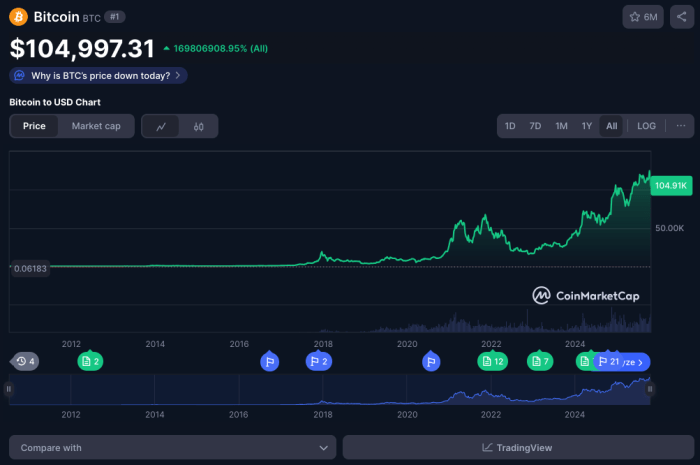
Bitcoin’s all-time performance on CoinMarketCap

Bitcoin’s recent performance only adds to that. $BTC now trades at just under $106K after a 13.7% drop over the last week, which is painful for leverage traders, but neutral for long-term investors, because Bitcoin will eventually bounce back.

Especially with Bitcoin Hyper just around the corner.

How Bitcoin Hyper Promises to Change the Bitcoin Ecosystem

Bitcoin Hyper ($HYPER) aims to address Bitcoin’s most pressing problem: its performance limitation.

With a hard cap of seven transactions per second (TPS), Bitcoin currently ranks 22nd on the list of the fastest blockchains by TPS. This translates to slow confirmation times, high fees, and lack of scalability.

Hyper relies on tools like the Solana Virtual Machine (SVM) and the Canonical Bridge to change that.

While SVM increases the network’s performance, unlocking the ultra-fast execution of DeFi apps and smart contracts, the Canonical Bridge addresses Bitcoin’s long confirmation times directly.

Once the Bitcoin Relay Program confirms incoming transactions in milliseconds, the Bridge then mints the bitcoins on the Hyper layer, allowing you to use the wrapped assets with near-instant finality within the Layer 2 ecosystem.
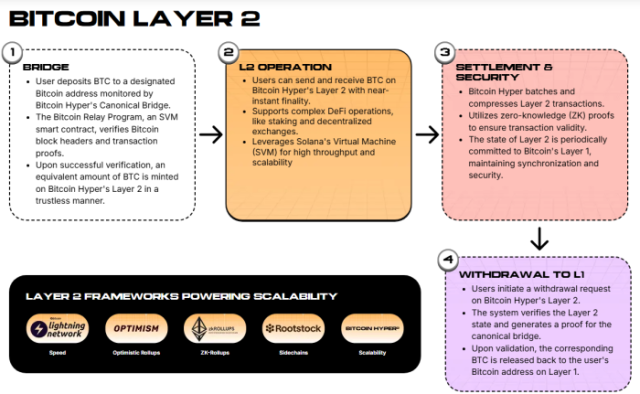
How Hyper’s Canonical Bridge works

Long-term, Hyper aims to turn Bitcoin into a more feasible option for institutional investors by making the network faster, cheaper, and more scalable.

The project is seeing outstanding investor support, managing to reach $23.9M since its beginning and it’s still growing fast.

$HYPER is available right now at the presale price of $0.013125, which could be the lowest you could ever buy the token at.

Based on the project’s utility, release window, and current investor support, our price prediction for $HYPER is $0.32 in 2025, with a Q4 release. Long-term, the token could push as high as $1.5 or higher by 2030, for a projected ROI of 11,328% if you invest today.

Long-term investments, remember?

If you want to get in while you still can, check our guide on how to buy $HYPER and visit the presale page today.

Join the $HYPER presale here.

This isn’t financial advice. Do your own research (DYOR) before investing.

Authored by Bogdan Patru, Bitcoinist: https://bitcoinist.com/blackrock-tokenization-bitcoin-etf-100b-hyper-surges

Editorial Process for bitcoinist is centered on delivering thoroughly researched, accurate, and unbiased content. We uphold strict sourcing standards, and each page undergoes diligent review by our team of top technology experts and seasoned editors. This process ensures the integrity, relevance, and value of our content for our readers.

As a crypto writer, Bogdan’s responsibilities are split between researching and writing articles and entertaining the team with his humor bordering on the politically incorrect, an aspiring Bill Burr, if you will. Thanks to his 12+ years of writing experience in just as many fields, including tech, cybersecurity, modelling, fitness, crypto, and other topics-that-shall-not-be-named, he's become a genuine asset to the team. While his position as a senior writer at PrivacyAffairs thought him valuable lessons about the power of self-management, his entire writing career was and is an exercise in self-improvement. Now, he's ready to sink his teeth into crypto and teach people how to take control of their own money on the blockchain. With fiat as an eternally devaluing currency, Bitcoin and altcoins seem like the best-fitting alternative for Bogdan. Bogdan’s biggest professional accomplishment, aside from securing a position as a main writer for Bitcoinist, was his 5-year run as a writing manager at Blackwood Productions, where he coordinated a team of four writers. During that time, he learned the value of teamwork and that of creating a working environment that breeds efficiency, positivity, and friendship.

Leituras Relacionadas

Consumer Confidence Hits Bottom, Macro Correlations Simultaneously Break Down: How Much Longer Can the U.S. Stock Market's Solo Rally Last?

The U.S. stock market is exhibiting a rare divergence: while consumer confidence hits historic lows and traditional macro asset correlations break down, major indices like the Nasdaq 100 and S&P 500 continue reaching record highs, fueled primarily by AI and semiconductor momentum. The rally is now highly concentrated, with strength rotating from giants like Nvidia to higher-beta plays within semiconductors, particularly memory chips. This surge occurs despite a significant split between pessimistic consumer sentiment and still-resilient actual spending behavior, partially supported by fiscal stimulus. Goldman Sachs traders highlight a critical structural fissure: correlations between the S&P 500 and key macro assets (rates, gold, VIX, oil) have deviated extremely from long-term historical norms. Concurrently, the market is in a negative Gamma regime, making it more sensitive to price moves, and hedge fund positioning in momentum and semiconductors is at crowded levels. The sustainability of this "solo rally" faces three main constraints: 1) Oil price volatility linked to Middle East geopolitical risks, 2) Extreme crowding in semiconductor and momentum trades, increasing vulnerability to disappointments, and 3) The breakdown of traditional macro correlations, suggesting the rally reflects a specific mix of factors rather than broad-based risk appetite. The key question is not if indices can rise further, but which variable—oil, rates, or semiconductor momentum—might trigger a repricing of the current fragile logic.

marsbitHá 1h

Consumer Confidence Hits Bottom, Macro Correlations Simultaneously Break Down: How Much Longer Can the U.S. Stock Market's Solo Rally Last?

marsbitHá 1h

Trading

Spot
Futuros
活动图片