Cardano Founder Hoskinson Launches Government And Policy Center

bitcoinistPublicado em 2025-10-16Última atualização em 2025-10-16

Resumo

Charles Hoskinson, founder of Cardano, has launched the Hoskinson Government and Policy Center in Wyoming, positioning the new entity to...

Trusted Editorial content, reviewed by leading industry experts and seasoned editors. Ad Disclosure

Charles Hoskinson, founder of Cardano, has launched the Hoskinson Government and Policy Center in Wyoming, positioning the new entity to work on rural health care, agriculture, blockchain policy and “government transparency,” with plans to engage directly in the state’s 2026 election cycle in coordination with a Wyoming Integrity political action committee. The announcement was made on Oct. 15, 2025, via a sponsored post carried by Cowboy State Daily and by new social channels tied to the Center.

Cardano Founder Predicts ‘A Lot Of Fun Next Year’

The Center will concentrate its government-relations efforts inside Wyoming, a jurisdiction where Hoskinson has been steadily increasing his physical footprint. The announcement points to a medical clinic he financed in Gillette and a bison ranch in Platte County as examples of prior commitments, and lists near-term legislative priorities that include securing access to stem-cell therapies in the state.

In his statement, Hoskinson framed the initiative as a vehicle to “strengthen rural health care, modernize agriculture, and improve government transparency,” adding that “with smart legislation and the right technology, Wyoming can set the standard for how decentralized systems can deliver beneficial change in all walks of life.”
Leadership appointments were disclosed alongside the launch. Karen Wheeler, a career Wyoming official who served for decades in the Secretary of State’s office — including a brief stint as acting Secretary in 2018 and a 2015–2022 tenure as Deputy Secretary — will serve as Executive Director.

“I am truly honored to lead the Hoskinson Government and Policy Center as we work to advance thoughtful, forward-looking policy across healthcare, agriculture, and technology,” Wheeler said, describing the sectors as central to “Wyoming’s strength and growth.”

Kendrick Ladd, identified as a former US Army officer and federal regulatory investigator who now practices law in Wyoming, was named General Counsel and Head of Policy. “To benefit current and future Wyoming generations, the integration of emerging technology in government must spring from and strengthen Wyoming’s foundational principles of liberty, integrity, and government accountability,” Ladd said in the release.

The Center also named longtime Wyoming politics reporter Leo Wolfson as Wyoming Communications Director. Wolfson most recently covered the Legislature and state politics for Cowboy State Daily from 2022 through 2025. “I am beyond thrilled to be joining an organization like the Policy Center that’s focused on supporting Charles Hoskinson’s efforts to make Wyoming a strong and independent state for generations to come,” he said.

Beyond policy advocacy, the Center signaled electoral ambitions. It “plans on taking an active role in the 2026 elections in Wyoming” and will coordinate “throughout the election cycle” with the Wyoming Integrity PAC, an entity that Hoskinson previewed earlier this year as a vehicle to press for procurement transparency and ethics in state contracting.

Hoskinson amplified the launch on X. In a light-toned post, he wrote, “We are going to have a lot of fun next year :)” and reposted the Center’s announcement from its new @WyomingHGPC account.

The initiative builds on Hoskinson’s Wyoming-focused projects. The Gillette-based Hoskinson Health & Wellness Clinic as well as the Twin Pine/Hoskinson bison ranch near Wheatland are Hoskinson’s well-known projects besides Cardano. What remains less defined in the launch materials is the Center’s funding model, and any formal relationship, if any, with Cardano-affiliated entities such as Input Output Global.

For the crypto industry, the Wyoming emphasis is consistent with Hoskinson’s public critiques earlier this year of opaque procurement around the state’s stablecoin initiative, and his argument that clearer, more competitive processes could sustain Wyoming’s reputation as a crypto-friendly hub. “I’ve invested my time and resources here in Wyoming because I believe this state can lead the nation,” Hoskinson said.

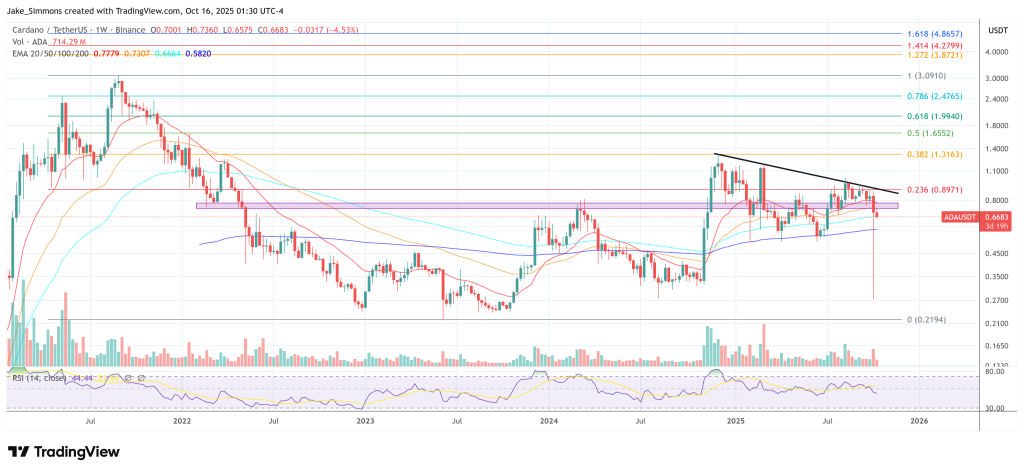
At press time, Cardano traded at $0.6683.
Cardano price
Cardano remains below key resistance, 1-day chart | Source: ADAUSDT on TradingView.com
Featured image from YouTube, chart from TradingView.com
Editorial Process for bitcoinist is centered on delivering thoroughly researched, accurate, and unbiased content. We uphold strict sourcing standards, and each page undergoes diligent review by our team of top technology experts and seasoned editors. This process ensures the integrity, relevance, and value of our content for our readers.

Jake Simmons has been a Bitcoin enthusiast since 2016. Ever since he heard about Bitcoin, he has been studying the topic every day and trying to share his knowledge with others. His goal is to contribute to Bitcoin's financial revolution, which will replace the fiat money system. Besides BTC and crypto, Jake studied Business Informatics at a university. After graduation in 2017, he has been working in the blockchain and crypto sector. You can follow Jake on Twitter at @realJakeSimmons.

Leituras Relacionadas

Competitors Going Public, Kimi Can't Sit Still

Competitors Go Public, Kimi Feels the Pressure Yue Zhi An Mian (Moonshot AI), the company behind the AI assistant Kimi, has begun dismantling its VIE and red-chip structure, clearing a key obstacle for a potential Hong Kong IPO. This marks a significant shift from six months ago when founder Yang Zhilin stated the company was in "no hurry" to list. The move comes as rivals like Zhipu AI and MiniMax have successfully listed on the Hong Kong Stock Exchange in early 2026, experiencing massive surges in market value. This has reset valuation logic for AI companies, turning "going public" from an end goal into a competitive necessity. Analysts suggest Kimi is both seizing a favorable market window and responding to competitive pressure. Kimi's valuation has skyrocketed from around $3 billion at its 2023 founding to over $20 billion by May 2026. Capital is betting on its potential as a future AI platform and gateway, though some caution this "emotional valuation" depends on sustained technological leadership and successful commercialization. Traditionally focused on core model R&D over user growth, Kimi has recently pivoted strategy. While its monthly active users declined through 2025, it shifted focus to Agent development and reducing marketing spend. The release of its K2.5 model in early 2026 reportedly generated substantial revenue, with annual recurring revenue reaching $200 million by April, driven by subscriptions and API services. A $2 billion D-round financing in May signaled investor approval of this commercial shift. However, listing will bring new pressures. Experts predict a listed Kimi would face stricter scrutiny on financial controls, compliance, and R&D efficiency. The narrative must evolve from pure technological breakthroughs to demonstrating clear commercialization paths, sustainable income, and a defensible valuation, balancing model superiority with business performance.

marsbitHá 8m

Competitors Going Public, Kimi Can't Sit Still

marsbitHá 8m

End of the 'Gray Era' for Hong Kong and US Stock Trading Accounts: Where Can Your Money Go Now?

Hong Kong and US stock “grey account opening era” ends, where can your money go? In a coordinated regulatory crackdown starting May 22nd, Hong Kong's SFC and China's securities regulator have targeted the previously common but legally ambiguous practice of mainland Chinese investors opening accounts with Hong Kong brokers to trade Hong Kong and US stocks. The SFC issued a stern circular after a review of 12 brokerages, citing major deficiencies including inadequate due diligence, acceptance of suspicious or forged documents, and weak management of cross-border relationships. New requirements mandate mainland clients to submit a written declaration confirming their investment funds originate from *outside* mainland China, the account has never been closed for using suspicious documents, and agreeing to information disclosure. Brokers must immediately close accounts opened with suspicious documents and dormant accounts. Simultaneously, Chinese authorities launched a two-year campaign to rectify illegal cross-border securities activities. Key internet brokers like Futu, Tiger Brokers, and Longbridge are facing penalties, with existing accounts allowed only to sell/withdraw funds, not add new ones. The impact is immediate. Reports from social media and financial news outlets confirm that individuals traveling to Hong Kong to open accounts are now required to sign the new declaration. However, even after signing, applications are frequently rejected. The declaration shifts compliance responsibility to the client and acts as a filter, as most mainland investors' funds do not legally meet the "from outside China" criterion. Major brokers like Futu and Tiger have stopped accepting new mainland clients. A few, such as uSmart Securities, Fosun Wealth, and Cheerful Investment, still offer limited channels, but approvals have tightened significantly. Crucially, funding must now come exclusively from the investor's own bank account in Hong Kong or a qualified jurisdiction, blocking previous workarounds like using money changers or stablecoins. For mainland investors, compliant pathways still exist but are narrower. Individuals with overseas status (students, work visa holders) and verifiable offshore funds may still qualify. Official channels like Stock Connect, QDII, and the Cross-boundary Wealth Management Connect remain fully compliant options, albeit with product and quota limitations. On-chain alternatives exist but carry their own regulatory uncertainties and often exclude mainland users. The crackdown signals the end of the lax expansion period for Hong Kong brokers targeting mainland clients. While investment opportunities persist, the era of easy, low-compliance access is over. Investors must now carefully assess their eligibility and understand that signing the new declaration carries personal legal liability.

Odaily星球日报Há 56m

End of the 'Gray Era' for Hong Kong and US Stock Trading Accounts: Where Can Your Money Go Now?

Odaily星球日报Há 56m

SpaceX's $1.75 Trillion IPO: A Quick Guide to 17 Related Stocks

**Title: SpaceX's $1.75 Trillion IPO: Analysis of 17 Related Stocks** SpaceX is set to IPO on Nasdaq with a $1.75 trillion valuation. The real value driver is Starlink, contributing 61% of Q1 revenue with high margins. Its valuation heavily depends on future execution, including user growth despite falling ARPU. Key stocks have already surged pre-IPO. Tesla (TSLA, +10%) is a primary beneficiary due to deep integration with SpaceX in chip design and AI. Rocket Lab (RKLB, +89%) is seen as a "mini-SpaceX," but faces risk from potential Neutron rocket delays. AST SpaceMobile (ASTS) competes in the same satellite-to-phone market as Starlink. Firefly (FLY, +70%) is a strong government contractor in lunar services. Partners like EchoStar (SATS), Planet Labs (PL), and T-Mobile (TMUS) will see revaluation. Suppliers like Qualcomm (QCOM, +57%) are critical ecosystem "picks and shovels." Investment vehicles like DXYZ (+80%) hold significant SpaceX stakes but trade at high premiums, which may collapse post-IPO. Redwire (RDW) is highlighted as an under-the-radar "pick and shovel" play in space components, with growth in defense contracts and microgravity pharmaceuticals. The article warns that much of the positive news is already priced in, and a post-IPO sell-off is possible. Large IPOs often underperform initially. Key risks include Starship delays, ARPU decline, and unforeseen black swan events affecting Elon Musk or space operations. Investors are advised to focus on companies with solid fundamentals and manage overall sector exposure carefully.

marsbitHá 58m

SpaceX's $1.75 Trillion IPO: A Quick Guide to 17 Related Stocks

marsbitHá 58m

Trading

Spot
Futuros

Artigos em Destaque

Como comprar ADA

Bem-vindo à HTX.com!Tornámos a compra de Cardano (ADA) simples e conveniente.Segue o nosso guia passo a passo para iniciar a tua jornada no mundo das criptos.Passo 1: cria a tua conta HTXUtiliza o teu e-mail ou número de telefone para te inscreveres numa conta gratuita na HTX.Desfruta de um processo de inscrição sem complicações e desbloqueia todas as funcionalidades.Obter a minha contaPasso 2: vai para Comprar Cripto e escolhe o teu método de pagamentoCartão de crédito/débito: usa o teu visa ou mastercard para comprar Cardano (ADA) instantaneamente.Saldo: usa os fundos da tua conta HTX para transacionar sem problemas.Terceiros: adicionamos métodos de pagamento populares, como Google Pay e Apple Pay, para aumentar a conveniência.P2P: transaciona diretamente com outros utilizadores na HTX.Mercado de balcão (OTC): oferecemos serviços personalizados e taxas de câmbio competitivas para os traders.Passo 3: armazena teu Cardano (ADA)Depois de comprar o teu Cardano (ADA), armazena-o na tua conta HTX.Alternativamente, podes enviá-lo para outro lugar através de transferência blockchain ou usá-lo para transacionar outras criptomoedas.Passo 4: transaciona Cardano (ADA)Transaciona facilmente Cardano (ADA) no mercado à vista da HTX.Acede simplesmente à tua conta, seleciona o teu par de trading, executa as tuas transações e monitoriza em tempo real.Oferecemos uma experiência de fácil utilização tanto para principiantes como para traders experientes.

1.2k Visualizações TotaisPublicado em {updateTime}Atualizado em 2025.03.21

Como comprar ADA

Discussões

Bem-vindo à Comunidade HTX. Aqui, pode manter-se informado sobre os mais recentes desenvolvimentos da plataforma e obter acesso a análises profissionais de mercado. As opiniões dos utilizadores sobre o preço de ADA (ADA) são apresentadas abaixo.

活动图片