Shiba Inu Reopens Shibarium Bridge After 1-Month Freeze

bitcoinistPublicado em 2025-10-16Última atualização em 2025-10-16

Resumo

Shiba Inu has restored BONE transfers on Shibarium’s Plasma bridge, re-enabling deposits and withdrawals between Ethereum and the layer-2 network...

Trusted Editorial content, reviewed by leading industry experts and seasoned editors. Ad Disclosure

Shiba Inu has restored BONE transfers on Shibarium’s Plasma bridge, re-enabling deposits and withdrawals between Ethereum and the layer-2 network following a security incident that forced a month-long pause. In an October 14 post, core contributor Kaal Dhairya wrote that the “Plasma Bridge is back online for BONE, following a comprehensive review and a series of security enhancements,” adding that users can now bridge BONE “with a safer, stronger, and more resilient experience.”

Shiba Inu Relaunches The Shibarium Bridge

The relaunch comes after Shibarium’s bridge was restricted in mid-September following a validator-key compromise that enabled a malicious exit on the PoS bridge. In a September 21 incident report, Dhairya stated that “on September 12, 2025 at 18:44 UTC, unauthorized validator signing power was used to push a malicious state/exit through the PoS bridge, withdrawing multiple assets,” prompting immediate containment measures and a broader hardening program. The team said at the time it would publish full technical details once it was safe to do so and that “bridging remains restricted during containment/hardening.”

Shibarium’s team is positioning the re-opened BONE bridge as the first step in a phased restoration of services, backed by new policy-level and operational controls. The most visible change for users is a mandatory delay before withdrawals finalize: “All BONE Plasma withdrawals now include a 7-day finalization delay. This buffer gives operators and security teams time to monitor and respond to unusual activity before funds finalize—significantly improving defense without removing user access.” The post frames the delay as reinforcing Plasma’s fraud-resistance guarantees.

Another control introduced at the bridge layer is proactive address blacklisting. According to the team, the new mechanism “lets us flag and block suspicious addresses at the bridge layer,” with the intent of preventing repeat abuse across the ecosystem. The Shiba Inu team also emphasized that critical code changes underwent an external review: “All critical changes were reviewed by Hexens, adding an independent layer of expert scrutiny.” The relaunch followed a validation sequence that included unit tests, end-to-end simulations, deployment on the public testnet (“Puppynet”), and “multi-timeframe” monitoring before production activation.

The October 14 update also addresses a separate strand of the September incident involving KNINE and minor OSCAR token flows. The Shiba Inu team disclosed that the attacker “drained and sold roughly $600 worth of OSCAR tokens from the bridge but ignored the 5 ETH recovery offer for KNINE tokens,” which now remain blacklisted and unusable to the attacker. The previously announced KNINE bounty “has expired,” the team said, but it plans “one final, conditional bounty (amount TBD) for complete return of all KNINE held by attacker-controlled addresses,” stressing that partial returns will not qualify and that terms will appear only on verified channels.

While only BONE is live on the Plasma bridge today, Shibarium signaled a broader roadmap. The team plans “gradual re-enablement for other tokens” and is “finalizing a fair and transparent repayment framework for affected users,” with specifics to be published once doing so would not increase risk. The post underscores a measured posture after the September compromise: “Safety first: We won’t publish specifics that could be gamed while security work is ongoing. Expect measured, verifiable updates.”

Context around the month-long outage highlights the extent of remediation behind the scenes. In late September, Shibarium detailed rotations of validator signers, migrations of contract control to multi-party hardware custody, targeted contract-level protections, live monitoring and exchange coordination, and the engagement of independent security and incident-response specialists. The September 21 update also acknowledged decentralization shortcomings in validator operations and outlined a hardening plan “in progress collaboration with Hexens,” with restoration gated on third-party sign-offs and successful drills on test environments.

For now, the reopening restores a critical path for validators, liquidity providers and users who rely on BONE mobility between Ethereum and Shibarium. As the post concludes, the new safeguards—including blacklisting and the 7-day challenge window—are intended to align the bridge’s user experience with the practical realities of operating a Plasma-style system under adversarial conditions: “Every new safeguard, every extra check, and yes—even the 7-day delay—reflects one core principle: protecting the community.”

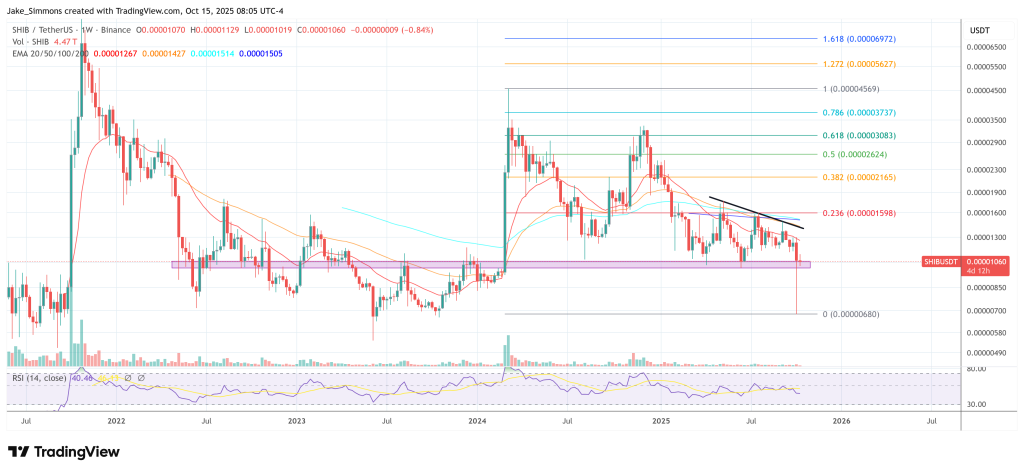
At press time, the Shiba Inu (SHIB) token traded at $0.00001060.
Shiba Inu price
Shiba Inu trades at key support zone, 1-week chart | Source: SHIBUSDT on TradingView.com
Featured image created with DALL.E, chart from TradingView.com
Editorial Process for bitcoinist is centered on delivering thoroughly researched, accurate, and unbiased content. We uphold strict sourcing standards, and each page undergoes diligent review by our team of top technology experts and seasoned editors. This process ensures the integrity, relevance, and value of our content for our readers.

Jake Simmons has been a Bitcoin enthusiast since 2016. Ever since he heard about Bitcoin, he has been studying the topic every day and trying to share his knowledge with others. His goal is to contribute to Bitcoin's financial revolution, which will replace the fiat money system. Besides BTC and crypto, Jake studied Business Informatics at a university. After graduation in 2017, he has been working in the blockchain and crypto sector. You can follow Jake on Twitter at @realJakeSimmons.

Leituras Relacionadas

Uniswap Founder: When Stocks and Treasuries Are Fully On-Chain, How Will AMMs Restructure the Global Market?

Uniswap founder Hayden Adams argues that as traditional assets like stocks become tokenized, Automated Market Makers (AMMs) could fundamentally restructure global markets. The core insight is that AMMs are most efficient in "correlated pairs"—such as NVDA/SPY—where assets move together. In these pairs, passive liquidity providers (LPs) who are willing to hold the underlying assets face lower inventory risk and minimal hedging costs compared to traditional, delta-neutral market makers. This cost advantage allows AMMs to undercut professional firms. Tokenization enables assets to trade directly against each other on a shared settlement layer, rather than being siloed in dollar-based systems. Adams observes this pattern already emerging in DeFi, where assets naturally pair with correlated benchmarks (e.g., ETH for Ethereum assets). He believes this will extend to tokenized stocks, with liquidity concentrating in low-volatility correlated pairs, while a few high-volume "bridge pairs" (like SPY/USD) handle dollar conversions. The article highlights that early correlated markets for tokenized stocks already exist (e.g., on Robinhood's chain), and Uniswap v4 hooks like DualPool can further boost LP returns. Adams draws a parallel to the rise of passive index funds, suggesting passive AMM liquidity could similarly democratize market-making and capture significant market share from traditional finance. A response from crypto KOL Cody adds practical analysis, noting that while the correlated pair strategy reduces impermanent loss, current on-chain fees may not yet fully compensate for it. He shares his own LP strategy using valuation models, emphasizing that AMMs offer a novel, low-cost market-making avenue for those willing to hold inventory.

marsbitHá 10m

Uniswap Founder: When Stocks and Treasuries Are Fully On-Chain, How Will AMMs Restructure the Global Market?

marsbitHá 10m

Goldman Sachs Buys Volatility, Turns Bitcoin into a Yield Business

Goldman Sachs acquired NEOS Investments for up to $2.25 billion, gaining a suite of ETFs that generate income by selling options against crypto assets, particularly Bitcoin. This includes the BTCI fund, which sells call options against Bitcoin ETF holdings to capture high premiums from crypto’s volatility, offering investors stable cash flow—around 27% annualized in returns—while capping upside potential and fully exposing them to downside risk. The move highlights Wall Street’s broader push to package crypto-native yield—through staking, lending, and structured products—without taking directional bets on prices. Firms like Fidelity, JPMorgan, and Morgan Stanley now offer staking services or accept crypto as collateral for loans, collecting steady fees regardless of market direction. In contrast, native crypto firms like Bitwise remain vulnerable to market downturns, as their revenue depends entirely on assets under management. This reflects a strategic pivot: large institutions no longer need to “believe” in crypto to profit from it. They monetize volatility and investor activity through fee-based structures, leaving price risk to retail investors. As regulatory shifts like the proposed 401(k) rules unfold, yield-generating crypto products may gain even broader adoption in traditional portfolios, further cementing Wall Street’s role as a neutral intermediary capturing reliable revenue streams from the ecosystem.

marsbitHá 14m

Goldman Sachs Buys Volatility, Turns Bitcoin into a Yield Business

marsbitHá 14m

AI Launches a Fierce Assault on Cancer, Virtually Tests 4,000 Anti-Cancer Drugs, Google Gemma Downloads Exceed 1 Billion

Google's open-source Gemma AI model family has reached a new milestone, surpassing 10 billion cumulative downloads in two and a half years since its February 2024 launch. This growth has fueled a vast ecosystem, with over 100,000 developer-derived model variants powering diverse applications, from NASA satellites to over 100 million phones. A standout application involves cancer research. In collaboration with Google Research and Yale, a team developed a 27-billion-parameter model called Cell2Sentence-Scale 27B (C2S-Scale). This model innovatively converts complex single-cell sequencing data into a "sentence" of gene names ranked by activity, allowing it to analyze cellular behavior. It was used to conduct a "dual-context virtual screen" of over 4,000 drugs, aiming to find one that specifically boosts antigen presentation—a key process for immune system recognition—only in the presence of low interferon signals (a "cold tumor" context), not in neutral conditions. The model identified silmitasertib (CX-4945), a CK2 kinase inhibitor, as a top candidate. Subsequent live-cell experiments validated this AI-generated hypothesis, showing that the drug combined with low-dose interferon increased antigen presentation by about 50%, whereas neither element alone had a significant effect. This represents a novel, AI-proposed mechanistic pathway for potential cancer therapy. Beyond biomedicine, the Gemma ecosystem is expanding into unique domains. Models have been deployed in space on high-performance GPUs and are being used in projects like DolphinGemma to decipher dolphin communication patterns. The 10-billion-download milestone underscores a key trend: the disruptive potential of AI lies not just in raw model capability but in its widespread, silent integration into diverse hardware and real-world applications, as evidenced by the thriving "Gemmaverse" community.

marsbitHá 15m

AI Launches a Fierce Assault on Cancer, Virtually Tests 4,000 Anti-Cancer Drugs, Google Gemma Downloads Exceed 1 Billion

marsbitHá 15m

Shocking: OpenAI Fully Open-Sources Codex Harness

OpenAI has open-sourced the core framework of Codex, called "Harness," under an Apache-2.0 license. This move allows developers to deeply integrate AI agents into their own applications and workflows, moving beyond the limitations of generic chat interfaces. The Harness is the underlying execution system that manages an AI agent's complete lifecycle: understanding tasks, maintaining memory, using tools, handling failures, and requesting human approvals. OpenAI demonstrated that optimizations to the Harness alone can dramatically boost a model's performance, tripling scores on a benchmark while using significantly fewer tokens. The release includes three key components: a CLI tool (`codex exec`) for automated tasks, official SDKs (TypeScript/Python) for programmatic control, and the `app-server` for embedding agents directly into products. This enables features like persistent state, real-time event streaming, and human-in-the-loop controls. Early adopters showcase its versatility beyond coding. Examples include a tax preparation system that cut processing time by one-third, Cisco's platform for building apps with natural language, and a demo logistics dashboard where agents analyze data and propose actions within the existing interface. This paradigm shift grants developers full control over the user interface, context, tools, and security boundaries. AI becomes an invisible assistant within specialized software, rather than a separate chatbot. By open-sourcing the engine behind its powerful agents, OpenAI aims to spark a new wave of native, deeply integrated AI applications.

marsbitHá 20m

Shocking: OpenAI Fully Open-Sources Codex Harness

marsbitHá 20m

Trading

Spot
活动图片