Hoskinson Says Cardano Will Anchor The Human Internet In The AI Age

bitcoinistPublicado em 2025-10-14Última atualização em 2025-10-14

Resumo

Cardano founder Charles Hoskinson used an October 13 livestream to sketch an expansive, two-track future for the web, arguing that...

Trusted Editorial content, reviewed by leading industry experts and seasoned editors. Ad Disclosure

Cardano founder Charles Hoskinson used an October 13 livestream to sketch an expansive, two-track future for the web, arguing that accelerating AI automation will force a structural split between a bot-dominated “slop land” and an invitation-only “human internet” whose trust rails run on decentralized identity, NFTs and on-chain incentive systems. In that architecture, he said, Cardano’s stack—spanning DIDs, the Midnight data-protection network, and a planned decentralized social platform—would serve as foundational infrastructure.

Opening with a diagnosis that “the internet is dying,” Hoskinson framed the problem as a runaway rise in automated accounts and AI-generated media that he believes has already tipped major platforms away from authentic human interaction. “The majority of internet users today are bots,” he claimed, citing “credible 2025 research” that allegedly pegs the share of botlike X accounts at 45%–64%.

“Over the next five years, the slop will get so bad that there’s going to be a better than 75% chance that what you see is a bot.” His contention is that this trajectory effectively nullifies social discourse: “We are no longer interacting with humans… The probability that it’s actually Bob and not Robo Bob is going to approach zero by 2030.”

Cardano’s Role In Rebuilding The Human Internet

Hoskinson’s proposed remedy centers on cryptographic identity and attestations. He placed decentralized identifiers (DIDs) at the core, coupled with “proof-of-humanity” methods that bind a persistent identifier to a verified person without leaking private data. “What [DIDs] allow you to do is assign to a person an ID and then you can prove properties about that person,” he said, adding that humanity checks could draw on a variety of approaches—from existing “Proof of Humanity”-style mechanisms to more novel biometric signals. He even referenced experiments related to his Quantum Hosky gaming venture, suggesting “your brain actually has a unique fingerprint… and you can use your brain for proof of human.”

Once identity is anchored, the Cardano founder argued, content itself must carry provenance. He envisions authenticity NFTs attached to media artifacts, cryptographically signed by a DID that has passed a humanity test. “When you look at content you will have a marketplace for non-slop… ‘Verified made by human,’ a proof of humanity,” he said. That, in turn, would allow clients to filter feeds to human-originated material and restore high-signal social spaces.

The architectural consequence, in Hoskinson’s view, is a bifurcated web: one substrate optimized for autonomous agents and AI-to-AI commerce, and a separate, admission-controlled human layer. “We’re basically going to create an invitation-only second internet… the only place humans are allowed to go,” he said. Agents would still traverse the open web to execute tasks on a user’s behalf—shopping, research, negotiations—while the human layer preserves identity, privacy and discourse.

Blockchains, he argued, are indispensable to both halves. For the human layer, the chain becomes “the ledger for humanity… the place where the DIDs live… where the NFT[s] verifying [genuine] content are.” For the agentic layer, it provides coordination of model licensing, personalization data, and payments among swarms of bots. He described a coming marketplace of pre-parameterized, task-specific agents—“Uncle Bob’s magic hatbot” as a toy example—bought, tuned and composed much like today’s app economy, but transacted as digital goods on an “AI ledger.” “What if that marketplace lives on an AI ledger?” he asked. “This will be the next-gen browser as the interface.”

Privacy-preserving data sharing, Hoskinson said, is where Cardano’s Midnight fits. Framing it as a way to “share without sharing,” he positioned Midnight as a substrate that lets users lend the semantic value of their personal data to agents (for example, preferences that improve recommendations) while keeping raw information shielded. “That’s why we got Midnight,” he said.

Hoskinson Plans A Decentralized Social Platform

Beyond identity and provenance, the Cardano founder called for new truth-seeking primitives built into social applications: prediction markets, “veracity bonds” and what he termed an “epistemic funnel.” In his telling, users and institutions that assert facts could post economic stakes that are slashed if claims later prove false, while consumers would run claims through layered tests—automated AI checks, authenticity NFTs, reputational vouching—before conferring belief. “I think all the media has to be here,” he said, arguing that economic consequences would curb low-quality publishing. “There are lots of money to be made in building these applications that enforce epistemic hygiene.”

On the business side, he forecast an AdTech realignment as human attention slips and agents transact directly with paywalled content on a micro-licensing basis. “Humans aren’t there to watch [ads]… a whole multi-trillion-dollar industry is going to be disrupted,” he said, predicting protocols where agents “check out” articles or datasets for cents and negotiate usage and summarization rights through machine-readable contracts. He referenced emergent “402/ATA”-style access standards and “X.42”-type protocols in that context, while stressing the need for a neutral settlement layer.

While much of the AMA surveyed the broader industry, Hoskinson repeatedly returned to Cardano’s roadmap and adjacent efforts. He suggested the ecosystem would move “after we get done with Midnight and get that out by RealFi and Quantum Hosky” to “some form of decentralized social network,” integrating proof-of-humanity credentials, authenticated content, and truth-market mechanisms. He also highlighted Lace as the prospective on-ramp: “We have the perfect interface for it… Lace is a great on and off ramp because it has the money there. It’s built right into the browser… and Lace is just about to go into mobile.”

The normative thread running through the session was a rejection of price fixation and a call to re-center crypto on coordination and civilizational resilience. “If you think it’s just token go up, token go down… you’re a useless person,” he said bluntly. He portrayed the industry’s purpose as “to liberate humanity’s economic, political, and social systems,” adding that blockchains “create a shared space for a synthetic objective reality… immutable, timestamped and auditable,” that lets societies bind rights and rules to accelerating technologies.

At press time, Cardano (ADA) traded at $0.69.
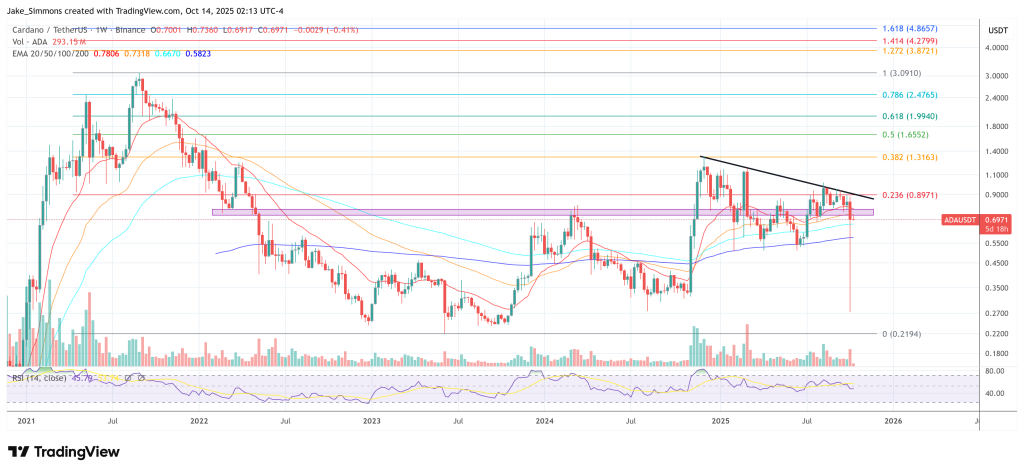
Cardano price
Cardano is now below the red resistance band again, 1-day chart | Source: ADAUSDT on TradingView.com
Featured image created with DALL.E, chart from TradingView.com
Editorial Process for bitcoinist is centered on delivering thoroughly researched, accurate, and unbiased content. We uphold strict sourcing standards, and each page undergoes diligent review by our team of top technology experts and seasoned editors. This process ensures the integrity, relevance, and value of our content for our readers.

Jake Simmons has been a Bitcoin enthusiast since 2016. Ever since he heard about Bitcoin, he has been studying the topic every day and trying to share his knowledge with others. His goal is to contribute to Bitcoin's financial revolution, which will replace the fiat money system. Besides BTC and crypto, Jake studied Business Informatics at a university. After graduation in 2017, he has been working in the blockchain and crypto sector. You can follow Jake on Twitter at @realJakeSimmons.

Criptomoedas em alta

Leituras Relacionadas

Grayscale: Zcash, Financial Privacy in the Age of AI

Grayscale Research suggests a third wave of public focus on financial privacy is approaching, driven by stablecoin/blockchain adoption and new AI-powered surveillance tools. In this context, Zcash emerges as a decentralized digital currency, similar to Bitcoin but with built-in, robust privacy mechanisms via its "shielded" transactions that conceal sender, receiver, and amount using zero-knowledge proofs. While privacy is often seen as a niche feature, it is argued to be a core requirement for functional money, needed by individuals and businesses alike. Zcash's optional privacy is distinct from mixers or default-private chains like Monero. After years of development (Sapling, Orchard/NU5, Ironwood upgrades) to improve usability, key metrics show growing adoption: shielded transactions comprise ~90% of network activity, and ~25% of circulating ZEC is in shielded pools—a historical high. Despite this, ZEC's market valuation remains low (~0.6% of the "digital currency" sector), implying the market prices privacy as a marginal concern. The investment thesis hinges on a potential re-rating if the value of financial privacy is recognized more broadly. Risks include regulatory challenges around shielded transactions, legacy trusted setup pools, quantum computing threats, and execution risks for upcoming upgrades like Tachyon for scaling. In summary, Zcash represents a significant, technologically mature option in the privacy currency space, with current valuation offering potential upside if privacy demand grows.

marsbitHá 36m

Grayscale: Zcash, Financial Privacy in the Age of AI

marsbitHá 36m

The Bear Market Has Ended, A New Bull Cycle Has Begun

**Title: Bear Market Over, New Bull Cycle Begins** Bitcoin surged over 20% in just three days, from a low of $64,100 on August 19th to a high of $79,500 by August 21st, marking a dramatic shift in market sentiment. This rapid rise triggered massive liquidations exceeding $4 billion, with short positions accounting for $3.7 billion—the largest short squeeze since 2021. The rally was fueled by several key factors. Macroeconomic conditions improved as the US Treasury doubled its long-term bond buyback size, easing pressure. Significant regulatory developments included a White House meeting where former President Trump urged Senate action on the CLARITY Act and hinted at potential US Bitcoin reserves, followed by the CFTC Chairman stating the agency would establish crypto market rules if the bill stalls. On-chain data revealed a fierce battle: large whales faced substantial liquidations on short positions, while others took profits or doubled down on longs. Major altcoins like ETH and XRP also saw impressive gains. Analysts are divided but increasingly bullish. Many, including CryptoQuant's founder, declare the bear market over and a new bull cycle begun. Price targets range from $100k by year-end to ambitious long-term projections of $200k. However, some caution against immediate chasing, noting overbought conditions and viewing the move as a potential "trap" ahead of the crucial September 15th Senate vote on the CLARITY Act. The market's next test is sustaining the momentum with real buying pressure, holding above key resistance near $78k-$80k, and watching ETF inflows and the upcoming regulatory vote.

marsbitHá 40m

The Bear Market Has Ended, A New Bull Cycle Has Begun

marsbitHá 40m

Xiaomi Defended Its Smartphone Gross Margin, Yet to Find a Profit Successor

Xiaomi's Q2 2026 financial report reveals a company navigating a complex transition. While smartphone gross margin held steady at 8.5% through strategic product mix and a record-high average selling price (ASP), this came at the cost of a 26.5% year-over-year decline in global shipments, pressuring its core user acquisition engine. This illustrates Xiaomi's central challenge: managing the "timing gap" between its established and emerging growth engines. Its smartphone business is pivoting from scale to premiumization, but it's unclear if high-end models can fully offset the volume loss from more price-sensitive segments, especially in markets like India and Africa. Meanwhile, the electric vehicle segment has become a significant revenue contributor, delivering 104,200 units and generating ¥23.9 billion. However, its profit contribution remains unclear as it, along with AI investments, is still in a scaling and investment phase. The AI and humanoid robot initiatives, though strategically prioritized and tested in Xiaomi's own factories, are in early-stage validation with no near-term commercialization timeline. Financially, the company remains stable, supported by a robust cash position and its high-margin internet services business, which hit a new high in monthly active users. Management emphasized continued heavy investment in AI, chips, and robotics to fuel the next growth cycle. The key question is whether these new engines—cars, AI, robotics—can achieve commercial scale and profitability before the smartphone engine's growth slows further.

marsbitHá 41m

Xiaomi Defended Its Smartphone Gross Margin, Yet to Find a Profit Successor

marsbitHá 41m

Is RWA Still Meaningful Without DeFi?

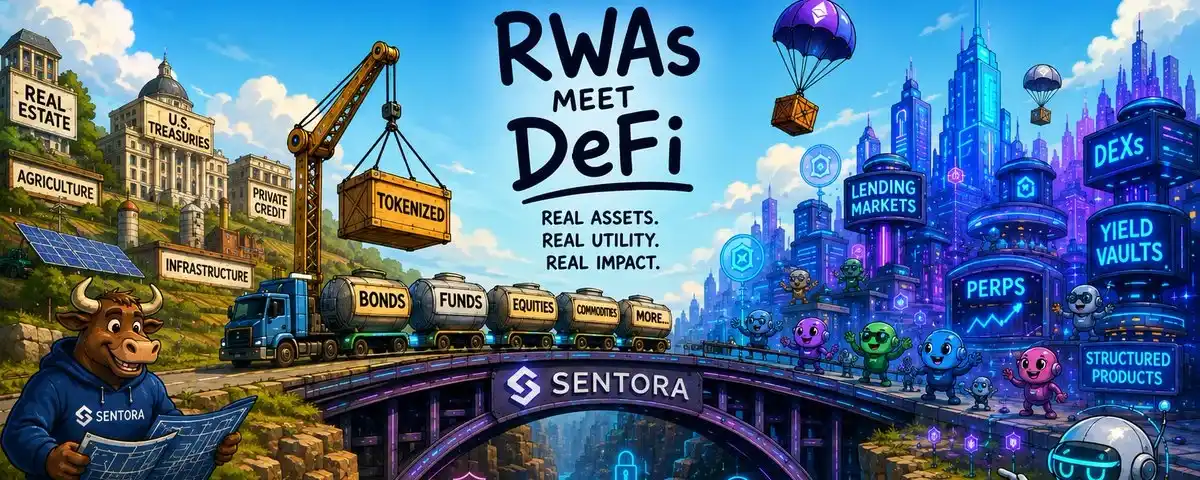
The article "Would RWA Still Matter Without DeFi?" argues that tokenizing real-world assets (RWA) alone, like putting a barcode on a container, is not transformative. True value emerges when these tokenized assets are integrated into decentralized finance (DeFi) ecosystems, enabling valuation, financing, hedging, trading, and loss management in a programmable, automated manner. Tokenization provides digital representation, but DeFi provides utility through leverage, liquidity, and composability. The core challenge lies in aligning the different "time clocks" of blockchain (fast, 24/7), traditional markets (limited hours), and asset redemption (slow processes), which creates liquidation risks and gaps. Effective RWA integration requires more than a token; it needs a full stack: legally enforceable rights, reliable data oracles, clear transfer rules, executable secondary liquidity, appropriate collateral parameters, and credible loss resolution paths. Liquidity is defined not by total value locked (TVL) but by the ability to exit a position under stress within a required timeframe. Risk management for RWAs must be modeled as a dependency graph, monitoring interconnected nodes like issuers, custodians, oracles, and liquidity pools for early warning signs beyond just price data. While tokenized government bonds serve as an initial "ping test," the future lies in more complex assets like computing power and energy, which require bespoke risk models. Tokenized stocks paired with perpetual futures present a major test, combining global equity ownership with crypto-native leverage, necessitating robust architectural safeguards like isolation and dynamic collateral rules. The conclusion is that without DeFi, RWA tokenization offers limited value—improving distribution and transparency. The significant opportunity arises when tokenized assets become functional components within open, programmable capital markets, where they can be used as collateral and facilitate complex financial strategies. The token is merely the barcode; the market operating system is the real machine.

marsbitHá 1h

Is RWA Still Meaningful Without DeFi?

marsbitHá 1h

Trading

Spot

Artigos em Destaque

Como comprar ADA

Bem-vindo à HTX.com!Tornámos a compra de Cardano (ADA) simples e conveniente.Segue o nosso guia passo a passo para iniciar a tua jornada no mundo das criptos.Passo 1: cria a tua conta HTXUtiliza o teu e-mail ou número de telefone para te inscreveres numa conta gratuita na HTX.Desfruta de um processo de inscrição sem complicações e desbloqueia todas as funcionalidades.Obter a minha contaPasso 2: vai para Comprar Cripto e escolhe o teu método de pagamentoCartão de crédito/débito: usa o teu visa ou mastercard para comprar Cardano (ADA) instantaneamente.Saldo: usa os fundos da tua conta HTX para transacionar sem problemas.Terceiros: adicionamos métodos de pagamento populares, como Google Pay e Apple Pay, para aumentar a conveniência.P2P: transaciona diretamente com outros utilizadores na HTX.Mercado de balcão (OTC): oferecemos serviços personalizados e taxas de câmbio competitivas para os traders.Passo 3: armazena teu Cardano (ADA)Depois de comprar o teu Cardano (ADA), armazena-o na tua conta HTX.Alternativamente, podes enviá-lo para outro lugar através de transferência blockchain ou usá-lo para transacionar outras criptomoedas.Passo 4: transaciona Cardano (ADA)Transaciona facilmente Cardano (ADA) no mercado à vista da HTX.Acede simplesmente à tua conta, seleciona o teu par de trading, executa as tuas transações e monitoriza em tempo real.Oferecemos uma experiência de fácil utilização tanto para principiantes como para traders experientes.

1.6k Visualizações TotaisPublicado em {updateTime}Atualizado em 2026.06.02

Como comprar ADA

Discussões

Bem-vindo à Comunidade HTX. Aqui, pode manter-se informado sobre os mais recentes desenvolvimentos da plataforma e obter acesso a análises profissionais de mercado. As opiniões dos utilizadores sobre o preço de ADA (ADA) são apresentadas abaixo.

活动图片