В криптофонды поступило $3,17 млрд на фоне коррекции рынка

cryptonews.ruPublicado em 2025-09-12Última atualização em 2025-10-13

С 4 по 10 октября инвесторы вложили в криптовалютные инвестиционные продукты $3,17 млрд. Об этом говорится в отчете CoinShares.
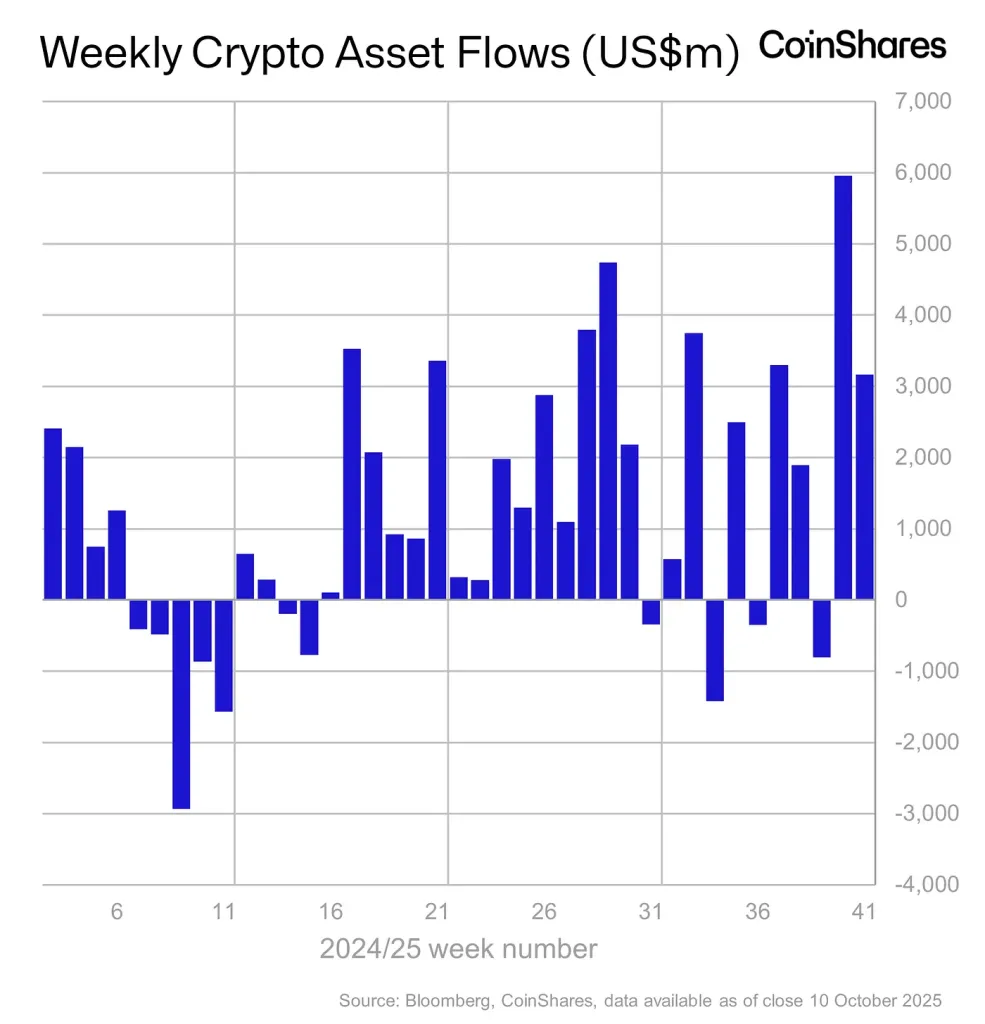
Динамика недельных притоков в криптофонды. Источник: CoinShares.

Аналитики отметили, что объявление президента США Дональда Трампа о введении 100% пошлин на китайский импорт почти не повлияло на динамику инструментов. 10 октября отток составил $159 млн.

С января совокупный приток достиг $48,67 млрд. Показатель превзошел итоговую сумму инвестиций за прошлый год $48,56 млрд. Объемы торгов составили $53 млрд — вдвое выше среднего показателя 2025 года.

После появления информации о пошлинах совокупные активы под управлением снизились на 7%, до $242 млрд.

Большая часть вложений пришлась на биткоин-продукты — $2,67 млрд за неделю и рекордные $30,2 млрд с начала года. 10 октября объем торгов акциями фондов на базе первой криптовалюты пробил $10,4 млрд. В тот день цена актива снизилась со $121 000 до $116 000.
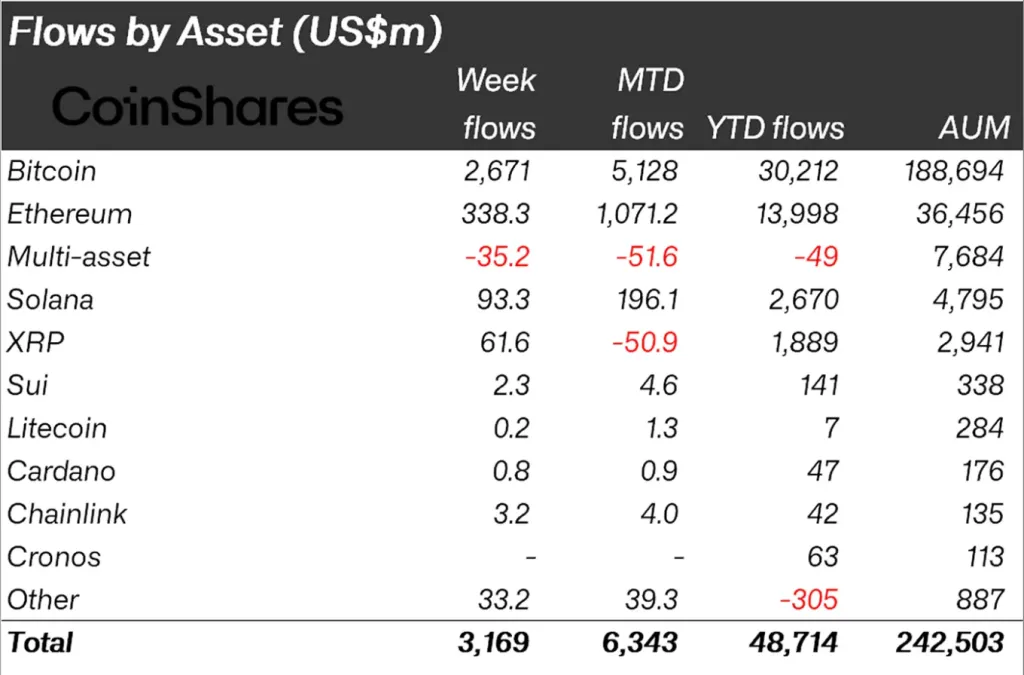
Еженедельное распределение привлеченного капитала по активам. Источник: CoinShares.

Ориентированные на Ethereum инструменты привлекли $338 млн, столкнувшись с оттоком на $172 млн 10 октября.

Притоки в фонды на основе Solana и XRP замедлились вопреки ожиданиям запуска спотовых ETF, сфокусированных на этих альткоинах. В них поступило $93,3 млн и $61,6 млн соответственно.

Основной объем средств пришелся на США, где зафиксировали $3 млрд. Второй по величине недельный приток — в Швейцарии ($132 млн). Позитивные настроения также наблюдались в Германии ($53 млн), Австралии ($9,9 млн) и Канаде ($3,8 млн).
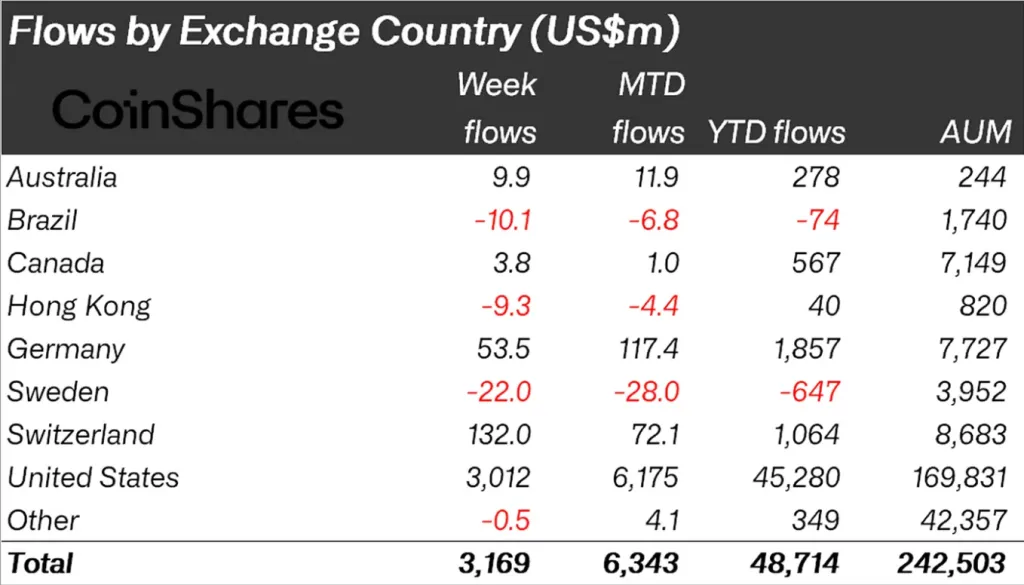
Еженедельное распределение привлеченного капитала по регионам. Источник: CoinShares.

Напомним, с 26 сентября по 4 октября инвестпродукты на основе цифровых активов зафиксировали рекордный приток в размере $5,95 млрд.

Leituras Relacionadas

Pax Silica vs. WAICO: The US Wants to Prohibit Europe from Using Chinese Artificial Intelligence

The United States is preparing to demand that European and other partners abandon Chinese artificial intelligence initiatives, threatening exclusion from the American-led "Pax Silica" coalition, according to a leaked U.S. State Department document. This ultimatum forces signatories of the "AI Opportunity Statement" to choose between the Western technological ecosystem and alternative frameworks, with China not explicitly named but clearly targeted. Pax Silica is a U.S. strategy for AI and semiconductor hegemony, launched in late 2025. Its European presence expanded significantly in mid-2026. Concurrently, China, Russia, and 27 other nations established the World AI Cooperation Organization (WAICO) in July 2026 as an independent intergovernmental platform promoting AI governance based on UN principles. This situation creates a difficult choice, especially for European nations balancing strategic autonomy with dependence on U.S. tech and security. It also pressures Global South countries with pragmatic ties to both Washington and Beijing. The formation of competing blocks risks fragmenting the global tech landscape, forcing companies to split supply chains, increasing costs, and potentially leading to incompatible standards and protocols. The era of open globalization in AI may be ending, replaced by geopolitical confrontation where technological sovereignty trumps economic efficiency. The decisions made will shape the global digital economy for decades.

cryptonews.ruHá 1h

Pax Silica vs. WAICO: The US Wants to Prohibit Europe from Using Chinese Artificial Intelligence

cryptonews.ruHá 1h

Robert Kiyosaki Shares His Mentor's Predictions About the Emergence of Bitcoin and AI

American entrepreneur and author of "Rich Dad Poor Dad," Robert Kiyosaki, discussed the influence of futurist R. Buckminster Fuller on his worldview, linking Fuller's past technological predictions to the emergence of Bitcoin and the development of artificial intelligence. In an X post, Kiyosaki also reflected on personal purpose, sharing his journey from the music business—where he worked with bands like The Police and Iron Maiden—to creating the "Cashflow" board game and writing his famous book. He described feeling an inner emptiness despite his success, a turning point that came after meeting Fuller, whom he studied with for three summers. Kiyosaki described Fuller as a "friendly genius" who foresaw world-changing developments like Bitcoin and AI. However, the core of his post focused on Fuller's philosophical impact, particularly a quote about belonging to the universe and finding purpose by dedicating one's life to the maximum benefit of others. The entrepreneur remains a vocal advocate for cryptocurrencies. He regularly advises buying Bitcoin during market panics, viewing it and assets like Ethereum, gold, and silver as hedges against traditional financial system failures. Kiyosaki has predicted a major market crash by 2026, seeing it as an opportunity for prepared investors, with long-term price targets including $750,000 for Bitcoin and $95,000 for Ethereum.

cryptonews.ruHá 3h

Robert Kiyosaki Shares His Mentor's Predictions About the Emergence of Bitcoin and AI

cryptonews.ruHá 3h

Etherealize CEO Calls Wall Street's Private Blockchains a 'Race to the Bottom'

Etherealize co-founder and CEO Vivek Raman criticized Wall Street's growing interest in private, permissioned blockchains, calling them a "race to the bottom." In an interview with CoinDesk, Raman argued that consortium networks fragment liquidity and return the industry to the siloed systems that blockchain technology was meant to overcome. He stated that closed networks do not interoperate, undermining two key advantages of the technology: system compatibility and liquidity concentration. Etherealize promotes Ethereum as an open, foundational layer for institutional players. Raman insists that privacy and access restrictions should be built on top of public infrastructure—at the application or L2 level—rather than creating separate, closed networks. He compared Ethereum to HTTP as a base layer, with additional permissioned and private layers akin to HTTPS. Examples of this new wave of "closed" solutions mentioned include Canton Network from Digital Asset, Circle's Arc project, and Stripe's Tempo. Raman termed this trend "consortium chains 2.0," recalling earlier initiatives like the R3 interbank consortium and the Hyperledger corporate ecosystem from 2016 that failed to gain significant traction. He reiterated his firm belief that a global, open, permissionless infrastructure is necessary as a foundational base layer. Raman previously noted in June that traditional financial institutions had begun implementing Ethereum-based solutions into real business processes.

cryptonews.ruHá 3h

Etherealize CEO Calls Wall Street's Private Blockchains a 'Race to the Bottom'

cryptonews.ruHá 3h

Trading

Spot
活动图片