‘Cardano Will Break The Internet’: Hoskinson Explains Why

bitcoinistPublicado em 2025-10-03Última atualização em 2025-10-03

Resumo

In an interview with Bloomberg’s Haslinda Amin on the sidelines of Token2025, Cardano founder Charles Hoskinson sketched an unabashedly expansionary...

Trusted Editorial content, reviewed by leading industry experts and seasoned editors. Ad Disclosure

In an interview with Bloomberg’s Haslinda Amin on the sidelines of Token2025, Cardano founder Charles Hoskinson sketched an unabashedly expansionary roadmap for both crypto markets and the Cardano ecosystem, arguing that the next phase of adoption will be institutional, privacy-aware, and integrated with legacy finance—and that Cardano is positioned to be a core settlement layer in that world. The X quip that Cardano will “break the internet,” he said, was less a meme than a signal of the scope of partnerships and primitives he believes are nearing product readiness.

Bitcoin And Crypto Enter The Bull Run: Hoskinson

Hoskinson dismissed the latest market drawdown as a transient pause. “Quick pit stop at the gas station,” he said when asked if the recent sell-off suggested fading momentum. He described crypto’s underlying strength as “incredibly strong,” tying the next leg to policy catalysts. “The Clarity Act is likely to get passed and bring institutional players in,” he argued, placing regulation—not retail cycles—at the heart of the coming expansion.

On macro linkages, Hoskinson urged investors to decide what they believe crypto is—a high-beta tech proxy or a counter-cyclical hedge—because the answer shapes expectations through rate and dollar regimes. “When the dollar is weak, it wakes up,” he noted, adding that crypto has recently tracked tech, then gold, with the goal that the asset class becomes “large enough to be in its own asset class.”

He remains explicitly constructive on Bitcoin, placing a marker on timing and magnitude while cautioning his trading acumen: “I think by the middle of next year, $250,000 Bitcoin… depends on the macroeconomics… I’m the worst trader in the world.” The message was less a price call than a framing device: if institutions drive the next cycle, flows and correlations will not look like prior, retail-led four-year rhythms. “Those cycles were retail driven… this [one is] institutional and [about the] Clarity Act… a billion users,” he said, adding that banks are stirring “because the Genius Act,” which he cast as a bridge for mainstream capital.

Pressed on whether enthusiasm could be derailed by tariffs, geopolitics, or slower-than-expected easing, Hoskinson acknowledged the sector is “not immune to the macro,” reminding that heightened uncertainty makes allocators “more conservative and wait to deploy capital.” Yet he returned to a secular bull thesis: “I think we are headed towards the bull market,” with crypto continuing to “follow tech stocks” even as it matures toward standalone status.

Why Cardano Could ‘Break The Internet’

The interview’s pivot—and the line that lit up social media—was Amin’s reference to his recent post that “Cardano is going to break the internet.” Hoskinson tied the rhetoric to concrete pillars: an energized community, expanding collaborations, and privacy-preserving infrastructure designed for regulated finance.

“We’re having a lot of fun… a lot of wonderful partnerships and collaborations like Google Cloud,” he said, adding that the ecosystem “has been running and [has] never been hacked,” which in his view underpins why “a lot of institutional [capital sees Cardano as] one of the blue chips of the industry.”

For Hoskinson, the last mile between blockchains and capital markets is privacy and programmability that fit compliance envelopes. “Tokens are financial brain cells… Having 24/7 global settlement is a really powerful thing. Only thing missing is privacy,” he said. The remedy, he argued, is contract design that separates public and private data paths so that broker-dealers and custodians can meet obligations without forfeiting blockchain’s composability. “You need contracts to sort out the public side and private side… solving that last mile problem,” he said. Once such rails exist, “there is no reason to run on the legacy system.”

He located the time horizon in a regulatory cadence rather than a product roadmap alone. “Next three to five years,” he said when asked when this flips. “The regulation is getting done and [then] two to three years of rulemaking… every jurisdiction in Europe [will] be operable and [we’ll] not talk about tokens in securities law [terms]. We can adapt our software accordingly. Everything else is sky is the limit.”

Cardano’s privacy-focused Midnight stack is the bet he described as tailored to Wall Street workflows, according to Hoskinson. “We have Midnight coming out… a big bet because we wanted something for Wall Street and something for the custodians and exchanges [to] tokenize what they have and bring it into the crypto space,” he said.

The project, he added, is “coming towards the end of the year,” framed as a bridge for legacy financial institutions to issue and settle assets with policy-compliant confidentiality on public rails. That emphasis on privacy and compatibility also informed his comments about reconciling blockchains with supervisors. “We’re talking [to] the Federal Reserve and SEC and now we have to reconcile the legacy world,” he said. “Everybody has a role to play… It’s going to take a little bit of time what privacy looks like and how global settlement is going to look like.”

At press time, ADA traded at $0.855.
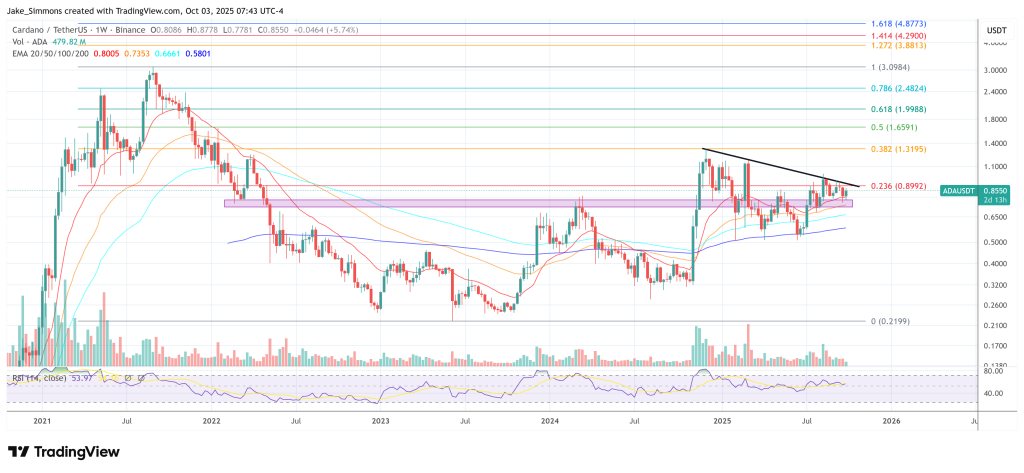
Cardano price
ADA hovers below key resistance, 1-day chart | Source: ADAUSDT on TradingView.com
Featured image created with DALL.E, chart from TradingView.com
Editorial Process for bitcoinist is centered on delivering thoroughly researched, accurate, and unbiased content. We uphold strict sourcing standards, and each page undergoes diligent review by our team of top technology experts and seasoned editors. This process ensures the integrity, relevance, and value of our content for our readers.

Jake Simmons has been a Bitcoin enthusiast since 2016. Ever since he heard about Bitcoin, he has been studying the topic every day and trying to share his knowledge with others. His goal is to contribute to Bitcoin's financial revolution, which will replace the fiat money system. Besides BTC and crypto, Jake studied Business Informatics at a university. After graduation in 2017, he has been working in the blockchain and crypto sector. You can follow Jake on Twitter at @realJakeSimmons.

Criptomoedas em alta

Leituras Relacionadas

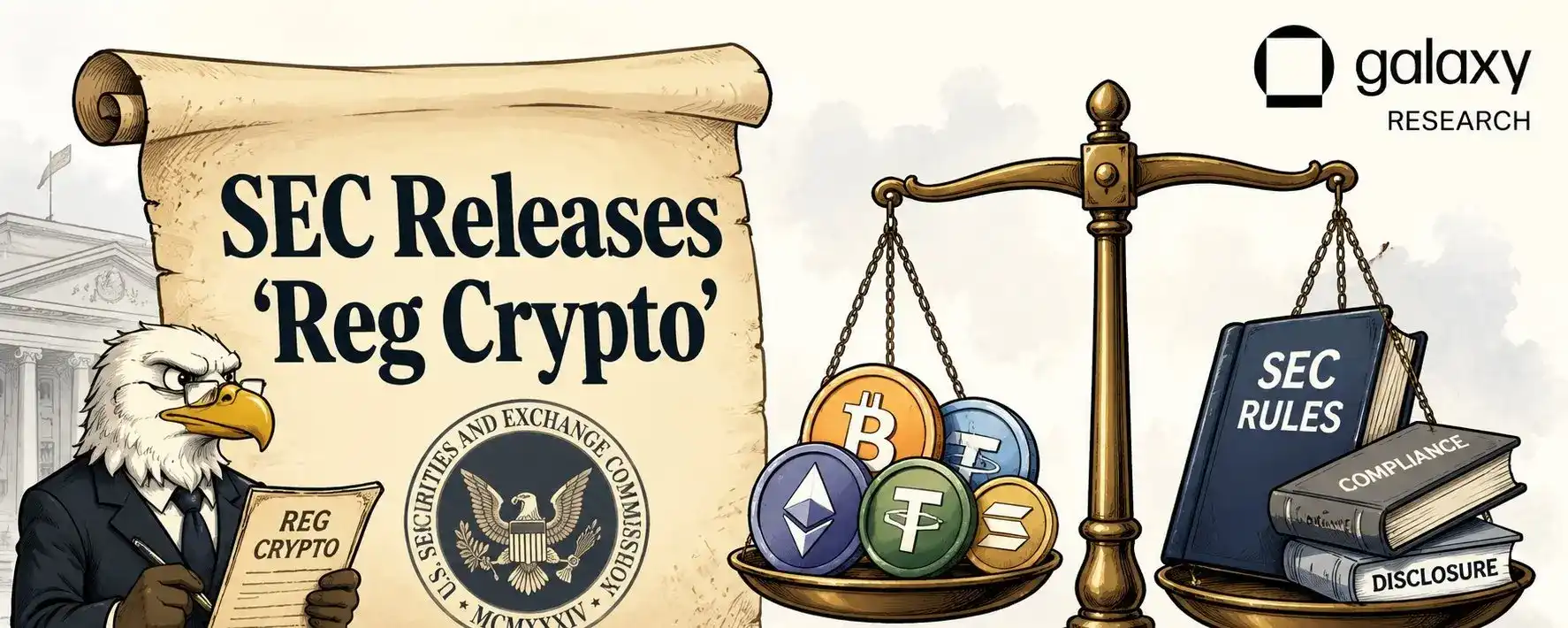
Galaxy Research: Can SEC's New Regulations Usher in a New Era for Token Financing?

**SEC Proposes New Framework for Token Offerings, Potentially Unlocking Legal Paths for U.S. Crypto Fundraising** On August 18, the U.S. Securities and Exchange Commission (SEC) proposed new rules, dubbed "Reg Crypto," specifically tailored for crypto asset offerings. This framework marks a departure from applying traditional securities rules designed for stocks to tokens. It creates a potential legal pathway for token sales to the U.S. public, including non-accredited investors, without full registration. The proposed rules apply to crypto assets that are not themselves securities but were sold as part of an investment contract where the issuer promised to build a product, network, or ecosystem. It establishes a four-phase lifecycle: Raise, Disclose, Build, and Exit. The "Raise" phase includes two new fundraising exemptions: a startup exemption allowing up to $5 million over four years and a larger, Regulation A-based exemption for up to $20 million or $75 million over 12 months. The "Disclose" phase requires specific token-related disclosures like supply schedules, governance, and development progress. After the issuer completes its promised development work and files a transition report, the "Exit" phase allows the associated investment contract to terminate, even if the token continues to trade. The analysis highlights that the framework's most immediate impact may be providing a formal "exit" path for existing tokens with unclear legal status, rather than immediately sparking a new wave of U.S.-based token offerings. It offers advantages over traditional private placements by allowing public sales and immediate token transferability but imposes ongoing disclosure and reporting obligations. A key hurdle is that the larger exemption requires a substantial U.S. operational presence, which may deter projects with offshore structures. Overall, the proposal is seen as a constructive step toward regulatory clarity, acknowledging that token offerings differ from equity offerings and require tailored investor disclosures. However, it remains a proposal subject to a 60-day public comment period, and its long-term stability may ultimately depend on congressional action.

marsbitHá 22m

Galaxy Research: Can SEC's New Regulations Usher in a New Era for Token Financing?

marsbitHá 22m

Bitcoin and Ethereum Soar Together! Eight Altcoins Worth Watching in the Later Market

Bitcoin and Ethereum Surge, Fueling Altcoin Speculation. Bitcoin Eyes $77,000, Ethereum Gains 20% in a Single Day. Market anticipates capital rotation from major cryptos to high-beta altcoins, but a selective rise is expected, favoring projects with genuine users, protocol revenue, and healthy tokenomics. Analysts highlight eight altcoins across key sectors: **High-Performance Blockchains:** * **SOL (Solana):** Market cap ~$51.88B. A dominant player with a strong ecosystem. Considered a relatively safe bet for potential catch-up growth. * **SUI (Sui):** Market cap ~$3.03B. High volatility potential but faces risks from its low circulating supply and future token unlocks. **DeFi Lending:** * **UNI (Uniswap):** Market cap ~$2.38B. Transitioning to a revenue-capturing asset post-fee switch implementation. * **AAVE (Aave):** Market cap ~$1.53B. Features balanced tokenomics and revenue but has seen significant recent gains. * **MORPHO:** Market cap ~$1.50B. Rapid protocol growth but weaker token value capture and opaque supply data. **Perpetual DEX:** * **HYPE (Hyperliquid):** Market cap ~$16.41B. The clear sector leader with strong revenue but high valuation and a large portion of tokens still locked, warranting caution. **RWA & On-Chain Finance Infrastructure:** * **LINK (Chainlink):** Market cap ~$8.09B. A key oracle provider positioned to benefit from multiple trends like RWA and institutional adoption, offering strong fundamentals. * **ONDO (Ondo Finance):** Market cap ~$1.77B. Shows strong business growth but carries high risks due to concentrated token holdings and a massive unlock scheduled for 2027. **Conclusion:** The altcoin rally is expected to be selective. Recommendations include a medium position in SOL, small allocations to SUI and UNI/AAVE for DeFi exposure, and caution with HYPE and ONDO due to their specific risks. LINK is suggested as a core holding for the RWA thematic.

marsbitHá 2h

Bitcoin and Ethereum Soar Together! Eight Altcoins Worth Watching in the Later Market

marsbitHá 2h

Shanghai's $10 Billion Unicorn Is About to Go Public

Shanghai-based automotive-grade millimeter-wave radar chip unicorn Calterah Microelectronics Technology (Shanghai) Co., Ltd. has filed for an IPO on Shanghai's STAR Market, aiming to raise 3.49 billion yuan. Founded in 2014 by Chen Jiashu, a UC Berkeley PhD graduate, and his professor Ali Niknejad, Calterah pioneered CMOS technology for 77GHz radar chips, breaking the decades-long monopoly of international giants like Texas Instruments. Its low-cost, highly integrated solutions enabled millimeter-wave radar to move from luxury to mass-market vehicles. By 2025, Calterah captured a 31.1% share in China's automotive millimeter-wave radar chip market (second domestically, fourth globally), with cumulative shipments exceeding 30 million units. Its client list includes BYD, Geely, Nio, and Volvo. The company has undergone 11 funding rounds, attracting high-profile investors such as the National Integrated Circuit Industry Investment Fund Phase II, China Capital Management, and GD Capital. Its valuation has reached tens of billions of yuan, with a projected post-IPO valuation of approximately 14 billion yuan. Despite rapid revenue growth—increasing from 206 million yuan in 2023 to 632 million yuan in 2025 with a 75.28% CAGR—Calterah remains unprofitable. It reported net losses of 323 million yuan, 334 million yuan, and 193 million yuan from 2023 to 2025, accumulating over 900 million yuan in losses over three and a half years. These losses are primarily attributed to heavy R&D investment, which totaled over 1.039 billion yuan in the reporting period, often exceeding annual revenue. The company faces significant risks, including high customer concentration (its top five customers accounted for over 99% of revenue from 2023-2025, with BYD alone representing over 50% in 2025) and supply chain concentration. Revenue pressure from key customers and dependencies on overseas suppliers for EDA tools and IP pose challenges to sustainable growth. The IPO is seen as crucial for securing capital to expand production, diversify its customer base, and reduce supply chain dependencies.

marsbitHá 3h

Shanghai's $10 Billion Unicorn Is About to Go Public

marsbitHá 3h

Ray Dalio's Latest Macro Analysis Full Text: Buy More Gold, Add Some Bitcoin

In his latest macro analysis, Ray Dalio applies his framework from "How Countries Go Broke: The Big Cycle" to the current global debt environment. He highlights recent events like Japan selling U.S. Treasuries and rising U.S. long-term yields as signs of an unsustainable debt dynamic. Dalio explains that excessive government debt leads to either unacceptably high interest rates, severe economic downturns, or significant currency debasement through central bank money printing. He summarizes the U.S. fiscal situation: with $5.5 trillion in revenue, $7.5 trillion in spending, a $2 trillion deficit, and total debt at six times annual revenue, debt servicing costs are immense. Without correction, U.S. debt could reach $55-$60 trillion in a decade. Dalio proposes a "3% Three-Way" solution: reducing the budget deficit to 3% of GDP through balanced spending cuts, tax increases, and interest rate reductions to avoid a traumatic adjustment. In response to FAQs, he argues that the risk of a U.S. debt crisis is high and could materialize within a few years if the current path continues. He dismisses the notion that the dollar's reserve status makes the U.S. immune, citing historical precedents of reserve currency declines. He is also unconvinced by Japan's high-debt stability, noting poor returns for yen-denominated assets. For investors, Dalio recommends diversifying globally, underweighting bonds, and overweighting assets like gold and a small allocation to Bitcoin (around 10-15% to gold) to hedge against currency debasement and poor debt returns.

marsbitHá 4h

Ray Dalio's Latest Macro Analysis Full Text: Buy More Gold, Add Some Bitcoin

marsbitHá 4h

Trading

Spot

Artigos em Destaque

Como comprar ADA

Bem-vindo à HTX.com!Tornámos a compra de Cardano (ADA) simples e conveniente.Segue o nosso guia passo a passo para iniciar a tua jornada no mundo das criptos.Passo 1: cria a tua conta HTXUtiliza o teu e-mail ou número de telefone para te inscreveres numa conta gratuita na HTX.Desfruta de um processo de inscrição sem complicações e desbloqueia todas as funcionalidades.Obter a minha contaPasso 2: vai para Comprar Cripto e escolhe o teu método de pagamentoCartão de crédito/débito: usa o teu visa ou mastercard para comprar Cardano (ADA) instantaneamente.Saldo: usa os fundos da tua conta HTX para transacionar sem problemas.Terceiros: adicionamos métodos de pagamento populares, como Google Pay e Apple Pay, para aumentar a conveniência.P2P: transaciona diretamente com outros utilizadores na HTX.Mercado de balcão (OTC): oferecemos serviços personalizados e taxas de câmbio competitivas para os traders.Passo 3: armazena teu Cardano (ADA)Depois de comprar o teu Cardano (ADA), armazena-o na tua conta HTX.Alternativamente, podes enviá-lo para outro lugar através de transferência blockchain ou usá-lo para transacionar outras criptomoedas.Passo 4: transaciona Cardano (ADA)Transaciona facilmente Cardano (ADA) no mercado à vista da HTX.Acede simplesmente à tua conta, seleciona o teu par de trading, executa as tuas transações e monitoriza em tempo real.Oferecemos uma experiência de fácil utilização tanto para principiantes como para traders experientes.

1.6k Visualizações TotaisPublicado em {updateTime}Atualizado em 2026.06.02

Como comprar ADA

Discussões

Bem-vindo à Comunidade HTX. Aqui, pode manter-se informado sobre os mais recentes desenvolvimentos da plataforma e obter acesso a análises profissionais de mercado. As opiniões dos utilizadores sobre o preço de ADA (ADA) são apresentadas abaixo.

活动图片