The U.S. government officially entered a shutdown at 12:01 a.m. ET, and markets, including crypto, immediately recalibrated in response to uncertainty. U.S. equity futures slipped, the dollar extended its losing streak, and gold punched to fresh records near $3,875/oz as investors sought safety.
Crypto, however, has been more balanced, as Bitcoin (BTC) hovered around $114,000–$116,000 after a two-day rebound, while Ethereum (ETH) traded near $4,300. Total digital-asset capitalization held above $4 trillion, even as altcoins posted mixed, defensive moves.
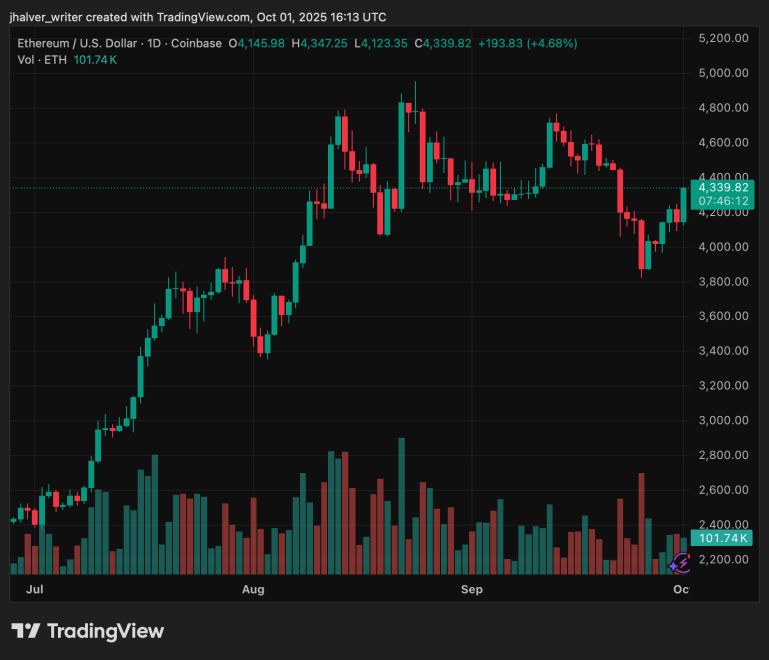
ETH's price trends to the upside on the daily chart. Source: ETHUSD on Tradingview
Options desks flagged a modest tilt toward puts, typical when macro visibility deteriorates, yet derivatives liquidations remained contained, suggesting positioning was not excessively stretched into the event.
Shutdown History Meets Uptober Seasonality
Historically, U.S. government shutdowns have delivered mixed outcomes for Bitcoin. In 2013, BTC gained around 14% during the 16-day closure, while the 35-day standoff in late 2018 coincided with a 6% decline amid a broader bear market.
Beyond those short-term swings, shutdowns have had little lasting influence compared to Bitcoin’s broader cycle trends. What matters more now is seasonality, as Q4 has traditionally been one of Bitcoin’s strongest periods, with “Uptober” often marking the start of double-digit gains.
That pattern keeps dip-buyers alert, suggesting sentiment may lean bullish if price confirms above resistance instead of reacting solely to political headlines.
Data blackout and thinner regulators: Why Volatility Could Rise
A shutdown delays key economic releases like jobs reports, CPI, and PPI, which deprives the market of the data it uses to gauge the Fed’s future actions.
When these reports are delayed, implied volatility often increases because traders need to account for a wider range of possible outcomes. For crypto, this uncertainty is worsened by limited staff at agencies like the SEC and CFTC, which may slow down ETF reviews and other rulemaking processes.
Many issuers and traders had aimed for early to mid-October for potential spot-altcoin ETF milestones, but those timelines might slip if staffing and approval delays continue, reducing one of the quarter’s most anticipated catalysts. Still, macro trends aren’t always straightforward.
A weaker dollar, already on track for its worst year in decades, can support risk assets, and a potential Fed pause in the near term could reduce yield-related headwinds. In short, path dependency dominates, meaning the longer the shutdown and data blackout last, the more unpredictable the market becomes.
Cover image from ChatGPT, ETHUSD chart from Tradingview

Related Posts