7 XRP ETFs Draw Close To Their Decision Deadlines With The SEC – Here Are The Dates

bitcoinistPublicado em 2025-09-30Última atualização em 2025-09-30

Resumo

The race to launch XRP ETFs in the US is reaching a critical stage, with several issuers awaiting final decisions...

Trusted Editorial content, reviewed by leading industry experts and seasoned editors. Ad Disclosure

The race to launch XRP ETFs in the US is reaching a critical stage, with several issuers awaiting final decisions from the Securities and Exchange Commission (SEC). Multiple applications, filed by some of the world’s largest asset managers, are already approaching strict approval deadlines in October. 

SEC Faces Wave Of XRP ETF Deadlines In October

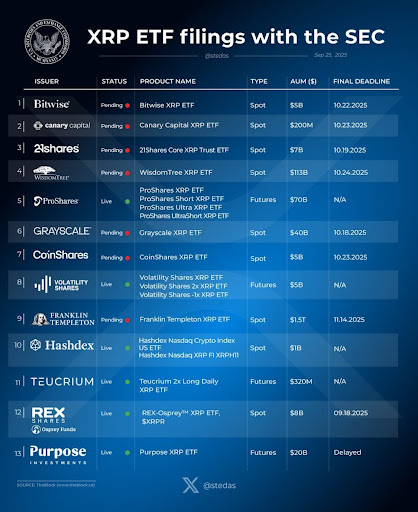
According to a recent update from crypto analyst Stedas, seven XRP ETF applications are now pending with the US SEC. These filings represent a mix of major institutional players and crypto-focused firms, all seeking to secure a first-mover advantage in what could be one of the most competitive markets for digital asset ETFs. 

The earliest deadline falls on October 18, when the SEC must issue a decision on Grayscale’s XRP ETF application, which seeks to leverage the firm’s $40 billion Assets Under Management (AUM). Just a day later, 21Shares will face its own deadline on October 19, with a proposal for its Core XRP Trust ETF backed by $7 billion AUM. Bitwise, another well-known crypto asset manager, will follow on October 20 with its ETF filing and a $5 billion AUM.

CoinShares is expected to enter the spotlight on October 23, with its $5 billion product pending SEC judgement. On the same day, Canary Capital, a smaller but equally ambitious issuer with $200 million in AUM, will also face a final ruling. WisdomTree, with an eye-watering $113 billion AUM, rounds out the October deadlines on October 24, as the SEC decides the fate of its proposed XRP ETF. 
XRP
Source: Chart from Stedas on X

Notably, Franklin Templeton, which oversees approximately $1.5 trillion in assets, will not face its deadline until November 14, giving the firm slightly more runway than its October competitors. Collectively, these ETF applications highlight the broader institutional demand for XRP-based investment vehicles. 

Although REX-Shares and Osprey Funds were the first to launch an XRP ETF in the US, they did so in a collective bundle with the Dogecoin ETF. Furthermore, future-based products from companies such as ProShares, Volatility Shares, and Purpose Investments, among other issuers, are already live. 

Could A US Government Shutdown Affect The Funds Decision Dates?

While October promises to be a decisive month for the funds, concerns have been raised over whether a potential US government shutdown could disrupt the timeline of these products. Funding for the US government is set to expire at the end of Tuesday, September 30, unless an agreement is reached between Republicans and Democrats on a new spending bill. If no deal is signed, the country will enter its first government shutdown in almost seven years. 

The US SEC, as a federal agency, would not be immune to a potential government shutdown. While no official reports have confirmed whether a shutdown would impact the regulator’s ability to decide on XRP ETFs in October, the SEC’s Operations Plan, dated August 7, indicates that such an event would leave it running on a skeletal staff. This would severely restrict its capacity to review corporate filings, investigate misconduct, and oversee markets.

XRP
XRP trading at $2.87 on the 1D chart | Source: XRPUSDT on Tradingview.com
Featured image from Getty Images, chart from Tradingview.com
Editorial Process for bitcoinist is centered on delivering thoroughly researched, accurate, and unbiased content. We uphold strict sourcing standards, and each page undergoes diligent review by our team of top technology experts and seasoned editors. This process ensures the integrity, relevance, and value of our content for our readers.

Scott Matherson is a leading crypto writer at Bitcoinist, who possesses a sharp analytical mind and a deep understanding of the digital currency landscape. Scott has earned a reputation for delivering thought-provoking and well-researched articles that resonate with both newcomers and seasoned crypto enthusiasts. Outside of his writing, Scott is passionate about promoting crypto literacy and often works to educate the public on the potential of blockchain.

Leituras Relacionadas

MiCA is coming for DeFi vaults, but regulation will be difficult

The European Commission is exploring whether to extend the Markets in Crypto-Assets (MiCA) regulation to cover decentralized finance (DeFi) lending and borrowing, including lending vaults. These vaults, which channel billions into on-chain credit markets, present significant regulatory challenges because their decentralized structure doesn't map neatly onto existing financial frameworks. Their legal status is currently based on non-binding interpretations that they fall outside MiCA and EU fund rules. The article uses Morpho's decentralized lending protocol as an example, illustrating how responsibilities are divided among various participants (owner, curator, allocator, sentinel), making it difficult to identify a single "provider" to regulate. Experts warn that broadly categorizing "DeFi lending" could inadvertently capture vastly different structures. They argue that any regulatory approach should focus on the specific structure and control mechanisms of a vault, rather than using decentralization as a simple dividing line, and that DeFi lending may require a dedicated, carefully crafted framework distinct from traditional finance. The Commission's consultation closes on September 30, 2026. The core challenge for regulators is not just whether to regulate DeFi lending, but how to design rules that distinguish between different forms of on-chain lending and the entities that control them.

cointelegraphHá 56m

MiCA is coming for DeFi vaults, but regulation will be difficult

cointelegraphHá 56m

Grayscale Report: Financial Privacy in the AI Era, Why Zcash Should Not Be Overlooked?

Title: Grayscale Report: Financial Privacy in the AI Era – Why Zcash Should Not Be Overlooked The article argues that privacy is a fundamental, not niche, attribute of functional money. It highlights that technological shifts, like the rise of AI and stablecoins, are driving a new wave of public focus on financial privacy. Zcash, a decentralized digital currency similar to Bitcoin but with built-in privacy via zero-knowledge proofs, is positioned to address this need. Unlike transparent blockchains, Zcash offers users the option to conduct "shielded" transactions that hide sender, receiver, and amount while remaining verifiable. The report details Zcash's evolution, noting key upgrades that improved usability and security. It points to rising on-chain usage of privacy features as evidence of real demand. Currently, ZEC holds a minimal share (~0.4%) of the total crypto market cap. Grayscale suggests this reflects a market assumption that privacy is a marginal concern. The investment thesis hinges on a potential market re-evaluation: if privacy is recognized as a core monetary feature in an era of enhanced surveillance, Zcash's current valuation represents significant upside potential. Key risks discussed include regulatory challenges, historical trusted setup concerns for older pools (mitigated by newer protocols), quantum computing threats, and execution risks associated with future technical upgrades. The conclusion is that while the future scale of private digital currency is uncertain, the market currently prices in little chance of its value increasing substantially, presenting a potential opportunity for investors.

marsbitHá 3h

Grayscale Report: Financial Privacy in the AI Era, Why Zcash Should Not Be Overlooked?

marsbitHá 3h

Trading

Spot
活动图片