Wisconsin lawmakers have introduced a proposal that could reshape how cryptocurrency businesses are treated under state law. The measure, Assembly Bill 471, aims to exempt a wide range of digital asset activities from money transmitter licensing requirements.
The proposal has been referred to the Committee on Financial Institutions and is backed by several Republican legislators.
Bill Targets Mining, Staking And Wallet Use
Based on reports, the Wisconsin Legislative Reference Bureau outlines clear exemptions for crypto-related work that usually falls into regulatory gray zones.
Mining, staking, and operating blockchain nodes are among the activities that would not require a money transmitter license. Developers creating blockchain software or tools are also included in the exemptions.
The bill goes further by stating that individuals can keep custody of their own coins, whether through hardware wallets or self-hosted digital wallets, without state interference.
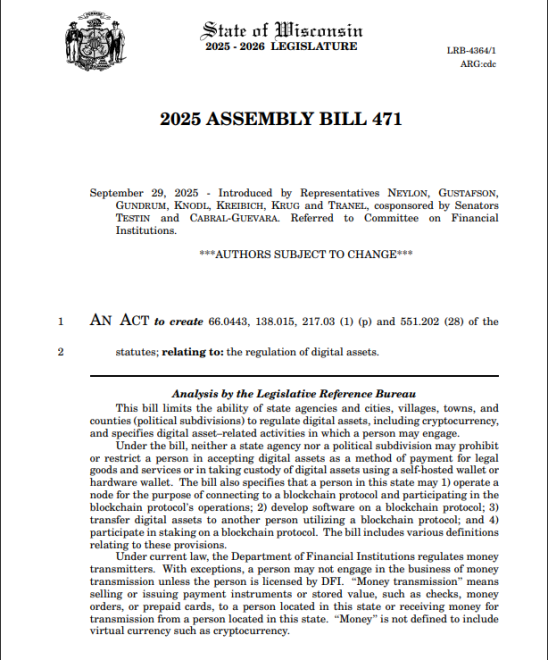
It also seeks to prevent local governments from banning the use of digital assets in payments for lawful goods or services, as long as the transaction doesn’t involve conversion to US dollars or bank deposits.
This distinction matters. While businesses may be free to accept tokens directly, the bill does not cover cases where cryptocurrency is exchanged into legal tender.
That boundary keeps traditional regulatory requirements intact for fiat conversions and custodial services tied to banks.
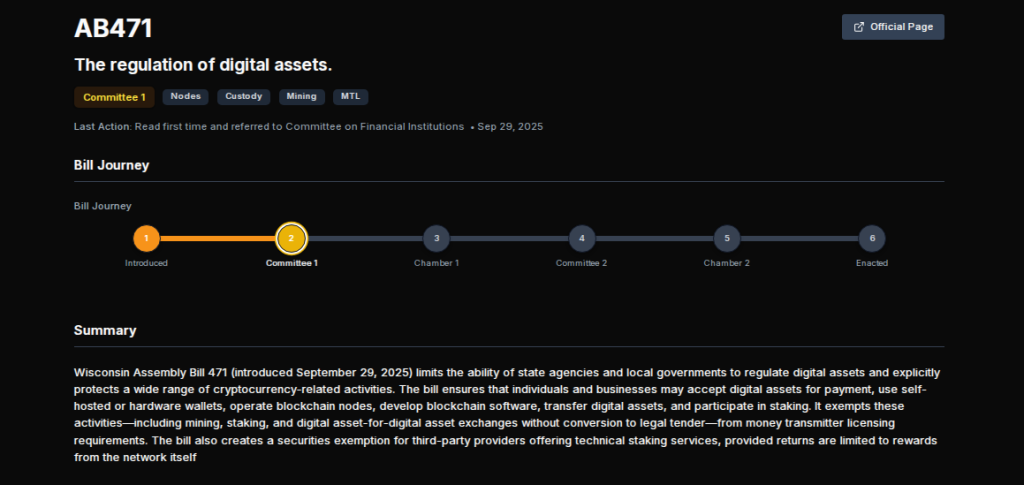
The status of AB471 Bill. Source: Bitcoin Laws
Another Bill Targets Crypto Kiosks
While Assembly Bill 471 attempts to carve out freedom for certain digital asset activities, another measure, Senate Bill 386, pushes in a different direction.
SB 386 would require anyone operating a virtual currency kiosk in Wisconsin to obtain a license. These kiosks, often compared to ATMs, allow users to swap cash for cryptocurrency and vice versa.
Thus, in a nutshell, two separate paths are being pursued in the state legislature: one expanding exemptions for miners, developers, and users, and the other providing more regulation to business involved in providing direct fiat-to-crypto services.
This distinction shows what a route policymakers are taking with supporting innovation while still having consumer protections. There are still questions of who would be covered and the actual effect of the changes.
BTCUSD trading at $113,725 on the 24-hour chart: TradingView
Bill Advocates Upbeat
The proponents of the exemption bill are optimistic it will secure Wisconsin’s advantage as a center for blockchain developers and firms that are exploring careers in blockchain development, smart contracts, research, etc., and who want fewer burdensome regulations to work with.
By protecting users who merely operate nodes, stake coins, or have tokens stored in private wallets, the state would be more friendly to mainstream users too.
But there are open questions. Federal regulators such as the Securities and Exchange Commission and the Financial Crimes Enforcement Network may still claim oversight in areas the state bill does not touch.
Ambiguities in the language, such as how “conversion to legal tender” is defined, could spark disputes later.
Featured image from Northwest Wisconsin, chart from TradingView

Related Posts