Pump.fun’s 2-week high looks impressive – UNTIL you see what’s really happening

ambcryptoPublicado em 2025-09-29Última atualização em 2025-09-29

Key Takeaways

What fueled Pump.fun’s 13% rally?

Perpetual traders added $56 million in Open Interest, while Spot buyers accumulated $2.94 million.

Why could PUMP’s surge fade soon?

Protocol revenue plunged 72% to $945K, Fees dropped to $1.82 million, token graduations fell from 286 to 70, and Daily Active Users dropped under 86,000.


Pump.fun [PUMP] recorded a major liquidity surge in the past day, with price climbing more than 13% from its previous daily candle close.

Market data showed mixed sentiment, as revenue and fees slipped to their lowest levels in two weeks. This gap between rising prices and falling usage left questions about the rally’s durability.

AMBCrypto analysis provides more context on what this could imply for PUMP.

Where did PUMP’s surge come from?

The recent rally in PUMP was driven largely by investors in the Perpetuals market, who poured more liquidity into the memecoin.

In fact, analysis showed that inflows in the Derivatives market amounted to $56 million, based on recent percentage changes in Open Interest.

The surge also coincided with the Open Interest-Weighted Funding Rate holding in the positive zone. This indicated that long contracts were dominating the market and providing most of the liquidity.

PUMP open interest chartPUMP open interest chart

Source: CoinGlass

Spot investors also joined in, though to a lesser extent. This group accumulated $2.94 million worth of PUMP—their first notable accumulation since the 25th of September, when they added $3.52 million.

This buying activity across Spot and Perpetuals may be speculative, given that on-chain data showed falling usage and revenue.

Revenue falls—Is this a warning?

Sentiment around PUMP has weakened. At the time of writing, Revenue and Fees generated on the protocol dropped to a two-week low.

Revenue fell from $3.38 million to $945,960 at press time, while fees declined more sharply, from $8.52 million to $1.82 million during the same period.

PUMP fees and revenue chart.PUMP fees and revenue chart.

Source: DeFiLama

That steep decline suggested weaker activity on Pumpfun and PumpSwap. It pointed to lower demand for the asset across on-chain users.

On top of that, active investors had not reached past milestones set in previous months.

Milestones become harder to reach

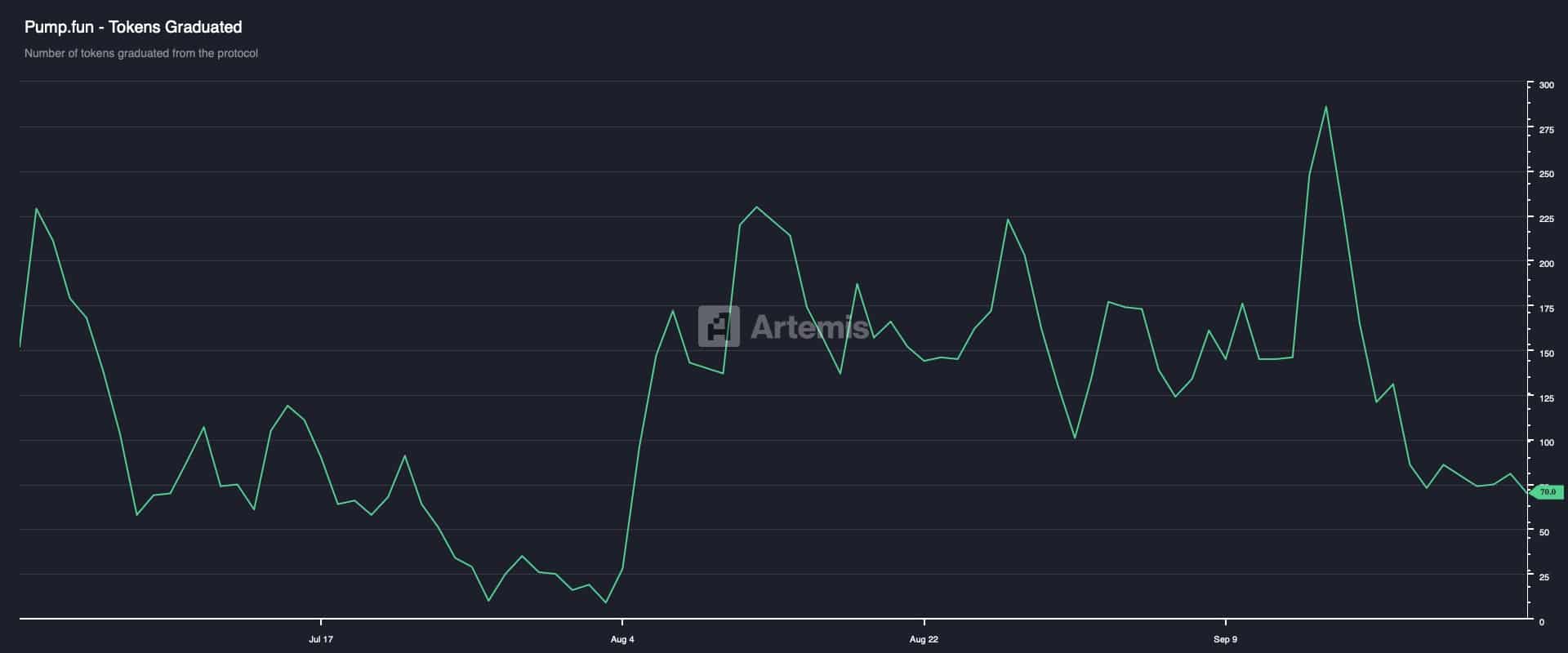
According to Artemis, both “Tokens Graduated” and “Token Minted” metrics on the Pump.fun protocol fell to monthly lows, signaling waning user interest and purchasing power.

Tokens Graduated —those that reached a $100,000 market capitalization—dropped sharply from 286 to just 70 at press time.
Pump.fun - Tokens GraduatedPump.fun - Tokens Graduated

Source: Artemis

Similarly, minted coins, referring to meme tokens created on the platform, fell to 13,700 within the same period. This decline suggested that reduced investor interest is discouraging creators from launching new tokens.

The launchpad’s Daily Active Users also plummeted, hitting a recent low of 85,700, further confirming fading activity in the market.

Share

Leituras Relacionadas

Beyond the 'Kimchi Premium': Institutional Transformation in Korea

South Korea's crypto landscape is moving beyond the volatile "Kimchi Premium" era driven by retail speculation, according to Andrew Park, CEO of Factblock. Park, who organizes Korea Blockchain Week, notes a significant shift in the nature of international inquiries. Global institutions are now focusing on market access, asset custody, tokenization, stablecoins, and regulatory compliance, rather than just token listings and prices. This institutionalization is being built through foundational, "unsexy" back-office work: developing corporate crypto accounts, legal finality for settlements, accounting standards, and custody solutions. Key regulatory steps include the Financial Services Commission's framework for corporate virtual asset accounts and National Assembly amendments to laws governing tokenized securities and real-world assets. Park, with a traditional finance background, bridges the perspectives of Wall Street and Web3. He explains that traditional banks prioritize managing edge-case failures and regulatory reporting, which crypto-native firms sometimes misunderstand. Conversely, traditional financiers often overlook blockchain's systemic utility for 24/7 global settlement and programmable money. Looking ahead, Park sees South Korea's next frontier at the intersection of AI and programmable blockchain infrastructure. He is particularly interested in the infrastructure needed for a "machine-to-machine" economy, where AI agents could autonomously conduct micropayments and transactions using on-chain settlement mechanisms—a concept already being explored in pilot projects by the Bank of Korea. With its advanced digital infrastructure and investments in both Web3 and AI, South Korea is uniquely positioned to develop this future.

cryptonews.ruHá 5m

Beyond the 'Kimchi Premium': Institutional Transformation in Korea

cryptonews.ruHá 5m

Telegram Introduces WEB-Proxy Technology: Traffic Camouflaged as Regular Website Visits

Telegram has introduced an experimental WEB-proxy technology, unveiled on August 21, 2026, designed to bypass blocking by disguising messenger traffic as regular, encrypted website visits. This new method in Telegram Desktop routes MTProxy data through a WebView transport using HTTPS or WebSocket, making the data stream indistinguishable from legitimate web browsing and offering a new avenue for accessing the service under restrictions. The core innovation is a multiplexed stream sent through the app's built-in browser engine. It maintains MTProxy's encryption but sends all data via a single WebView session. Special frame types (OPEN, DATA, WINDOW, CLOSE) package multiple Telegram connections into one secure channel that appears as a standard webpage load. A server-side relay receives this stream, separates it into individual connections for the MTProxy without decrypting content or knowing final destinations, preserving privacy. The WEB-proxy operates on a regular HTTPS domain that simultaneously hosts a public website. The proxy bridge page activates only with a specific parameter derived from the configuration; all other requests receive the standard homepage, providing reliable cover. Connection links use formats like https://t.me/webproxy?server=... or tg://webproxy, with port 443 and HTTPS being mandatory. Currently a proof-of-concept, the project includes a desktop implementation, an experimental Android client, and plans for iOS support. It represents a shift towards more sophisticated integration with legitimate web infrastructure, leveraging standard browser mechanisms to complicate traffic filtering. The practical value will depend on its resilience to adaptive traffic analysis and scalability. This approach structurally echoes earlier techniques like domain fronting, highlighting the cyclical nature of the struggle between censorship and circumvention technologies.

cryptonews.ruHá 22m

Telegram Introduces WEB-Proxy Technology: Traffic Camouflaged as Regular Website Visits

cryptonews.ruHá 22m

Trading

Spot
活动图片