Are Ethereum Treasuries’ Reserves Slowing Down? Here’s How Much Has Been Acquired In September

bitcoinistPublicado em 2025-09-29Última atualização em 2025-09-29

Resumo

Cryptocurrency-based treasury reserves have become a highly adopted initiative in the sector, with Ethereum and Bitcoin leading the charge. Even...

Trusted Editorial content, reviewed by leading industry experts and seasoned editors. Ad Disclosure

Cryptocurrency-based treasury reserves have become a highly adopted initiative in the sector, with Ethereum and Bitcoin leading the charge. Even though the initiative kicked off with Bitcoin, Ethereum treasury reserves have witnessed exponential growth as accumulation grows among large companies in the past few months.

Institutional Ethereum Adoption Still Growing

Amid the new wave of crypto adoption in the financial landscape, Ethereum’s role as a premier institutional asset is gaining traction, with treasury reserves holding ETH expanding at a rapid pace. In recent months, corporate and cryptocurrency-native treasuries have both increased their holdings, indicating a growing conviction in Ethereum’s long-term value and utility.

However, Ted Pillows, a crypto enthusiast and investor, has reported a cooling down in ETH accumulation among treasury companies in September. Such a development hints at a potential pause in the accumulation trend.

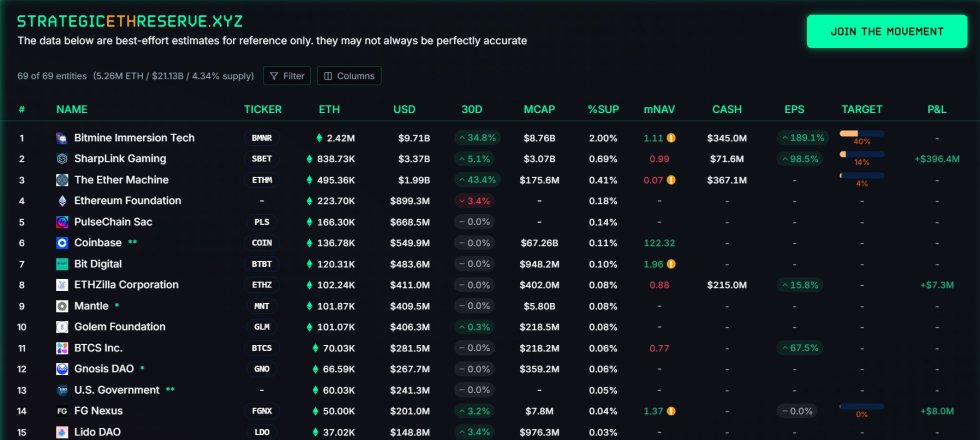
Following months of aggressive ETH allocations, this cooling trend raises the question of whether treasuries are taking a break or waiting for the market to reevaluate. Data shared by Ted shows that companies have acquired over 816,000 ETH in the month alone. While it may seem like a large quantity, this is a 50% decline when compared to August’s accumulation.
Ethereum
ETH holdings held by treasury companies | Source: Chart from Ted Pillows on X

This drop in half marks one of the steepest month-to-month pullbacks of this year. Despite the pullback in institutional accumulation, Ethereum treasury reserves remain elevated, with over 5 million ETH held in total by companies.

According to the expert, there are now 5,255,246 ETH held by treasury reserve corporations, signaling growing confidence in Ethereum’s long-term value and utility. With these enormous holdings, ETH is positioned as a key component of treasury diversification strategies across the globe, highlighting not only its growing reputation as a store of value but also its pivotal role in decentralized finance and staking economies.

ETH Being Hailed As The Asset To Drive The Next Business Strategy

Forbes has proclaimed that the ETH treasuries could be the next big business strategy in the financial sector. What was once seen as a high-risk experiment is now being reconsidered as a forward-looking business strategy, with business and investors exploring ETH holdings as a hedge and a growth engine.

The firm’s bold statement is driven by its belief that ETH treasuries are yield-bearing assets, unlike Bitcoin, which typically sits idle on corporate balance sheets. Furthermore, Forbes stated that the statement is not from a speculative view because ETH is balance sheet engineering. By staking or lending ETH, treasury funds can lower circulating liquidity and generate new revenue streams.

At the time of writing, ETH’s price was trading back above $4,100, demonstrating a nearly 3% increase in the last 24 hours. Bullish sentiment is gradually returning to the market, as evidenced by an increase in its trading volume. Data from CoinMarketCap shows that the trading volume has spiked by more than 50% in the last day.

Ethereum
ETH trading at $4,110 on the 1D chart | Source: ETHUSDT on Tradingview.com
Featured image from iStock, chart from Tradingview.com
Editorial Process for bitcoinist is centered on delivering thoroughly researched, accurate, and unbiased content. We uphold strict sourcing standards, and each page undergoes diligent review by our team of top technology experts and seasoned editors. This process ensures the integrity, relevance, and value of our content for our readers.

Godspower Owie is my name, and I work for the news platforms NewsBTC and Bitcoinist. I sometimes like to think of myself as an explorer since I enjoy exploring new places, learning new things, especially valuable ones, and meeting new people who have an impact on my life, no matter how small. I value my family, friends, career, and time. Really, those are most likely the most significant aspects of every person's existence. Not illusions, but dreams are what I pursue.

Leituras Relacionadas

Major Altcoin Market Players Did This During the Massive Rally!

As the cryptocurrency bull market intensifies, large-scale transactions by crypto 'whales' are drawing significant attention. Blockchain data reveals multi-million dollar positions opened and closed in Bitcoin ($BTC), Ethereum ($ETH), and Hyperliquid ($HYPE). A major investor, likely tied to Matrixport, closed a 40,000 $ETH long position worth ~$100.5M for a $9.9M profit. The investor still holds 80,000 $ETH (~$201M) and 500 $BTC (~$39M), with an unrealized profit of ~$22.9M. This turned their previous $92.5M total loss into an approximate $32.8M overall profit. On Hyperliquid, a trader known as loracle.hl reportedly lost over $70M trading $HYPE in the past three months. The investor currently holds ~$54.88M in $HYPE short positions, at risk of liquidation if $HYPE's price reaches $101.15. Notorious trader Machi Big Brother, who reportedly survived 500 liquidations, capitalized on the recent rally. He grew his portfolio from $152K to $12.72M in just three days, yielding over $12.5M in profit. While $HYPE hits a new all-time high, Multicoin Capital has deposited 427,422 $HYPE (~$31.74M) to Coinbase Prime over three days, raising speculation about a potential sale or portfolio rebalance. In Bitcoin markets, an anonymous whale stands out, selling ~2,700 $BTC (~$211.8M) in a recent transaction. Over three days, this whale sold a total of 7,700 $BTC, valued at approximately $576.6M.

cryptonews.ruHá 23m

Major Altcoin Market Players Did This During the Massive Rally!

cryptonews.ruHá 23m

Goldman Sachs' Summary After Silicon Valley Investigation: Agents Enter the Execution Era, AI Competition Shifts to Workflows, World Models Rise

Based on a recent field research in Silicon Valley, Goldman Sachs highlights a key shift in the AI industry: moving from systems that "answer questions" to autonomous AI agents that "execute tasks." Commercial models are transitioning from per-seat subscriptions to usage- and outcome-based pricing. The competition is shifting from raw model capability to mastery over specific business workflows, with value accruing to proprietary data, domain context, and operational expertise. A major hurdle for enterprise Agent deployment is not technical ability but "controllability"—issues of accountability, auditability, and error correction, especially in regulated fields. Workflows with clear rules, verifiable outcomes, and reversible actions (e.g., invoice processing) are being automated first. The model landscape is evolving toward a division of labor. Frontier models (like GPT-4) are expected to handle high-value, high-reliability core tasks, while improving open-source models will likely capture the majority (~90%) of inference tokens for standardized, high-volume tasks due to cost advantages. Finally, attention is moving from Large Language Models (LLMs) to "World Models," which understand physical environments, causality, and dynamic interactions. This shift elevates the importance of proprietary, real-world data (from industrial, scientific, and robotic systems) and could drive a second wave of compute demand. Goldman Sachs projects compute needs could grow ~24x over five years, benefiting cloud and infrastructure providers.

marsbitHá 1h

Goldman Sachs' Summary After Silicon Valley Investigation: Agents Enter the Execution Era, AI Competition Shifts to Workflows, World Models Rise

marsbitHá 1h

Fidelity Warns: The Boom in AI Agents May Not Be a Feast for Public Blockchains

Fidelity Digital Assets cautions that the anticipated boom in AI agents does not automatically guarantee a corresponding surge in public blockchain adoption or token value. While AI agents that can autonomously perform tasks like payments and data calls could theoretically utilize blockchain for settlement, a significant gap exists between "can use" and "must use." The analysis highlights six key risks. First, many AI agents, especially in corporate settings, may prefer closed, permissioned systems over public blockchains due to needs for speed, cost, compliance, and control. Second, increased on-chain transactions from AI-driven micropayments may not benefit native tokens if fees remain low or if value is captured by stablecoins and payment service providers instead. Third, while AI lowers development costs and increases the number of projects, more code does not equal more economic value and can lead to market oversaturation. Fourth, AI commoditizes coding, making pure technological advantage less of a sustainable moat; competition may shift to brand, liquidity, and user networks. Fifth, AI can also lower the cost of attacks by making vulnerability discovery easier, potentially outpacing security auditing and increasing ecosystem risk. Sixth, institutions may require "controlled blockchain" systems with robust identity, permissioning, and audit trails, conflicting with the permissionless nature of public chains. Ultimately, Fidelity argues against simply equating AI growth with blockchain prosperity. The narrative requires moving from speculation to a concrete analysis of which infrastructures can convert real AI agent needs into sustainable economic value, critically examining each step of the assumed value chain.

marsbitHá 1h

Fidelity Warns: The Boom in AI Agents May Not Be a Feast for Public Blockchains

marsbitHá 1h

Telegram Introduces WEB-Proxy Technology: Masks Traffic as Regular Website Visits

Telegram has introduced a new experimental WEB-Proxy technology designed to circumvent blocking by disguising messenger traffic as regular, secure website visits. Announced on August 21, 2026, the technology routes MTProxy data through an in-app WebView using HTTPS or WebSocket transport, making the data stream indistinguishable from legitimate web surfing. The core innovation is a multiplexed stream sent through a single WebView session. It uses special frame formats to pack multiple logical Telegram connections into one encrypted channel that externally resembles loading a web page. A server-side relay receives this stream, separates it into individual connections for the standard MTProxy, without decrypting content or knowing final destinations, thus preserving privacy. The WEB-Proxy operates on a standard HTTPS domain that also hosts a public website. The proxy bridge page is only activated by a specific URL parameter derived via HMAC-SHA256 from the proxy configuration; all other requests receive the normal site homepage. This provides reliable cover against automated detection systems. Currently a proof-of-concept, the system includes a desktop implementation, an experimental Android client, and plans for iOS support. The technology represents a shift towards more sophisticated integration with legitimate web infrastructure, complicating filtering systems that must choose between blocking HTTPS traffic entirely or allowing service access. Its long-term value will depend on resilience to adaptive traffic analysis and scalability without performance loss.

cryptonews.ruHá 1h

Telegram Introduces WEB-Proxy Technology: Masks Traffic as Regular Website Visits

cryptonews.ruHá 1h

Trading

Spot
活动图片