加密财库 vs SEC:叙事还能撑多久?

比推Publicado em 2025-09-29Última atualização em 2025-09-29

原文来源:区块律动 BlockBeats

原文标题:美SEC开始下手,加密财库叙事还能继续吗?


9 月 24 日,美国证券交易委员会(SEC)与金融业监管局(Finra)联合宣布,将对 200 余家曾宣布加密财库计划的上市公司展开调查,理由是这些公司在发布相关消息前夕普遍出现了「异常股价波动」。

自 MicroStrategy 率先将比特币纳入资产负债表以来,「加密财库」(Crypto Treasury)成为美股市场一项轰动性的「金融炼金术」——Bitmine、SharpLink 等新贵股价曾因类似操作暴涨数十倍。根据 Architect Partners 发布的数据,2025 年以来已有 212 家新公司 宣布将筹集约 1020 亿美元 用于购买 BTC、ETH 等主流加密资产。

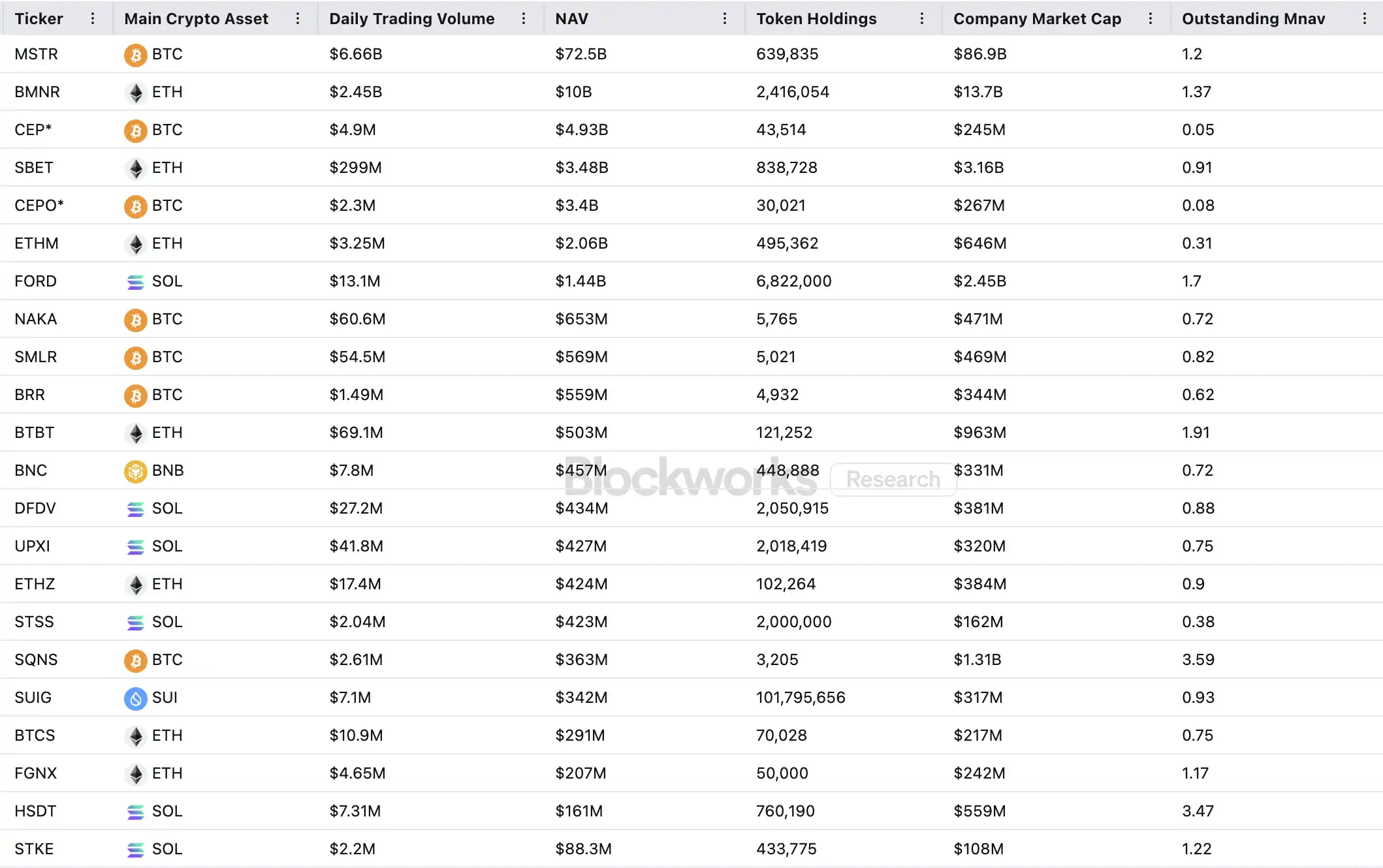
然而,这场资本狂欢在推高价格的同时,也引发了广泛质疑。MSTR 的 mNAV(市值与账面资产净值之比)一个月内从 1.6 跌至 1.2,而前二十家加密财库公司的 mNAV 更有三分之二低于 1。有关资产泡沫、内幕交易等质疑声层出不穷,当下这一新型资产配置潮流正面临前所未有的监管挑战。
加密财库公司的飞轮是如何运转的

财库公司的融资飞轮建立在 mNAV 机制上,其本质是一种反身性的飞轮逻辑,让财库公司在牛市里拥有看似「无限子弹」的能力。mNAV 指的是市场净资产价值比,计算方式是企业市值(P)相对于其每股净资产(NAV)的倍数。在财库策略公司语境下,NAV 则指的是其所持有的数字资产价值。

当股价 P 高于每股净资产 NAV(即 mNAV > 1)时,公司就能持续募资,把募集资金再投入数字资产。每次增发买入都会推高每股持仓和账面价值,从而进一步强化市场对公司叙事的信心,推动股价走高。于是,一个闭环的正反馈飞轮开始转动:mNAV 上行 → 增发融资 → 买入数字资产 → 每股持仓增厚 → 市场信心增强 → 股价再升。正是凭借这种机制,MicroStrategy 能够在过去几年中能够持续融资买入比特币而不严重稀释股份。

一旦股价和流动性被推到足够高,公司就能解锁一整套机构资金的入场机制:可以发行债务、可转债、优先股等融资工具,把市场上的叙事变现为账面上的资产,再反过来推高股价,形成飞轮。这场游戏的本质,是股价、故事与资本结构之间的复杂共振。

然而,mNAV 是一把双刃剑。溢价可以代表市场的高度信任,也可能仅仅是投机炒作。一旦 mNAV 收敛到 1 或跌破 1,市场从「增厚逻辑」切换为「稀释逻辑」。如果此时代币本身价格下跌,飞轮就会从正向转动转为负反馈循环,造成市值和信心的双杀。此外,财库策略公司的融资也建立在 mNAV 的溢价飞轮上,当 mNAV 长期处于折价状态,增发空间将被封锁,本就处于业务停滞或濒临退市的中小盘壳公司的业务将被全部推翻,建立的飞轮效应也将瞬间崩塌。理论上,当 mNAV < 1 时,公司更合理的选择是卖出持仓回购股票,以恢复平衡,但也不应以偏概全,折价公司也可能代表价值被低估。

在 2022 年熊市里,即便 MicroStrategy 的 mNAV 一度跌破 1,公司也没有选择卖币回购,而是通过债务重组坚持保留所有比特币。这种「死守」的逻辑来自于 Saylor 对 BTC 的信仰式愿景,将其视为「永远不会卖出」的核心抵押资产。但这种路径并非所有财库公司都能复制。大多数山寨币财库股本身缺乏稳定的主营业务,转型为「买币公司」只是生存手段,并没有信仰加持。一旦市场环境恶化,它们更可能为了止损或兑现利润而抛售,从而引发踩踏。

内幕交易是否存在

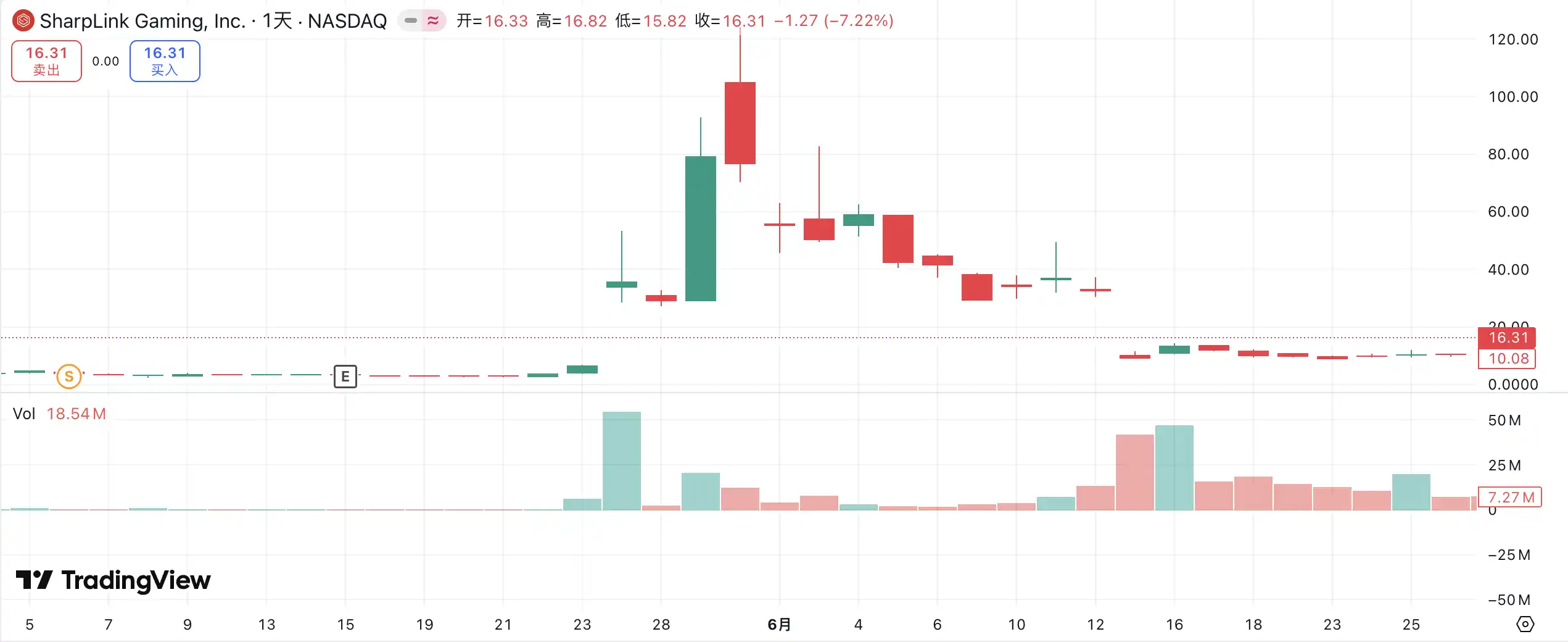
SharpLink Gaming 是这轮「加密财库热潮」中最早引发市场震动的案例之一。5 月 27 日,公司宣布将增持高达 4.25 亿美元的以太坊作为储备资产,消息公布当日,股价一度飙升至 52 美元。然而诡异的是,早在 5 月 22 日,该股的交易量就已显著放大,股价从 2.7 美元跃升至 7 美元,而彼时公司尚未发布公告,也未向 SEC 披露任何信息。
这种「消息未发、股价先行」的现象并非孤例。MEI Pharma 在 7 月 18 日宣布启动 1 亿美元莱特币财库策略,但在消息发布前连续四天上涨,股价从 2.7 美元涨至 4.4 美元,接近翻倍。公司并未提交重大更新,也未公开新闻稿,其发言人则拒绝对此置评。
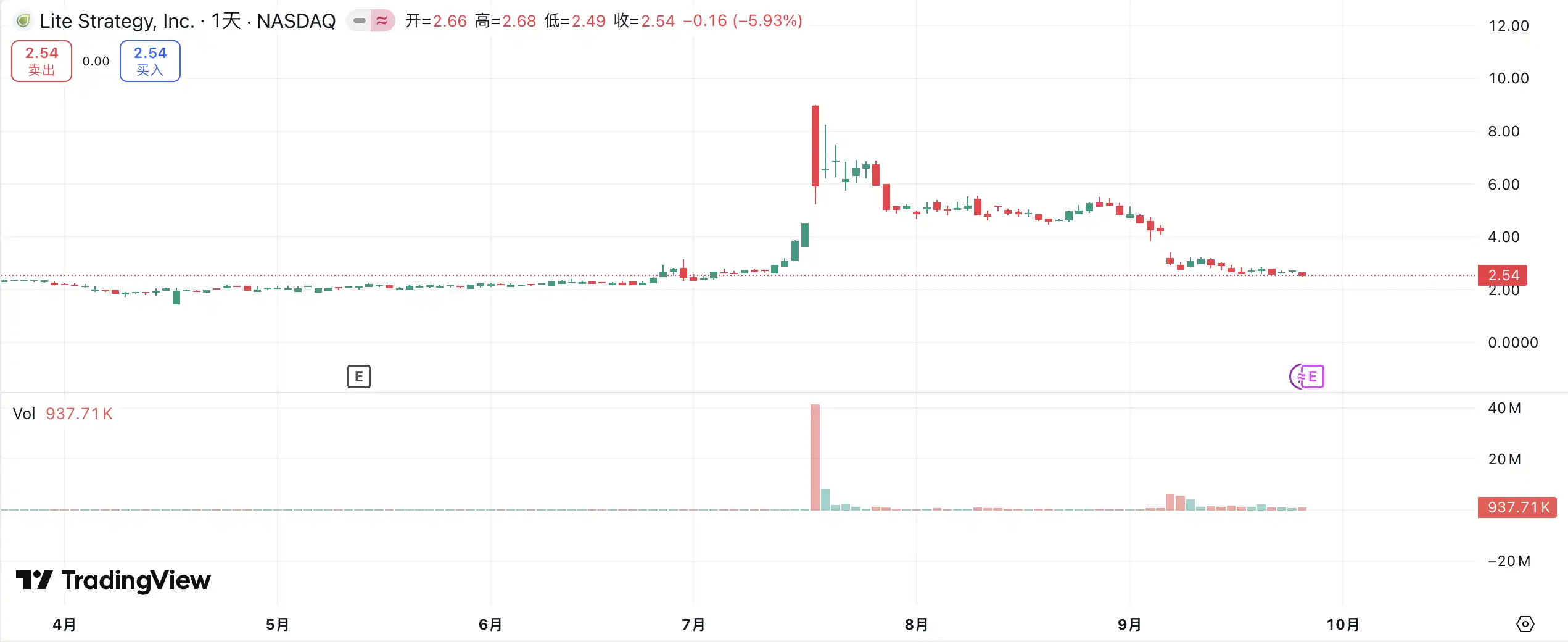
类似情况还出现在 Mill City Ventures、Kindly MD、Empery Digital、Fundamental Global 和 180 Life Sciences Corp 等公司中,均在发布加密财库计划前出现不同程度的异常交易波动。是否存在信息泄露与提前交易,已引起监管层警觉。

DAT 叙事会就此崩溃吗

「Solana 微策略」Upexi 的顾问 Arthur Hayes 指出,加密财库已成为传统公司金融圈的新叙事。他认为,这一趋势将在多个主流资产赛道中持续演进。不过,我们必须清楚地看到:每条链上,最终能跑出来的赢家最多只有一两家。

与此同时,头部效应正在加速形成。尽管 2025 年已有超过 200 家公司宣布加密财库策略,覆盖 BTC、ETH、SOL、BNB、TRX 等多条链,但资金与估值正在迅速向极少数公司与资产集中——BTC 财库与 ETH 财库占据了 DAT 公司的大半壁江山。在每种资产类别中,也只有一到两家公司可以真正跑出来,BTC 赛道是 MicroStrategy,ETH 赛道是 Bitmine,SOL 赛道或许是 Upexi,其余项目难以构成规模竞争。
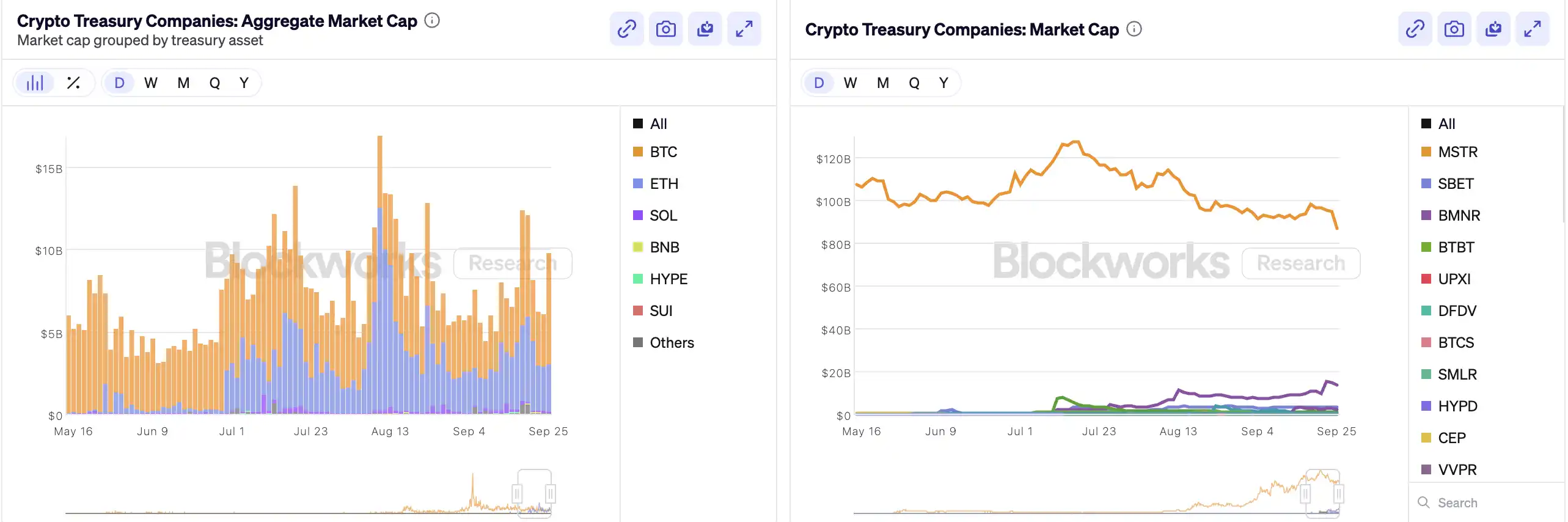
正如 Michael Saylor 所验证的那样,市场上存在大量想要获得比特币风险敞口的机构资金管理人,他们不能直接买 BTC,也无法持有 ETF——但他们可以买 MSTR 的股票。如果你能把一家持有加密资产的公司包装进他们的「合规篮子」,这些资金就愿意以 $2、$3、甚至 $10 的价格去买账面上仅值 $1 的资产。这不是非理性,这是制度套利。

在周期后半段,市场仍会涌现更新的发行人,并诉诸更激进的公司金融工具来追求更高股价弹性。价格下行时,这些做法就会反噬。Arthur Hayes 判断,本轮周期会出现类似 FTX 暴雷的大型 DAT 事故。届时,这些公司会翻车,其股票或债券可能出现巨幅折价,造成市场大幅动荡。

监管层也注意到了这一结构性风险。9 月初,纳斯达克就提出增强 DAT 公司的审查;今天,SEC 与 FINRA 又联合启动对于其内幕交易的调查。监管层的这些做法意在压缩内幕空间、提高发行门槛与融资难度,从而降低新晋 DAT 公司的操纵空间。对于市场而言,这意味着「伪龙头」将被加速出清,而真正的龙头公司仍将借着叙事生存甚至壮大。

总结

加密财库的叙事仍在,但门槛提高、监管加严、泡沫出清将同步进行。对投资者而言,既要看清金融结构背后的逻辑与套利路径,也需时刻警惕叙事背后的风险堆积——这场「链上炼金术」终究无法无限制上演,胜者为王,败者退场。


Twitter:https://twitter.com/BitpushNewsCN

比推 TG 交流群:https://t.me/BitPushCommunity

比推 TG 订阅: https://t.me/bitpush
说明: 比推所有文章只代表作者观点,不构成投资建议

Leituras Relacionadas

The AI Stock Genius Who Made 60x Bets $7.7 Billion on Nvidia Topping Out

An AI-focused hedge fund named Situational Awareness LP, known for its 60x returns, has taken a significant bearish stance on semiconductor stocks in Q1 2026. Its 13F filing reveals a massive 148% quarterly increase in nominal exposure to $13.677 billion, with over 60% of the new exposure directed towards put options on major chip players. Key bearish bets include $2.04 billion in puts on the VanEck Semiconductor ETF (SMH) and $1.56 billion on NVIDIA, alongside positions against Broadcom, Oracle, AMD, and others. The fund simultaneously increased its long equity holdings in AI infrastructure and compute providers like CoreWeave and Bitcoin mining companies repurposing for compute. The core thesis behind this positioning is a shift in the primary constraint for AI expansion. The fund argues that while GPU supply was the critical bottleneck in previous years, the new limiting factors for large-scale AI cluster deployment are physical infrastructure: electrical grid access (with multi-year backlogs in the US), power availability, land, and data center construction timelines. The fund is not betting against AI's success but rather hedging against potential valuation corrections in semiconductor stocks whose prices may have run ahead, while directly investing in the downstream physical bottlenecks—power and data center capacity—it believes will capture value next. This move translates a previously theoretical narrative about infrastructure constraints into a concrete, high-conviction portfolio structure.

链捕手Há 7m

The AI Stock Genius Who Made 60x Bets $7.7 Billion on Nvidia Topping Out

链捕手Há 7m

Deep Dissection of the Anthropic Account Banning Storm: The Behind-the-Scenes of the Safety Religion, AI Civil War, and Claude's Dilemma Under US-China Decoupling

"Deconstructing Anthropic's Account Banning Storm: Safety Dogma, AI Civil War, and the Claude Dilemma Under US-China Decoupling" analyzes the aggressive user account suspension policies of Anthropic, particularly for its product Claude Code. The article attributes this to a multi-layered convergence of factors. The root cause is traced to founder Dario Amodei's personal "safety religion." Shaped by his father's illness and his exit from OpenAI over safety disagreements with Sam Altman, Amodei embedded this "zero-tolerance" philosophy into Anthropic's DNA. This manifests in technologies like Constitutional AI and a "preventive enforcement" approach to risk, prioritizing safety over user experience or growth. This stance defines Anthropic's position in the US "AI Civil War," pitting "safety-first" proponents like Amodei against "accelerationists" like Altman who prioritize rapid development and commercialization. Anthropic's strict model aligns with its business strategy targeting high-value, low-risk enterprise clients who pay a premium for security, unlike OpenAI's mass-market approach. Capital from Amazon and Google supports Anthropic but also creates a delicate balance, as these investors need its safety reputation without allowing overly restrictive policies to cripple its commercial viability. The conflict escalated when Anthropic refused a US Department of Defense contract requiring the removal of safety guardrails, leading to its placement on a "supply chain risk" blacklist—a key example of the public battle between the two AI factions. For Chinese users, the stringent bans are further compounded by US-China tech decoupling. Anthropic's policies act as a tool for compliance with US export controls, making Chinese users—who often circumvent regional blocks via VPNs or virtual cards—primary targets for "preventive" account terminations to avoid regulatory penalties. The article concludes that Anthropic's harsh account control measures are unlikely to loosen in the near future, being integral to its founding philosophy, business model, and geopolitical compliance needs, positioning it as a unique, security-obsessed player in the tripartite global AI competition involving US safety and acceleration factions and rising Chinese AI power.

marsbitHá 23m

Deep Dissection of the Anthropic Account Banning Storm: The Behind-the-Scenes of the Safety Religion, AI Civil War, and Claude's Dilemma Under US-China Decoupling

marsbitHá 23m

SpaceX IPO Rush: A Capital Feast That Could Reshape the Landscape of AI and Crypto

SpaceX's potential IPO is emerging as a pivotal event that could reshape the landscape for both AI and Crypto markets. Far more than a traditional aerospace offering, SpaceX represents the core of Musk's future-tech ecosystem, with its Starlink satellite network positioning it as a global digital infrastructure company. This shift could redefine the foundational layers of the internet, communication, and data flow. Historically, major tech capital market movements, like AI booms or Bitcoin ETF approvals, have profoundly influenced crypto cycles. The SpaceX IPO could trigger a similar "super-narrative" fusion, boosting investor sentiment toward future digital infrastructure. This is particularly relevant for Crypto, which aims to build decentralized versions of such global systems. Key crypto sectors likely to benefit include: * **DePIN (Decentralized Physical Infrastructure Networks):** Projects like Render, Filecoin, and Helium, which incentivize real-world infrastructure for compute, storage, and connectivity. * **AI Crypto:** Platforms such as Bittensor and Fetch.ai, which leverage blockchain for decentralized AI computation, data markets, and agent economies. * **On-chain Payments & SocialFi:** Ecosystems like Solana and Ton, which could gain traction if Musk's X platform integrates digital payments and stablecoins. Ultimately, the IPO symbolizes a broader capital re-evaluation of core digital-age assets—networks, AI, data, and decentralized systems—aligning closely with crypto's long-term vision. It may act as a catalyst, redirecting global tech investment flows toward the crypto space as the next chapter in digital infrastructure unfolds.

marsbitHá 1h

SpaceX IPO Rush: A Capital Feast That Could Reshape the Landscape of AI and Crypto

marsbitHá 1h

KUN and Pharos Network Forge Strategic Partnership to Jointly Drive Innovation in RealFi, RWA, and Cross-Border Payment Infrastructure

Hong Kong. Layer 1 infrastructure Pharos Network and licensed digital payment expert KUN have signed a strategic MoU. They will integrate Pharos's institutional blockchain with KUN's licensed global payment rails to drive the tokenization of supply chain credit assets and enable more efficient global settlement on-chain. **Background:** Emerging market SMEs face severe working capital challenges due to slow, costly traditional trade finance, often waiting 30-90 days for payment after delivery. While RWA tokenization is a focus, few projects effectively connect underlying infrastructure to real commerce and licensed payment networks. **Collaboration Focus:** The partnership aims to bridge this gap by bringing supply chain credit and B2B cross-border payments on-chain compliantly. Initial priorities include: * Tokenizing supply chain credit assets to unlock liquidity. * Enabling native on-chain settlement of digital assets. * Exploring enterprise virtual card solutions. * Providing compliant on-chain financial services for verticals like commodities, trade, B2B e-commerce, and Web3. **Executive Quotes:** * Wish Wu, Co-founder & CEO of Pharos Network, highlighted KUN's trusted, licensed payment network as a perfect fit for bringing supply chain assets and cross-border capital flows on-chain accessibly. * Dr. Louis Liu, Founder & CEO of KUN, stated that settlement certainty is RealFi's final hurdle. Bridging KUN's payment rails with Pharos's infrastructure will help convert on-chain assets into real-world liquidity with institutional-grade trust. They will also explore AI-driven optimization for global capital flows. Pharos mainnet is live with over 50 dApps. This partnership strengthens its position as RealFi infrastructure by linking licensed payment systems with on-chain finance.

marsbitHá 1h

KUN and Pharos Network Forge Strategic Partnership to Jointly Drive Innovation in RealFi, RWA, and Cross-Border Payment Infrastructure

marsbitHá 1h

Trading

Spot
Futuros
活动图片