Криптоаналитики спорят: это начало медвежьего рынка или просто коррекция?

cryptonews.ruPublicado em 2025-09-26Última atualização em 2025-09-26

Общая капитализация криптовалютного рынка снизилась на 6,9% за последнюю неделю, свидетельствуют данные TradingView. Большинство монет оказались в красной зоне после решения Федеральной резервной системы о снижении процентной ставки на прошлой неделе.
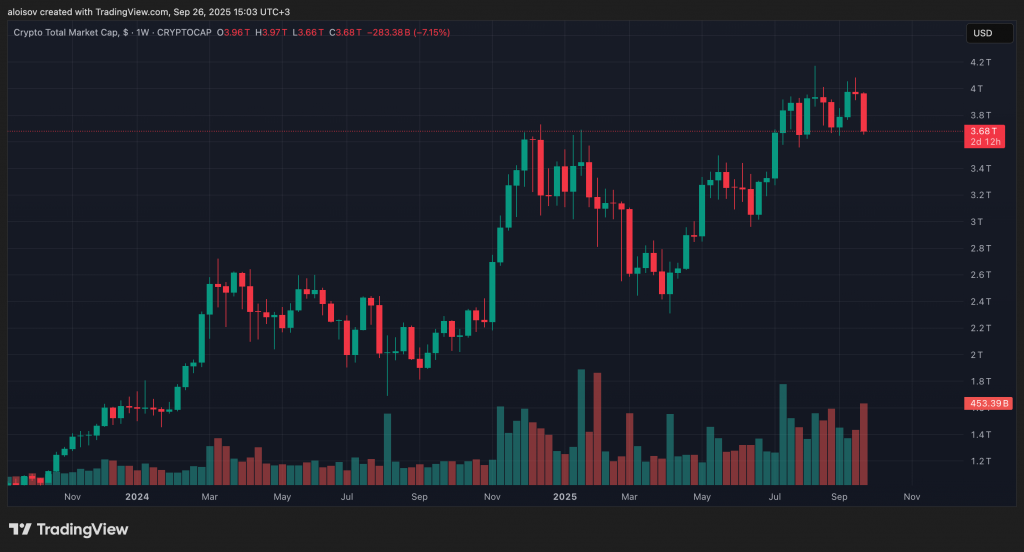
1-недельный график капитализации криптовалютного рынка. Источник: TradingView

Среди топ-10 монет Solana показала самое резкое падение — минус 20%. Биткоин и Ethereum также значительно просели, опустившись ниже ключевых уровней поддержки $110 000 и $4 000 соответственно.

Предостережения от скептиков

Резкая распродажа привлекла внимание давнего критика криптовалют Питера Шиффа (Peter Schiff), который отметил рост серебра на фоне падения биткоина. Он указал, что пока BTC снижался, серебро подскочило почти на 3%.

«Я всегда думал, что именно золото проколет пузырь биткоина. Похоже, это может сделать серебро», — заявил Шифф.

Экономист также обратил внимание на падение Ethereum ниже $4 000, утверждая, что это официально переводит альткоин в медвежий рынок. Он предсказал, что биткоин может вскоре пойти по тому же пути.

«Мы вступаем не просто в очередную криптозиму, за которой последует весна. Готовьтесь к криптовалютному ледниковому периоду. У вас есть золото?» — добавил он.

Хотя прогноз Шиффа откровенно негативен, другие аналитики также отмечают тревожные сигналы. xTrends обратил внимание, что исторически крупные падения часто совпадают с циклами снижения ставок Федрезервом.

«За последние три десятилетия каждый серьезный медвежий рынок начинался примерно в то время, когда ФРС начинала снижать ставки», — отметил он.
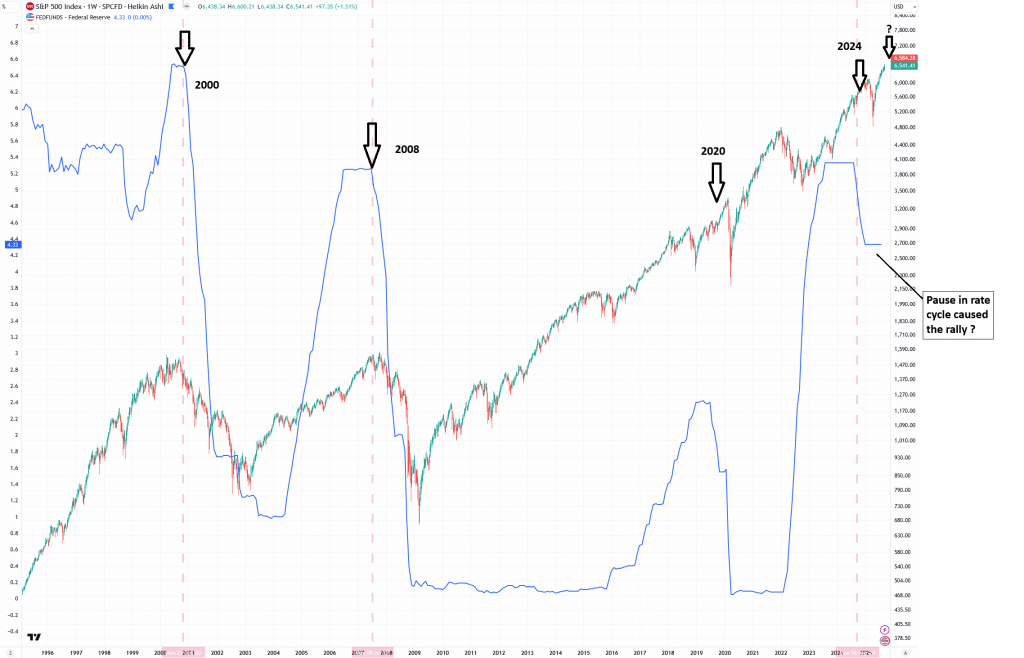

1-недельный график S&P 500. Аналитика: xTrends

Технические индикаторы

Аналитик PlanC обратил внимание на базовую стоимость краткосрочных держателей (STH Cost Basis) биткоина, которая в настоящее время составляет $111 500. Этот сетевой показатель отражает среднюю цену, по которой недавние покупатели приобрели свои монеты, и обычно рассматривается как разделительная линия между бычьими и медвежьими рынками.

«Во время бычьего рынка цена должна оставаться выше базовой стоимости краткосрочных держателей большую часть времени, с лишь краткими падениями ниже нее и быстрым восстановлением. Если эта стоимость действует как постоянное сопротивление — когда цена опускается ниже нее и неоднократно получает откат — это признак медвежьего рынка», — пояснил аналитик.
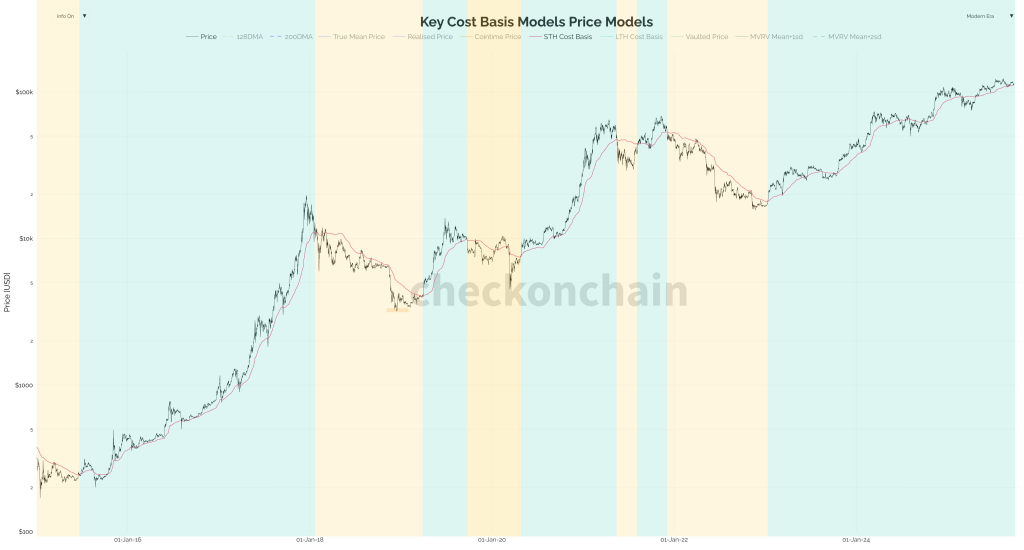
График биткоина и базовая стоимость краткосрочных держателей. Источник: PlanC

В настоящее время BTC находится ниже этого ориентира. Если восстановления не произойдет, это будет указывать на начало медвежьего рынка.

Альтернативный взгляд: ловушка для медведей

В то же время другие аналитики утверждают, что падение представляет собой медвежью ловушку — временная коррекция, которая выглядит как начало более глубокого снижения, но вместо этого предшествует росту.

NoName уверен, что рынок все еще находится в середине цикла, а не приближается к его завершению. Это оставляет место для финальной фазы эйфории и новых исторических максимумов.

По его словам, несколько сигналов обычно указывают на приближение пика цикла. Среди них движение показателя MVRV-Z в зону 3–4, резкое падение ликвидности на биржах по мере перевода монет в холодные кошельки, значительно положительные ставки финансирования и достижение индексом страха и жадности уровня «крайняя жадность».

«Что делает циклы такими похожими? Все они повторяют одну и ту же структуру: 9–12 месяцев роста, коррекция в середине цикла, которая выглядит как конец тренда, затем финальный памп, ведущий к массовой эйфории», — написал он.

Джо Консорти (Joe Consorti) отметил, что биткоин поглощает предложение на ключевом психологическом уровне. Он предположил, что как только продажи со стороны долгосрочных держателей ослабнут, а институциональный спрос сохранится, вероятность сильного прорыва возрастет.

«С учетом того, что долгосрочные держатели сокращают продажи, а также устойчивого институционального спроса, благоприятной сезонности и дружественной политики ФРС, следует ожидать еще одного взрывного роста в четвертом квартале», — спрогнозировал Консорти.


Leituras Relacionadas

Claude Accused of Becoming Dumber by the Entire Internet, Anthropic Steps In to Reveal: It’s Not the Model That’s Tricking You

When users complained that Claude was "getting dumber," the root cause wasn't the AI model itself. In an official blog post, Anthropic clarified the critical difference between two key settings in Claude Code: Model and Effort. Model refers to the core "brain"—the fixed, trained weights of a specific AI (like Sonnet, Opus, or Fable). Changing the Model addresses *capability* ("can it do this?"), but its knowledge is static post-training. Effort, however, controls the AI's *approach and thoroughness* for a specific task. A higher Effort level instructs Claude to read more files, run tests, perform verification, and complete multi-step reasoning before responding, significantly increasing its "work output" for that job. Conversely, low Effort leads to quicker, less thorough replies. This distinction explains the March 2024 uproar where users experienced a sudden drop in Claude's performance. The cause was not a model change but Anthropic quietly lowering the *default* Effort setting from "high" to "medium" to reduce latency, which was later reverted. The key insight is that a smaller, capable model (like Sonnet) on high Effort can often outperform a larger, more powerful model (like Opus) on low Effort for many tasks. The article provides a practical troubleshooting framework: if Claude makes an error, first check the context and instructions. If it seems to skip necessary steps or validations, increase Effort. If it diligently attempts the task but fails conceptually or makes consistent factual errors despite good context, then consider switching to a more capable Model. The takeaway is a shift in focus: effective AI programming is less about always choosing the "strongest" model and more about intelligently *orchestrating* models and effort levels—acting like a project manager to assign the right "brain" with the right level of diligence for each job, optimizing both results and cost.

marsbitHá 31m

Claude Accused of Becoming Dumber by the Entire Internet, Anthropic Steps In to Reveal: It’s Not the Model That’s Tricking You

marsbitHá 31m

Will the Ethereum Foundation Evolve into a 'Mascot'? Diversified Organizations Are Fragmenting Its Functions

The Ethereum Foundation (EF) is undergoing significant internal turmoil and functional erosion. Following its largest-ever layoff of 54 staff (20% of its workforce) and a major organizational restructuring announced in June, its Protocol Support Team has been officially dissolved. This comes alongside the high-profile resignation of key figures like co-executive director Xiaowei Wang, bringing senior departures this year to at least eight. Criticism of EF's rigid structure, opaque decision-making, and perceived lack of a clear value narrative for ETH has intensified within the community. The layoffs have catalyzed the emergence of independent, non-profit organizations like Ethlabs and Ethereum Institutional, founded by former EF researchers and members. These entities are now taking on core functions such as protocol research/development and institutional adoption, effectively fragmenting the EF's traditional leadership role. Concurrently, EF's security team is adapting to technological change, deploying specialized AI agents to audit Ethereum's codebase, which successfully discovered a critical vulnerability (CVE-2026-34219). While EF states AI complements rather than replaces researchers, it signals a potential future shift in its operational model. Faced with these challenges—internal restructuring, talent drain, the rise of competing organizations, and AI integration—the Ethereum Foundation appears to be stepping back from a central commanding role. Analysts and community observers speculate it may increasingly transition towards a symbolic "ecosystem mascot" function, while decentralized initiatives drive Ethereum's future growth and institutional adoption.

marsbitHá 57m

Will the Ethereum Foundation Evolve into a 'Mascot'? Diversified Organizations Are Fragmenting Its Functions

marsbitHá 57m

Nearly a Hundred Players Rush into Embodied Data: With 4.47 Billion Yuan in Financing in One Year, Who Can Really Make Money by 'Selling Data'?

The domestic embodied AI data industry has attracted nearly 100 players, with 70 focused on data collection and 27 on data infrastructure. In the past year, 15 independent embodied data service providers raised approximately 4.47 billion yuan. Despite this growth, the sector remains early-stage, fragmented, and faces significant challenges. Data collection methods are diverse, categorized into four main routes: teleoperation of real robots, human demonstration without a robot (using motion capture, exoskeletons, etc.), simulation synthesis, and distillation from internet videos. Most companies (43%) adopt hybrid approaches, combining multiple routes, as no single method can meet all training needs. Teleoperation alone is pursued by 31% of players, often by state-owned platforms and robot companies, while newer firms favor asset-light, no-hardware human demonstration. Independent data service providers now form the largest player group (40%), indicating the emergence of a distinct industry segment rather than just a subsidiary function for robot makers. Two-thirds of all players are "embodied-native" startups, while one-third are companies that pivoted from fields like AI data annotation, which are more prevalent in the data infrastructure layer. Current annual industry capacity is estimated at 1.6-1.8 million hours plus 70-80 million data points, with a short-term goal to increase this 15-20 fold within 1-3 years. Data collection factories are spread across 20 provinces in China, concentrated in the Yangtze River Delta, Beijing-Tianjin-Hebei, and Pearl River Delta regions. Financially, the 4.47 billion yuan raised in the past year pales compared to the 43.8 billion yuan raised by the broader embodied intelligence sector in just the first half of 2026, highlighting that data remains a less "sexy" bet for investors. The 15 funded independent providers show clear stratification: a top tier led by a unicorn (Lightwheel Intelligence, 3.1 billion yuan), a middle tier of 11 firms raising tens to hundreds of millions, and an early-stage tier of 3 companies. Sixty-nine investment institutions have participated, but none have made concentrated bets, reflecting uncertainty about viable business models. Over half of these funded companies are less than a year old, most are at pre-A or A rounds, and profitability remains largely unproven. In summary, the embodied data industry has become an independent track creating jobs and local economic activity. However, it is still nascent, with unformed consensus, unsolved problems, and unproven business models. The coming 1-2 years will be a critical validation window to see if companies can build sustainable, profitable businesses purely by "selling data."

marsbitHá 3h

Nearly a Hundred Players Rush into Embodied Data: With 4.47 Billion Yuan in Financing in One Year, Who Can Really Make Money by 'Selling Data'?

marsbitHá 3h

Trading

Spot
活动图片