从财库看风向:2025年哪些山寨正被企业“真金白银”买单?

marsbitPublicado em 2025-09-18Última atualização em 2025-09-19

如果说行情是情绪的温度计,那么「财库配置」就是企业的投票器。谁把真金白银写进资产负债表,押注哪些山寨币,往往比社交媒体的热闹更可靠。2025 年,我们在公开披露里看到越来越多上市公司把非 BTC、非 ETH 的代币纳入财库,比如 AI 赛道的 FET、TAO,新型 DeFi 基建的 HYPE、ENA,以及支付老将 LTC、TRX,甚至还有社群色彩更浓的 DOGE。这些持仓背后,既有商业协同,也有资产多元化的诉求,更给了普通投资者一个「看风向」的窗口:谁在买、为什么买、买了之后怎么用。从这些问题出发,你会更容易分辨强叙事与弱叙事,理解哪些山寨在被「机构化的资金」认真对待。

为什么看财库配置?

用「企业真金白银」识别强叙事。第一,因为它更难作假。公司一旦把代币写进财报或监管文件,就意味着管理层要对持仓规模、会计政策、托管与风险做说明,这比「喊口号」更有约束力。第二,因为它更接近「用而持」。这次财库潮里,不少公司并非只买代币,还同步签了技术合作、引入代币作为产品使用或做链上质押收益,典型如 Interactive Strength 计划购入约 5,500 万美元 FET 并与 fetch.ai 签合作、Freight Technologies 将 FET 与物流优化场景绑定、Hyperion DeFi 把 HYPE 用于质押并与 Kinetiq 打通收益与抵押路径、TLGY(拟并入 StablecoinX)计划建立 ENA 财库押注 Ethena 的合成稳定与收益结构。这些动作的共同点是:代币不仅是价格,更是「凭证」和「油料」。第三,它为普通投资者提供了另一条路径。你可以直接研究代币,也可以通过研究持有这些代币的上市公司获得「间接敞口」。当然,这是一把双刃剑:小市值公司叠加高波动代币,股价往往成为「代币代理」,涨跌会更猛。如果你走「股票间接敞口」的路子,仓位控制和节奏感就格外重要。

从 2025 年市场背景来看,这一趋势正在加速。宏观上,美国现货型加密 ETF 的落地提升了风险偏好,BTC、ETH 的强势给了山寨一个「由点到面」的外溢窗口,优质赛道获得更多关注。公司侧的态度也在变化:从几年前的「试探性持有」,升级成「策略性配置」,甚至出现了「以加密财库为主业」的新物种——有公司主动转型,明确把构建和运营加密财库当成主线业务。在披露层面,企业不再满足于新闻稿,而更多通过监管文件、季度报告、投资者演示来披露持仓规模、公允价值、托管细节和风控安排,信息的可验证性在增强。简而言之,热度回来了,路径更清晰了,资金开始更「认真」了。这也意味着,观察财库动态正在成为理解行业方向的一扇可靠窗户。
TAO

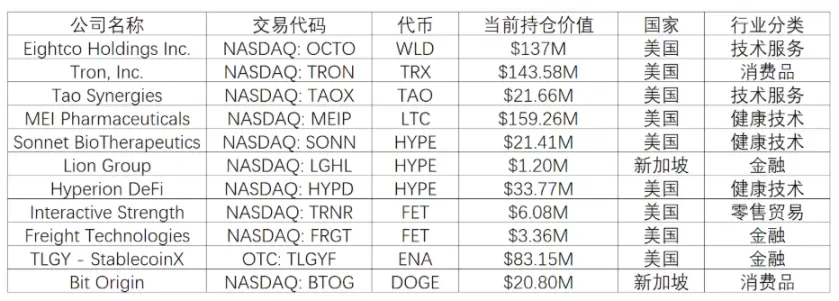
近期上市企业财库山寨币持仓统计

三大山寨主线:AI、新型 DeFi 与支付老币

AI 赛道(FET、TAO):这一条主线的关键信号是「用而持」。AI 原生网络的代币往往不是单纯的投机标的,而是接入与结算的「门票和燃料」:智能代理的调用、算力和模型市场的接入、网络激励机制,都需要内生使用代币。企业财库的进入,往往伴随着技术合作与业务整合,例如在物流优化、算力调用或智能代理落地中形成闭环,因此投机权重相对较低,更偏向战略性配置。不过,这一赛道也存在不确定性:AI 与区块链的结合仍处在验证阶段,估值可能提前反映未来预期,代币经济的长期可持续性(通胀 / 通缩机制、激励模型、费用回收)仍需观察。

新型 DeFi 基础设施(HYPE、ENA):这一赛道走的是「效率 + 收益」的组合拳。HYPE 代表的是性能导向的 DeFi 基础设施:通过高性能链承载衍生品交易与质押衍生,形成「赚收益 + 流动质押再抵押」的资金循环,为机构和资金池提供高效利用路径。企业财库的兴趣点在于,它不仅能带来链上治理和收益,还能通过资金循环增强流动性和市场黏性。

ENA 的吸引力则更集中在合成稳定与对冲收益的设计。Ethena 通过结合质押衍生和对冲策略,试图在不依赖传统银行体系的前提下,创造「类美元」的稳定资产,并内生生成收益来源。如果这种模式能与交易所、托管机构和支付端打通,就可能形成一个真正闭环的「加密美元 + 收益」体系。对企业财库而言,这意味着既能持有稳定的记账单位,又能获得收益和对冲波动的工具。不过,其风险也更复杂:清算安全、智能合约的稳健性,以及极端行情下的稳定性,都是需要高强度审计与风控的关键点。
TAO

Source: X

支付与老牌大盘(LTC、TRX、DOGE):相比之下,这组资产更偏向「省心的底仓与支付通道」。它们的历史更长、流动性更强、基础设施更完善,因此便于成为企业财库的「类现金」配置,既能满足长期价值储存,也能用于支付场景。LTC 和 TRX 在支付和结算层的效率优势,使其成为财库可直接利用的支付敞口;DOGE 则凭借社区与品牌外溢效应,在轻量支付与话题传播上具备独特价值。总体来看,这类资产承担的角色更多是稳健和基础性的,但新的增长故事有限,未来可能更多受到稳定币与 L2 支付网络的竞争压力。

知道买啥,更要知道怎么看

看清风向,但别简单类比。企业把哪种代币写进财报,等于用真金白银投票,这能帮我们过滤很多噪音,但它不等于万能指标。更全面的观察框架,是同时看三个层面:有没有业务协同(公司真的用到这个代币了吗)、有没有正式披露(写进监管文件,说明买了多少、怎么保管、有哪些风险)、链上数据是否跟得上(活跃度、交易深度、清算是否稳定)。企业财库配置的真正价值,不在于提供投资建议,而在于揭示行业演进的底层逻辑——当传统上市公司开始大规模配置特定代币时,这背后反映的是整个加密生态从「纯粹投机」向「价值锚定」的结构性转变。

从宏观角度看,这轮财库配置潮标志着三个重要趋势的交汇:监管环境的成熟化——企业敢于在公开文件中披露加密资产持仓,说明合规框架正在建立;应用场景的具体化——不再是抽象的「区块链革命」,而是 AI 训练、DeFi 收益、跨境支付等可量化的业务需求;资金结构的机构化——从散户主导转向企业参与,意味着更长的持有周期和更理性的定价机制。更深层的意义在于,财库配置正在重新定义「数字资产」的本质。过去我们习惯把加密货币视为高风险的投机工具,但当越来越多的企业将其作为运营资产或战略储备时,它们开始具备类似外汇储备、商品库存或技术许可的属性。这种认知转变,可能比任何技术突破都更具颠覆性。

Leituras Relacionadas

Google CEO Admits Lagging Behind in Coding

Google CEO Sundar Pichai acknowledged in a recent interview that Google's Gemini AI models are currently "lagging behind" in coding capabilities, particularly for complex, long-horizon tasks requiring advanced developer expertise. He noted the field is advancing at an "unprecedented" pace, where 30-60 days now brings changes equivalent to five years in the past. Pichai expressed that achieving Artificial General Intelligence (AGI) now seems closer than previously imagined due to rapid progress. While highlighting strengths in text, multimodal, and reasoning tasks, Pichai admitted competitors like Anthropic and OpenAI have focused more intently on coding. He emphasized Google's commitment to catching up, citing internal tools like Antigravity 2.0 and the newly released Gemini 3.5 Flash, which aims to address previous shortcomings. Regarding Google Search's AI-driven overhaul, Pichai stated changes will be gradual to align with user needs, not disrupt the core search experience or its advertising model. He addressed public AI anxiety as understandable, given the technology's potential to reshape jobs and society, but remained optimistic about AI augmenting human capabilities and creating new opportunities. Pichai stressed the need for broad societal dialogue and responsible development as AI approaches more advanced, potentially recursive self-improvement stages. He affirmed Google's long-term commitment to leading in AI while navigating its profound implications responsibly.

marsbitHá 8m

Google CEO Admits Lagging Behind in Coding

marsbitHá 8m

The Paradox of Automation: The Stronger the AI, the Busier Humans Become

The Paradox of Automation: The more powerful AI becomes, the more work humans have to do. This article, based on observations from AI-heavy company Every, argues that while AI agents automate tasks like coding, writing, and customer service, they don't eliminate human jobs. Instead, they transform work and create *more* demand for human expertise. AI commoditizes "yesterday's human capabilities" by cheaply generating code, text, and images from past data. This leads to an abundance of similar, generic outputs. Consequently, what becomes scarce and valuable is human judgment in the present moment: knowing *what* is worth doing, *why*, and *how* to do it well. The article identifies two collaboration models: "Agent employees" for delegated tasks and "human-AI collaboration" within tools like Claude Code for complex work. In both cases, humans are essential to set direction, judge quality, and maintain systems. As AI makes execution cheap, human roles shift from executors to designers, reviewers, and meaning-makers. The author addresses "benchmark anxiety" by explaining that AI excels within specific, human-defined problem "frames." As AI masters one frame (e.g., code rewriting), new, more complex frames emerge (e.g., deciding *when* to rewrite). This creates an ongoing cycle where AI chases the frames, but humans remain the "framers." Even with advanced AGI, this dynamic may persist as long as AI lacks true human-like agency and self-directed purpose. The core paradox holds: automation amplifies the need for the very human judgment it seems to replace.

marsbitHá 1h

The Paradox of Automation: The Stronger the AI, the Busier Humans Become

marsbitHá 1h

a16z: 7 Charts to Understand How Tokenization is Changing the Nature of Assets

"a16z: 7 Charts on How Tokenization is Changing the Nature of Assets" Tokenized Assets (or Real-World Assets - RWA) are transforming asset forms, liquidity, and financial system construction. The market recently surpassed $30 billion, stabilizing around $34 billion (excluding stablecoins), representing a tenfold increase in less than two years, driven by clearer regulations, mature institutional infrastructure, and increased financial institution adoption. The primary driver of recent growth is tokenized U.S. Treasury bonds. These offer investors efficient, flexible digital access to yield-bearing assets and improve institutional operations like settlement and collateral management. Other asset classes show varied growth: asset-backed credit leads, followed by niche financial assets (e.g., reinsurance, mining notes), while venture capital took longer to scale. Market segmentation shows high concentration. In commodities, tokenized gold dominates (~$5 billion), as its standardized, storable nature fits tokenization well. Bonds are the largest category ($15.2B), but only ~5% are used in DeFi protocols. Conversely, smaller niches like reinsurance tokens see high (~84%) on-chain utilization, highlighting a core industry divide: most current tokenized assets are merely digitized records for easier holding/transfer, lacking the "composability" (free combination/interaction) that is key to blockchain-native finance. The ecosystem is distributed across multiple blockchains, with Ethereum hosting over half the value ($15.7B), followed by BNB Chain, Solana, and others. Future market size predictions vary widely (e.g., $2-$30 trillion by 2030+), but all indicate massive potential from the current small base. Tokenized assets currently represent minuscule fractions of their global counterparts (e.g., 0.01% of global bonds). The current phase focuses on digitizing straightforward assets. The next challenge is to bring more complex financial components on-chain and deeply integrate tokenized assets into composable, internet-native financial infrastructure.

链捕手Há 2h

a16z: 7 Charts to Understand How Tokenization is Changing the Nature of Assets

链捕手Há 2h

a16z: How Tokenization is Transforming the Nature of Assets in 7 Charts

"Tokenized Assets: How Tokenization Changes the Nature of Assets" by a16z Crypto The market for tokenized assets, excluding stablecoins, has grown from under $3 billion two years ago to over $340 billion today. US Treasury bonds are the primary growth driver, allowing investors to hold yield-bearing assets digitally and enabling more efficient settlement. Other key sectors include private credit (growing fastest), commodities (dominated by gold), and niche financial assets. However, the market remains concentrated in tokenized US Treasuries and gold. A critical insight is that most tokenized assets currently lack "composability." While the total market is large, only a small fraction is actively used within DeFi protocols. For instance, only about 5% of tokenized bonds and a low percentage of tokenized gold are utilized on-chain. In contrast, assets like reinsurance and private credit tokens show much higher on-chain usage rates (84% and 33%, respectively). This highlights a divide: many tokenized assets are merely digital records on a blockchain without enabling new, programmable financial applications. The Pantera Capital Token Native Index indicates over 70% of tokenized assets have minimal on-chain native functionality. Ethereum remains the dominant blockchain for tokenized assets (over $150B), but the ecosystem is diversifying across chains like BNB Chain, Solana, and Stellar, based on factors like cost and compliance. Major institutions forecast massive future growth, with predictions for the tokenized asset market ranging from $2 trillion to over $30 trillion by the early 2030s. However, compared to the global financial system (e.g., ~$140T bonds, multi-trillion dollar gold market), tokenized assets currently represent a tiny fraction (0.01% or less). The conclusion is that while tokenization has begun by digitizing and streamlining settlement for simpler assets, the next phase involves bringing more complex financial instruments on-chain and deeply integrating them into composable, internet-native financial infrastructure.

Odaily星球日报Há 2h

a16z: How Tokenization is Transforming the Nature of Assets in 7 Charts

Odaily星球日报Há 2h

The Revived Codex, Carrying OpenAI's Hopes for IPO

This article analyzes the intense recent development of OpenAI's Codex, positioning it as a crucial component for OpenAI's impending IPO. Over the past two months, Codex has seen a rapid series of major updates focused on integrating into real enterprise workflows. Key new features include enhanced context capture (Appshots, file previews, built-in browser), long-running task execution ("Goal Mode"), remote operation (phone control, lock-screen access), and enterprise management tools (plugin sharing, access tokens, automated risk review). These updates aim to make Codex a comprehensive AI workbench that can "see the scene, push tasks, and manage risks." The author argues that while ChatGPT proves OpenAI's massive user base and API provides foundational revenue, Codex represents OpenAI's clearest path to demonstrating tangible, high-value commercial viability. It targets developers and engineering teams—a segment already accustomed to paying for efficiency gains in costly software development cycles. This is critical because, despite higher overall revenue, OpenAI's adjusted operating margins remain deeply negative, highlighting the challenge of outrunning immense compute costs. The pressure is amplified by competitor Anthropic's success with Claude Code, which has shown that a focused approach on high-value enterprise and developer workflows can lead to a path toward profitability. Codex's aggressive evolution is thus seen as OpenAI's strategic move to capture a similar enterprise-ready, revenue-generating narrative essential for its market debut. In essence, "ChatGPT proved OpenAI has users. Codex needs to prove OpenAI is a business that can make money."

marsbitHá 3h

The Revived Codex, Carrying OpenAI's Hopes for IPO

marsbitHá 3h

Trading

Spot
Futuros
活动图片