Base Network Token Exploration Unveiled By Coinbase CEO, Future Plans Disclosed

bitcoinistPublicado em 2025-09-16Última atualização em 2025-09-16

Resumo

In a recent announcement on X (formerly Twitter), Brian Armstrong, the CEO of US-based cryptocurrency exchange Coinbase, revealed that the...

Trusted Editorial content, reviewed by leading industry experts and seasoned editors. Ad Disclosure

In a recent announcement on X (formerly Twitter), Brian Armstrong, the CEO of US-based cryptocurrency exchange Coinbase, revealed that the company is actively considering a token launch for Base, its Ethereum (ETH) layer-2 (L2) network. 

Coinbase’s Base Network Takes Steps Toward Token Launch 

Armstrong articulated that the potential introduction of a network token could serve as a “powerful tool” to accelerate decentralization and foster growth among creators and developers within the ecosystem. 

Following the firm’s BaseCamp 2025 event in Vermont, the executive emphasized the importance of building in the open, stating that the exploration of this token aligns with their commitment to transparency and community engagement.

Accompanying Armstrong’s announcement, the Base network published a blog post confirming its intention to explore a network token. The post highlighted that this exploration is in its early stages and does not come with definitive plans at this moment

In addition to the token exploration, the blog post also unveiled an open-source bridge designed to enhance interoperability between Base and the Solana (SOL) blockchain as part of a broader initiative to facilitate seamless interactions across different chains. 

No Definitive Plans Yet

When Base originally launched, its focus was clear: to establish a developer-friendly ecosystem capable of executing secure transactions at low costs. The introduction of a network token was not deemed necessary to meet these goals. 

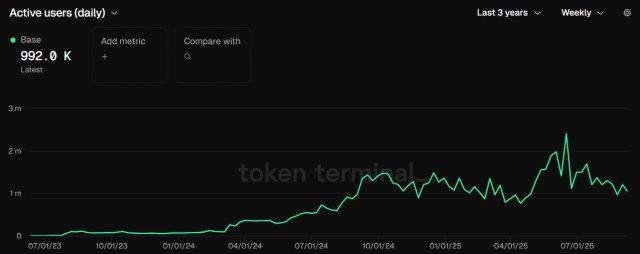
However, with the successful achievement of sub-second and sub-cent transactions, as well as nearly one million active users according to Token Terminal data, the team aims to establish a more open and accessible on-chain economy.
Base
Base’s active users. Source: Token Terminal

The network’s blog post noted that exploring this possibility is one avenue toward realizing their vision of a global on-chain economy, which could enhance decentralization and create more opportunities for builders and creators.

While the exploration is in its nascent stages, the firm made it clear that there are no specific timelines, designs, or governance structures in place yet.

In addition, the blog post reiterated three key commitments to the community: a continued dedication to the Ethereum blockchain, adherence to regulatory guidelines as a US-based company, and a focus on building transparently: 

If and when we move forward with a token, it will be grounded in principles, values, and in alignment with our long-term mission: to build a global economy that increases innovation, creativity, and freedom.

In conclusion, Armstrong specified that this is not a definitive plan but rather an update to their philosophy as they consider the future of the network. 

Base
The daily chart shows COIN’s consolidation following its recently achieved all-time high. Source: COIN on TradingView.com

When writing, Coinbase’s stock, which trades on the Nasdaq, has reached a valuation of $324. It is still in consolidation mode after dropping from its record high of $444 in July of this year. 

Featured image from CCN.com, chart from TradingView.com

Editorial Process for bitcoinist is centered on delivering thoroughly researched, accurate, and unbiased content. We uphold strict sourcing standards, and each page undergoes diligent review by our team of top technology experts and seasoned editors. This process ensures the integrity, relevance, and value of our content for our readers.

Ronaldo is a seasoned crypto enthusiast with over four years of experience in the field. He is passionate about exploring the vast and dynamic world of decentralized finance (DeFi) and its practical applications for achieving economic sovereignty. Ronaldo is constantly seeking to expand his knowledge and expertise in the DeFi space, as he believes it holds tremendous potential for transforming the traditional financial landscape.

Leituras Relacionadas

Canada MSB, Why is it More Suitable for Teams Focused on Long-Term Payment Solutions?

**Canada MSB: Why Is It More Suitable for Teams Focused on Long-Term Payments?** Many crypto payment projects initially obtain a U.S. MSB registration for its cost-effectiveness and market recognition. However, as they scale operations, they often find it insufficient for sustainable, real-world payment business. This is where the Canadian MSB, regulated by FINTRAC, gains serious consideration. Unlike the U.S. framework, the Canadian MSB is not a "lightweight alternative" but a choice for projects committed to long-term, compliant operations, especially in B2B payments, cross-border settlements, and stablecoin transactions. **Key Distinctions:** The Canadian MSB emphasizes substantive, ongoing regulation. It requires establishing a full-fledged AML/CTF framework *before* launching operations, with continuous obligations for KYC, transaction monitoring, and reporting. This positions the holder as a regulated financial service provider from day one. **Operational Scope:** A properly structured Canadian MSB can support businesses like stablecoin/crypto payments and transfers, fiat-crypto exchange, B2B batch settlements, payment APIs for merchants, and underlying structures for services like crypto cards. **Strategic Advantages:** 1. **Bank & Partner Relations:** Its clear regulatory framework and operational requirements make it easier to explain compliance to banks and institutional partners, which is crucial for securing stable banking relationships. 2. **Centralized Path:** It offers a nationally unified system, avoiding the complexity and cost of navigating multiple U.S. state-level Money Transmitter Licenses (MTLs). 3. **Business Model Clarity:** It fosters long-term stability by requiring clear business structures, transparent fund flows, and real risk management from the outset, reducing future uncertainties. **Ideal Candidates:** The Canadian MSB is particularly suitable for B2B crypto payment platforms, cross-border stablecoin services, enterprise payment solutions, Web3 financial infrastructure projects, and teams building a "compliance benchmark" for sustainable growth. **Choosing Between U.S. and Canadian MSB:** The choice depends on the project's stage and goals. The **U.S. MSB** is better for **speed, initial validation, and early launch**. The **Canadian MSB** is better for **stability, substantive compliance, and long-term operation**, especially when serving B2B/enterprise clients and requiring reliable banking channels. In essence, while the Canadian MSB involves higher initial compliance rigor, it provides a more solid foundation for building a payment business that banks, partners, and regulators can accept over the long term.

marsbitHá 13m

Canada MSB, Why is it More Suitable for Teams Focused on Long-Term Payment Solutions?

marsbitHá 13m

Trading

Spot
Futuros
活动图片