120亿美元的虚假繁荣?Figure与DefiLlama的“RWA数据造假”之争

Odaily星球日报Publicado em 2025-09-14Última atualização em 2025-09-14

原创 | Odaily 星球日报(@OdailyChina

作者 | Ethan(@ethanzhang_web3)

在 DeFi 世界里,TVL 是为关键数据——它既是协议实力的象征,也是用户信任的晴雨表。然而,一场围绕 120 亿美元 RWA 资产的指标造假争议,迅速撕裂了用户信任。

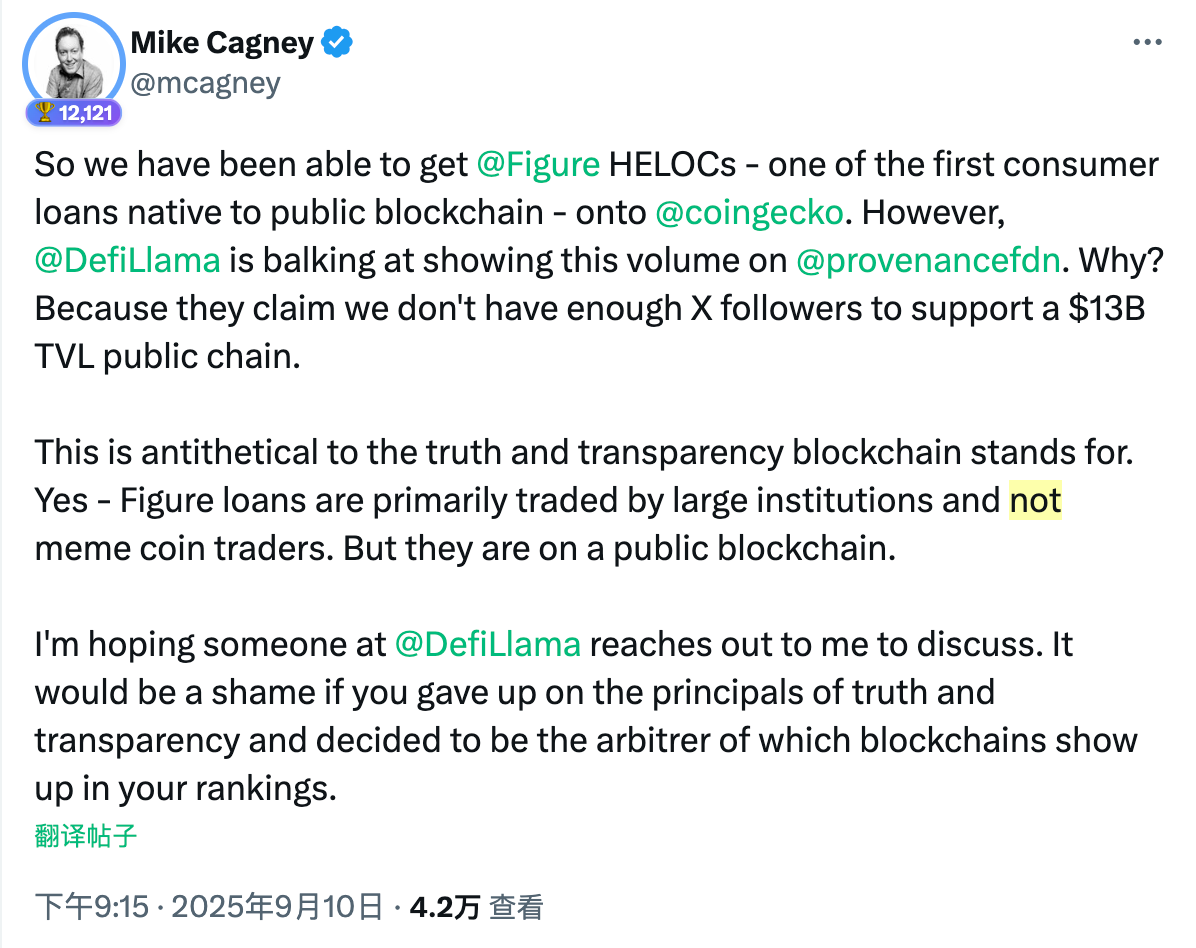
9 月 10 日,Figure 联合创始人 Mike Cagney 在 X 平台率先开火公开指责链上数据平台 DefiLlama 拒绝展示其 RWA TVL,仅因“社交平台粉丝数不足”,并质疑其“去中心化标准”的公允性。

几天后,DefiLlama 联合创始人 0xngmi 发布长文《The Problem in RWA Metrics》进行回应,逐条揭示 Figure 所声称的 120 亿美元规模背后的数据异常,直指其链上数据不可验证、资产缺乏真实转移路径,甚至存在规避尽调的嫌疑

由此,一场关于“链上可验证性”与“链下映射逻辑”的信任争夺战全面爆发。

事件时间线:Figure 主动发难,DefiLlama 强硬回应

这场风波的导火索来自Figure 联合创始人 Mike Cagney的一则推文。

9 月 10 日,他在 X 平台高调宣布,Figure 的房屋净值信贷产品(HELOCs)已成功登陆 CoinGecko,但同时指责DefiLlama 拒绝展示 Figure 在 Provenance 链上的 130 亿美元 TVL。他将矛头直指 DefiLlama 的“审查逻辑”,甚至直言对方以“X 粉丝数不足”为由否决其上榜。(Odaily 注:这里Mike Cagney说的是130亿美元,与后文0xngmi回应中的120亿存在数据不对称情况。)
此言一出,约一小时后Provenance Blockchain CEO Anthony Moro(从语境看疑似未掌握全部背景就介入)在同帖下发言,表达对行业数据平台DefiLlama的强烈不信任:
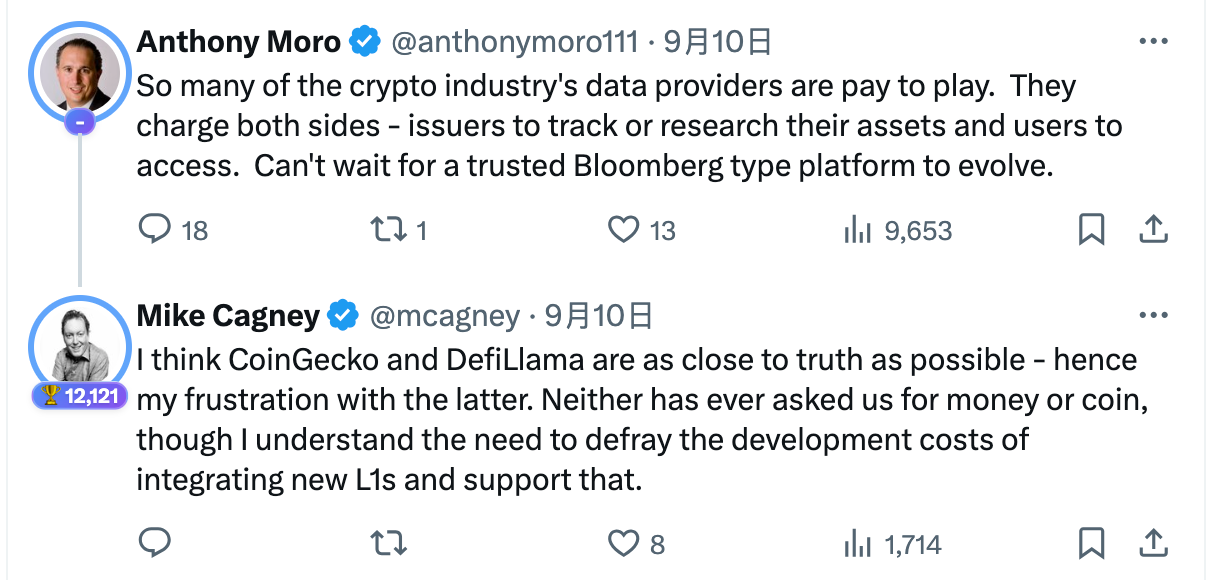
随后,Figure 联合创始人 Mike Cagney补充称他理解集成新 L 1 的开发成本,但亦表示CoinGecko 和 DefiLlama 从未向 Figure 索要过费用或代币,以澄清其“付费上榜”的暗示。

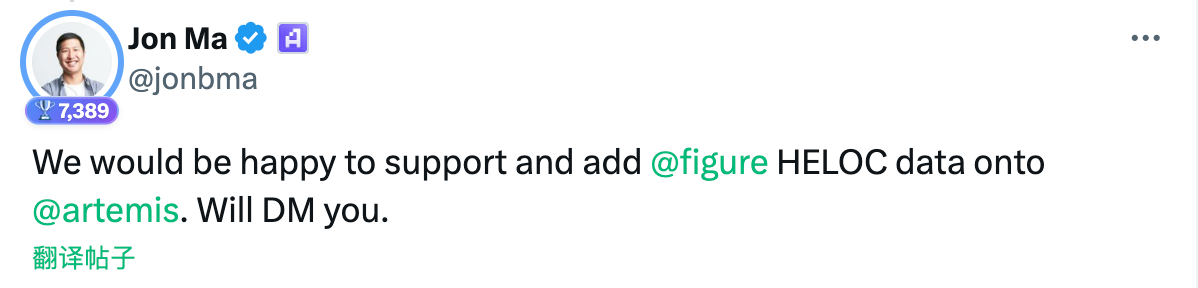
9 月 12 日,L1 数据仪表板Artemis 联合创始人兼 CEO Jon Ma(同样看起来在未充分了解争议细节的情况下)公开抛出橄榄枝。
在这一时段里,舆情一度明显倾向 Figure——不少围观者将矛头指向 DefiLlama 的“可信度与中立性”。

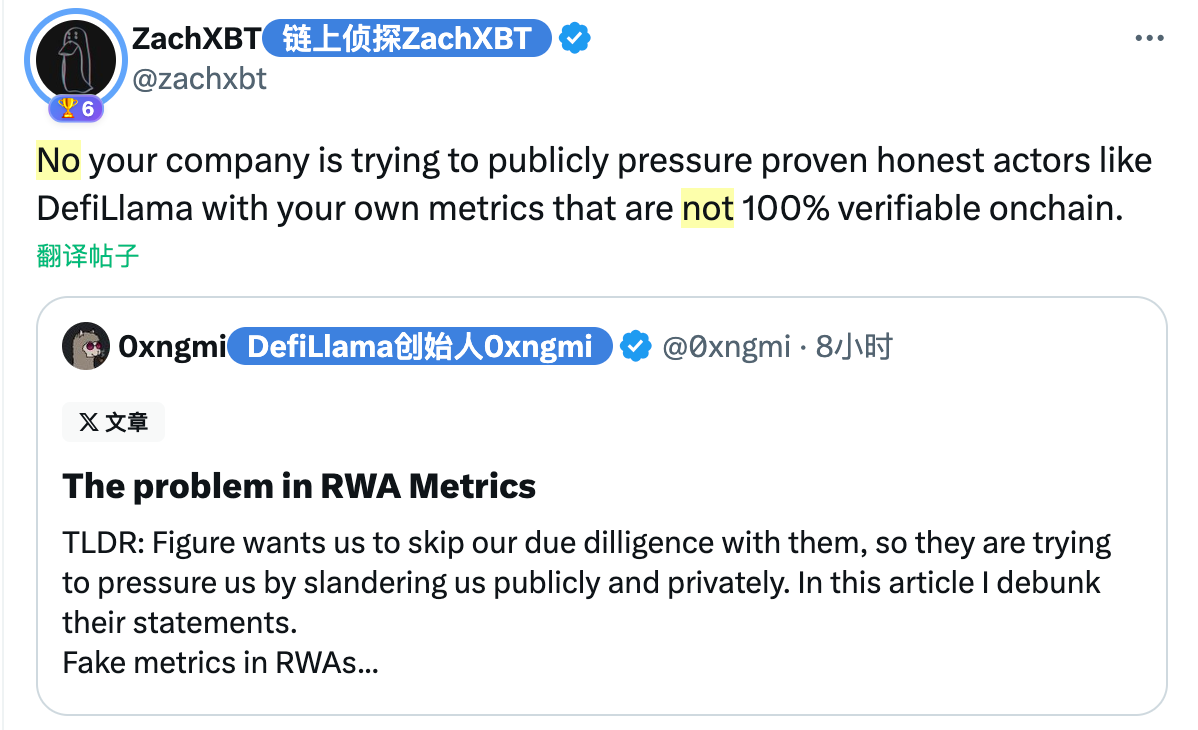
直到 9 月 13 日,DefiLlama 联合创始人0xngmi发布长文《The Problem in RWA Metrics》,系统披露其尽调发现与四点质疑,叙事风向才开始反转;紧接着ZachXBT等意见领袖转发声援,强调“这些指标并非 100% 可在链上验证”,DefiLlama 的立场获得更广泛支持。
DefiLlama 的调查结果:数据对不上

长文《The Problem in RWA Metrics》 中,0xngmi 公布了 DefiLlama 团队针对 Figure 的尽职调查结果,逐条列出了多个异常点:

链上资产规模与宣称规模严重不符

Figure 声称其链上发行的 RWA 规模达到120 亿美元,但实际可在链上验证的资产只有约500 万美元的 BTC400 万美元的 ETH。其中 BTC 的 24 小时成交量甚至只有2000 美元

稳定币供给不足

Figure 自己发行的稳定币YLDS总供应量仅2000 万,理论上所有 RWA 交易都应以此为基础,但供给量远不足以支撑 120 亿美元的交易规模。

可疑的资产转账模式

大部分 RWA 资产的转账交易并非由资产实际持有者发起,而是通过其他账户操作。很多地址本身几乎没有任何链上交互,疑似只是数据库镜像

缺乏链上支付痕迹

Figure 的绝大多数贷款流程仍然通过法币完成,链上几乎找不到对应的支付和还款记录。

0xngmi 补充称:“我们不确定 Figure 的 120 亿美元资产规模究竟是如何形成交易的。大多数持有人似乎并没有用自己的密钥转移这些资产——他们是不是只是把自己的内部数据库映射到链上?”

社区表态:DefiLlama 获压倒性支持

随着风波扩散,社区舆论几乎一边倒地支持 DefiLlama,但在此过程中,也出现了一些不同角度的声音。

ZachXBT(链上侦探)

直言 Figure 的操作属于“公然施压”,并明确指出:“不,你们公司正试图用那些并非 100%可在链上验证的指标,公开向像 DefiLlama 这样被证实是诚信的参与者施压。”

Conor Grogan(Coinbase 董事成员)

则把 矛头指向那些在争议未明之时,就被 Figure 游说、并私下质问 DefiLlama 的机构人士。他写道:“我收到了很多来自大型加密货币机构和风险投资公司的人私下联系 defillama 和我们的合作伙伴。这些人中的每一个都需要被当面点名,问问他们如果连自己都无法核实事情,怎么能在这个行业工作。”

Conor 的发言道出了许多人心声:如果连基本的链上验证都无法独立完成,那么这些机构在 RWA 和 DeFi 赛道的可信度也将大打折扣

Ian Kane(Midnight Network 伙伴关系负责人)

则提出了一个 更偏技术性的建议,认为 DefiLlama 可以在现有的 TVL 追踪之外,增加“活跃 TVL(active TVL)”的新指标,用来显示 RWA 在一定时间内的实际转移速度。他举例:“示例:两个 DApp 各自铸造了 1000 亿美元的 TVL(总计 2000 亿美元)。DApp 1 有 1000 亿美元只是闲置在那里,可能只有 2%的资金流动,产生 20 亿美元的活跃锁仓价值,而 DApp 2 有 30%的资金流动,产生 300 亿美元的活跃锁仓价值(是 DApp 1 的 15 倍)。”

在他看来,这样的维度既能显示总规模,也能避免“停滞或作秀式的 TVL”。

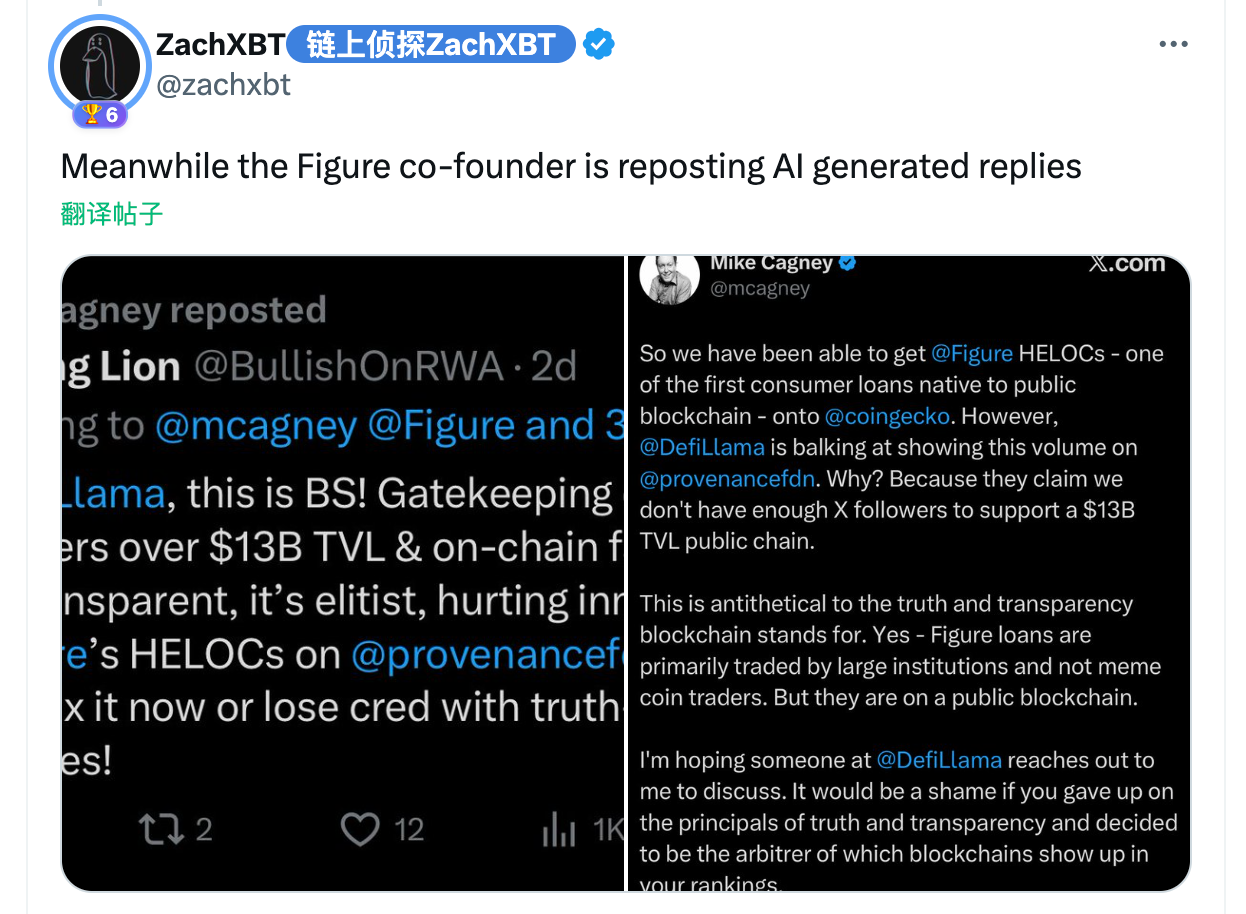
与此同时,ZachXBT 还注意到 Figure 联合创始人 Mike Cagney 不断转发一些疑似 AI 自动生成的“声援评论”,并公开点出这一点,进一步引发对 Figure 舆论操作的反感。
结语:信任的代价,才刚刚开始显露

Figure 与 DefiLlama 的争端,看似是一场榜单风波,实则击中了 RWA 赛道的核心软肋——到底什么才算“链上资产”

这场风波的核心矛盾,其实是链上原教旨主义 vs 链下映射逻辑

  • DefiLlama 的坚持:只统计能够链上验证的 TVL,坚持开源适配器逻辑,拒绝接受未能满足透明度的资产数据。
  • Figure 的模式:资产可能真实存在,但业务逻辑更多依赖传统金融系统,链上部分只是数据库回显。换言之,用户无法用链上交易去证明资产的流转,这与 DeFi 原住民的“可验证性”标准相冲突。

所谓的 120 亿美元,如果无法链上验证,就等于 0。

在一个以透明与可验证为底线的行业里,任何绕过链上验证、用数据库数字冒充链上 TVL 的尝试,最终都会反噬用户与市场信任。

这场争议可能只是开始。未来,随着更多 RWA 协议涌入,类似的问题还会不断出现。行业亟需明确统一的验证标准,否则“虚拟 TVL”就会不断膨胀,成为击穿信任的下一颗雷。
Leituras Relacionadas

τ Scaling: Huawei's New Growth Engine Designed for the Post-Moore Era

**Tau Scaling: Huawei's New Growth Engine for the Post-Moore Era** For 60 years, progress in semiconductors was driven by Moore's Law – making transistors smaller, denser, and cheaper. This path has now stalled due to plummeting returns below 7nm, astronomical lithography costs, and rising per-transistor expenses. After six years and testing 381 production chips, Huawei’s semiconductor team proposes a fundamental shift: **stop competing on size, start competing on time**. This is the core of their "τ (Tau) Scaling" theory. It treats *time* as the key optimization metric, compressing characteristic delays (τ) across all levels – from transistor switching (picoseconds) to data center tasks (seconds), spanning 12 orders of magnitude. **What is τ Scaling?** It holistically minimizes delay/time constants (τ) across four layers: transistors (switching speed), circuits (signal delay), chips (compute/memory access), and systems (end-to-end communication). The goal is to align optimization from process and circuit design to architecture and systems using this unified metric. **Mobile Application: LogicFolding** Without advancing the process node, this technique vertically stacks chips using ultra-precision hybrid bonding, distributing critical paths across layers ("stacking floors"). Results include a 55% transistor density increase, 41% better energy efficiency, over 40% higher SRAM frequency, and a roadmap targeting 4GHz by 2029. **AI Data Center Application: Full-Link Latency Compression** With 80% of AI cluster energy and 70% cost spent on data movement, the focus is slashing communication time. Key innovations include: 1. **Unified Bus:** Cuts multi-layer protocols, reducing remote access latency from microseconds to ~100 nanoseconds – 500x faster. 2. **Hi-ONE Optical Interconnect:** Replaces copper with fiber, enabling 8Tb/s per module and scaling distances from 1m to 100m for 10,000-chip clusters. 3. **3D Folding:** Solves the "interface bottleneck" of 2.5D packaging by vertically integrating memory, power, and optical I/O alongside compute, predicting over 100x integration density gain by 2035. **Re-fusion of Logic and Memory** The AI era, where data movement is more critical than computation, demands tight 3D integration of logic and memory, shifting industry influence towards memory and advanced packaging. **Remaining Challenges** include adapting EDA tools for 3D design, optimizing wafer-to-wafer process variation and vertical interconnect losses, and establishing new energy efficiency and benchmarking standards. **Conclusion:** The era of scaling physical dimensions is over. The era of scaling time has begun. By leveraging 3D stacking, system architecture, and interconnect optimization—rather than solely chasing advanced lithography—performance and efficiency can continue to advance. This is poised to be the semiconductor industry's core roadmap for the next decade.

marsbitHá 12m

τ Scaling: Huawei's New Growth Engine Designed for the Post-Moore Era

marsbitHá 12m

NodeStrategy: The First Ordinals DAT Project, Bringing the Strategy Treasury Narrative to NFTs

**Summary: The Fundamental Flaws of NodeStrategy, the 'First Ordinals DAT'** NodeStrategy presents itself as the first Ordinals Digital Asset Treasury (DAT) on Bitcoin. Its model mirrors MicroStrategy's treasury narrative but for NFTs, specifically targeting the NodeMonkes collection (not officially affiliated). The project's core mechanism is a four-step flywheel: a 10% fee on all trades (90% to treasury, 10% to radFi/Bound marketplace) is used to buy NodeMonkes. These NFTs are then listed for sale on Satflow, with 100% of the sale proceeds used to buy back and burn the project's token, NODESTRAT, aiming to create a perpetual value cycle. However, the design contains critical, self-defeating flaws: 1. **Platform Lock-In:** As a Bitcoin Rune, NODESTRAT lacks smart contract functionality and cannot natively enforce the 10% fee. The fee can only be collected on the radFi/Bound marketplace itself. This makes the entire flywheel dependent on a single platform. If liquidity moves elsewhere, fee revenue drops to zero, halting the mechanism. 2. **Self-Suffocating Economics:** The 10% fee acts both as the flywheel's fuel and a major drag on demand. A buy/sell roundtrip incurs a 20% cost, creating a massive hurdle for traders. This strangles the very trading volume needed to generate fees. 3. **Ineffective Value Support:** The flywheel is starved. Low daily volume (~$9K) generates minimal fees for NFT purchases. The NFT "ladder" sales are slow and unpredictable (only 39 total sold), meaning buybacks are infrequent. While 30.77% of the supply has been burned, this supply reduction cannot lift price without corresponding demand, which is suppressed by the high transaction tax. 4. **Meaningless NAV:** The Net Asset Value (NAV), currently at a 0.46x discount to market cap, is merely a marketing figure. There is no redemption mechanism for token holders to claim the underlying NodeMonkes assets. Price is set by market liquidity flows, not by this theoretical backing. In essence, NodeStrategy's design forces its revenue source (trading fees) to simultaneously cripple the demand and liquidity required for its own success, trapping the project in a stagnant state.

marsbitHá 19m

NodeStrategy: The First Ordinals DAT Project, Bringing the Strategy Treasury Narrative to NFTs

marsbitHá 19m

Agentic Design Patterns: A Book That Made Me Re-Understand "What Is an Agent, Really?"

"Agentic Design Patterns" is a 2025 book by Antonio Gullí, a Google engineering director, which offers a systematic framework for AI Agent development through 21 design patterns. A core contribution is the "Four Levels of Agency": Level 0 (bare LLMs) are not true agents. Level 1 agents actively decide when and how to use tools. Level 2 agents engage in strategic planning, context engineering (curating and filtering information), and self-reflection. Level 3 involves multi-agent collaboration with defined communication topologies. The book introduces **Context Engineering** as a superset of prompt engineering, managing four layers of information for the agent: system prompts, external data, implicit context (user history, environment), and feedback loops for automated optimization. A key pattern is **Reflection (Producer-Critic)**, where two distinct agents with different prompts collaborate iteratively—one produces output, the other critiques it—until quality is satisfactory or a max iteration limit is reached. For **Memory**, a three-layer model is proposed: Session (ephemeral conversation context), State (temporary task data), and Memory (persistent, long-term storage). Regarding **Multi-Agent Systems**, the book advises against unnecessary complexity, recommending simple topologies like Supervisor or Peer-to-Peer based on task needs. It emphasizes perfecting a single Level 2 agent before moving to multi-agent setups. The author concludes with three actionable takeaways: 1) Add a Critic agent to existing workflows, 2) Practice Context Engineering beyond simple prompts, and 3) Avoid premature multi-agent complexity; first master a robust single agent. The book provides a practical map, codifying common challenges like reflection, memory, and coordination into reusable patterns, saving developers from reinventing foundational solutions.

链捕手Há 1h

Agentic Design Patterns: A Book That Made Me Re-Understand "What Is an Agent, Really?"

链捕手Há 1h

An AI Read SpaceX's Prospectus and Wrote This Investment Memo in 12 Minutes

An AI agent autonomously analyzed SpaceX's 226MB S-1 filing, purchased real-time market data on-chain for $1.87, and generated a comprehensive investment memo in 12 minutes. The memo concludes a "Hold" recommendation. Bull Thesis: SpaceX holds a near-monopoly in commercial launch (80% of global orbital mass since 2023), operates the profitable Starlink business (10.3M subscribers, $7.2B adj. EBITDA), and is vertically integrated from rockets to AI via the xAI acquisition. Starlink alone is a standout, high-margin business. Bear Thesis: The AI division is a massive cash burn ($6.4B operating loss on $3.2B revenue in 2025). True debt obligations approach ~$42B, not the headline $29B, due to bridge loans and X-related debt. Significant contingent liabilities exist, including a potential $10B fee from a Cursor option agreement. The company faces concentrated counterparty risk (e.g., a $45B Anthropic contract), slowing revenue growth, and complex governance as a controlled company with four share classes. Valuation anchors Starlink's standalone value at ~$84B (applying Iridium's 7.4x sales multiple), suggesting the current ~$500B+ IPO target prices in immense future execution risk for Starship and AI. Key risks include Starship delays, accelerating AI losses, and underwriter conflicts (the IPO's lead banks are also lenders on the $20B bridge loan it aims to refinance). Investment triggers: upgrade to "Overweight" if priced ≤$350B and Starship meets milestones; downgrade to "Pass" if priced >$510B or key risks materialize.

marsbitHá 1h

An AI Read SpaceX's Prospectus and Wrote This Investment Memo in 12 Minutes

marsbitHá 1h

Trading

Spot
Futuros
活动图片