US Bitcoin ETFs Post Over $2 Billion Weekly Inflow—A Show Of Renewed Investor Appetite?

bitcoinistPublicado em 2025-09-14Última atualização em 2025-09-14

Resumo

US spot Bitcoin ETFs struggled through August while Ethereum funds dominated the scene. Now, the storm has settled, and capital...

Trusted Editorial content, reviewed by leading industry experts and seasoned editors. Ad Disclosure

US spot Bitcoin ETFs struggled through August while Ethereum funds dominated the scene. Now, the storm has settled, and capital is flowing back into crypto investment products.

The Bitcoin ETFs seem to be back enjoying the attention of US investors in the month of September, as seen with some significant performances over the past two weeks. The past week was particularly impressive, as the Bitcoin funds recorded no single outflow day.

Bitcoin ETFs Close Week With $642-M Inflow

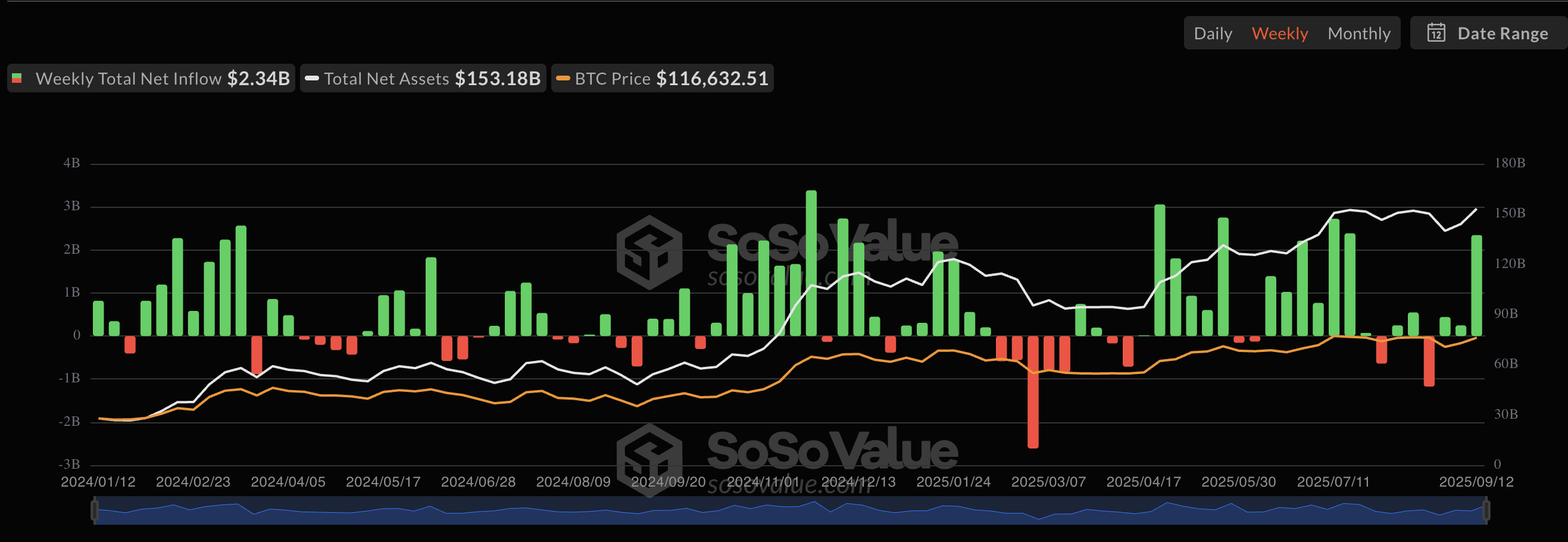
According to the latest market data, the US-based Bitcoin ETFs posted a total net inflow of $642.35 million on Friday, September 12. This single-day performance marked the fifth consecutive day of positive capital influx for the exchange-traded funds.

Surprisingly, Fidelity Wise Origin Bitcoin Fund (with the ticker FBTC) led the pack on Friday, closing the week with a net inflow of over $315 million. Meanwhile, BlackRock’s iShares Bitcoin Trust (with the ticker IBIT) came in second with a daily net inflow of $264.71 million on Friday. This impressive daily performance pushed the largest Bitcoin exchange-traded fund closer to reaching a net assets valuation of $90 billion.

Bitwise Bitcoin ETF (BITB) with a $29.16 million net inflow and ARK 21Shares Bitcoin ETF (ARKB) with a $19.37 million net inflow also added value in double digits on Friday. Grayscale Bitcoin Mini Trust (BTC) and VanEck Bitcoin ETF (HODL) were the only Bitcoin ETFs that recorded any activity, with $5.69 million and $8.24 million, respectively, on the day.

As inferred earlier, Friday’s $642-million performance was only the latest in a line of strong performances by the US-based Bitcoin ETFs. The latest market data shows that the BTC exchange-traded funds added $2.34 billion in value over the past week.
Bitcoin ETFs

Source: SoSoValue

This past week’s performance represents the first time that the Bitcoin ETFs would be crossing the billion-dollar mark on the inflow chart. Also, the BTC-linked investment products outperformed the US Ethereum ETF market, which closed the week with a net weekly inflow of $637.69.

Bitcoin Price At A Glance

This positive performance of the spot Bitcoin ETFs is a reflection of the resurgence that the BTC price went through over the past week. According to data from CoinGecko, the premier cryptocurrency is up by more than 5%. As of this writing, Bitcoin is valued at around $115,990, with no substantial price change in the past 24 hours.

Bitcoin ETFs

The price of BTC on the daily timeframe | Source: BTCUSDT chart on TradingView

Featured image from DALL-E, chart from TradingView
Editorial Process for bitcoinist is centered on delivering thoroughly researched, accurate, and unbiased content. We uphold strict sourcing standards, and each page undergoes diligent review by our team of top technology experts and seasoned editors. This process ensures the integrity, relevance, and value of our content for our readers.

Opeyemi Sule is a passionate crypto enthusiast, a proficient content writer, and a journalist at Bitcoinist. Opeyemi creates unique pieces unraveling the complexities of blockchain technology and sharing insights on the latest trends in the world of cryptocurrencies. Opeyemi enjoys reading poetry, chatting about politics, and listening to music, in addition to his strong interest in cryptocurrency.

Leituras Relacionadas

South Korean Institutions' Crypto Race: Dual Explosion of Stablecoins and RWA

**Summary: South Korea's Institutional Crypto Race: Stablecoins and RWA Take Off** South Korea is undergoing a structural shift in its crypto ecosystem, moving beyond its historical role as a major retail trading hub. Major financial institutions and internet platforms are now building institutional-grade blockchain infrastructure, with stablecoins and Real-World Asset (RWA) tokenization as the primary drivers. The push for a regulated Korean won stablecoin market is a major policy and corporate focus. This is driven partly by an estimated $115 billion outflow into dollar stablecoins like USDC, threatening the domestic financial system. Banks (e.g., KB Financial, Hana), payment giants (e.g., Shinhan Card, BC Card), and internet super-apps (KakaoPay, NAVER Pay) are all conducting pilots. The goal is to anchor future digital finance to the Korean won and local regulations. In RWA, South Korea is advancing rapidly within regulatory sandboxes, focusing on unique domestic assets beyond typical global templates like US Treasuries. Projects involve tokenizing ships (with Hyundai Heavy Industries), defense supply chain assets, and K-pop intellectual property, alongside more conventional assets. A legal framework is set for 2027, and platforms like NXT are preparing for regulated trading. Key opportunities for crypto-native projects lie in providing the underlying technology these traditional institutions lack: global distribution channels for tokenized assets, cross-chain liquidity solutions, and enabling infrastructure tools (e.g., for asset packaging and management). Partnerships, such as Solana with Shinhan Card or LayerZero with the Korea Gold Exchange, exemplify this proactive approach. Crucially, user access is being shaped by consumer platforms. NAVER's planned acquisition of Upbit's operator Dunamu and Kakao's development of a unified wallet aim to seamlessly integrate crypto with everyday payments for tens of millions of users. The race is now about which protocols and projects will become the foundational standards as regulation solidifies and institutional adoption accelerates.

Foresight NewsHá 52m

South Korean Institutions' Crypto Race: Dual Explosion of Stablecoins and RWA

Foresight NewsHá 52m

How to Detect AI-Generated Videos? A Review of Dynamic, Traceable, and Explainable Detection Systems

**How to Detect AI-Generated Videos: A Survey on Dynamic, Traceable, and Explainable Detection Systems** With rapid advances in AI video generation (e.g., Sora, Veo), creating highly realistic, multi-minute videos is now possible, widening the gap with detection research. Current AI video detection, often limited to unreliable binary classifications, is insufficient. This survey, accepted at ACL 2026, reframes the goal as **"factual fidelity verification"**—checking if a video's content (who, when, where, what) aligns with the real world perceptually and cognitively. It categorizes AI-generated videos into three paradigms: **Local Manipulation Videos (LMV**, e.g., face swaps), **Audio-Visual Editing (AVE**, e.g., lip-syncing), and **Generative Video Synthesis (GVS**, fully synthetic videos like Sora's). Detection challenges evolve from visual artifacts in LMV to multi-modal inconsistencies in AVE and higher-level world knowledge violations in GVS. The core proposal is a **Vision-Language Dual-View framework** with four hierarchical layers: 1. **Layer 1 (Intrinsic Visual Cues):** Analyzes low-level signal statistics, noise patterns, and physiological signals. 2. **Layer 2 (Spatiotemporal Consistency):** Checks for temporal coherence in object motion and scene dynamics. 3. **Layer 3 (Cross-Modal Consistency):** Verifies alignment between video, audio, and text within the video. 4. **Layer 4 (Language-Guided World-Level Reasoning):** Uses external knowledge, facts, and physical laws to judge semantic plausibility and factual correctness. The survey traces a shift in detection focus from lower layers (1 & 2) toward higher, language-involved layers (3 & 4). It also reviews evolving evaluation metrics and datasets tailored for each video paradigm. The conclusion advocates for a **dynamic, evidence-first detection system** that moves beyond simple classification. Future trustworthy detection requires combining visual evidence (from CV) with semantic reasoning and explanation (from NLP & multimodal AI), ultimately creating traceable and explainable judgments about a video's adherence to real-world constraints.

marsbitHá 1h

How to Detect AI-Generated Videos? A Review of Dynamic, Traceable, and Explainable Detection Systems

marsbitHá 1h

Trading

Spot
活动图片