The altcoin market is back on the rise. Just look at MemeCore ($M), for instance. Since last week, it has spiked by an eye-boggling 244%+.
And it’s not the only big mover in the altcoin arena. Pump.fun has jumped by over 10% in the past 24 hours, propelled by a hefty $359.2M in trading volume during the same time period.
With more capital flowing into the top altcoins, now might be the perfect time to explore the next crypto to explode to position yourself for potential gains.
Altcoin Market Exceeds 1.6T, Traders Rotate Away From $BTC
MemeCore and Pump.fun’s rallies align with broader market trends.
With the altcoin market cap above $1.6T, it shows that traders are shifting preference from $BTC – despite it being the world’s largest crypto, currently donning a $110K price tag.
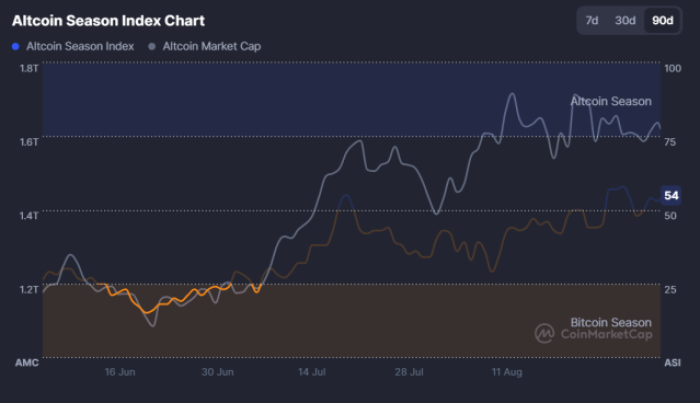
Also confirming the altcoin market’s current strength, the Altcoin Season Index (ACI) now sits at 55, up from 43 compared to last month.
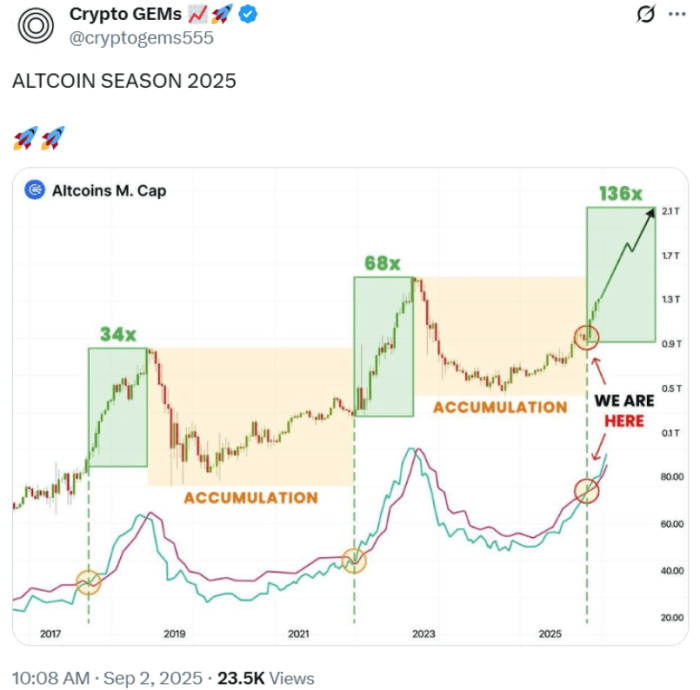
In fact, crypto analyst ‘Crypto GEMs’ suggests that the altcoin market is on the verge of its biggest breakout to date.
On a recent X post, they posted a chart that highlights that altcoins surged 34x in 2017 and 68x in 2021–2022 following long accumulation phases.
Now, in 2025, they believe the altcoin sector is about to hit another exciting accumulation period. Their prediction points to a potential 136x rally that could propel the market cap beyond $2.1T.
With altcoins poised for even more mighty growth, there may not be a better time to check out top coins with optimal potential.
We have high hopes for Snorter Token ($SNORT), PinLink ($PIN), and Maxi Doge ($MAXI) – and for superb reasons.
1. Snorter Token ($SNORT) – Presale Tops $3.7M as Telegram Bot Launch Nears
Snorter Token ($SNORT) has quickly scooped up $3.7M+ on presale, thanks to its role as the backbone of a novel Telegram trading bot.
Once launched this quarter, Snorter Bot aims to give you a potent edge in the market by allowing you to execute trades instantly, set strategies, and tap into top market opportunitie
All can be achieved through its cutting-edge features, spanning ultra-fast swaps, automated sniping, and copy trading.
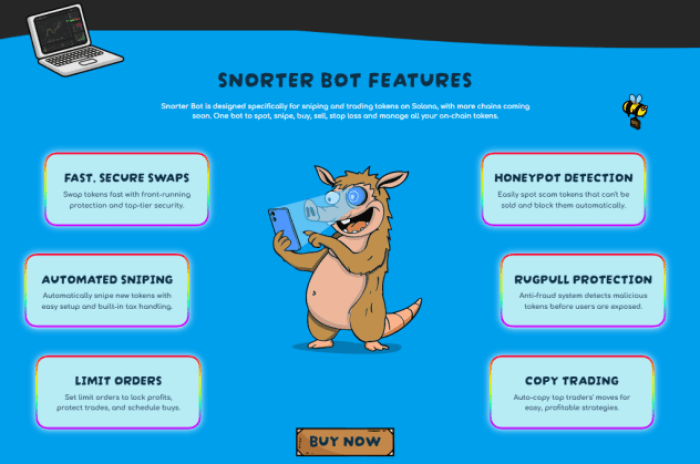
First, you can anticipate the bot launching on the Solana network as part of its plan to deliver fast execution with super low fees at just 0.85%. Owing to this, it claims that it’ll override rival bots like Maestro and Trojan.
Then, it’ll expand to Ethereum, BNB Chain, and other EVM networks. This way, you’ll be able to capture the hottest crypto opportunities across networks without having to turn to different platforms and tools.
Best of all, it promises to achieve all this without compromising security. With built-in MEV protection, plus honeypot and rugpull alerts, you can rest assured that the bot will shield you from malicious activity.
But don’t wait around. Once the bot officially goes live and expands multi-chain, it’s anticipated to reach a high of $1.92 in 2026. This means that buying in now could potentially deliver an ROI exceeding 1,759% – and that’s not even counting the passive income from staking rewards.
2. PinLink ($PIN) – RWA-Tokenized Protocol Surges 10% Following Hashrate Initiative Teaser
$PIN is the foundation of PinLink, a cutting-edge RWA-tokenized protocol that connects AI developers with cost-friendly compute power. Why? To unlock new revenue streams for asset owners.
Through ERC-1155 fractionalization, DePin operators can tokenize their assets to raise capital for reinvesting in new infrastructure: expanding compute power, scaling storage, or energy networks.
In return, those who invest in these fractions gain access to steady passive income, even if they don’t own DePin hardware.
$PIN powers the marketplace, enabling transactions, staking, and governance. Additionally, it unlocks dual revenue streams for asset owners.
And it doesn’t end there. PinLink is expanding beyond AI compute with HashLink, its new Bitcoin primitive. It’ll enable future hashrate speculation and direct $BTC payouts via Ethereum – another avenue to give you exposure to mining economics without owning traditionally pricey DePin hardware.
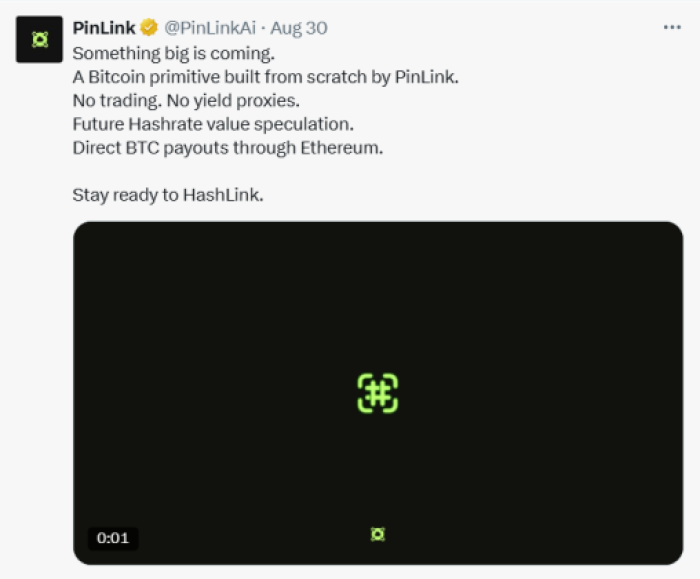
Following this news breaking out, $PIN rose by over 10%. Now signals an opportune time to purchase the token, available for roughly $0.61 on some of the best crypto exchanges.
3. Maxi Doge ($MAXI) – Offers 172% Staking Rewards, Eyes Degen Trading Tournaments
Maxi Doge ($MAXI) is a meme coin on a mission to dominate the $45.1B dog-themed token niche.
As yet another Shiba Inu-inspired coin, it builds on the legacy of the top dogs on the market, $DOGE and $SHIB. But it visually sets itself apart from them, with muscles and a bold heavyweight persona that symbolizes its push toward extreme trading and market strength.
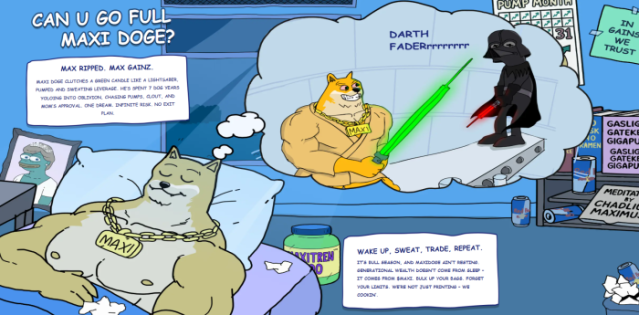
Despite its meme coin facade and origins, $MAXI wants to bring more to the arena than just speculation, a bit like $SHIB. But instead of launching a DEX or card game like its predecessor, it’s barking up its own path.
Despite only being live on presale thus far, it’s already engaging its community through staking. You can lock up $MAXI to earn daily rewards through smart contract distribution. Right now, its staking APY stands at an eye-catching 172% APY.
To top it off, Maxi Doge plans to host contests and reward top ‘ROI hunters’ with prizes. For the time being, the key details remain under wraps.
The project also aims to integrate futures platform integrations and host gamified tournaments in the future. Then, it’ll offer you a distinct way to partake in degen-style trading. For more information, check out our review.
You can join the action by acquiring $MAXI on presale for just $0.0002555. And there’s no better time to do precisely that; its price will go up tomorrow and is anticipated to break $0.0024 before 2026 gets going.
Verdict – MemeCore & Pump.fun’s Rally Sparks Growth for Top Altcoins
Hype surrounding altcoins is real, as evidenced by MemeCore and Pump.fun’s surge, plus a rising ASI.
If you’re seeking the next 1000x crypto, it might be wise to consider projects with strong utility and community hype, just like $SNORT, $PIN, and $MAXI.
Whichever one floats your boat, they each have significant growth potential.
Still, only time will truly tell their success. So, as always, DYOR and never invest more than you’d be sad to lose.

Related Posts