Global Crypto Adoption 2025: Chainalysis Reveals Which Countries Are Winning

bitcoinistPublicado em 2025-09-04Última atualização em 2025-09-04

Resumo

Chainalysis has released its sixth annual Global Crypto Adoption Index, naming India the world’s top market for grassroots crypto adoption...

Trusted Editorial content, reviewed by leading industry experts and seasoned editors. Ad Disclosure

Chainalysis has released its sixth annual Global Crypto Adoption Index, naming India the world’s top market for grassroots crypto adoption in 2025, with the United States in second place, followed by Pakistan, Vietnam and Brazil. Published on September 2, 2025 as an excerpt from the forthcoming Geography of Cryptocurrency Report, the study blends on-chain and off-chain data to rank 151 countries by how widely and intensively ordinary people and institutions are using crypto, rather than by headline market capitalization alone.

Global Crypto Adoption Report 2025

At the heart of the ranking is a composite score built from four sub-indices: on-chain value received by centralized services; retail-sized on-chain value received by centralized services; on-chain value received by DeFi protocols; and institutional-sized on-chain value received by centralized services. Chainalysis says it ranks each country across these pillars, weights the results by factors such as population and purchasing power, and then takes a geometric mean to produce a normalized 0–1 score. The firm emphasizes scale, noting that its inputs encompass “hundreds of millions of cryptocurrency transactions and more than 13 billion web visits,” while acknowledging web-traffic-based geolocation limits.

Methodologically, 2025 marks a notable pivot. Chainalysis “removed the retail decentralized finance (DeFi) sub-index” after concluding it over-weighted a “relatively niche behavior,” and added a new institutional activity lens capturing transfers over $1 million, reflecting the post-ETF surge in professional participation. The aim, the firm writes, is a “fuller view of global crypto engagement, capturing both bottom-up (retail) and top-down (institutional) activity.”

The headline table underscores Asia’s weight. India sits first overall and first across all four underlying categories; Pakistan and Vietnam join it in the global top four, while Brazil rounds out the top five. Nigeria, Indonesia, Ukraine and the Philippines rank sixth through ninth, with the Russian Federation at ten and the United Kingdom at eleven. Notably, Ethiopia and Yemen enter the top twenty at twelfth and sixteenth, respectively, while Japan ranks nineteenth and Argentina twentieth. Chainalysis attributes the regional momentum to a surge in both centralized and decentralized usage across major APAC markets.
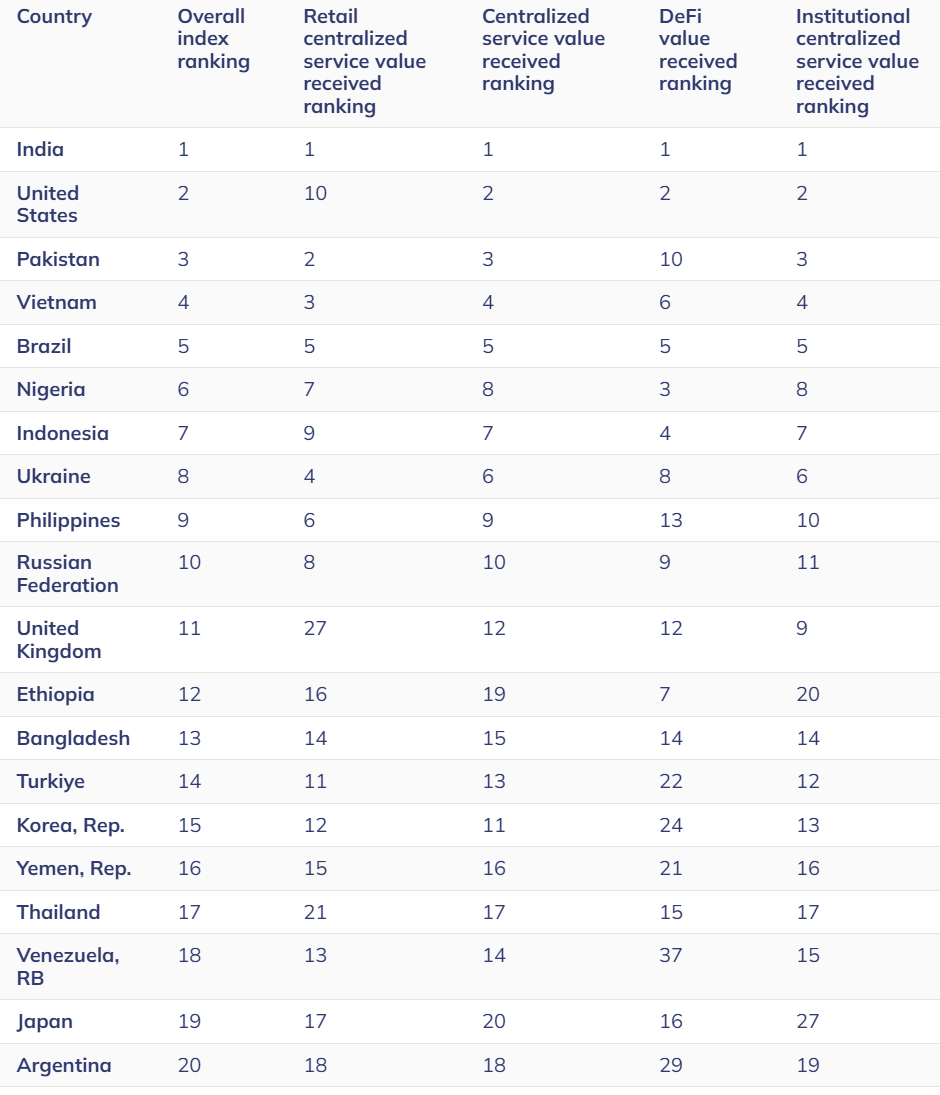
Global crypto adoption index 2025
Global crypto adoption index 2025 | Source: Chainalysis

Regional flow data deepen that picture. Over the twelve months to June 2025, APAC’s on-chain value received jumped 69% year over year—from roughly $1.4 trillion to $2.36 trillion—making it the fastest-growing region. Latin America followed at 63% growth and Sub-Saharan Africa at 52%. In absolute terms, Europe and North America still dominate, receiving about $2.6 trillion and $2.2 trillion respectively over the period; North America’s activity grew 49% amid renewed institutional participation, while Europe rose 42%. MENA expanded by 33%.

A population-adjusted cut of the index tells a different story, highlighting where crypto has penetrated most deeply relative to country size. On that basis, Eastern Europe is ascendant: Ukraine ranks first, Moldova second and Georgia third, ahead of Jordan and Hong Kong SAR. Chainalysis links the region’s leadership to economic uncertainty, distrust in banks, and high technical literacy that make crypto attractive for wealth preservation and cross-border transfers. Vietnam again appears near the top in this view, underscoring its broad-based retail engagement.
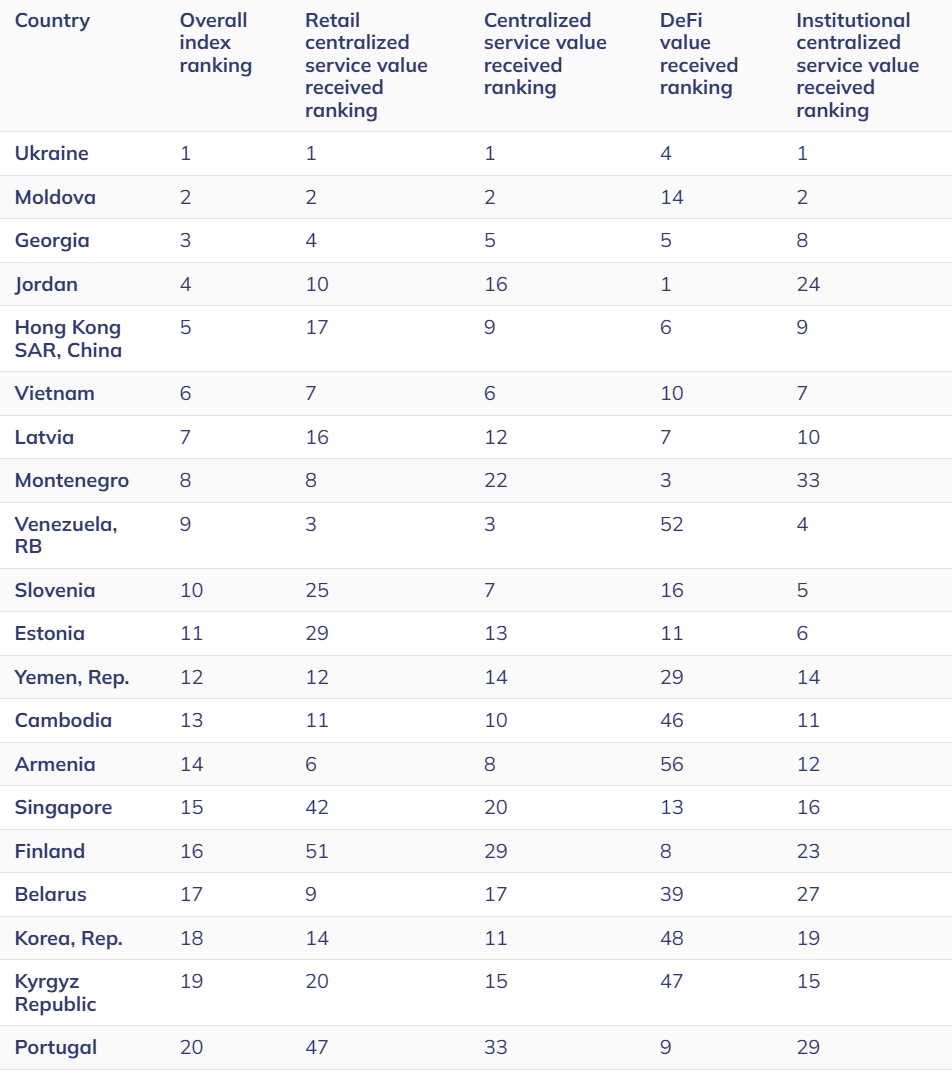
Global crypto adoption index 2025 adjusted by population
Global crypto adoption index 2025 adjusted by population | Source: Chainalysis

Stablecoins remain the connective tissue of global crypto commerce. Chainalysis finds that USDT and USDC continue to dwarf peers in transaction volume, with USDT processing over $1 trillion per month between June 2024 and June 2025 and USDC ranging roughly from $1.24 trillion to $3.29 trillion monthly, even as newer, more regulated or regionally tailored tokens accelerate. EURC’s monthly volume, for example, rose from about $47 million to more than $7.5 billion over the period, while PYUSD climbed from roughly $783 million to $3.95 billion.

The firm situates these flows within shifting rulesets—MiCA’s stablecoin regime in the EU and US legislative momentum exemplified by the GENIUS Act—alongside expanding merchant rails from payments giants and card-linked integrations by major crypto platforms.

Crucially, the report analyzes the fiat “on-ramp” into crypto across centralized exchanges. “Bitcoin leads by a wide margin,” Chainalysis writes, accounting for over $4.6 trillion in fiat purchase volume from July 2024 to June 2025—more than double Layer-1 tokens ex-BTC and ETH (about $3.8 trillion), with stablecoins at $1.3 trillion and altcoins around $540 billion. The United States is the largest national on-ramp at more than $4.2 trillion, followed by South Korea above $1 trillion and the European Union just under $500 billion; Bitcoin’s share of fiat inflow is especially pronounced in the UK and EU at roughly 47% and 45%.

At press time, Bitcoin traded at $110,518.
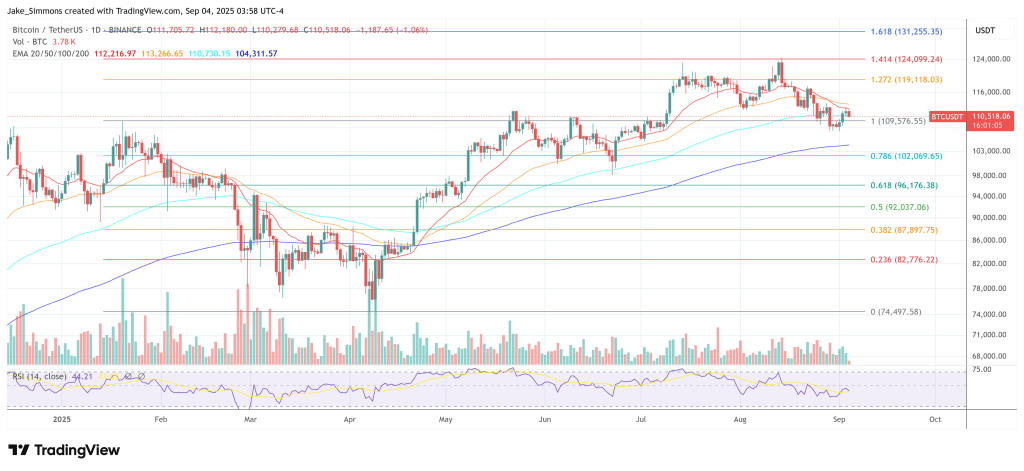
Bitcoin price
BTC falls below the EMA100 again, 1-day chart | Source: BTCUSDT on TradingView.com
Featured image created with DALL.E, chart from TradingView.com
Editorial Process for bitcoinist is centered on delivering thoroughly researched, accurate, and unbiased content. We uphold strict sourcing standards, and each page undergoes diligent review by our team of top technology experts and seasoned editors. This process ensures the integrity, relevance, and value of our content for our readers.

Jake Simmons has been a Bitcoin enthusiast since 2016. Ever since he heard about Bitcoin, he has been studying the topic every day and trying to share his knowledge with others. His goal is to contribute to Bitcoin's financial revolution, which will replace the fiat money system. Besides BTC and crypto, Jake studied Business Informatics at a university. After graduation in 2017, he has been working in the blockchain and crypto sector. You can follow Jake on Twitter at @realJakeSimmons.

Leituras Relacionadas

Apple and the Power Rebalancing with 'The Microns': Dissecting the Profit Ledger Behind the iPhone

The article analyzes the shifting profit dynamics and power balance between Apple and memory suppliers like Micron within the iPhone supply chain. It highlights a social media post criticizing Apple for raising iPhone prices while blaming memory chip cost increases, despite historically paying suppliers like Micron very little. An estimated iPhone 18 cost breakdown is referenced. Historically, memory was a minor cost component. In 2017's iPhone X, memory accounted for only about 1.6-2.3% of the price, with Apple capturing nearly 50% net profit. Over time, memory's share of the Bill-of-Materials (BOM) cost has grown significantly, reaching an estimated 12-15% for the iPhone 17 series. The core driver of this change is soaring demand for memory from the AI industry, particularly for High Bandwidth Memory (HBM) and AI servers, which is diverting production capacity and squeezing supply for consumer electronics. Memory manufacturers, after enduring periods of low profits, now hold greater pricing power. This is reflected in their recent strong financials, like Micron's 84.6% gross margin. Apple CEO Tim Cook initially described the memory price pressure as unprecedented in his 40-year career, later calling it a "once-in-a-century flood," before Apple announced price hikes across several product lines, causing a significant stock drop. Elon Musk echoed Cook's sentiment about the dramatic cost surge. The article concludes that the era of memory suppliers being at the mercy of Apple's pricing power has temporarily reversed, thanks to AI-driven demand. It notes Apple is reportedly seeking to diversify its supply chain, including exploring chips from China's CXMT.

Odaily星球日报Há 1h

Apple and the Power Rebalancing with 'The Microns': Dissecting the Profit Ledger Behind the iPhone

Odaily星球日报Há 1h

Conversation with the Founder of 42 Macro: The Fed's 'Boiling the Frog Slowly' and the K-Shaped Economy

In a conversation with Anthony Pompliano, Darius Dale, founder of 42 Macro, discusses the Federal Reserve's monetary policy and the K-shaped U.S. economy. Dale characterizes new Fed Chair Kevin Warsh as a "dove in hawk's clothing," expecting the Fed to signal or enact policy tightening in the coming quarters to create room for later easing. He argues current economic signals, including high deficit spending, debt monetization, and credit growth, strongly indicate inflation is not on a credible path back to 2%, forcing the Fed to act. The discussion highlights the stark "K-shaped" economic reality. While top earners, buoyed by massive cash savings (up ~$8 trillion since pre-pandemic), continue robust spending, those at the bottom face severe financial strain, with delinquency rates on consumer loans reaching crisis-era highs. Dale attributes much of the current social and political anxiety to this divergence, driven by the "Cantillon effects" of monetary expansion, which disproportionately benefits asset owners. He emphasizes that in this environment of "financial repression," individuals must participate in asset markets to avoid being left behind. On equities, Dale notes a rotation from the "Magnificent Seven" tech giants into broader AI-exposed companies, while warning that the tech giants' massive capital expenditure cycles could eventually puncture over-optimistic cash flow projections. Dale concludes by stressing that the core desire across all economic strata is simply the dignity to provide for one's family, a goal currently undermined by systemic policies that act as a "wealth siphon" from the bottom to the top.

marsbitHá 1h

Conversation with the Founder of 42 Macro: The Fed's 'Boiling the Frog Slowly' and the K-Shaped Economy

marsbitHá 1h

The Domestic Answer to Space Computing Power: Photonics Are More Efficient, Musk and Huang's Approaches Are Too Roundabout

The Space Computing Race: A Photonic Advantage The competition for space-based computing has intensified, with figures like Elon Musk and NVIDIA's Jensen Huang highlighting its potential. Musk predicts solar-powered AI satellites could offer the most cost-effective computing by 2032. However, space presents extreme challenges for traditional electronic chips: radiation from cosmic particles can cause errors, the vacuum environment hinders heat dissipation, and limited solar power constrains energy-hungry systems. Photonic computing, using light instead of electrons, offers a promising solution. Its core advantages for space are threefold: 1) **Radiation Resistance**: Photons are charge-neutral, making them inherently immune to particle interference. 2) **Low Heat Generation**: Light propagation in waveguides generates minimal heat, bypassing critical thermal management issues. 3) **Low Power Consumption**: Photonic chips have near-zero static power draw, aligning perfectly with the energy constraints of satellites. Furthermore, for a given payload weight and volume, photonic systems can potentially deliver higher total compute density. Since they require less bulky cooling and power infrastructure, more space can be allocated to the compute units themselves. While photonic computing holds great promise, current industry approaches face hurdles like the memory-compute bottleneck (separate storage and processing) and challenges in large-scale integration. Engineering for space—withstanding launch vibrations and validating full system operation in orbit—remains a critical step. The path forward resembles the evolution from single GPUs to computing clusters, but via a photonic route. As electronic chips approach physical limits in miniaturization, photonic computing and optical interconnects (光算光联) may provide a key alternative to bypass these constraints and define the next generation of space-based computing capabilities.

marsbitHá 2h

The Domestic Answer to Space Computing Power: Photonics Are More Efficient, Musk and Huang's Approaches Are Too Roundabout

marsbitHá 2h

Trading

Spot
活动图片