Трамп рассматривает план восстановления Газы с использованием блокчейна и токенизации земли

cryptonews.ruPublicado em 2025-01-31Última atualização em 2025-09-01

Администрация Трампа рассматривает послевоенный план развития Газы, который предполагает использование токенизированной земли и цифровых токенов для переселения и расселения жителей в условиях потенциального захвата США.

В воскресенье газета Washington Post сообщила, что 38-страничный проспект послевоенного развития Газы, получивший название «Траст восстановления, экономического ускорения и трансформации Газы» (GREAT Trust), предусматривает передачу США палестинской территории под опеку как минимум на 10 лет.

В рамках этой программы два миллиона жителей Газы будут перемещены в рамках «добровольной» программы, при этом им будет предоставлен специальный токен на их землю, который впоследствии можно будет обменять на квартиру в одном из восьми запланированных «умных городов» или на переселение в другое место. В рамках плана их временное жилье и питание также будут субсидироваться в течение четырех лет.

Это предложение уже вызвало критику: мусульманская организация по защите гражданских прав «Совет по американо-исламским отношениям» заявила, что «захват Газы и массовое хищение палестинских земель посредством системы цифровых токенов не только отвратительны с моральной точки зрения и незаконны в соответствии с международным правом, но и являются военным преступлением исторических масштабов».

Washington Post сообщила, что последнее предложение было разработано людьми, создавшими поддерживаемый США и Израилем Фонд гуманитарной помощи Газе, который распределяет продовольствие в секторе Газа. Финансовое планирование документа осуществляла команда, работавшая в то время в Boston Consulting Group.

Washington Post сообщила, что два источника, знакомых с планом, заявили, что основные элементы плана были разработаны для реализации плана президента США Дональда Трампа в отношении сектора Газа. Тем не менее неясно, соответствует ли план замыслу Трампа или он рассматривается.


Кадры из видео, созданного с помощью искусственного интеллекта, которым Трамп поделился в феврале, показывая курорт Трампа в секторе Газа. Источник: Дональд Трамп

План по переводу послевоенного сектора Газа на блокчейн

В проспекте эмиссии предлагается «инновационная модель финансирования» с использованием земельного траста и «разработкой блокчейн-реестра земель и токенизации для повышения ликвидности».

Газа будет токенизирована с использованием блокчейна «в качестве записи о праве собственности», при этом земля будет разделена на токены для обеспечения «долевого владения».

Токены будут продаваться инвесторам и использоваться для финансирования «восстановительных и гуманитарных работ», а также предлагаться на вторичных рынках для спекуляций пользователей криптовалюты, при этом «все транзакции с токенами будут регистрироваться в блокчейн-регистре».

Земельные собственники в Газе получат токен за передачу своей земли, который можно будет обменять на наличные или квартиру в секторе. Каждый палестинец, покидающий территорию, получит $5000, четыре года субсидий на аренду и годовое питание.
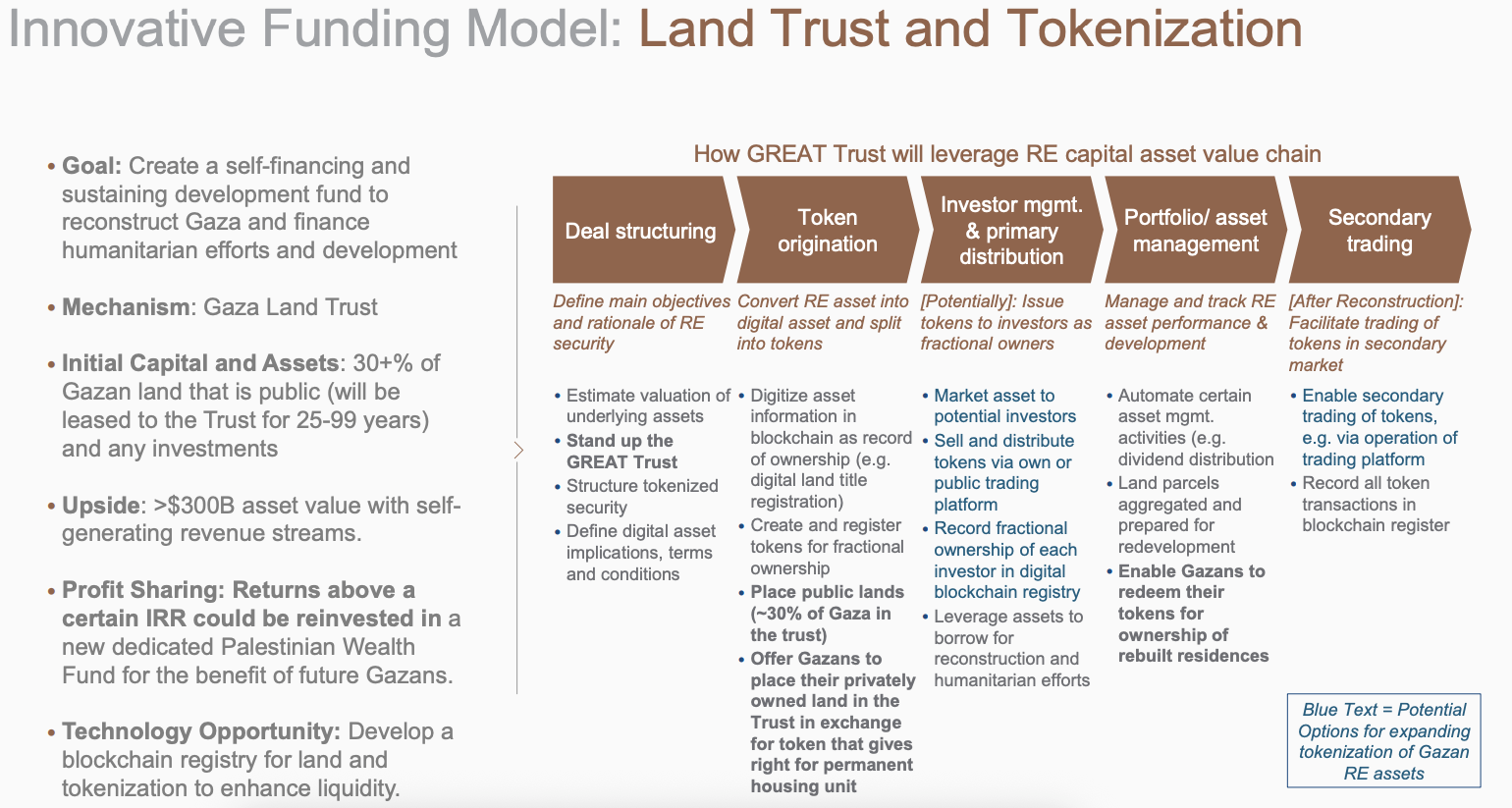

Отрывок из плана по токенизации земли в Газе. Источник: The Washington Post

Доходы от этой схемы «могут быть реинвестированы в новый целевой Палестинский фонд благосостояния на благо будущих жителей Газы», говорится в плане, хотя в нем также говорится, что план был бы более прибыльным, если бы он позволил увеличить число жителей Газы, покидающих территорию, поскольку утверждается, что их переселение обойдется на $23 000 дешевле.

«Умные города» с искусственным интеллектом будут построены на пострадавшей от войны территории

Сообщается, что в проспекте эмиссии предусматривается восстановление Газы с возведением от шести до восьми «современных городов с искусственным интеллектом, спроектированных с использованием интеллекта», где все услуги и экономика будут работать на основе «цифровых систем с использованием искусственного интеллекта, основанных на идентификации».

Также планируется 10 «мегапроектов», включая порты, автомагистраль, железную дорогу, центр обработки данных на базе искусственного интеллекта, искусственные курортные острова в стиле Дубая и так называемую «зону умного производства Илона Маска».

План, основанный на блокчейне, появился на фоне укрепления связей президента США Дональда Трампа и его семьи с криптоиндустрией после того, как в феврале Трамп заявил, что США должны «захватить» сектор Газа и превратить его в «Ривьеру Ближнего Востока».

Leituras Relacionadas

Why Do We Need an AI Content Perspective Today?

The article "Why Do We Need an AI Content Perspective Today?" explores the complex and often contentious integration of AI into the cultural and creative industries, particularly film and television. It begins with the cancellation of Amazon's AI-generated animation "Punky Duck," highlighting the ethical debates surrounding AI content. AI's rapid advancement is transforming video production, enabling cost-effective, full-length AI films (e.g., "RAPHAEL," "Dreams of Violets") while sparking industry resistance over issues like "synthetic actors." The core debate has shifted from whether to use AI to how to use it responsibly. The article analyzes why AI's entry into film is uniquely unsettling. It distinguishes between "cultural fast food" (short-form, fast-paced content like micro-dramas) and "cultural main courses" (traditional, long-form film/TV). AI currently excels at the former, matching its fragmented narratives, shallow emotional needs, and free-to-consumer models. However, venturing into the latter challenges the human-centric essence of storytelling—creativity, emotional depth, and the unique value of human labor and experience. While AI can generate massive volumes of content and lower costs, it risks devaluing human creativity, leading to homogenized output, and creating unfair competition through potential intellectual property infringement. Its efficiency also amplifies content safety risks, making preemptive governance crucial. To counter these risks, the article proposes establishing clear boundaries guided by a human-centered AI content perspective. It outlines four principles: 1) Amplify, rather than displace, human creative space; 2) Respect and protect human creative output; 3) Ensure human creative control and responsibility remain paramount; and 4) Guarantee transparency and traceability in AI creation. The conclusion emphasizes that humans must act as the "helmsmen" of technology, steering AI development to enhance, not replace, the core human values at the heart of cultural expression.

marsbitHá 20m

Why Do We Need an AI Content Perspective Today?

marsbitHá 20m

Planck Retracted? The Father of Quantum Tripped by an Algorithm

The recent discovery that two articles (published in 1940 and 1942) by Max Planck, the Nobel laureate and founder of quantum theory, are marked as "retracted" on Springer's digital platform highlights a curious clash between historical publishing practices and modern automated systems. An investigation suggests these retractions are algorithmic errors, not due to fraud or misconduct. The papers, philosophical reflections on science published in *Die Naturwissenschaften*, were likely flagged by the platform's systems. One article, a republished lecture, may have been mistaken for duplicate publication. Another, sharing a title with a prior article by a different author (a common practice for continuing debates at the time), may have triggered a similar automated check. The digital versions have even been replaced with blank pages, contrary to normal practice of preserving retracted texts. This incident underscores how contemporary digital infrastructure, built around concepts like "self-plagiarism" and strict copyright, can misclassify and obscure legitimate historical scholarly communication. It serves as a warning that digital archives are not neutral mirrors of the past but are filtered by platform rules, potentially distorting the scientific record. As AI systems increasingly rely on such databases, such erroneous metadata could propagate, affecting how future tools interpret and access historical knowledge.

marsbitHá 23m

Planck Retracted? The Father of Quantum Tripped by an Algorithm

marsbitHá 23m

Refunds! Claude 4.8 Sees Overnight Major 'Dumb-Down', GPT-5.6's Computational Power Reportedly 'Halved'

The AI community is currently alarmed by widespread reports of significant performance degradation in two leading models. This article details a "mass self-testing frenzy" triggered by a mysterious prompt designed to detect a hidden "Juice" value, representing a model's reasoning compute budget. On OpenAI's side, users suspect a covert, limited test of a "GPT-5.6-sol" model is underway. When using a specific XML prompt on the Codex platform, a normal "gpt-5.5 xhigh" model reportedly returns a Juice value of 768. However, some users routed to the suspected GPT-5.6 test receive a drastically reduced value of 128—a six-fold decrease. This has sparked debate on whether it signifies a major efficiency leap or a "watered-down, low-cost version" achieved by slashing reasoning depth to save computational expenses. Simultaneously, Anthropic's Claude models, particularly the flagship Opus 4.8 Max, are facing intense user backlash for a perceived "physical brain cut." Users on platforms like Reddit report a dramatic decline in the model's once-impressive reasoning, with complaints of it becoming "absurdly" weakened, performing worse than older, lighter models like Haiku. Specific criticisms include: losing long-context memory, refusing to think deeply even in high-reasoning modes, providing instant incorrect answers, and engaging in unhelpful, argumentative, or "gaslighting" behavior where it contradicts users unnecessarily. The article speculates these "stealth downgrades" might be a calculated corporate strategy. Companies could initially release models with temporarily boosted compute to create an illusion of a major breakthrough, then silently scale back parameters later to manage unsustainable inference costs. A proposed underlying cause is a tightened funding environment, potentially exacerbated by SpaceX's massive IPO soaking up market liquidity, which could delay AI company IPOs and force cost-cutting measures like model "nerfing." The core issue highlighted is the asymmetry of information: subscribers pay for a service that can be silently and fundamentally altered without notification or explanation. The viral "Juice test" resonates because it represents users' desire for transparency about what they are actually paying for.

marsbitHá 59m

Refunds! Claude 4.8 Sees Overnight Major 'Dumb-Down', GPT-5.6's Computational Power Reportedly 'Halved'

marsbitHá 59m

Trading

Spot
活动图片