Can RWA Become The Next Millionaire-Making Trend? How Can XYZVerse (XYZ) Surprise Everyone?

bitcoinistPublicado em 2025-08-27Última atualização em 2025-08-28

Resumo

The crypto market thrives on narratives, and every cycle brings a new wealth-making trend. In the past, it was DeFi,...

Trusted Editorial content, reviewed by leading industry experts and seasoned editors. Ad Disclosure

The crypto market thrives on narratives, and every cycle brings a new wealth-making trend. In the past, it was DeFi, then NFTs, then meme coins. Now, many investors are asking whether Real-World Assets (RWA) could become the next frontier for outsized gains. By bringing tangible value—like real estate, commodities, and collectibles—onto the blockchain, RWA is reshaping how people think about ownership and investment. 

But amid the hype, attention is shifting to projects with unique approaches. XYZVerse (XYZ) stands out as one of them. Will this newcomer bring something no one expects? Investors are watching closely to see what surprise XYZVerse might reveal next.

Demand for $XYZ Surges As Its Capitalization Hits the $15M Milestone
Community-First Vibes

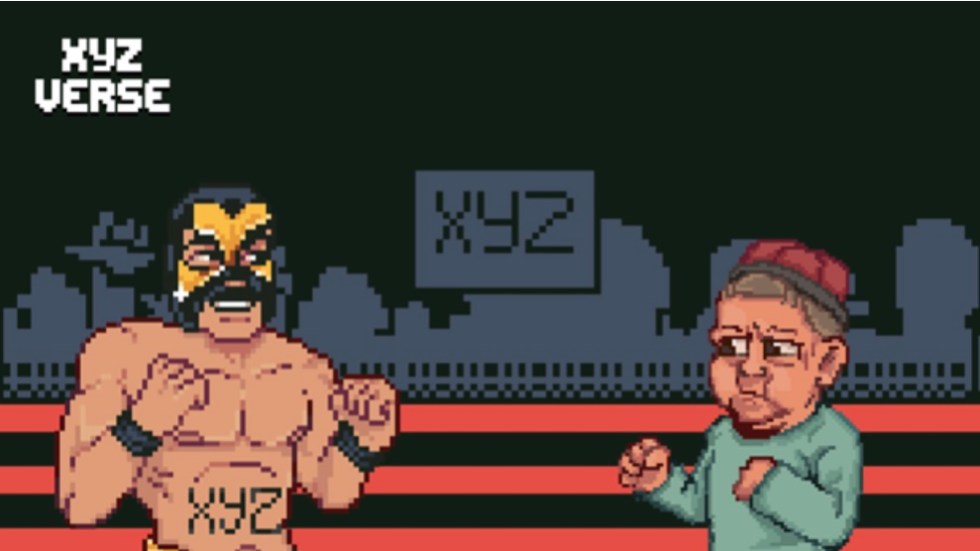
XYZVerse ($XYZ), recently recognized as Best NEW Meme Project, is drawing significant attention thanks to its standout concept. It is the first ever meme coin that merges the thrill of sports and the innovation of web3.

Unlike typical meme coins, XYZVerse offers real utility and a clear roadmap for long-term development. It plans to launch gamified products and form partnerships with big sports teams and platforms.

Notably, XYZVerse recently delivered on one of its goals ahead of schedule by partnering with bookmaker.XYZ, the first fully on-chain decentralized sportsbook and casino. As a bonus, $XYZ token holders receive exclusive perks on their first bet.

Price Dynamics and Listing Plans

During its presale phase, the $XYZ token has shown steady growth. Since its launch, the price has increased from $0.0001 to $0.005, with the next stage set to push it further to $0.01. The final presale price is $0.02, after which the token will be listed on major centralized and decentralized exchanges.

The projected listing price of $0.10 could generate up to 1,000x returns for early investors, provided the project secures the necessary market capitalization.

So far, more than $15 million has been raised, and the presale is approaching another significant milestone of $20 million. This fast progress is signaling strong demand from both retail and institutional investors.

Champions Get Rewarded

In XYZVerse, the community calls the plays. Active contributors are rewarded with airdropped XYZ tokens for their dedication. It’s a game where the most passionate players win big.

The Road to Victory

With solid tokenomics, strategic CEX and DEX listings, and consistent token burns, $XYZ is built for a championship run. Every play is designed to push it further, to strengthen its price, and to rally a community of believers who believe this is the start of something legendary.

Airdrops, Rewards, and More – Join XYZVerse to Unlock All the Benefits

Hedera (HBAR)
Hedera (HBAR)

Source: TradingView

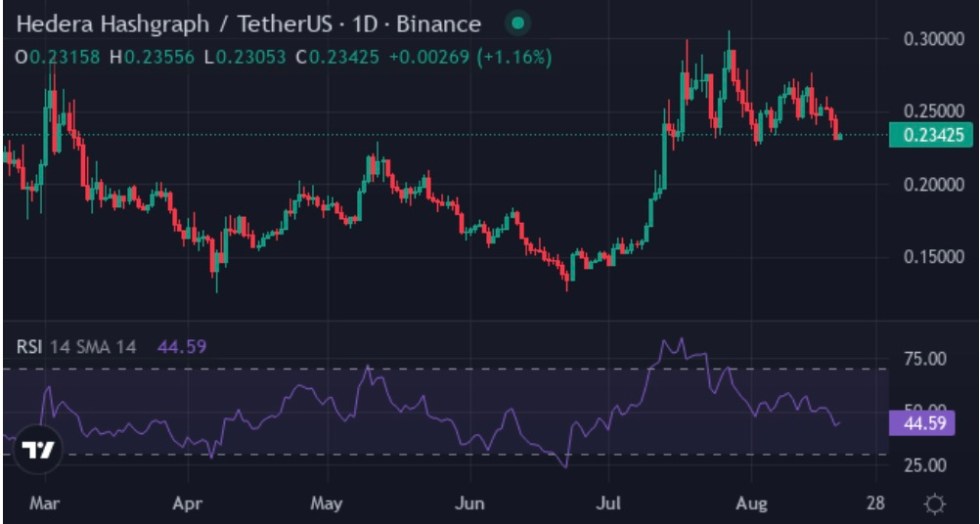
HBAR fell 10.53% in the past week and 13.52% over the month, but it is still up 5.71% in 6 months. The coin now trades at 0.24-0.27, hovering around the 100-day average of 0.25 and just above the 10-day average of 0.23.

Support at 0.22 has held so far. RSI at 42 shows lukewarm interest, while a negative MACD and Stochastic at 53 signal indecision. If buyers push through 0.29, the next cap sits at 0.33, which would be roughly a 25% jump from 0.26. On the flip side, a drop below 0.22 could drag the price to 0.18, a slide near 25%.

With mixed momentum, the chart favors more range-bound action. Traders will watch a close above 0.29 for a bullish break or below 0.22 for a bearish swing. Either move could trigger a fast 20-25% shift as HBAR seeks its next level.

Ondo (ONDO)
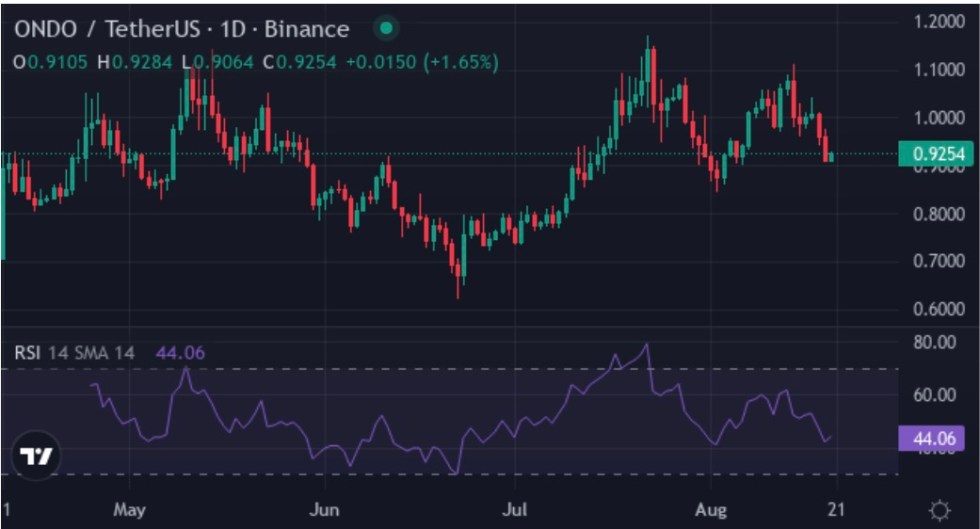
Ondo (ONDO)

Source: TradingView

ONDO is boxed between $0.94 and $1.09 after a 12.73% weekly dip and an 11.63% monthly slide. The 6-month loss is 25.39%. Its 10-day average at $0.92 trails the 100-day mark at $0.97, underlining soft demand.

The strength gauge reads 44.97 while the fast-slow meter sits at 61.17. Trend pressure is slightly negative at ‑0.0081. Support rests at $0.88; holding that floor could spark a push to $1.18, a gain of about 15%. A stronger burst might test $1.33, roughly 22% from today’s high.

Failure to protect $0.88 opens room to $0.72, lopping off near 20%. Until a clear break, the token drifts sideways. A close above $0.97 would brighten the tone and hint at the first real recovery in weeks.

VeChain (VET)
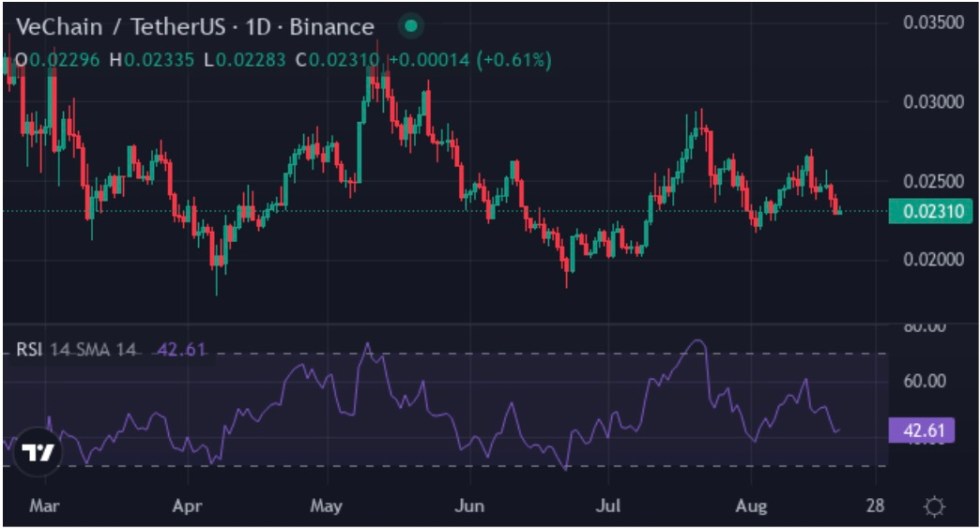
VeChain (VET)

Source: TradingView

This week VET lost close to 10%. The drop widened the slide seen in May. The coin is now down more than 22% in a month and about 32% since winter. Price hovers between 0.023 and 0.027, near lows last seen in early spring.

Short-term trading shows stress. The 10-day average is 0.0231 and sits under the 100-day average at 0.0242, a bearish spread. The strength index is 44 and the stochastic meter is 39, both below the midline, hinting at weak demand but not panic selling. The trend gauge prints ‑0.000224, still negative but shallow.

If buyers return and push VET above 0.0289 the chart could flip positive. Long-term forecasts suggest an increase of roughly 15% to 0.0327. Failure to hold 0.0213 risks a quick slip near 0.0175, meaning a fall of up to 25%. For now, traders watch the 0.024 zone as the pivot for the next swing.

Conclusion

HBAR, ONDO and VET remain good bets, yet XYZVerse is the first all-sport memecoin, targeting significant gains via sports passion, early entry, community rule and clear plans.

You can find more information about XYZVerse (XYZ) here:

https://xyzverse.io/, https://t.me/xyzverse, https://x.com/xyz_verse

Editorial Process for bitcoinist is centered on delivering thoroughly researched, accurate, and unbiased content. We uphold strict sourcing standards, and each page undergoes diligent review by our team of top technology experts and seasoned editors. This process ensures the integrity, relevance, and value of our content for our readers.

Leituras Relacionadas

AI is Sweeping the Globe, So Why is Crypto + AI in a Slump?

AI Booms, But Crypto + AI Remains Sluggish: A Demand-Side Analysis Despite the AI industry's explosive growth and massive investment, the convergence of blockchain and AI (Crypto + AI) has seen limited traction. The core issue is a severe supply-demand mismatch, not a flawed premise. Analyzing four key sub-sectors reveals specific gaps: 1. **Decentralized Compute/Storage:** Offer logical benefits like data sovereignty and cost savings but lack a decisive technical advantage over entrenched cloud giants (AWS, GCP). Enterprises prioritize performance and stability and are unwilling to bear the switching risk and uncertainty of decentralized networks. 2. **Model Verification/Privacy (e.g., ZKML):** Address important long-term issues like auditability and data privacy, but these are not urgent operational pain points for most businesses today. Widespread demand will likely follow regulatory mandates (like the EU AI Act), not precede them. 3. **AI Agent Infrastructure:** Projects are building infrastructure for a future of autonomous, interacting agents. However, the current market focus is on internal process automation within corporate firewalls. The technology is ahead of market readiness. 4. **AI Agent Payments:** This is the only sub-sector where blockchain is on a level playing field with traditional finance. Both are trying to solve the unsolved problem of real-time, micro-transactions for machines, making it the most immediately competitive area. The overarching problem is that the AI industry invests heavily in solutions that solve immediate bottlenecks (e.g., faster memory, more power). Most Crypto + AI solutions target secondary, longer-term concerns (decentralization, transparency) and often come with performance trade-offs. The lack of a flagship, large-scale commercial success case further hinders mainstream capital inflow. The path forward requires either aligning more closely with the current industry's performance demands or patiently building the foundational infrastructure for the next phase of AI.

Foresight NewsHá 3m

AI is Sweeping the Globe, So Why is Crypto + AI in a Slump?

Foresight NewsHá 3m

Continuous Net Outflows from ETFs, Are Institutions Exiting?

US spot Bitcoin ETFs have experienced approximately $6 billion in net outflows over the past six weeks, marking the longest consecutive weekly withdrawal streak since their launch in 2024. The iShares Bitcoin Trust (IBIT) from BlackRock has been particularly affected, accounting for over 70% of recent outflows. On-chain analysis indicates that long-term Bitcoin holders (holding for over 155 days), who control about 83% of the circulating supply, remain steadfast. The selling pressure is primarily coming from allocators who entered through ETF brokerage accounts. This represents the first major collective capitulation since Bitcoin gained mainstream Wall Street recognition, driven more by risk-off portfolio adjustments than a fundamental rejection of the asset. Factors such as rising inflation, a hawkish shift in Federal Reserve policy, massive capital inflows into AI infrastructure, and attractive IPO opportunities have redirected speculative funds. Bitcoin, treated as a high-beta risk asset, was among the first to be sold. While the pace of outflows has slowed significantly—from $1.72 billion in early June to $226.8 million mid-month—the structural issue remains. IBIT's large size means its outflows alone exert substantial market pressure. With spot market volume thin, new capital inflows absent, and ETF buying muted, the market lacks sufficient buying support to absorb this selling. The coming sessions are critical. If IBIT outflows decelerate and Bitcoin reclaims $60,000, this phase could be seen as a healthy reset. However, if heavy IBIT redemptions resume and the price falls below $58,000, it would signal a more sustained institutional exit, requiring non-ETF buyers to shoulder the entire selling pressure alone. The ETF, while lowering entry barriers, has not removed Bitcoin's inherent volatility.

marsbitHá 44m

Continuous Net Outflows from ETFs, Are Institutions Exiting?

marsbitHá 44m

Introduction to the Concept of World Models: A Story from Psychology to the Main Battlefield of AI

**World Models: From Psychology to AI's Core Concept** "World model" is a trending but often confusing term in AI, describing a system that allows machines to internally simulate, predict, and rehearse potential outcomes before taking real-world action—like a mental "sandbox." While definitions vary—Yann LeCun emphasizes physical understanding, OpenAI's Sora is a video-based "world simulator," Google DeepMind's Genie 3 creates interactive 3D environments, and companies like Alibaba and Tesla focus on practical applications—the core goal is consistent: reduce reliance on vast real-world data by creating an internal, predictive model for safer and more efficient AI. The concept has deep roots, tracing back to psychologist Kenneth Craik (1943). In AI, it was revitalized by researchers like David Ha and Jürgen Schmidhuber (2018). Major technical approaches include: 1) generative video models (e.g., Sora) for visual realism; 2) abstract predictive models (e.g., LeCun's JEPA) for efficiency and physical reasoning; and 3) explicit 3D simulators (e.g., NVIDIA Omniverse) for precision. Fei-Fei Li proposes a classification based on the AI action loop: renderers (output observations), simulators (output world states), and planners (output actions). The emerging "World Action Model" (WAM) paradigm aims to unify future prediction and action generation. An industry framework is forming: upstream (data, compute, sensors), midstream (general and vertical platforms), and downstream applications (autonomous driving, robotics, gaming, etc.). Autonomous driving is currently the most mature use case. The current lack of a unified definition reflects the field's early, dynamic stage, similar to past tech revolutions. Different approaches—focusing on pixels, physics, or behavior—represent parallel explorations of how best to compress and understand the world. This diversity, while seemingly chaotic, signals that world models have moved from an academic idea to a critical industrial battleground, ultimately aiming to give machines the ability to understand, imagine, and reason about the world.

marsbitHá 1h

Introduction to the Concept of World Models: A Story from Psychology to the Main Battlefield of AI

marsbitHá 1h

Building the Bright Path While Secretly Crossing Chencang: Is Walsh Paving the Way for a September "Rate Cut"?

The title "Building the Plank Road Openly While Secretly Crossing at Chencang: Is Walsh Paving the Way for a September 'Rate Cut'?" suggests Federal Reserve Chair Kevin Walsh's hawkish stance may be a deliberate smokescreen. Academy Securities analyst Peter Tchir argues in a report that markets, currently pricing a 75% chance of a September hike, are missing a potential path to a September rate cut that Walsh himself might be quietly preparing. Tchir posits that Walsh's hawkish rhetoric aims to suppress long-term yield risks (with the 10-year Treasury yield falling recently) while creating room for a narrative shift based on upcoming data. The potential political endgame, according to this view, could be rate cuts in September and October, ahead of the midterm elections. This hinges on a political logic where the Trump administration's preference for lower rates remains unchanged. A core part of Tchir's argument involves redefining inflation metrics. He contends the Fed under Walsh may deprioritize the PCE index, criticizing its lagging components like Owners' Equivalent Rent (OER). Instead, he points to alternative, more real-time indicators like the New Tenant Repeat Rent Index (NTRR) and the Truflation daily index, which shows core inflation around 1.45%. He suggests the Fed could shift its data narrative to justify policy easing. Furthermore, Tchir downplays AI-driven inflation fears. He argues that consumer price sensitivity, evidenced by negative market reactions to price hikes (e.g., Apple), contradicts persistent inflation narratives. He also separates AI/data center spending—which he sees as relatively rate-insensitive—from broader consumer affordability issues, implying rate hikes are misdirected. Based on this analysis, Tchir sees a re-pricing of rate cut expectations as likely, creating opportunities in short-duration Treasuries. He maintains a neutral-to-slightly-bullish view on the long end of the yield curve. For equities, he recommends a significant overweight in energy (especially global nuclear assets) and, within defense/security themes, an overweight in biotech/pharma versus an underweight in semiconductors, expressing caution on AI/data center valuations.

marsbitHá 1h

Building the Bright Path While Secretly Crossing Chencang: Is Walsh Paving the Way for a September "Rate Cut"?

marsbitHá 1h

Trading

Spot
活动图片