Breaking: Ripple Finally Ends Lawsuit with SEC After Court Approves Dismissal

TheCryptoTimesPublicado em 2025-08-22Última atualização em 2025-08-22

The Ripple lawsuit with the U.S. Securities and Exchange Commission (SEC) has finally come to an end after almost five years. The court has approved a joint request from both Ripple and the SEC to dismiss their appeals.

Lawyer James Filan shared the news on X, saying the U.S. Court of Appeals for the Second Circuit signed the order.
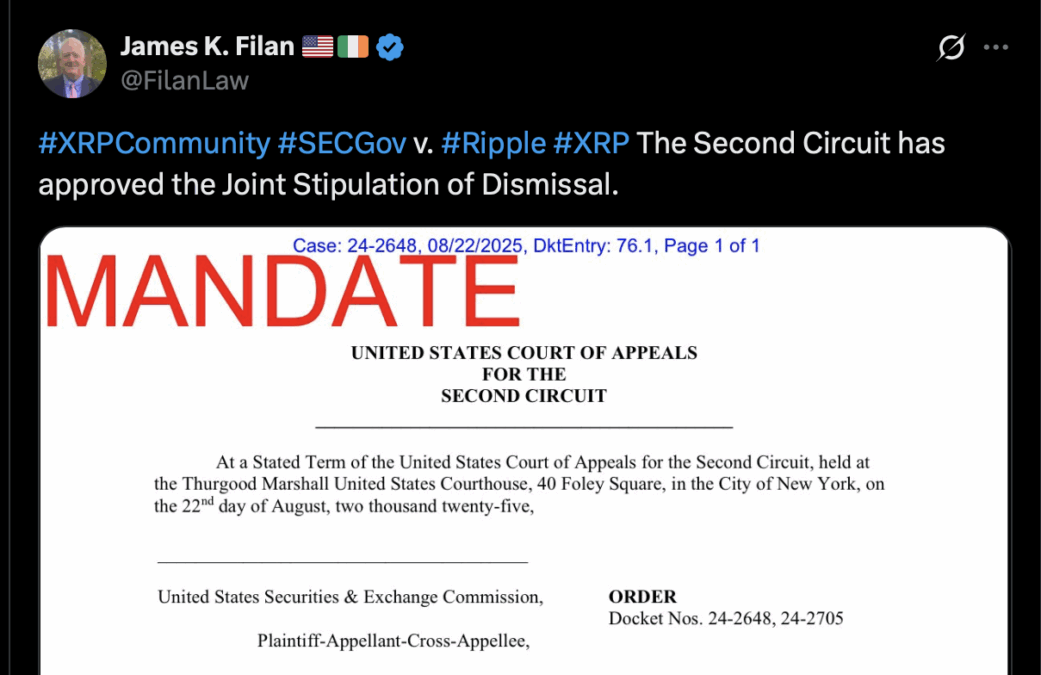
Jame Filan Shares The News On X
Jame Filan shares the news on X | Source: X

The SEC decided to drop its appeal, while Ripple and its executives, Chris Larsen and Brad Garlinghouse, also chose to withdraw their own cross-appeal. 

But now that the case is closed, Ripple must pay a penalty to the SEC. Judge Analisa Torres had already ruled that Ripple owed $125 million for breaking securities laws when selling XRP to institutional investors. This fund was already placed in escrow while the case continued, as it waited for the appeal decision to finish.

Earlier, Ripple and the SEC agreed to reduce the penalty to $50 million, but Judge Torres did not accept that amount. She refused to issue a ruling that would change the settlement, leaving the higher fine of $125 million in place. Ripple will now complete this payment to officially settle the matter.

Meanwhile, this is good news to the crypto space and it sure has been celebrated. At the time of writing this report, XRP is up 5.57%. This was from the previous day and intraday low of $2.78. Currently, the token is trading for $3.06, with an 89% surge in trading activity, leading to $9.27 billion in trading volume. 

Xrp Price Chart
XRP Price Chart | Source: CoinMarketCap

The case initially started back in December 2020, when the SEC accused Ripple of raising $1.3 billion through sales of unregistered securities. Since then, the lawsuit had become a turning point for the crypto space, with debate raising about whether digital tokens should be treated as securities under U.S. law. With the appeals dismissed and the fine confirmed, this chapter is officially closed.

Also Read: Traders Are Shifting to Ethereum as Bitcoin Volatility Drops


Leituras Relacionadas

In Such a Crowded Cross-border Payment Track, Where Does the Next Stop Lie in the Future?

The crowded cross-border payments industry faces a paradox: intense competition above water with financing and narratives, while beneath, price wars and shrinking margins in basic PSP services are common. The path forward lies not in simple "cross-border" solutions but in deep **localization**. Success requires mastering the fragmented and tightening regulations of fiat currencies in each market—the "last mile" of compliance, banking, and settlement. Many Chinese PSPs have succeeded by following Chinese merchants overseas but have not deeply penetrated mainstream local merchant ecosystems abroad. Their strong product capabilities need to be applied to new, complex markets. The future belongs to companies that evolve from single-channel providers to **cross-border capital network operators**. This means moving beyond competing on transaction fees to creating internal networks that optimize capital efficiency through multi-directional matching, netting, and position reuse across countries and currencies. For Web3 and stablecoins, the key is integration, not replacement. Stablecoins offer efficiency gains but cannot bypass the foundational trust, compliance, and legal frameworks of traditional finance. The realistic path is the gradual adoption and "taming" of Web3 technologies by established financial institutions. The ultimate solution is a **dual clearing infrastructure** combining deep local fiat capabilities (local accounts, compliance, banking) with lightweight stablecoin-native capabilities (on-chain settlement, wallets). The biggest opportunity lies not in oversaturated mainstream corridors but in complex, underserved regional corridors (e.g., specific CIS, Middle East-Southeast Asia, or Latin American trade pairs). The winners will be those who build hard-to-replicate, deep capabilities in these areas—acting as the essential "clearing shovels" or infrastructure providers. The future keywords are **more local, more networked, and more stablecoin-native**. High-profit opportunities remain in the non-standardized, difficult-to-replicate deep waters of the industry, requiring genuine on-the-ground presence and long-term patience.

链捕手Há 4h

In Such a Crowded Cross-border Payment Track, Where Does the Next Stop Lie in the Future?

链捕手Há 4h

Trading

Spot
活动图片