United States’ Bitcoin Holdings Top $24 Billion After Ruling Out Buying

bitcoinistPublicado em 2025-08-18Última atualização em 2025-08-18

Resumo

On-chain data shows the US is one of the world’s largest Bitcoin holders, with its portfolio now exceeding $24 billion....

Trusted Editorial content, reviewed by leading industry experts and seasoned editors. Ad Disclosure

On-chain data shows the US is one of the world’s largest Bitcoin holders, with its portfolio now exceeding $24 billion. However, recent events have shown that the possibility of the US government increasing its stash is very low. Particularly, the US government’s strategy for cryptocurrency took a new turn this week after Treasury Secretary Scott Bessent clarified that Washington will not be actively buying any additional Bitcoin.

Bessent Rules Out New Purchases But Leaves A Possibility

While speaking in a Fox Business interview, US Treasury Secretary Scott Bessent explained that the government has no plans to buy additional Bitcoin beyond its current reserve. The Treasury chief said the reserve will continue to be funded primarily through assets seized in criminal cases rather than direct purchases. His estimates place the value of the reserve between $15 billion and $20 billion.

Bessent later softened his position on social media, noting that even though the US is not allocating budgetary resources to acquire more Bitcoin, it is committed to “budget-neutral pathways” for expanding reserves to make the country the Bitcoin superpower of the world. The statement suggests that auctions, seizures, and non-traditional acquisitions could still increase holdings in the future, even if the Treasury avoids direct market buys.

Bitcoin Holdings Push Toward $24 Billion

Data from blockchain analytics platform Arkham Intelligence reveals a bigger picture than Bessent’s estimates of $15 billion to 20 billion. According to Arkham, wallets linked to the US government currently hold about 198,022 BTC, valued at approximately $23.42 billion. Many of these holdings originated from seizures related to criminal activity, including the well-known Silk Road case.

The portfolio, however, extends well beyond Bitcoin. Arkham’s data reveals holdings of about 59,951 ETH, worth $273 million, along with 347 million USDT and smaller allocations across other assets such as 750 WBTC, 40,293 BNB, 5,205 WETH, and 13.6 million BUSD. Taken together, the government’s digital asset holdings are valued at approximately $24.27 billion. This figure recently climbed as high as $25 billion during Bitcoin’s surge above $124,000 last week.
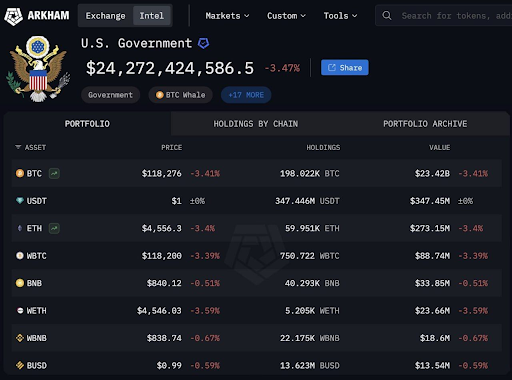
Bitcoin
Source: Chart from Arkham

Earlier this year, President Donald Trump signed into law the creation of a strategic crypto reserve, a move many interpreted as the start of government-led Bitcoin accumulation. Trump himself had many investors increase their expectations after stating that the United States would prioritize US-based cryptocurrencies like BTC as part of its financial strategy. 

This context is what made Bessent’s recent statement so significant. Although the reserve exists in law, the Treasury has now made it clear that active market purchases of Bitcoin are not on the table for the time being. However, it is clear that the US government isn’t planning to sell its holdings anytime soon, which might flood the market with selling pressure.

Bitcoin
BTC trading at $114,859 on the 1D chart | Source: BTCUSDT on Tradingview.com
Featured image from Pixabay, chart from Tradingview.com
Editorial Process for bitcoinist is centered on delivering thoroughly researched, accurate, and unbiased content. We uphold strict sourcing standards, and each page undergoes diligent review by our team of top technology experts and seasoned editors. This process ensures the integrity, relevance, and value of our content for our readers.

Scott Matherson is a leading crypto writer at Bitcoinist, who possesses a sharp analytical mind and a deep understanding of the digital currency landscape. Scott has earned a reputation for delivering thought-provoking and well-researched articles that resonate with both newcomers and seasoned crypto enthusiasts. Outside of his writing, Scott is passionate about promoting crypto literacy and often works to educate the public on the potential of blockchain.

Leituras Relacionadas

Earning Six Figures and Still Struggling to Rent in San Francisco

A couple in San Francisco with a combined tech income over $360,000 struggled for months to find a one-bedroom apartment under $5,000 per month. Their story highlights how the AI wealth boom, driven by upcoming IPOs from companies like OpenAI and Anthropic, is dramatically escalating the city's cost of living. Even six-figure salaries are becoming insufficient for a comfortable lifestyle. The article details the financial reality for tech workers earning around $180,000 annually. After taxes, retirement contributions, and healthcare, take-home pay is roughly $7,000 per month. With average rents exceeding $3,800 and one-bedrooms often costing $4,500-$5,200, discretionary income shrinks to $1,500-$2,500. This contrasts sharply with reported median total compensations of $640,000 at OpenAI and $420,000 at Anthropic. The AI gold rush is identified as the primary driver. The scale of potential wealth from these IPOs, far surpassing previous tech booms, is flooding the housing market. Data shows San Francisco's average rent is now the highest in the U.S., with vacancy rates in desirable neighborhoods plummeting to around 3%. The overall cost of living is 65.6% above the national average. The piece features multiple professionals, including a 25-year-old with a $250,000 salary, facing housing instability, fierce competition for rentals, and a persistent, low-grade financial anxiety despite high earnings. It concludes that the rapid concentration of AI wealth is redefining what constitutes a "high salary" in San Francisco, pushing out mid-tier tech talent and creating a stark divide between those in the AI sector and everyone else.

marsbitHá 1h

Earning Six Figures and Still Struggling to Rent in San Francisco

marsbitHá 1h

Rate Hikes to Save STRC, Selling Bitcoin to Preserve Credit: Strategy Picks Its Two Most Expensive Paths

Over the past six weeks, Strategy has faced a significant crisis of confidence, with its core securities MSTR and STRC experiencing sharp price declines. The situation escalated as the company utilized dollar reserves intended for dividends and interest payments to repurchase debt, and then sold a small amount of Bitcoin for the first time since 2022—an action that contradicted its "never sell" narrative and signaled potential liquidity strain. In response, Strategy introduced a Digital Credit capital framework. This formalized a series of measures to manage the pressure down its capital structure: ordinary shareholders have already borne costs through equity dilution from an $11.5 billion ATM offering; new rules enforce a hard dollar reserve covering at least 12 months of expected dividend and interest payments; the STRC dividend rate was increased from 11.5% to 12%; and, most notably, Bitcoin was officially integrated into the capital toolkit, with board authorization to sell up to $1.25 billion worth if needed to support obligations and repurchase programs. The market reacted with a mix of relief and skepticism. While the announcement triggered a sharp single-day rally in both MSTR and STRC, the preferred shares still trade at a significant discount. Supporters view the framework as pragmatic crisis management that provides a price floor and clearer rules. Critics argue that institutionalizing Bitcoin sales undermines the core investment thesis and, with Bitcoin's price below the company's average cost basis, amounts to selling assets at a loss to maintain its financial structure. The broader context shows institutional Bitcoin buying drying up, highlighting that Strategy's challenges and new framework are now a key indicator for overall market risk sentiment. Ultimately, the framework buys time, but STRC's return to par value depends on market belief in the company's ability to cover dividends without further dilution or substantial Bitcoin sales—a task that would be easier if Bitcoin's price recovers.

链捕手Há 1h

Rate Hikes to Save STRC, Selling Bitcoin to Preserve Credit: Strategy Picks Its Two Most Expensive Paths

链捕手Há 1h

Trading

Spot
活动图片