Bitcoin’s short-term price prospects slightly improved, but most traders are far from optimistic

CointelegraphPublicado em 2022-06-28Última atualização em 2022-06-28

Resumo

A mild sense of hope emerged among Bitcoin (BTC) investors after the June 18 drop to $17,600 becomes more distant and an early ascending pattern points toward $21,000 in the short-term.

A mild sense of hope emerged among Bitcoin (BTC) investors after the June 18 drop to $17,600 becomes more distant and an early ascending pattern points toward $21,000 in the short-term.

Bitcoin 12-hour USD price at FTX. Source: TradingViewRecent negative remarks from lawmakers continued to curb investor optimism. In an interview with Cointelegraph, Swiss National Bank (SNB) deputy head Thomas Muser said that the decentralized finance (DeFi) ecosystem would cease to exist if current financial regulations are implemented in the crypto industry.
An article published in "The People's Daily" on June 26 mentioned the Terra network's collapse and local blockchain expert, Yifan He referred to crypto as a Ponzi scheme. When asked by Cointelegraph to clarify the statement on June 27, Yifan He stated that "all unregulated cryptocurrencies including Bitcoin are Ponzi schemes based on my understanding."
On June 24 Sopnendu Mohanty the chief FinTech officer of the Monetary Authority of Singapore (MAS) pledged to be "brutal and unrelentingly hard" on any "bad behavior" from the cryptocurrency industry.
Ultimately, Bitcoin investors face mixed sentiment as some think the bottom is in and $20,000 is support. Meanwhile, others fear the impact that a global recession could have on risk assets. For this reason, traders should analyze derivatives markets data to understand if traders are pricing higher odds of a downturn.
Bitcoin futures show a balanced force between buyers and sellers
Retail traders usually avoid monthly futures because their price differs from regular spot markets at Coinbase, Bitstamp and Kraken. Still, those are professional traders' preferred instruments as they avoid the funding rate fluctuation of the perpetual contracts.
These fixed-month contracts usually trade at a slight premium to spot markets because investors demand more money to withhold the settlement. Consequently, futures should trade at a 5% to 10% annualized premium in healthy markets. One should note that this feature is not exclusive to crypto markets.

Bitcoin 3-month futures’ annualized premium. Source: LaevitasWhenever this indicator fades or turns negative, this is an alarming, bearish red flag signaling a situation known as backwardation. The fact that the average premium barely touched the negative area while Bitcoin traded down to $17,600 is remarkable.
Despite currently holding an extremely low futures premium (basis rate), the market has kept a balanced demand between leverage buyers and sellers.
To exclude externalities specific to the futures instrument, traders must also analyze the Bitcoin options markets. For instance, the 25% delta skew shows when Bitcoin whales and arbitrage desks are overcharging for downside or upside protection.
During bearish markets, options investors give higher odds for a price crash, causing the skew indicator to rise above 12%. On the other hand, a market's generalized FOMO induces a negative 12% skew.

Bitcoin 30-day options 25% delta skew: Source: LaevitasAfter peaking at 36% on June 18, the highest-ever record, the indicator receded to the current 15%. Options markets had shown extreme risk-aversion until June 25, when the 25% delta skew finally broke below 18%.
The current 25% skew indicator continues to display higher risks of a downside from professional traders but it no longer sits at the levels reflecting extreme risk aversion.
The bottom could be in according to on-chain data
Some metrics suggest that Bitcoin may have bottomed on June 18 after miners sold significant quantities of BTC. According to Cointelegraph, this indicates that capitulation has already occurred and Glassnode, an on-chain analysis firm, demonstrated that the Bitcoin Mayer Multiple fell below 0.5 which is extremely rare and hasn't happened since 2015.
Whales and arbitrage desks might take some time to adjust after key players like Three Arrows Capital face serious contraction and liquidation risks due to lack of liquidity or excessive leverage. Until there's enough evidence that the contagion risk is alleviated, Bitcoin price probably continue to trade below $22,000.

Leituras Relacionadas

US Government Suddenly Halts Anthropic's Strongest Model, "Quasi-IPO Stock Price" Plunges 3.7% Overnight

U.S. Government Halts Anthropic's Top AI Models, 'Pre-IPO' Price Drops 3.7% On June 12, the U.S. government ordered Anthropic to shut down access to its two most powerful AI models, Claude Fable 5 and Claude Mythos 5, citing national security concerns. The directive, issued by the Department of Commerce, required Anthropic to block access for all foreign nationals, leading the company to disable the models globally for all users. Anthropic strongly opposed the move, arguing the government's basis was a "narrow jailbreak vulnerability" and warning that applying such a standard industry-wide would effectively halt all frontier model deployments. The news impacted Anthropic's implied valuation in speculative markets. The Anthropic perpetual contract on Hyperliquid fell approximately 3.7% to around $1,627, down from highs above $1,800 following the models' release. Unauthorized tokenized products linked to Anthropic on Solana also saw significant declines. The models, launched just days earlier on June 9, represented a major capability leap for Anthropic. Fable 5 was its first public release of a "Mythos"-tier model above its flagship Claude Opus. The shutdown creates an ironic situation for Anthropic, a company founded on "AI safety" principles, and adds uncertainty to its ongoing IPO preparations. The company is actively engaging with regulators to resolve what it calls a "misunderstanding" and restore service.

marsbitHá 8m

US Government Suddenly Halts Anthropic's Strongest Model, "Quasi-IPO Stock Price" Plunges 3.7% Overnight

marsbitHá 8m

SpaceX IPO Creates Trillion-Dollar Billionaire: Musk's Wealth Equals Half of Crypto Market

SpaceX's record-breaking IPO has propelled Elon Musk to become the first modern billionaire with a personal net worth exceeding $1 trillion, reaching $1.11 trillion according to Bloomberg. This staggering wealth surpasses the total market capitalization of all cryptocurrencies excluding Bitcoin and equals roughly half of the entire crypto market's value. The milestone highlights extreme wealth concentration and the significant devaluation of the altcoin market, whose total cap has nearly halved since late 2025 as capital flows into large tech stocks. SpaceX's Nasdaq debut saw its valuation hit $2.2 trillion, with shares soaring from a $135 offer price to close at $161. Its first-day trading volume of $85 billion set a new global IPO record. Musk owns 42% of the company. Despite his wealth dwarfing the altcoin sector, Musk maintains deep ties to digital assets. He personally holds Bitcoin, Ethereum, and Dogecoin, while his companies, SpaceX and Tesla, collectively hold over 30,000 Bitcoin, ranking among the top corporate BTC holders globally. His acquisition and integration of financial data tools into X (formerly Twitter) further connect his ecosystem to the markets. Ultimately, Musk's trillion-dollar status underscores the immense wealth controlled by tech founders, though this fortune remains largely tied to volatile stock prices rather than liquid assets.

Foresight NewsHá 16m

SpaceX IPO Creates Trillion-Dollar Billionaire: Musk's Wealth Equals Half of Crypto Market

Foresight NewsHá 16m

Hardcore First Look | Ocean Embodied Intelligence Company 'Shihang Intelligence' Secures Record-Breaking 1 Billion in Funding, Zhu Xiaohu, Temasek Place Bets

Breaking News | Ocean Embodied Intelligence company "Shihang Intelligent" secures a record-breaking 1 billion RMB (approximately 10 billion yuan) in Series A financing, with investment from Zhu Xiaohu and Temasek. Author: Qiu Xiaofen | Editor: Yuan Silai Ocean Embodied Intelligence company "Shihang Intelligent" has completed its Series A funding round, raising over 1 billion RMB. This marks the largest single funding round in the global marine robotics field to date. Investors include upstream momentum funds from chip companies "Moore Thread" and "Kunlunxin," Singapore's state-owned investment platform Vertex Growth, and listed company Dyneo, among others. Existing investors like GSR Ventures (whose founder Zhu Xiaohu has invested for the fifth time), Vertex Ventures China, Hua Ying Capital, and Long Capital also significantly increased their investments. Founder and CEO Chen Xiaobo, a 1989-born alumnus of Harbin Engineering University, is a long-time expert in underwater robotics. He received the National Defense Science and Technology Progress Award at age 28 (the youngest recipient) and led the development of China's first commercial underwater cleaning robot. The funds will be used for core technology R&D, global market expansion, and building the industry chain ecosystem to scale the application of marine robots in complex underwater scenarios. The ocean is considered one of the most challenging environments for robotics due to low light, high turbidity, complex currents, limited communication, high pressure, and corrosion. "Shihang Intelligent" focuses on developing core underlying technologies for marine robots, covering six key systems: power, control, sensing, navigation, sealing, and deployment. Its robots are capable of operating at depths from 0 to 10,000 meters with full degrees of freedom, performing complex maneuvers, autonomous navigation, and multi-robot collaboration. Applications include ship cleaning, underwater security, offshore wind power, marine ranching, and seabed inspection. The company's order value for the first half of 2026 alone has exceeded 1 billion RMB. Its "Orca Robot" is used by major shipping companies and has performed maintenance on over a thousand large vessels. In April of this year, the company launched its ocean embodied large model "Cangqiong CEORION." Unlike traditional remote-controlled or pre-programmed robots, this model integrates environmental perception, task understanding, and action generation into a single end-to-end architecture. Trained on millions of hours of commercial operation data and simulation data, it covers 12 major underwater operation scenarios. In simulations, it achieved over 90% task success rate and over 70% zero-shot adaptation capability to unseen environments. A built-in physics reasoning module reduces collision risk by 80%, enabling autonomous operation even with weak or no communication. Recently, "Shihang Intelligent" was selected as a core technology partner for Singapore's Maritime and Port Authority national hull inspection and cleaning program. These advancements indicate marine robotics is moving from pilot projects to scaled applications, with real-world operations generating valuable data to continuously improve robot capabilities. CEO Chen Xiaobo stated the company will continue investing in core marine robotics technology, the embodied intelligence model, and global application scenarios to expand into more high-risk, high-difficulty, and high-value underwater operations.

marsbitHá 41m

Hardcore First Look | Ocean Embodied Intelligence Company 'Shihang Intelligence' Secures Record-Breaking 1 Billion in Funding, Zhu Xiaohu, Temasek Place Bets

marsbitHá 41m

Three Months, 35 Billion Yuan: Investors Rush to Grab the OpenAI of the Physical World

Investors flock to a physical AI startup as the race for the "OpenAI of the physical world" heats up. Ji Jia Shi Jie (GigaWorld), a company dedicated to developing Artificial General Intelligence (AGI) for the physical world, has raised 3.5 billion RMB (approximately $490 million) in just three months, according to a report from investment media outlet Touzijie. The latest B2 funding round of 1 billion RMB attracted a wide range of top-tier investors, including sovereign wealth funds, industrial capital, and financial institutions. This brings the total funding for the young company, now valued over 10 billion RMB, to 3.5 billion RMB across three recent rounds. The company is led by Huang Guan, a post-90s Tsinghua University PhD with extensive experience in AI, autonomous driving, and entrepreneurship. Its core innovation is a "dual-pyramid" system comprising a five-layer data pyramid (from internet videos to real-world robot data) and a three-layer algorithm pyramid focused on world simulation, action alignment, and reinforcement learning. This system underpins its key models: the "World Action Model" (e.g., GigaBrain series for robot control) and the "World Generation Model" (e.g., GigaWorld series for simulating and understanding the physical world). Its models have reportedly achieved top rankings in global robotics benchmarks. Ji Jia Shi Jie argues that while current digital AGI excels in information processing, the next frontier is physical AGI—systems that can understand and interact with the real world. The company believes the field is approaching its "GPT-3 moment," a key inflection point in capability scaling. To achieve this, the company is pursuing a dual-market strategy. For the consumer (C) market, it launched the "SeeLight" brand and its S1 general-purpose humanoid robot, which has secured initial orders for deployment in real homes. For the business (B) market, it focuses on industrial automation with its Maker series robots, having signed agreements for large-scale deployment in factories, and its DriveDreamer world model for autonomous driving, which is already in use with over 30 automakers and tech companies. The report concludes that by bridging the gap between digital intelligence and physical action, Ji Jia Shi Jie aims to unlock a new wave of productivity, ultimately bringing physical AGI into everyday life.

marsbitHá 1h

Three Months, 35 Billion Yuan: Investors Rush to Grab the OpenAI of the Physical World

marsbitHá 1h

What's the Connection Between Pinduoduo's Huang Zheng and Blockchain?

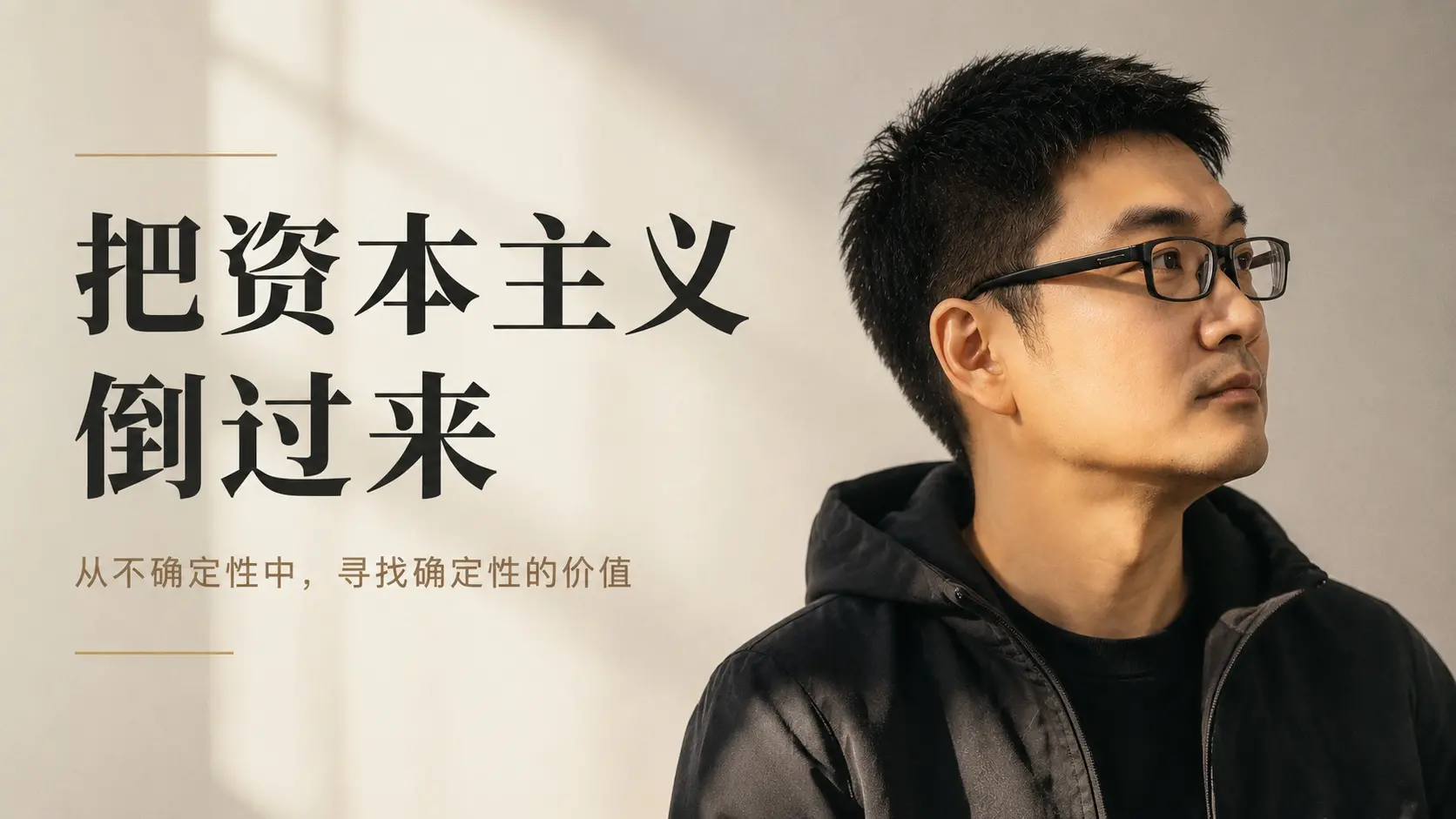
This text explores the unexpected connection between Pinduoduo founder Colin Huang and blockchain, as suggested in his article *Turning Capitalism Upside Down*. Huang argues Pinduoduo's core business is about managing "uncertainty." He posits that wealth flows to the rich because they absorb life's uncertainties (e.g., illness, job loss) that devastate the poor, who pay a premium for certainty through insurance or stable prices. Pinduoduo's model attempts a "reverse insurance": by aggregating consumer demand via group-buying and flash sales, it creates a large, predictable order for manufacturers. This certainty allows factories to remove risk premiums, passing savings back as lower prices, thus partially reversing the wealth flow. The key obstacle, Huang notes, is that an individual's buying intent is an unreliable promise. He then asks if blockchain is the natural solution for this "reverse insurance." The text elaborates that blockchain, through smart contracts with binding deposits, could transform casual intent into a costly-to-break, enforceable commitment. This replaces interpersonal trust with coded rules, making promises credible, pricable, and resistant to fraud. Finally, the author draws a parallel to Bitcoin, framing two paths to creating certainty: the "Pinduoduo path" of aggregating decentralized will into scale, and the "Bitcoin path" of locking rules into immutable code. Both sacrifice something—personal freedom or system flexibility—to manufacture trust and predictability.

链捕手Há 2h

What's the Connection Between Pinduoduo's Huang Zheng and Blockchain?

链捕手Há 2h

Trading

Spot
Futuros
活动图片