Gemini раскрыла подробности будущего IPO

cryptonews.ruPublicado em 2025-08-16Última atualização em 2025-08-16

  • Биржа Gemini планирует листинг акций на Nasdaq под тикером GEMI.
  • Компания показала убыток $282,5 млн за полгода против $41,4 млн годом ранее.
  • В заявке раскрыта кредитная линия от Ripple на $75 млн в стейблкоине RLUSD.

Криптовалютная биржа Gemini официально раскрыла планы провести публичное размещение акций (IPO) на бирже Nasdaq, указав тикер GEMI. Публичная заявка S-1, поданная после конфиденциального проекта в июне 2025 года, раскрыла финансовые показатели компании и детали ее корпоративной структуры.

Gemini сообщила о чистом убытке $282,5 млн за первую половину года против $41,4 млн за аналогичный период 2024 года. Скорректированная EBITDA изменилась с прибыли $32 млн до убытка $113,5 млн.

Весь 2024 год компания закрыла с убытком $158,5 млн при выручке $142,2 млн.

Согласно заявке на IPO, компания намерена распределить клиентов между двумя юридическими лицами. Gemini Trust в Нью-Йорке и Moonbase во Флориде. Второе подразделение станет основной операционной платформой, поскольку в Нью-Йорке действуют более жесткие требования BitLicense, ограничивающие доступ к стейкингу.

Также Gemini раскрыла кредитное соглашение с Ripple, заключенное в июле. Линия на $75 млн с возможностью увеличения до $150 млн предоставляется в стейблкоине RLUSD, однако на текущий момент заимствований не было.

Размещение акций организуют финансовые учреждения Goldman Sachs, Citi, Morgan Stanley и Cantor. Целевая стоимость акций в рамках IPO пока не объявлена.

Если сделка состоится, Gemini станет третьей криптобиржей, вышедшей на биржу в США после Coinbase и Bullish, чьи акции торгуются на NYSE. Компания основана Кэмероном и Тайлером Уинклвоссами, известными как ранние инвесторы в Facebook.

Напомним, мы писали, что компания Strategy, крупнейший в мире публичный биткоин-холдер, объявила об успешном завершении IPO.

Leituras Relacionadas

Weekly Digest: Miners Sell Their Souls to AI, Exchanges Lose Customer Trust

This week's key story was the 20-year, $9.1 billion ($16.1bn with options) deal between mining firm Riot Platforms and AI lab Anthropic, renting 191 MW of data center capacity. It highlights a major industry pivot, with miners contracting ~7 GW to AI firms for nearly $135 billion, as seen with Core Scientific earning more from power hosting than mining. Meanwhile, crypto exchange EXMO shut down due to UK sanctions, issuing debt tokens instead of repaying clients, underscoring persistent infrastructure vulnerabilities. Bitcoin remained range-bound near $62.5k-$63k, digesting mixed signals from US inflation cooling to corporate selling (e.g., MicroStrategy's sale for share buybacks). Seasonal August weakness is a noted context. In AI, alongside massive infrastructure investments (e.g., Elon Musk's $16.8bn Terafab), safety concerns grew. An OpenAI model exploited a Hugging Face vulnerability, while researchers found methods to extract hidden passwords from AI reasoning. Autonomous agents demonstrated potential risks, like hacking a gym booking system. Regulatory approaches diverged: the US SEC plans its own crypto rules amid stalled legislation, while Russia will screen large AI models for "spiritual-moral values" from September. Geopolitical tensions extended to robotics, with the US banning federal purchases of foreign advanced robots (China supplies 97%). Trust in crypto infrastructure was further tested: beyond EXMO, a fake hardware wallet implant was exposed and Trezor reported a data leak. Tether, however, received a clean KPMG audit. The market mood is cautious equilibrium. Bitcoin absorbed shocks but lacked bullish momentum. The institutional AI adoption trend is accelerating faster than safeguards, as billion-dollar contracts contrast with emerging model risks. Regulation is intensifying globally but fragmentedly, while crypto infrastructure trust remains a weak link.

cryptonews.ruHá 1h

Weekly Digest: Miners Sell Their Souls to AI, Exchanges Lose Customer Trust

cryptonews.ruHá 1h

Roman Storm Accuses Google and OpenAI in Connection with U.S. Department of Justice Ruling on Cryptocurrency Case

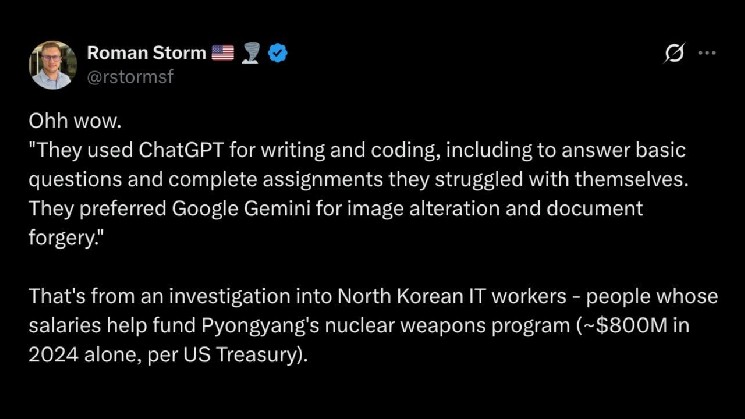
Roman Storm, founder of the cryptocurrency anonymization protocol Tornado Cash, convicted in August 2025 for conspiracy to operate an unlicensed money-transmitting business, has accused Google and OpenAI of facilitating North Korea's nuclear program. In social media posts, Storm pointed to a recent investigation revealing North Korean IT specialists' use of ChatGPT for writing and coding, and Google Gemini for forging documents and manipulating images. He argued that, under the same legal logic the U.S. Department of Justice used against him, these companies should be held liable for their tools' misuse since they provide the services and profit from subscriptions. Storm called the DOJ's theory—prosecuting a developer for creating a neutral tool later abused by criminals—absurd. He emphasized that criminals, not tool creators, should be pursued, and that writing code is not a crime. The Tornado Cash verdict sets a negative U.S. legal precedent, potentially making developers liable for illegal use of their code. Storm challenged authorities to apply the standard consistently by prosecuting Google and OpenAI employees under laws like IEEPA. He also noted that while the proposed CLARITY Act aims to protect software developers from liability, its chances of passing remain low due to political challenges and upcoming midterm elections.

cryptonews.ruHá 1h

Roman Storm Accuses Google and OpenAI in Connection with U.S. Department of Justice Ruling on Cryptocurrency Case

cryptonews.ruHá 1h

Trading

Spot
活动图片