Google Bows To Crypto Fury, Unbans Non-Custodial Wallets

bitcoinistPublicado em 2025-08-14Última atualização em 2025-08-14

Resumo

A policy whiplash at Google set the crypto industry ablaze on Wednesday before ending in a rare and explicit climbdown:...

Trusted Editorial content, reviewed by leading industry experts and seasoned editors. Ad Disclosure

A policy whiplash at Google set the crypto industry ablaze on Wednesday before ending in a rare and explicit climbdown: non-custodial wallets are not covered by the Play Store’s new licensing regime.

The clarification, posted by Google’s official communications account on X late August 13, came after lawyers, developers, and high-profile Bitcoiners blasted an earlier interpretation of revised rules that appeared to force Anti-Money-Laundering and Know-Your-Customer checks on self-custody software in the United States and effectively box out indie wallet teams across the European Union.

“Non-custodial wallets are not in scope of Google Play’s Cryptocurrency Exchanges and Software Wallets Policy. We are updating the Help Center to make this clear,” Google wrote.

The initial backlash was swift. VP of Regulatory Affairs at Paradigm Justin Slaughter called it a “surprising move… amid [Google’s] antitrust litigation,” arguing that “pure coding should not require a federal license,” while Jack Dorsey summed up the mood with a one-word verdict: “terrible.”

By nightfall in the US, crypto analyst Pentoshi declared “Breaking news Google has unbanned self custodial wallets,” while Pierre Rochard praised the course correction: “All companies make mistakes, great companies listen to online feedback and course-correct. Google Play can’t afford to ban itself from Bitcoin.”

Google Bow To Crypto Community (Partially)

Under the policy actually taking effect, Google is synchronizing Play Store distribution with licensing in roughly 15 jurisdictions for custodial products—crypto exchanges and custodial “software wallets”—with enforcement to begin on October 29, 2025. In practice that means US developers must operate under a federal or state banking charter or register with FinCEN as a money services business and obtain state money transmitter license; in the EU they must hold authorization as a MiCA crypto-asset service provider.

France and Germany have transitional windows before MiCA fully displaces national licensing. Google’s own policy pages and the updated explainers published Wednesday night underline that non-custodial wallets—apps where users retain their private keys and no third party takes custody—are outside this licensing scope.

The pivot capped a confusing news cycle. Several outlets reported during the day that Google would require licenses for all wallets, custodial and non-custodial alike, before clarifications on X and in follow-up coverage reversed that reading. Google’s statement confirms that self-custody apps are exempt, while noting that the Play Store will still gate custodial apps and exchanges in the US, EU, UK, and other listed markets. The net effect: the compliance burden shifts squarely onto entities that hold user funds, not the open-source code that enables users to hold their own.

Even with Google’s clarification, edge cases remain. Francis Pouliot, CEO of Bull Bitcoin, pressed the company to explain whether the policy captures non-custodial wallets that embed optional gateways to regulated exchanges, with access controls enforced inside the app rather than via Play Store geo-targeting. That unresolved ambiguity matters to builders who have stitched together self-custody with fiat on-ramps through partner integrations, and who must now assess whether those features nudge a wallet into “custodial software wallet” territory for Play’s purposes.

Developers also reported inconsistent enforcement as the policy story evolved. Adam Simecka, founder of the self-custodial Manna Wallet, said the app was de-listed from Play search “with no warning, notice, or recourse,” then later observed that visibility differed across devices and regions: “Some people are able to see it in their Play Store… Out of our family’s 3 Android devices, it is showing on 1.” He added that positive reviews had disappeared alongside search visibility.

For users and developers, the path ahead is clearer but not frictionless. The Help Center’s country-by-country matrix now anchors distribution for custodial apps to local licensure—FinCEN MSB and state money transmission in the US; CASP authorization under MiCA in the EU; FCA registration in the UK; and comparable regimes in Switzerland, the UAE, Japan, South Korea, and others—with France and Germany granted interim national options before their MiCA deadlines.

Google states the blockchain content policy update becomes effective October 29, 2025, with additional Help Center links added to reflect the new requirements. In parallel, Google has reiterated—now on the record—that non-custodial wallets are outside the scope of these licensing checks.

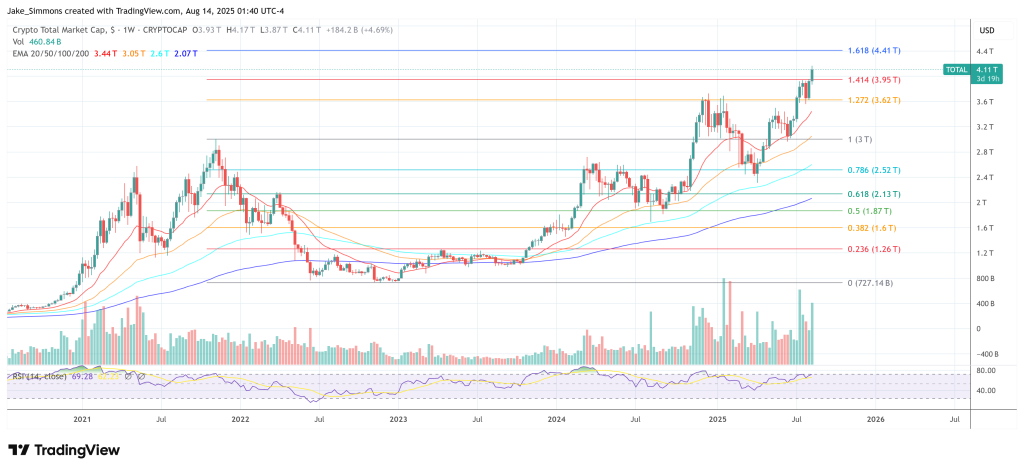
At press time, the total crypto market cap stood at $4.11 trillion.
Total crypto market cap
Total crypto market cap, 1-week chart | Source: TOTAL on TradingView.com
Featured image created with DALL.E, chart from TradingView.com
Editorial Process for bitcoinist is centered on delivering thoroughly researched, accurate, and unbiased content. We uphold strict sourcing standards, and each page undergoes diligent review by our team of top technology experts and seasoned editors. This process ensures the integrity, relevance, and value of our content for our readers.

Jake Simmons has been a Bitcoin enthusiast since 2016. Ever since he heard about Bitcoin, he has been studying the topic every day and trying to share his knowledge with others. His goal is to contribute to Bitcoin's financial revolution, which will replace the fiat money system. Besides BTC and crypto, Jake studied Business Informatics at a university. After graduation in 2017, he has been working in the blockchain and crypto sector. You can follow Jake on Twitter at @realJakeSimmons.

Leituras Relacionadas

A Country That Mined Bitcoin for 8 Years Has Built Its Own Dedicated Crypto Bank

A country that has been mining Bitcoin for eight years has established its own dedicated crypto bank. DK Bank, located in Bhutan's newly developed GMC special administrative zone, aims to fill the significant banking service gap for the cryptocurrency industry. Its CEO, Zheng YD, explained that most banks avoid crypto businesses due to a lack of risk management frameworks for decentralized and anonymous protocols. Operating under a unique "one country, two systems" governance model separate from mainland Bhutan, GMC aspires to become a financial hub for South Asia. DK Bank differentiates itself by offering integrated multi-currency accounts where users can manage both fiat currencies and stablecoins like USDT and USDC in one place, alongside services like Bitcoin-backed loans. The bank faces technical challenges in merging traditional banking systems with 24/7 crypto markets and implements rigorous on-chain and off-chain transaction monitoring for risk control. GMC's regulatory framework draws from Singaporean common law and Abu Dhabi's ADGM rules, offering a fast-track licensing process for already licensed firms while maintaining high standards. The initiative is part of Bhutan's longer-term crypto strategy, which includes Bitcoin mining since 2018. The focus, however, is on building a diversified institutional-grade crypto ecosystem—including custody and asset management—rather than retail speculative tokens. Proponents argue such sovereign crypto infrastructure is necessary, and Bhutan's early, measured approach exemplifies the thoughtful integration needed in global finance.

Foresight NewsHá 23m

A Country That Mined Bitcoin for 8 Years Has Built Its Own Dedicated Crypto Bank

Foresight NewsHá 23m

Unveiling the Whales of the World Cup Prediction Market: Smart Money Stumbles on the Pitch, 'Buy No' Outperforms 'Buy Yes'

**Title: Unveiling the Whales of the World Cup Prediction Market: "Smart Money" Stumbles on the Pitch as "Buying No" Outperforms "Buying Yes"** An analysis of pre-match trades over $5,000 on Polymarket for 20 completed group stage matches reveals a counterintuitive finding: large "smart money" bets were not consistently accurate. Aggregated pre-match buying volume was $89.55 million, with a weighted hit rate of only 48.5%. Holding these positions would have resulted in an estimated net loss of about $1.76 million (ROI -2.0%), challenging the notion that big money reliably predicts outcomes. The data highlights several key dynamics. Draws proved to be a major risk, significantly impacting bets on favored teams, as seen in Belgium-Egypt and Spain-Cape Verde. Markets were more efficient for clear mismatches (e.g., Germany's big win) but became prone to bias when favorites were overvalued. Notably, buying "No" shares (betting against a specific outcome) significantly outperformed buying "Yes," with hit rates of 62.4% vs. 37.5%. This suggests the market often overprices popular narratives, creating value in contrarian positions. Individual trades showed extreme volatility. One wallet (mintblade) earned an estimated $6.77 million by betting against Iran, while another (LEEEROYJENKINS) lost roughly $8.39 million on a Belgium win. The market favors high-risk, high-reward information trading rather than steady arbitrage. For sustained insight, wallets with consistent performance across multiple matches (e.g., swisstony) are more telling than one-off big bets. Ultimately, the Polymarket acts less as a crystal ball and more as a mirror, reflecting crowd bias and the inherent unpredictability of football. True "smart money" may lie not in predicting the future, but in identifying and exploiting market mispricings while respecting risk.

marsbitHá 47m

Unveiling the Whales of the World Cup Prediction Market: Smart Money Stumbles on the Pitch, 'Buy No' Outperforms 'Buy Yes'

marsbitHá 47m

Bezos' Third Startup Still Can't Avoid Musk

Jeff Bezos Returns as CEO for Third Venture, Still Can't Avoid Musk After stepping down as Amazon CEO in 2021, Jeff Bezos has returned to the front lines as co-CEO of Prometheus, an AI startup he founded. In a recent CNBC interview, Bezos described the experience as "Type 2 fun"—exhausting but ultimately rewarding. Founded less than a year ago, Prometheus has already raised over $18 billion in two funding rounds, achieving a staggering $41 billion valuation. Prometheus aims to develop a "General Engineer AI" to accelerate the entire "invention loop"—design, simulation, testing, and manufacturing—for complex physical products like jet engines, spacecraft, and medical devices. This positions the company at the intersection of Bezos's past experiences: Amazon's platform-building scale and Blue Origin's rigorous physical engineering. This marks Bezos's third major venture, following Amazon and Blue Origin. His co-CEO is Vik Bajaj, bringing expertise from life sciences and hard tech. Bezos now dedicates most of his time to Prometheus, signaling his belief in its transformative potential. The move also comes as Bezos's space company, Blue Origin, faces challenges, including a recent test explosion delaying its New Glenn rocket. Meanwhile, Elon Musk's SpaceX achieved a record-breaking IPO, surpassing Amazon's market cap. While Musk focuses on AI for executing physical tasks (like Tesla's robots and SpaceX's engineering), Bezos is betting on AI to *invent* in the physical world. Prometheus enters a crowded industrial AI field with players like OpenAI, NVIDIA, and Tesla's Optimus. Its lofty valuation bets on the unproven but massive opportunity to become the foundational platform for engineering in the AI era—a "blue ocean" Bezos hopes to define before Musk does.

marsbitHá 49m

Bezos' Third Startup Still Can't Avoid Musk

marsbitHá 49m

Trading

Spot
Futuros
活动图片