30-Year Treasury Yield Breaks 5% Again: The Era of 'Everything Is Cheap' Is Over

marsbitPublicado em 2026-06-01Última atualização em 2026-06-01

Resumo

The yield on the 30-year U.S. Treasury bond has again surpassed 5%, signaling a fundamental shift as markets begin to accept that high interest rates are here to stay. This reflects the simultaneous breakdown of three pillars that underpinned half a century of low inflation and low rates: cheap capital, cheap labor, and cheap energy. Global capital flows are shifting, energy security is strained, and labor costs are rising due to shortages and unionization, though partly offset by AI's impact. Long-term pressures like soaring government debt, geopolitical friction, and populism are also pushing up long-term borrowing costs. The role of AI remains the biggest uncertainty—it could boost productivity and lower debt or become a new source of inflation if it merely automates jobs while consuming vast resources. The core challenge for investors is adapting their models and expectations, calibrated during decades of cheap money, to this new, more persistent high-rate environment.

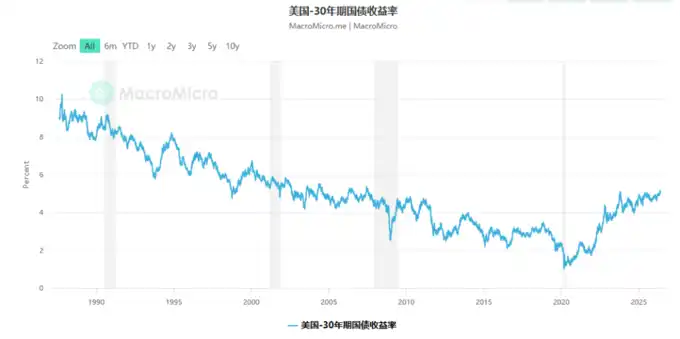
The yield on the 30-year Treasury bond has once again broken through 5%. This time, the market's reaction is markedly different from that in 2023—investors are beginning to truly accept the reality that high interest rates will persist for a long time.

Analysis points out that behind this lies a deeper structural shift: the three pillars supporting low inflation and low interest rates in the U.S. over the past 50 years—cheap capital, cheap labor, and cheap energy—are simultaneously eroding. And the direction of AI will be the biggest unknown determining future inflation trends.

The yield on the 30-year U.S. Treasury bond recently broke through 5% again. Writing in the Financial Times, columnist Rana Foroohar points out that, unlike the brief breach of 5% in 2023 followed by a rapid decline, this time the market's reaction is distinctly different—investors finally seem to be truly accepting the reality that the U.S. is bidding farewell to the era of low interest rates and entering a new phase with more persistent and diverse inflationary pressures.

The article cites a recent report to clients by Apollo chief economist Torsten Sløk, which states, "Investors should position their portfolios for a persistent high interest rate environment in the short, medium, and long term."

Behind this lies a larger structural story: the three cheap factors that drove U.S. economic growth over the past 50 years—cheap capital, cheap labor, and cheap energy—are simultaneously reversing.

How Did Half a Century of "Cheap Dividends" Come About?

The nearly half-century-long downward trend in the 30-year Treasury yield, falling from around double-digit percentages in the early 1980s to about 1% during the pandemic, was not an accident.

It was underpinned by a complete macro logic:

Cheap Capital: Decades of globalization and manufacturing technology advancements kept goods prices low; oil-exporting countries recycling massive petrodollars into the U.S. provided ample cheap funding; pension privatization reforms spurred enormous demand for various financial products; global investors vied to buy U.S. Treasuries, as no country was safer than America.

Cheap Labor: Outsourcing of industries, weakening of unions, automation waves, and the "shareholder primacy" corporate culture (emphasizing financial engineering over employee investment) collectively suppressed wages, especially for non-college-educated workers, persistently supporting corporate profit margins.

Cheap Energy: The petrodollar system helped curb inflation to some extent, and the global energy trade being settled in dollars also reinforced the dollar's global dominance.

These three pillars jointly supported half a century of low-inflation, low-interest-rate prosperity in the U.S.

The Three Pillars Are Simultaneously Loosening

In her article, Rana Foroohar notes that each of these supporting factors is now changing.

On the Capital Front: With each U.S. Treasury auction, international buyers are decreasing, not increasing. Deglobalization and supply chain reshoring will push up goods and services prices in the short term. Meanwhile, the foundation of the petrodollar system is being eroded.

On the Energy Front: Continued tensions in the Middle East directly impact Asian energy-importing countries. But in the longer term, this may accelerate the deployment of clean energy in major Asian nations—while the U.S. is retreating from climate commitments. This means long-term capital flows may shift from the U.S. to major Asian countries.

On the Labor Front: In recent years, labor shortages, large-scale strikes (including successful union action in the auto industry), tighter immigration restrictions, and growth in union membership in some sectors (especially white-collar industries) have all pushed wages higher. However, this trend is being partly offset by two factors: one is rising corporate healthcare insurance costs, leading companies to hedge by suppressing wages; the other is the impact of artificial intelligence.
And Then There Are the Slow Variables: Debt, Geopolitics, and Populism

In addition to the explicit factors above, there are several "slow variables": rising government debt, intensifying geopolitical friction, and the spread of populism.

The combined effect of these risks is that lenders demand a higher risk premium to lend money out—especially for terms of several years.

This directly pushes up long-term interest rates, i.e., the yield on the 30-year Treasury bond.

AI: Savior or New Source of Inflation?

Of all the variables, the direction of artificial intelligence is the most difficult to judge, yet its impact could be the most far-reaching.

Rana Foroohar outlines two starkly different scenarios:

The Optimistic Scenario: The productivity benefits of AI diffuse widely across industries and individuals, creating new jobs and income sources. Models from Yale's Budget Lab show that in this scenario, U.S. national debt would fall significantly, and inflation would also recede.

The Pessimistic Scenario: AI serves merely as a tool for corporate layoffs, cost compression, and profit expansion, while the infrastructure construction of AI itself (consuming vast amounts of chips, land, water, and electricity) creates new inflationary pressures. The net effect is to raise, not lower, costs. Governments would also be forced to bail out displaced workers, increasing debt instead.

Currently, AI giants are voraciously consuming real estate, chips, water resources, and electricity, already pushing up the prices of these resources in the overall economy. The final outcome will likely take years to become clear.

The Real Challenge Facing Investors

The article's conclusion is direct and sobering: Most market participants have spent their entire careers in the "cheap era." Their intuition, models, and expectations were calibrated in a low-interest-rate environment.

And now, that environment is changing.

"Expectational inertia" is a powerful force—when the 30-year yield broke 5% in 2023, many thought it was just a brief anomaly that would soon recede. But this time, the market's reaction is already different.

Adjusting means abandoning old expectations. For investors accustomed to low interest rates, that is no easy task.


Perguntas relacionadas

QWhat is the main reason behind the recent sustained rise in the 30-year US Treasury yield above 5%, according to the article?

AThe main reason is a deeper structural shift where the three pillars supporting low inflation and low interest rates in the US for the past 50 years—cheap capital, cheap labor, and cheap energy—are simultaneously eroding, leading investors to accept that a high-rate environment is here to stay.

QWhat were the three 'cheap pillars' that drove US economic growth for half a century?

AThe three pillars were cheap capital (from globalization, petrodollar recycling, and high demand for safe US debt), cheap labor (due to outsourcing, weaker unions, automation, and a 'shareholder-first' culture), and cheap energy (supported by the petrodollar system).

QHow might Artificial Intelligence (AI) contribute to future inflation, based on the pessimistic scenario described in the article?

AIn the pessimistic scenario, AI does not boost broad productivity but is used mainly for cost-cutting and layoffs. Meanwhile, AI infrastructure itself (consuming chips, real estate, water, and electricity) creates new inflationary pressures. Governments may also need to bail out displaced workers, increasing debt.

QBesides the three main pillars, what other 'slow-moving' factors are contributing to higher long-term interest rates?

AOther factors include rising government debt, increasing geopolitical friction, and the spread of populism. These factors increase risk premiums, meaning lenders demand higher yields for long-term loans, which pushes up long-end rates like the 30-year Treasury yield.

QWhy is adjusting to the new high-rate environment particularly challenging for investors, as stated in the article's conclusion?

AAdjusting is challenging because most market participants have spent their entire careers in the 'cheap era' of low interest rates. Their instincts, models, and expectations are calibrated for that environment, creating a powerful 'expectational inertia' that makes it difficult to abandon old assumptions.

Leituras Relacionadas

A Nation Blocks Chips, a Giant Buys a Nuclear Power Plant: Why It's Time to Seriously Consider DeAI

**Title: Great Powers Blockade Chips, Giants Buy Nuclear Plants: Why It's Time to Seriously Consider DeAI** In May 2026, the US closed loopholes for Chinese firms to acquire advanced NVIDIA chips via overseas subsidiaries. That same month, Kenya halted a $1B geothermal data center project involving Microsoft, fearing its immense energy consumption. Meanwhile, Huawei announced mass production of its Ascend AI chip. These disparate events underscore a new reality: the competition for computing power ("compute") has escalated beyond the tech industry, becoming a geopolitical and infrastructural battleground. A new era of oligopoly is forming, with control over the AI stack—from GPU chips (NVIDIA) and cloud platforms (AWS, Azure, Google Cloud) to foundational models (OpenAI, Anthropic)—concentrating in a few Western "AI Octopus" corporations. This centralization creates systemic risks: pricing power and platform lock-in for users, infrastructure fragility, and a widening "compute divide" that threatens to marginalize nations without independent AI capacity. An "AI Iron Curtain" is deepening through export controls. In response, some nations like Saudi Arabia and the UAE are investing heavily to buy compute power, aiming to transition from oil to AI economies. The EU seeks to triple its compute capacity by 2030 to reduce dependency. However, the spending gap is vast, with four US tech giants alone planning ~$750B in AI capex for 2026. The race is increasingly constrained by energy, with AI tasks consuming up to 1000x more power than web searches, pushing firms to even acquire nuclear plants. This landscape is fueling interest in Decentralized AI (DeAI). It proposes a third way: using open protocols to coordinate a global network of idle GPUs, independent developers, and data centers, creating an AI infrastructure without a single controlling entity. Leveraging blockchain and cryptographic verification, DeAI aims to break market concentration, disperse energy demands, reduce geopolitical dependencies, and enhance transparency. While still nascent in performance and stability, DeAI's core promise is not immediate superiority but providing a crucial alternative architecture to resist monopoly, censorship, and centralized power. As specialized AI hardware costs fall and open-source models flourish, the window to build this foundation is open. The very existence of such competition serves as a vital check against the inevitable abuse of concentrated power.

marsbitHá 2m

A Nation Blocks Chips, a Giant Buys a Nuclear Power Plant: Why It's Time to Seriously Consider DeAI

marsbitHá 2m

Outpoll Review: A Prediction Market Platform Built for Active Traders

Outpoll Review: A Prediction Market Platform Built for Active Traders In recent years, prediction markets have grown from a niche sector to a mainstream arena, attracting billions in trading volume and institutional capital. However, the user experience and tools for traders have not kept pace. Outpoll, a new global prediction market platform, aims to fill this gap by providing enhanced trading infrastructure for active and professional traders. Built on standard prediction market principles, Outpoll allows users to trade on the outcome of specific events. It uses fully collateralized contracts with USDC settlement, charges a competitive 0.1% fee per trade, and provides clear settlement rules upfront to minimize disputes. A key focus for Outpoll is its professional-grade trading tools. The platform supports limit and market orders, as well as take-profit and stop-loss orders for open positions—features uncommon in prediction markets. For automated trading, Outpoll offers comprehensive REST and WebSocket APIs, enabling portfolio management, price arbitrage, and integration with existing tools. The platform also features a creator-led market model, where approved experts and community leaders can create and manage markets for niche topics under platform supervision. Its integrated interface combines news feeds directly with trading functions, allowing users to monitor events and manage positions seamlessly. Outpoll launched with a native Android app (available on Google Play) and plans an iOS version later this year. In summary, Outpoll distinguishes itself with trader-focused tools, practical APIs, transparent and collateralized markets, integrated news, and an expanding creator program. For active traders, its advanced order types and API access alone make it a platform worth watching. Outpoll is now globally accessible via outpoll.com and Google Play.

marsbitHá 10m

Outpoll Review: A Prediction Market Platform Built for Active Traders

marsbitHá 10m

Bitwise: Crypto Becomes a Contrarian Investment, Three Logics to Understand the Current Market

**Summary** Matt Hougan, Bitwise's CIO, analyzes the current crypto market through three key lenses, arguing it has shifted from a momentum-driven to a contrarian investment. **1) Crypto Becomes a Contrarian Play:** The market is weak, with major assets like Bitcoin and Ethereum down significantly. Capital has moved to hot sectors like AI, leaving crypto as an "unloved" asset class. This transforms crypto investing from trend-following to a test of patience and fundamental analysis. Investors now favor projects with solid fundamentals (e.g., Hyperliquid) over speculative ones. **2) Regulatory Overhang:** The uncertain fate of the U.S. CLARITY Act, a major crypto regulatory framework, is a key headwind. With its passage in 2024 seen as far from guaranteed (estimates range from 30-55%), institutional capital remains on the sidelines, choosing less risky alternatives like AI stocks. The market needs clarity—whether the bill passes or fails—more than any specific outcome to move decisively. **3) Capital Rotates to New Fundamentals:** This cycle differs from past bear markets where money fled to Bitcoin. Now, capital seeks smaller assets with strong use cases. While major cryptos fell in May 2024, tokens like Hyperliquid (+72%), Zcash (+50%), and XLM (+44%) rallied on their specific fundamentals. This rotation confirms the new contrarian, fundamentals-driven logic and signals the bear market may be in its later stages. **Conclusion:** Short-term pressure persists due to regulatory uncertainty and competition from AI narratives. Investing in crypto now requires a contrarian mindset—acting against the crowd and focusing on fundamental value. Patience and targeting high-quality projects based on their merits are essential for capturing long-term gains.

marsbitHá 53m

Bitwise: Crypto Becomes a Contrarian Investment, Three Logics to Understand the Current Market

marsbitHá 53m

ChatGPT Might Be Disappearing Soon

OpenAI announced at its "Intelligence at Work" event that its coding assistant, Codex, will be fully integrated into the ChatGPT app within weeks. This move marks a strategic shift from a conversational AI (Chat) towards a unified "agentic" platform capable of execution. Codex, originally launched to compete with Anthropic's Claude Code, has grown rapidly to 5 million weekly active users, with 20% being non-developers like analysts and designers. Its enterprise revenue now constitutes 40% of OpenAI's total. The integration is the first step in creating a super-app combining ChatGPT (interface), Codex (execution engine), and the Atlas browser (web access). OpenAI also unveiled new Codex features: specialized Agent plugins for six professional roles, an "Annotations" tool for direct document editing, and a "Sites" function to turn work into shareable web apps. Internally, this reflects a power shift; the Codex team now leads core product strategy. While the ChatGPT brand remains for its vast user base, the platform's future is focused on autonomous agents that perform tasks, not just chat. The article notes that competition with Claude Code pushed OpenAI's development, with Codex competing on cost-effectiveness and accessibility rather than raw coding quality. It concludes that the essence of "ChatGPT" is evolving from a chatbot into an AI agent platform, with the name potentially becoming a legacy symbol of its original function.

marsbitHá 1h

ChatGPT Might Be Disappearing Soon

marsbitHá 1h

Trading

Spot
Futuros

Artigos em Destaque

Como comprar ERA

Bem-vindo à HTX.com!Tornámos a compra de Caldera (ERA) simples e conveniente.Segue o nosso guia passo a passo para iniciar a tua jornada no mundo das criptos.Passo 1: cria a tua conta HTXUtiliza o teu e-mail ou número de telefone para te inscreveres numa conta gratuita na HTX.Desfruta de um processo de inscrição sem complicações e desbloqueia todas as funcionalidades.Obter a minha contaPasso 2: vai para Comprar Cripto e escolhe o teu método de pagamentoCartão de crédito/débito: usa o teu visa ou mastercard para comprar Caldera (ERA) instantaneamente.Saldo: usa os fundos da tua conta HTX para transacionar sem problemas.Terceiros: adicionamos métodos de pagamento populares, como Google Pay e Apple Pay, para aumentar a conveniência.P2P: transaciona diretamente com outros utilizadores na HTX.Mercado de balcão (OTC): oferecemos serviços personalizados e taxas de câmbio competitivas para os traders.Passo 3: armazena teu Caldera (ERA)Depois de comprar o teu Caldera (ERA), armazena-o na tua conta HTX.Alternativamente, podes enviá-lo para outro lugar através de transferência blockchain ou usá-lo para transacionar outras criptomoedas.Passo 4: transaciona Caldera (ERA)Transaciona facilmente Caldera (ERA) no mercado à vista da HTX.Acede simplesmente à tua conta, seleciona o teu par de trading, executa as tuas transações e monitoriza em tempo real.Oferecemos uma experiência de fácil utilização tanto para principiantes como para traders experientes.

471 Visualizações TotaisPublicado em {updateTime}Atualizado em 2026.06.02

Como comprar ERA

Discussões

Bem-vindo à Comunidade HTX. Aqui, pode manter-se informado sobre os mais recentes desenvolvimentos da plataforma e obter acesso a análises profissionais de mercado. As opiniões dos utilizadores sobre o preço de ERA (ERA) são apresentadas abaixo.

活动图片