$30 Billion in Funding Just the Starting Point? Anthropic's Valuation Could Exceed $2 Trillion by 2030

marsbitPublicado em 2026-03-31Última atualização em 2026-03-31

Resumo

According to an internal investor presentation from Coatue Management, Anthropic is projected to reach a valuation of $1.995 trillion by 2030, potentially rising to $2.413 trillion in 2031. The forecast anticipates $18 billion in revenue by 2026, though with an EBITDA loss of $14 billion, and an annual recurring revenue (ARR) of $30 billion. By 2031, revenue is expected to surge to $200 billion, with $48 billion in EBITDA profit and $224 billion in ARR. In February, Anthropic completed a $30 billion Series G round led by Coatue and GIC, reaching a post-money valuation of $380 billion. However, the company's growth has already exceeded expectations, with ARR nearing $20 billion by March—more than double the $9 billion recorded at the end of 2025. CEO Dario Amodei highlighted the strong performance of Claude Code and enterprise clients, which make up 80% of its customer base. As a key competitor to OpenAI, Anthropic is recognized for its focus on safe and reliable AI, with its Claude models gaining significant traction in coding and enterprise applications. The company has achieved rapid revenue growth, surpassing $10 billion in under three years, fueled by strong demand in generative AI and enterprise digital transformation.

Author: Bright Company
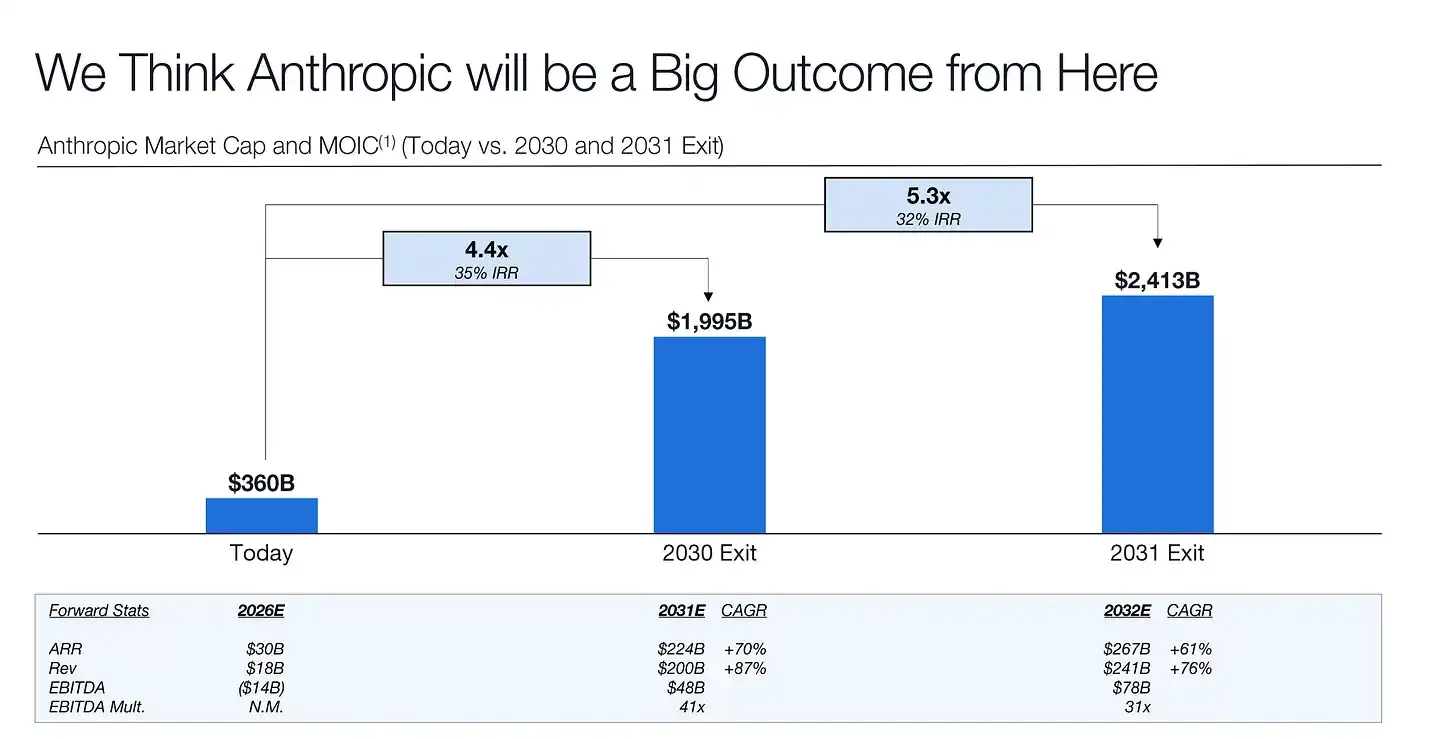
According to the Substack account Newcomer, renowned investment firm Coatue Management predicted in an internal investor presentation from January that Anthropic's valuation would soar to $1.995 trillion by 2030.

Based on the Coatue PPT released by Newcomer, Anthropic is projected to achieve revenue of $18 billion in 2026, but with an EBITDA loss of $14 billion, and its ARR is expected to reach $30 billion by the end of the year.

By 2031, the company's revenue is anticipated to jump to $200 billion, with an EBITDA profit of $48 billion, and ARR further climbing to $224 billion.

Using this as a basis, Coatue applied a 41x forward EBITDA multiple to derive a valuation of $1.995 trillion for 2030, suggesting it could potentially rise to $2.413 trillion in 2031.

In February of this year, Anthropic just completed a new round of financing. Coatue and Singapore's sovereign wealth fund GIC co-led Anthropic's $30 billion Series G funding round, resulting in a post-money valuation of $380 billion. This round of financing is among the largest in the history of the AI field, with participation from other top-tier institutions including D.E. Shaw Ventures and Founders Fund. Coatue founder Philippe Laffont stated at the time that the firm is highly confident in Anthropic's positioning in enterprise AI and Agent Coding.

However, Anthropic's actual growth rate has already partially exceeded Coatue's optimistic expectations. By early March, the company's ARR had approached $20 billion, doubling from $9 billion at the end of 2025, with particularly significant growth in February alone. Anthropic CEO Dario Amodei confirmed at a Morgan Stanley conference that products like Claude Code have made outstanding contributions, with enterprise customers accounting for as much as 80% of the business, and consumption-based billing models further amplifying revenue elasticity.

As a major competitor to OpenAI, Anthropic is known for its "safe and reliable" AI philosophy, and its Claude series of models are rapidly penetrating the coding and enterprise application markets. Since 2025, weekly active users of Claude Code have doubled, and the proportion of code generated by it on GitHub has significantly increased. The company achieved the leap from zero to tens of billions in revenue in less than three years, a growth rate far surpassing that of early cloud computing giants. The generative AI market is in a period of explosion, driven by data centers, computing power demands, and enterprise digital transformation, collectively fueling expectations of trillion-dollar growth.


Perguntas relacionadas

QWhat is the projected valuation of Anthropic by 2030 according to Coatue Management's internal investor presentation?

ACoatue Management projects that Anthropic's valuation will reach $1.995 trillion by 2030.

QHow much revenue is Anthropic expected to generate in 2026 and 2031 based on Coatue's forecast?

AAnthropic is expected to generate $18 billion in revenue in 2026 and $200 billion in revenue in 2031.

QWhat recent financing round did Anthropic complete, and what was the post-money valuation?

AAnthropic completed a $30 billion Series G financing round in February, led by Coatue and GIC, with a post-money valuation of $380 billion.

QWhich product has been a significant contributor to Anthropic's rapid growth, particularly in enterprise applications?

AClaude Code has been a significant contributor to Anthropic's rapid growth, especially in enterprise applications, with enterprise customers accounting for 80% of its business.

QHow does Anthropic's AI philosophy differentiate it from competitors like OpenAI?

AAnthropic is known for its 'safe and reliable' AI philosophy, differentiating itself by focusing on safety and reliability in its Claude series models, which have gained rapid traction in coding and enterprise applications.

Leituras Relacionadas

In Jinjiang, Fujian, a Storage Super Unicorn Lies Quiet

In Fujian's Jinjiang, a city known for sportswear, lies a quiet semiconductor giant: Fujian Jinhua Integrated Circuit Co. (JHICC). Once a promising domestic DRAM manufacturer alongside Yangtze Memory and ChangXin Memory Technologies (CXMT), its journey was derailed in 2018 when the U.S. placed it on an Entity List and filed criminal charges for alleged trade secret theft. This halted production for years. A turning point came in February 2024 when a U.S. federal court found JHICC not guilty. However, it had lost crucial time. While CXMT soared to become a top-valued A-share company in 2024, JHICC, with an estimated valuation of 80 billion RMB, was just restarting. Its current output is primarily customized DDR4 chips, not the advanced DDR5/HBM demanded for AI, but it still benefits from the broader memory chip upcycle. JHICC's story is tied to Chen Zhengkun, a veteran engineer who left Micron to lead the venture. Founded in 2016 with state-backed funding, JHICC partnered with Taiwan's UMC to develop DRAM technology. Rapid progress was cut short by the U.S. actions, which Micron initiated, partly due to its heavy reliance on the Chinese market. Post-sanctions, Chen's team worked to rebuild the production line with reduced reliance on U.S. technology. According to its records, JHICC achieved small-scale production and revenue growth under immense pressure. It now focuses on the stable "niche" DRAM market (e.g., TVs, routers) with a monthly capacity of ~40,000 wafers, aiming for 60,000 by 2026. It holds over 1,000 patents but remains on the Entity List. For Jinjiang, investing in JHICC was a bold industrial leap. The local government provided unwavering financial and logistical support during the crisis, helping the company survive. JHICC has become the anchor for a growing local semiconductor cluster. Though its scale lags behind domestic peers, JHICC's persistence symbolizes a hard-won foothold in a global market long dominated by Samsung, SK Hynix, and Micron. Having missed one boom, it seeks a place in the new AI-driven memory supercycle.

marsbitHá 41m

In Jinjiang, Fujian, a Storage Super Unicorn Lies Quiet

marsbitHá 41m

Must-Watch Events Next Week|CLARITY Act Could Face Senate Vote; SpaceX, Circle to Report Earnings (8.3-8.9)

**Summary: Key Events and Developments to Watch (August 3-9)** The upcoming week is marked by significant financial disclosures, key legislative deadlines, and notable product updates. **Major Financial Events:** Several companies are scheduled to release their Q2 2026 earnings. American Bitcoin (ABTC) will report on August 3, followed by SpaceX and Hut 8 Mining Corp. on August 4, and Circle on August 5. Notably, a significant portion of SpaceX shares (up to 12% of total shares) will be unlocked on August 6 following their earnings release. **Key Legislative Deadline:** The U.S. Senate faces an August 7 deadline to secure 60 votes for the CLARITY Act, a bipartisan bill aiming to establish a federal regulatory framework for cryptocurrencies. The Senate may hold a full vote on the bill during the week. **Economic Data:** The U.S. July Non-Farm Payrolls report will be released on August 7, providing crucial labor market data. **Technology & Product Updates:** * **Shutdowns:** DeFi portfolio tracker Zapper and wallet app Ctrl Wallet will cease operations on August 3. * **Upgrades:** LayerZero will deprecate its v1 relayers on August 3. XRP Ledger's new version 3.3.0, featuring five new functions, is expected next week. * **AI:** Elon Musk announced that the advanced Grok 4.6 AI model is set for release around August 7. * **Bitcoin:** The BIP-110 forced signaling for a potential Bitcoin network change is scheduled to begin around August 8. **Other Notable Events:** Chinese robotics firm Unitree Tech has set its preliminary price inquiry for its IPO for August 5. South Korean exchange Upbit will delist AQT and AERGO tokens on August 3.

marsbitHá 2h

Must-Watch Events Next Week|CLARITY Act Could Face Senate Vote; SpaceX, Circle to Report Earnings (8.3-8.9)

marsbitHá 2h

Trading

Spot
活动图片




