$30 Billion in Funding Just the Starting Point? Anthropic's Valuation Could Exceed $2 Trillion by 2030

marsbitPublicado em 2026-03-31Última atualização em 2026-03-31

Resumo

According to an internal investor presentation from Coatue Management, Anthropic is projected to reach a valuation of $1.995 trillion by 2030, potentially rising to $2.413 trillion in 2031. The forecast anticipates $18 billion in revenue by 2026, though with an EBITDA loss of $14 billion, and an annual recurring revenue (ARR) of $30 billion. By 2031, revenue is expected to surge to $200 billion, with $48 billion in EBITDA profit and $224 billion in ARR. In February, Anthropic completed a $30 billion Series G round led by Coatue and GIC, reaching a post-money valuation of $380 billion. However, the company's growth has already exceeded expectations, with ARR nearing $20 billion by March—more than double the $9 billion recorded at the end of 2025. CEO Dario Amodei highlighted the strong performance of Claude Code and enterprise clients, which make up 80% of its customer base. As a key competitor to OpenAI, Anthropic is recognized for its focus on safe and reliable AI, with its Claude models gaining significant traction in coding and enterprise applications. The company has achieved rapid revenue growth, surpassing $10 billion in under three years, fueled by strong demand in generative AI and enterprise digital transformation.

Author: Bright Company
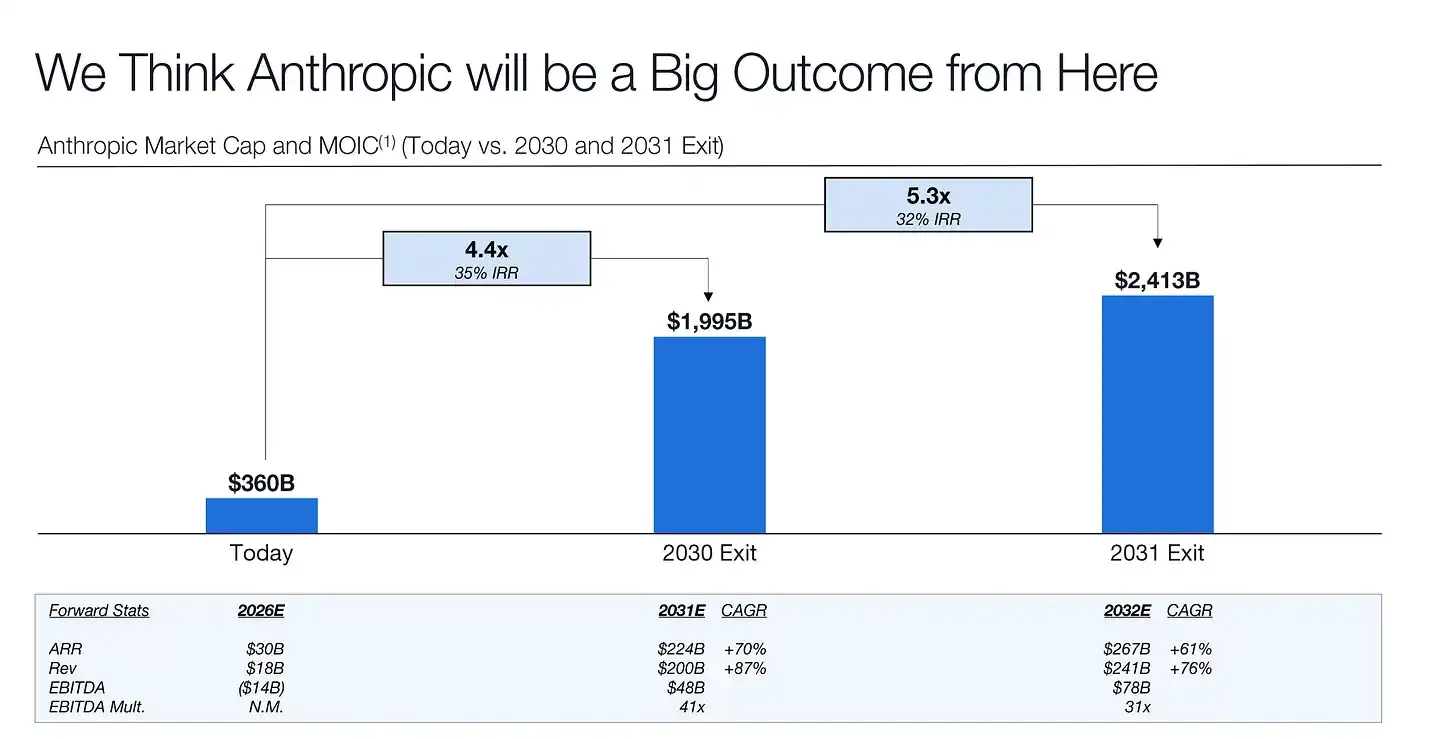
According to the Substack account Newcomer, renowned investment firm Coatue Management predicted in an internal investor presentation from January that Anthropic's valuation would soar to $1.995 trillion by 2030.

Based on the Coatue PPT released by Newcomer, Anthropic is projected to achieve revenue of $18 billion in 2026, but with an EBITDA loss of $14 billion, and its ARR is expected to reach $30 billion by the end of the year.

By 2031, the company's revenue is anticipated to jump to $200 billion, with an EBITDA profit of $48 billion, and ARR further climbing to $224 billion.

Using this as a basis, Coatue applied a 41x forward EBITDA multiple to derive a valuation of $1.995 trillion for 2030, suggesting it could potentially rise to $2.413 trillion in 2031.

In February of this year, Anthropic just completed a new round of financing. Coatue and Singapore's sovereign wealth fund GIC co-led Anthropic's $30 billion Series G funding round, resulting in a post-money valuation of $380 billion. This round of financing is among the largest in the history of the AI field, with participation from other top-tier institutions including D.E. Shaw Ventures and Founders Fund. Coatue founder Philippe Laffont stated at the time that the firm is highly confident in Anthropic's positioning in enterprise AI and Agent Coding.

However, Anthropic's actual growth rate has already partially exceeded Coatue's optimistic expectations. By early March, the company's ARR had approached $20 billion, doubling from $9 billion at the end of 2025, with particularly significant growth in February alone. Anthropic CEO Dario Amodei confirmed at a Morgan Stanley conference that products like Claude Code have made outstanding contributions, with enterprise customers accounting for as much as 80% of the business, and consumption-based billing models further amplifying revenue elasticity.

As a major competitor to OpenAI, Anthropic is known for its "safe and reliable" AI philosophy, and its Claude series of models are rapidly penetrating the coding and enterprise application markets. Since 2025, weekly active users of Claude Code have doubled, and the proportion of code generated by it on GitHub has significantly increased. The company achieved the leap from zero to tens of billions in revenue in less than three years, a growth rate far surpassing that of early cloud computing giants. The generative AI market is in a period of explosion, driven by data centers, computing power demands, and enterprise digital transformation, collectively fueling expectations of trillion-dollar growth.


Perguntas relacionadas

QWhat is the projected valuation of Anthropic by 2030 according to Coatue Management's internal investor presentation?

ACoatue Management projects that Anthropic's valuation will reach $1.995 trillion by 2030.

QHow much revenue is Anthropic expected to generate in 2026 and 2031 based on Coatue's forecast?

AAnthropic is expected to generate $18 billion in revenue in 2026 and $200 billion in revenue in 2031.

QWhat recent financing round did Anthropic complete, and what was the post-money valuation?

AAnthropic completed a $30 billion Series G financing round in February, led by Coatue and GIC, with a post-money valuation of $380 billion.

QWhich product has been a significant contributor to Anthropic's rapid growth, particularly in enterprise applications?

AClaude Code has been a significant contributor to Anthropic's rapid growth, especially in enterprise applications, with enterprise customers accounting for 80% of its business.

QHow does Anthropic's AI philosophy differentiate it from competitors like OpenAI?

AAnthropic is known for its 'safe and reliable' AI philosophy, differentiating itself by focusing on safety and reliability in its Claude series models, which have gained rapid traction in coding and enterprise applications.

Leituras Relacionadas

Google and Amazon Simultaneously Invest Heavily in a Competitor: The Most Absurd Business Logic of the AI Era Is Becoming Reality

In a span of four days, Amazon announced an additional $25 billion investment, and Google pledged up to $40 billion—both direct competitors pouring over $65 billion into the same AI startup, Anthropic. Rather than a typical venture capital move, this signals the latest escalation in the cloud wars. The core of the deal is not equity but compute pre-orders: Anthropic must spend the majority of these funds on AWS and Google Cloud services and chips, effectively locking in massive future compute consumption. This reflects a shift in cloud market dynamics—enterprises now choose cloud providers based on which hosts the best AI models, not just price or stability. With OpenAI deeply tied to Microsoft, Anthropic’s Claude has become the only viable strategic asset for Google and Amazon to remain competitive. Anthropic’s annualized revenue has surged to $30 billion, and it is expanding into verticals like biotech, positioning itself as a cross-industry AI infrastructure layer. However, this funding comes with constraints: Anthropic’s independence is challenged as it balances two rival investors, its safety-first narrative faces pressure from regulatory scrutiny, and its path to IPO introduces new financial pressures. Globally, this accelerates a "tri-polar" closed-loop structure in AI infrastructure, with Microsoft-OpenAI, Google-Anthropic, and Amazon-Anthropic forming exclusive model-cloud alliances. In contrast, China’s landscape differs—investments like Alibaba and Tencent backing open-source model firm DeepSeek reflect a more decoupled approach, though closed-source models from major cloud providers still dominate. The $65 billion bet is ultimately about securing a seat at the table in an AI-defined future—where missing the model layer means losing the cloud war.

marsbitHá 3h

Google and Amazon Simultaneously Invest Heavily in a Competitor: The Most Absurd Business Logic of the AI Era Is Becoming Reality

marsbitHá 3h

Computing Power Constrained, Why Did DeepSeek-V4 Open Source?

DeepSeek-V4 has been released as a preview open-source model, featuring 1 million tokens of context length as a baseline capability—previously a premium feature locked behind enterprise paywalls by major overseas AI firms. The official announcement, however, openly acknowledges computational constraints, particularly limited service throughput for the high-end DeepSeek-V4-Pro version due to restricted high-end computing power. Rather than competing on pure scale, DeepSeek adopts a pragmatic approach that balances algorithmic innovation with hardware realities in China’s AI ecosystem. The V4-Pro model uses a highly sparse architecture with 1.6T total parameters but only activates 49B during inference. It performs strongly in agentic coding, knowledge-intensive tasks, and STEM reasoning, competing closely with top-tier closed models like Gemini Pro 3.1 and Claude Opus 4.6 in certain scenarios. A key strategic product is the Flash edition, with 284B total parameters but only 13B activated—making it cost-effective and accessible for mid- and low-tier hardware, including domestic AI chips from Huawei (Ascend), Cambricon, and Hygon. This design supports broader adoption across developers and SMEs while stimulating China's domestic semiconductor ecosystem. Despite facing talent outflow and intense competition in user traffic—with rivals like Doubao and Qianwen leading in monthly active users—DeepSeek has maintained technical momentum. The release also comes amid reports of a new funding round targeting a valuation exceeding $10 billion, potentially setting a new record in China’s LLM sector. Ultimately, DeepSeek-V4 represents a shift toward open yet realistic infrastructure development in the constrained compute landscape of Chinese AI, emphasizing engineering efficiency and domestic hardware compatibility over pure model scale.

marsbitHá 3h

Computing Power Constrained, Why Did DeepSeek-V4 Open Source?

marsbitHá 3h

Trading

Spot
Futuros
活动图片




