$30 Billion in Funding Just the Starting Point? Anthropic's Valuation Could Exceed $2 Trillion by 2030

marsbitPublicado em 2026-03-31Última atualização em 2026-03-31

Resumo

According to an internal investor presentation from Coatue Management, Anthropic is projected to reach a valuation of $1.995 trillion by 2030, potentially rising to $2.413 trillion in 2031. The forecast anticipates $18 billion in revenue by 2026, though with an EBITDA loss of $14 billion, and an annual recurring revenue (ARR) of $30 billion. By 2031, revenue is expected to surge to $200 billion, with $48 billion in EBITDA profit and $224 billion in ARR. In February, Anthropic completed a $30 billion Series G round led by Coatue and GIC, reaching a post-money valuation of $380 billion. However, the company's growth has already exceeded expectations, with ARR nearing $20 billion by March—more than double the $9 billion recorded at the end of 2025. CEO Dario Amodei highlighted the strong performance of Claude Code and enterprise clients, which make up 80% of its customer base. As a key competitor to OpenAI, Anthropic is recognized for its focus on safe and reliable AI, with its Claude models gaining significant traction in coding and enterprise applications. The company has achieved rapid revenue growth, surpassing $10 billion in under three years, fueled by strong demand in generative AI and enterprise digital transformation.

Author: Bright Company
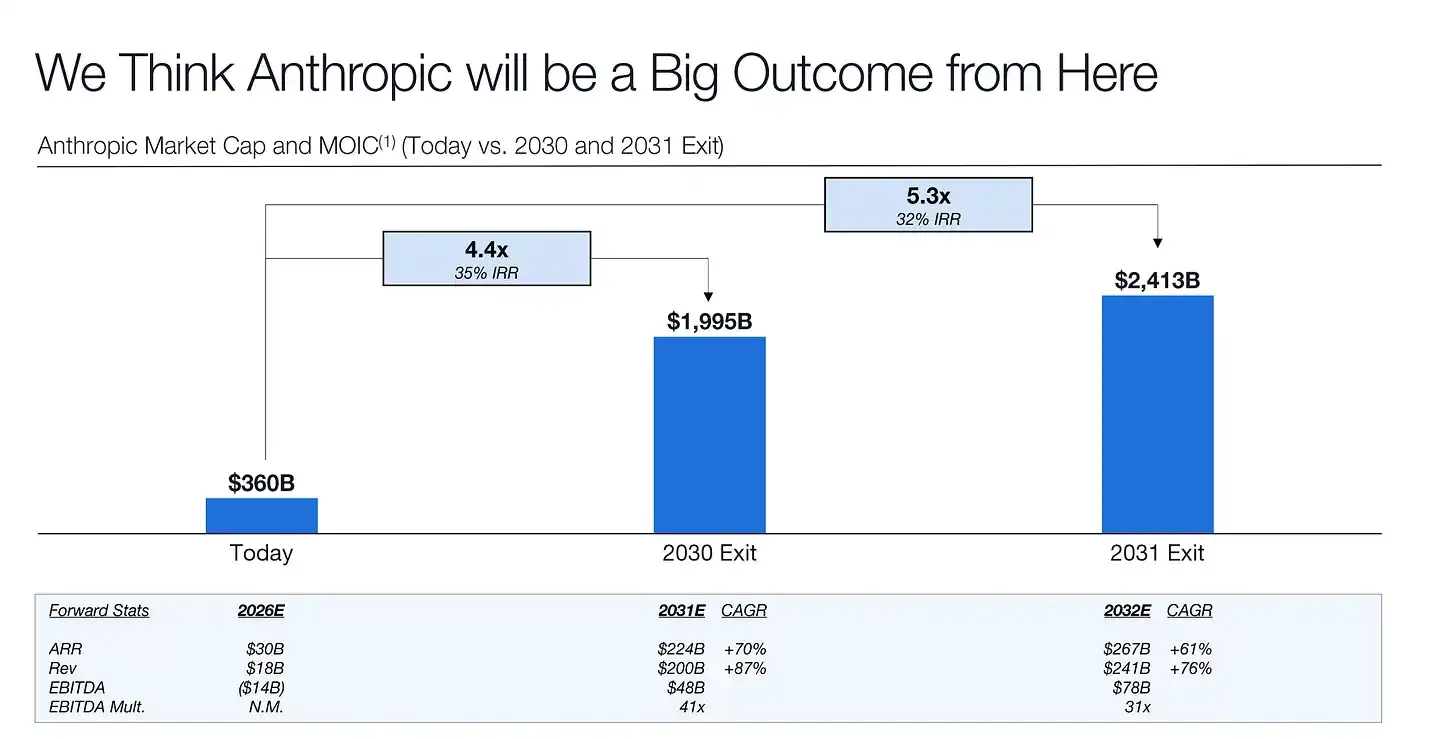
According to the Substack account Newcomer, renowned investment firm Coatue Management predicted in an internal investor presentation from January that Anthropic's valuation would soar to $1.995 trillion by 2030.

Based on the Coatue PPT released by Newcomer, Anthropic is projected to achieve revenue of $18 billion in 2026, but with an EBITDA loss of $14 billion, and its ARR is expected to reach $30 billion by the end of the year.

By 2031, the company's revenue is anticipated to jump to $200 billion, with an EBITDA profit of $48 billion, and ARR further climbing to $224 billion.

Using this as a basis, Coatue applied a 41x forward EBITDA multiple to derive a valuation of $1.995 trillion for 2030, suggesting it could potentially rise to $2.413 trillion in 2031.

In February of this year, Anthropic just completed a new round of financing. Coatue and Singapore's sovereign wealth fund GIC co-led Anthropic's $30 billion Series G funding round, resulting in a post-money valuation of $380 billion. This round of financing is among the largest in the history of the AI field, with participation from other top-tier institutions including D.E. Shaw Ventures and Founders Fund. Coatue founder Philippe Laffont stated at the time that the firm is highly confident in Anthropic's positioning in enterprise AI and Agent Coding.

However, Anthropic's actual growth rate has already partially exceeded Coatue's optimistic expectations. By early March, the company's ARR had approached $20 billion, doubling from $9 billion at the end of 2025, with particularly significant growth in February alone. Anthropic CEO Dario Amodei confirmed at a Morgan Stanley conference that products like Claude Code have made outstanding contributions, with enterprise customers accounting for as much as 80% of the business, and consumption-based billing models further amplifying revenue elasticity.

As a major competitor to OpenAI, Anthropic is known for its "safe and reliable" AI philosophy, and its Claude series of models are rapidly penetrating the coding and enterprise application markets. Since 2025, weekly active users of Claude Code have doubled, and the proportion of code generated by it on GitHub has significantly increased. The company achieved the leap from zero to tens of billions in revenue in less than three years, a growth rate far surpassing that of early cloud computing giants. The generative AI market is in a period of explosion, driven by data centers, computing power demands, and enterprise digital transformation, collectively fueling expectations of trillion-dollar growth.


Perguntas relacionadas

QWhat is the projected valuation of Anthropic by 2030 according to Coatue Management's internal investor presentation?

ACoatue Management projects that Anthropic's valuation will reach $1.995 trillion by 2030.

QHow much revenue is Anthropic expected to generate in 2026 and 2031 based on Coatue's forecast?

AAnthropic is expected to generate $18 billion in revenue in 2026 and $200 billion in revenue in 2031.

QWhat recent financing round did Anthropic complete, and what was the post-money valuation?

AAnthropic completed a $30 billion Series G financing round in February, led by Coatue and GIC, with a post-money valuation of $380 billion.

QWhich product has been a significant contributor to Anthropic's rapid growth, particularly in enterprise applications?

AClaude Code has been a significant contributor to Anthropic's rapid growth, especially in enterprise applications, with enterprise customers accounting for 80% of its business.

QHow does Anthropic's AI philosophy differentiate it from competitors like OpenAI?

AAnthropic is known for its 'safe and reliable' AI philosophy, differentiating itself by focusing on safety and reliability in its Claude series models, which have gained rapid traction in coding and enterprise applications.

Leituras Relacionadas

In-depth: The Foreign Guest Genspark

The article "The Foreign Guest: Genspark" investigates the identity and business practices of AI startup Genspark, which presents itself as a Palo Alto-based "AI Costco" offering a subscription bundle of over 70 models and numerous AI agent tools. Despite its official Silicon Valley narrative, Genspark's founding team has deep roots in Chinese tech giant Baidu, a history systematically downplayed in its branding. The company actively cultivates an image as an elite US firm, heavily publicizing partnerships and endorsements from OpenAI, Anthropic, and Microsoft, while distancing itself from the Chinese AI community and obscuring its connections to Chinese investors and open-weight models (like those from DeepSeek, Moonshot AI, and MiniMax) that power its services. Genspark's core strategy involves rapidly cloning and integrating successful AI product concepts (e.g., from Perplexity, Manus, Plaud) into its unified platform, supported by aggressive marketing, including Super Bowl ads and paid native content in publications like The Wall Street Journal. Critically, the article suggests a significant portion of its engineering and product development is conducted by a team in Beijing, operating outside its official US corporate structure. This duality allows Genspark to leverage Chinese talent and models for efficiency and cost reduction while constructing a public facade as a purely American success story. The piece concludes that Genspark's most effective agent is its own corporate identity, meticulously engineered to obscure its Chinese underpinnings and be perceived solely as a Silicon Valley company.

marsbitHá 42m

In-depth: The Foreign Guest Genspark

marsbitHá 42m

Debate: Korean Workers Fear Unemployment, While Musk Envisions a Society 'Without Work'?

While South Korean auto workers fear job losses from robotics, Elon Musk envisions a future where AI and robots render most work optional. This article explores the growing tension between immediate anxieties over automation and long-term visions of a post-work society. The piece begins with recent strikes at Hyundai's Korean plants, where unions, amid standard wage negotiations, also sought job guarantees against advancing robotics—specifically mentioning Boston Dynamics' Atlas. This reflects how anxiety about technological displacement is emerging even before robots are fully capable of replacing skilled labor on assembly lines. The author argues that while current robotics still struggle with the nuanced, experiential knowledge of veteran workers, the *perception* of imminent replacement is fueling social conflict prematurely. This modern "Luddite" sentiment is compared to the 19th-century English textile workers who smashed machines. Historically, Luddites weren't simply anti-technology; they were protesting the rapid devaluation of their skills and the unequal distribution of productivity gains. Similarly, today's workers ask who will bear the cost of transition and share in the new wealth created by machines. In contrast, figures like Elon Musk propose an optimistic endpoint: with AI and robotics driving extreme abundance, the link between work and survival could break. He suggests concepts like "Universal High Income" could allow society to share the technological bounty, transforming work from a necessity into a choice. The core challenge, however, lies in the transition. The author notes that technology's benefits diffuse slowly, while its disruptive costs—job losses, skill obsolescence—can be concentrated and immediate. The risk is a painful interim period where productivity gains are captured by a few before new social contracts, safety nets, and retraining systems are established. The conclusion calls for proactive governance. Just as past industrial revolutions gave rise to labor standards and social safety nets, the robotics era needs its own frameworks. These should address job transition support, distribution of productivity gains, safety liability, and ethical deployment. Embracing such "constraints" is not opposition to progress but a necessary step to ensure technology benefits society broadly. The discussion sparked by Hyundai's workers, therefore, is not premature but essential.

marsbitHá 55m

Debate: Korean Workers Fear Unemployment, While Musk Envisions a Society 'Without Work'?

marsbitHá 55m

Trading

Spot
活动图片