$30 Billion DeFi Capital Exodus: LayerZero Stumbles, Chainlink Feasts

marsbitPublicado em 2026-05-13Última atualização em 2026-05-13

Resumo

Following the major DeFi security incident involving Kelp DAO, a significant migration of funds is underway from the cross-chain protocol LayerZero to Chainlink's CCIP (Cross-Chain Interoperability Protocol). Over $30 billion in Total Value Locked (TVL) from protocols like Kelp DAO, Solv Protocol, Re, and Tydro has moved to Chainlink in the past week, driven by security concerns. LayerZero is facing a severe trust crisis after the attack. Initially denying responsibility, LayerZero Labs has now issued a public apology, acknowledging management oversights. These include a vulnerable "1/1" single-node configuration for its Decentralized Verification Network (DVN) and past misuse of a multi-signature wallet by a team member. The protocol's weekly bridge volume has slumped to near-historic lows of around $470 million. In contrast, Chainlink is experiencing a surge in adoption and activity. Its independent active addresses recently hit multi-month highs, and whales have been accumulating LINK tokens. Beyond DeFi, Chainlink is securing partnerships with traditional finance giants like DTCC, European stock exchange operator SIX Group, and asset manager Amundi. While LayerZero has announced security upgrades—such as migrating to stronger multi-signature configurations and developing a second DVN client—and contributed to a rescue fund, the event underscores that security is becoming a decisive competitive factor as DeFi matures.

Author: Nancy, PANews

With several leading protocols stepping in to inject capital, quickly covering the funding gap and advancing on-chain recovery, the rescue efforts for the Kelp DAO attack incident have recently seen substantial progress. However, compared to the financial repairs, the harder thing to restore remains market trust.

At the center of this vortex, cross-chain leader LayerZero is facing accelerating withdrawals from many protocols and was forced to make a dramatic shift in attitude within just a few weeks—from initially shifting blame and denying responsibility to now publicly apologizing and initiating rectifications. Meanwhile, Chainlink has unexpectedly become a beneficiary of this crisis, with its CCIP protocol absorbing a large portion of migrating liquidity, showing notable growth in on-chain data.

Securing $30 Billion in Migration in a Single Week, Chainlink Reaps Security Dividends

As the largest DeFi security incident to date in 2026, the Kelp DAO attack has accelerated the migration of on-chain liquidity.

As LayerZero's security controversy continues to ferment, an increasing number of DeFi protocols are reevaluating cross-chain risks and proactively seeking more reliable havens. Over the past week, Chainlink has intensively announced multiple migration cases.

On May 9, Chainlink officially disclosed that four protocols, including Kelp DAO, Solv Protocol, Re, and Tydro, had recently abandoned their original cross-chain bridge or oracle solutions and migrated to Chainlink CCIP. The combined TVL of these related protocols exceeds $30 billion. The official even specifically added the phrase "The Great Migration" to hype this ecosystem shift, revealing strong competitive undertones.

Behind this migration wave is a realignment centered on security.

And besides DeFi protocols realigning due to security concerns, Chainlink has also been continuously gaining favor from traditional financial institutions and crypto projects in recent months.

In March of this year, Coinbase directly put its exchange market data on-chain for the first time via Chainlink's newly launched DataLink service; Europe's largest asset management firm, Amundi, collaborated with Spiko to launch a tokenized public fund based on Chainlink.

In April, OpenAssets formed a strategic partnership with Chainlink, launching an asset tokenization infrastructure solution for institutions; major European stock exchange operator SIX Group partnered with Chainlink to push Swiss and Spanish stock market data on-chain; AWS Marketplace listed Chainlink data services, connecting traditional cloud and blockchain.

In May, the US Depository Trust & Clearing Corporation (DTCC) announced the introduction of Chainlink to build a blockchain collateral management platform, aiming to achieve near-real-time settlement around the clock; Huma Finance partnered with Chainlink to introduce institutional-grade yield products into the multi-chain ecosystem.

Accompanying the ongoing ecosystem expansion, Chainlink's on-chain activity has also noticeably heated up. According to Santiment monitoring, Chainlink's number of unique active addresses broke 282,000 and 264,000 on May 9 and 10, respectively, hitting the highest records since September 2025, and noted this was primarily influenced by the recent large-scale migration of DeFi protocol infrastructure.
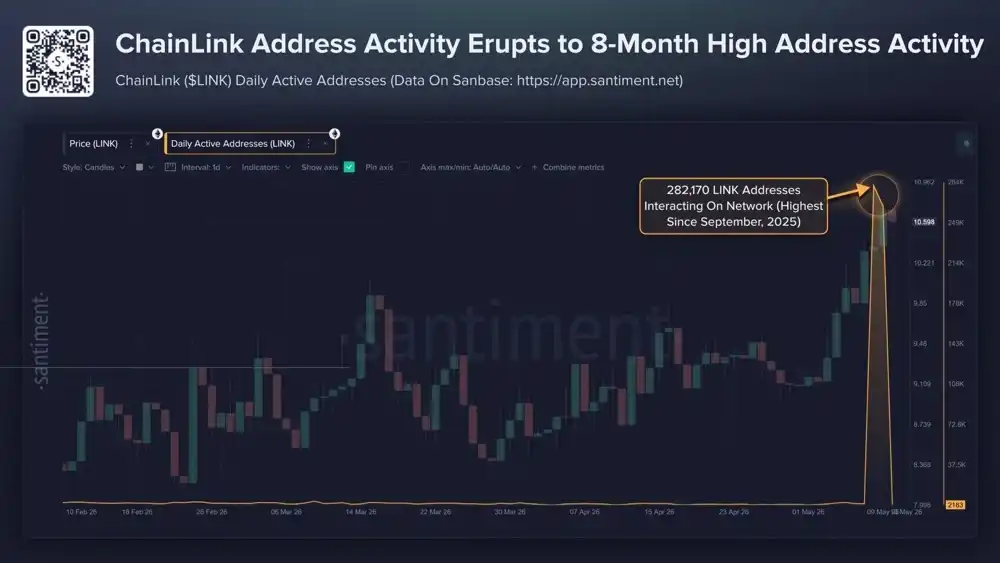
Meanwhile, official Chainlink data shows that the total value of its cross-chain tokens has exceeded $61.8 billion, with CCIP transaction volume reaching $19.5 billion.

Market confidence is also reflected in changes in LINK token holdings. According to Santiment monitoring earlier this month, over the past month, Chainlink whale and shark addresses holding between 100,000 and 10 million LINK cumulatively added 32.93 million LINK. Historically, this has often been a strong bullish signal. Over the past 30 days, LINK has risen approximately 19.7%.

LayerZero Faces Trust Crisis, Officials Issue Emergency Apology and Overhaul

Currently, LayerZero is mired in a trust crisis.

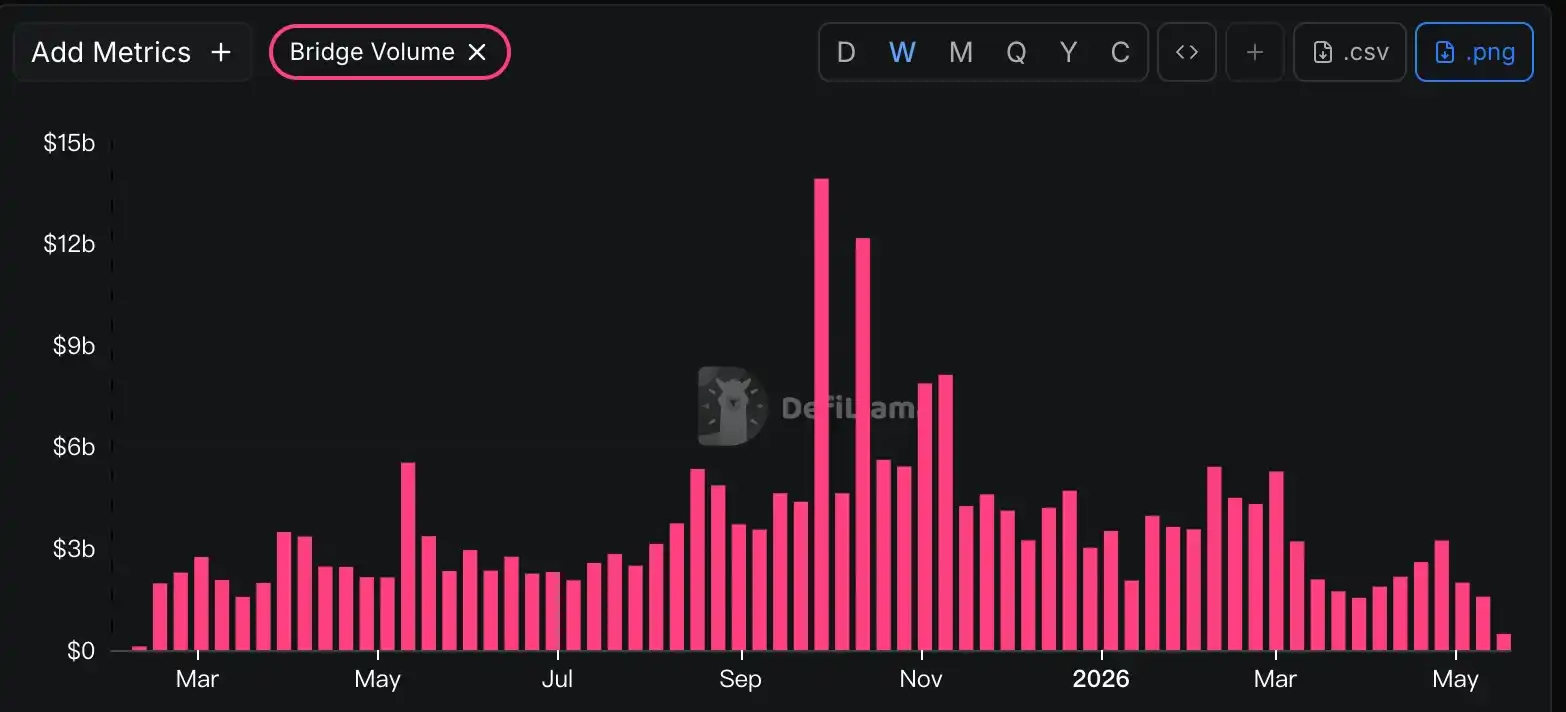
According to DefiLlama data, LayerZero's weekly Bridge transaction volume has now declined to about $470 million, approaching historical lows. This attack incident has plunged LayerZero into a trust crisis.
In the early stages of the hack, Kelp DAO attributed the vulnerability exploit to LayerZero's security issues. Subsequently, LayerZero quickly denied responsibility, stating that multiple accusations by Kelp DAO in the rsETH security incident were completely false.

But the controversy did not subside. Last week, LayerZero Labs co-founder and CEO Bryan Pellegrino engaged in heated debates with several security researchers in the ETHSecurity Community Telegram group.

The focal point of contention is that LayerZero Labs could immediately upgrade the default library contract without a timelock, theoretically allowing forged cross-chain messages. This exposed over $3 billion in LZ OFT assets to potential risk for a period. Security researcher Banteg pointed out that several mainstream projects, including Ethena and EtherFi, were still using this default library weeks ago, and about $178 million in assets remain exposed to risk.

Simultaneously, on-chain data also showed that LayerZero's multi-signature address had conducted Meme coin trading, DEX swaps, and cross-chain bridging operations unrelated to multi-signature duties, further raising community concerns about key security. In response, Bryan admitted that related operations were indeed performed by multi-signature team members but denied they constituted "Meme coin speculation trading," claiming the purpose was merely "testing PEPE OFT functionality," and stated that the involved members had been removed.

To mitigate risks, Bryan also publicly advised project teams to promptly adopt a "fixed configuration" to replace the default configuration. Subsequently, Banteg published a list of LayerZero projects still using the default library contract and called on related protocols to migrate as soon as possible.

These remarks quickly sparked industry discussion and skepticism. Chainlink Strategy Lead Zach Rynes had previously criticized LayerZero Labs, stating that its multi-signature keys had long suffered from serious OPSEC (operational security) failures, directly exposing tens of billions in OFT assets to security risks. He further stated that if LayerZero and the industry had truly heeded the persistent warnings from security researchers over the past few years, such attack incidents could have been entirely avoided.

Facing market舆论 and ongoing ecosystem bleeding, LayerZero's attitude shifted noticeably. On May 9, LayerZero officially released a public apology statement, addressing the security incidents and communication issues over the past three weeks.

LayerZero Labs stated that the internal RPC it used had been attacked by the Lazarus Group over the past three weeks, compromising the authenticity source of its DVN (Decentralized Verification Network), while external RPC providers suffered DDoS attacks. The incident affected only 0.14% of applications and approximately 0.36% of asset value, the LayerZero protocol itself was unaffected, and over $9 billion in assets continued normal cross-chain flow after the incident.

However, LayerZero Labs also acknowledged for the first time that it was responsible for management oversight in previously allowing DVNs to provide security for high-value transactions with a "1/1" single-node configuration, which posed a single point of failure risk. The official also disclosed that three and a half years ago, a multi-signature signer mistakenly used a multi-signature hardware wallet for personal transactions. That signer has been removed, and the relevant wallet has been rotated.

Regarding subsequent rectifications, LayerZero Labs announced a series of security upgrade measures, including: already ceasing services for the 1/1 DVN configuration, currently migrating all path default configurations to a 5/5 multi-signature setup with a minimum of 3/3; developing a second DVN client based on Rust to achieve client diversity; launching the dedicated multi-signature tool OneSig to enhance signature security; and launching the unified management platform Console for asset issuance configuration and abnormal behavior detection.

Additionally, LayerZero also contributed over 10,000 ETH to this DeFi United rescue effort, of which 5,000 ETH will be used for the fund, and the remaining 5,000 ETH will be reserved for Aave.

Despite the escalating controversy, LayerZero has not completely lost its market. Major assets, including Ethena's USDe product, EtherFi's weETH asset, and BitGo's WBTC, continue to use LayerZero's OFT standard.

Every major security crisis triggers a redistribution of liquidity and discourse power. As the crypto industry increasingly moves towards mainstream financial markets, the criteria for evaluating underlying infrastructure will become ever more stringent, with security capabilities becoming one of the core competitive advantages.


Perguntas relacionadas

QWhat was the immediate consequence of the Kelp DAO hack on the cross-chain infrastructure landscape?

AIt triggered a rapid migration of DeFi liquidity away from LayerZero due to security concerns, with over $30 billion in TVL from protocols like Kelp DAO moving to Chainlink's CCIP within a week.

QAccording to the article, what were two key security issues highlighted by researchers regarding LayerZero?

AFirst, LayerZero's default library contract, which could be upgraded instantly without a timelock, potentially allowing forged cross-chain messages. Second, suspicious non-multisig-related activities from a multisig signer address, raising concerns about key security.

QHow did Chainlink's on-chain activity and LINK token react to the migration trend mentioned in the article?

AChainlink's daily active unique addresses surged to over 282,000 and 264,000, the highest since September 2025. Furthermore, whales and sharks holding 100k to 10M LINK accumulated over 32.9 million LINK in a month, while the LINK token price rose approximately 19.7% in 30 days.

QWhat specific corrective measures did LayerZero announce in its public apology on May 9th?

ALayerZero announced several measures: stopping service for 1/1 DVN configurations, migrating all paths to at least 3/3 or 5/5 multisig setups, developing a second DVN client in Rust for client diversity, launching a dedicated multisig tool called OneSig, and releasing a management platform called Console for configuration and anomaly detection.

QDespite the crisis, which major assets and protocols were mentioned as still continuing to use LayerZero's technology?

AMajor assets and protocols continuing to use LayerZero's OFT standard include Ethena's USDe, EtherFi's weETH, and BitGo's WBTC.

Leituras Relacionadas

Anthropic's IPO Launch: Commercial Miracle or Valuation Bubble?

Anthropic has confidentially filed for an IPO, led by Morgan Stanley and Goldman Sachs, potentially going public by October. Following its latest $650 billion funding round, its pre-IPO valuation stands at $965 billion, with projections reaching up to $2 trillion at listing, which would make it the highest-valued private company ever. The article, written by Fu Sheng, addresses skepticism that this represents an AI bubble akin to the 2000 dot-com crash. It argues the current situation differs fundamentally. Unlike the internet bubble era, which relied on speculative narratives with little revenue, Anthropic's valuation is backed by unprecedented, measurable financial performance. Key data points include: * **Revenue Growth:** ARR skyrocketed from $10 billion in early 2025 to $470 billion by May 2026, targeting $100 billion by year-end—a growth curve unmatched in business history. * **Profitability:** It achieved operating profitability in Q2 2026 with an estimated $5.6 billion profit. * **Efficiency:** With ~3,000 employees and ~$470 billion ARR, its revenue per employee exceeds $10 million. Products like Claude Code, launched less than a year ago, already generate $25 billion in annualized revenue. * **Enterprise Adoption:** It boasts a strong enterprise client base, with 8 of the Fortune 10 and over 1,000 large firms spending over $1 million annually on Claude. The valuation is framed using a traditional SaaS model (e.g., a 10x Price-to-Sales multiple on $100 billion revenue). The author contends the core question for analysts has shifted from "How big could this be?" to "How much is it earning and will earn next quarter?" The discussion extends beyond Anthropic to a broader paradigm shift: the transition from a "carbon-based" to a "silicon-based" economy. Companies are increasingly prioritizing investment in compute and AI capabilities over human resources, as these directly scale productivity and competitive advantage. Anthropic's IPO is thus positioned not just as a corporate milestone, but as a price anchor for this new economic era.

链捕手Há 1h

Anthropic's IPO Launch: Commercial Miracle or Valuation Bubble?

链捕手Há 1h

Near Returns to the AI Stage: Transformation into a Public Chain Due to 'Payroll Difficulties,' Agent and Privacy Emerge as New Growth Narratives

NEAR Returns to AI Origins: From Payroll Struggles to Blockchain, Now Focusing on AI Agents and Privacy NEAR Protocol's journey began not with grand blockchain ambitions, but from a practical hurdle: its AI startup founders, including Transformer paper co-author Illia Polosukhin, couldn't efficiently pay international developers in 2017. This led them to pivot and build a high-performance, scalable blockchain. After years navigating various crypto narratives like sharding and cross-chain interoperability, NEAR is now leveraging its AI roots to re-enter the AI arena. A key driver is its "NEAR Intents" layer, which abstracts complex cross-chain transactions. Users simply state their goal (e.g., swap BTC for ETH), and a solver network finds the optimal route. This system has processed over $20B in cross-chain volume, generating significant fee revenue. A major growth area is private transactions via "Confidential Intents/Swaps," which hide trade details until settlement to protect against MEV and front-running. Remarkably, private swaps recently accounted for over 40% of NEAR's transaction volume, highlighting strong demand but also potential regulatory scrutiny. With its AI-founder pedigree, NEAR is positioning itself at the intersection of blockchain, AI agents, and privacy, aiming to become infrastructure for the emerging agent economy while navigating the challenges of its rapid adoption.

marsbitHá 3h

Near Returns to the AI Stage: Transformation into a Public Chain Due to 'Payroll Difficulties,' Agent and Privacy Emerge as New Growth Narratives

marsbitHá 3h

From Ethereum to AI's 'CROPS': What Exactly is This Set of 'Slow Variables' That Vitalik Repeatedly Emphasizes?

In recent discussions, Vitalik Buterin has frequently emphasized the concept of "CROPS," a framework defining core values for Ethereum's development. CROPS stands for Censorship Resistance, Capture Resistance, Open Source, Privacy, and Security. Initially outlined in the Ethereum Foundation's "EF Mandate," it represents a commitment to user sovereignty, ensuring that the network resists external control, remains open, protects privacy, and prioritizes security. The relevance of CROPS extends beyond Ethereum's foundational principles, becoming crucial in the context of AI integration. As AI agents begin handling wallet operations and automated transactions, the risk increases that users may cede control over their digital assets, privacy, and intentions to centralized AI service providers. A "CROPS AI" would therefore emphasize local execution where possible, privacy-preserving remote model calls (e.g., using zero-knowledge proofs), and transparent, verifiable processes to maintain user agency. Vitalik highlights a significant convergence between "CROPS Ethereum access layer" and "CROPS AI." Both address the same fundamental challenge: how users can access powerful services—be it blockchain data via RPCs or AI models—without exposing sensitive information or relinquishing ultimate control. This intersection points toward a future digital entry point that is more private, secure, and user-controlled. Ultimately, CROPS is not merely an abstract ideal but a practical guidepost. It steers development—from protocol resilience and wallet design to AI agent safety—towards a future where users retain self-sovereignty even as digital systems grow more complex and powerful. In an era of accelerating AI adoption, these "slow variables" of censorship resistance, openness, privacy, and security may define Ethereum's enduring value.

marsbitHá 3h

From Ethereum to AI's 'CROPS': What Exactly is This Set of 'Slow Variables' That Vitalik Repeatedly Emphasizes?

marsbitHá 3h

Trading

Spot
Futuros
活动图片