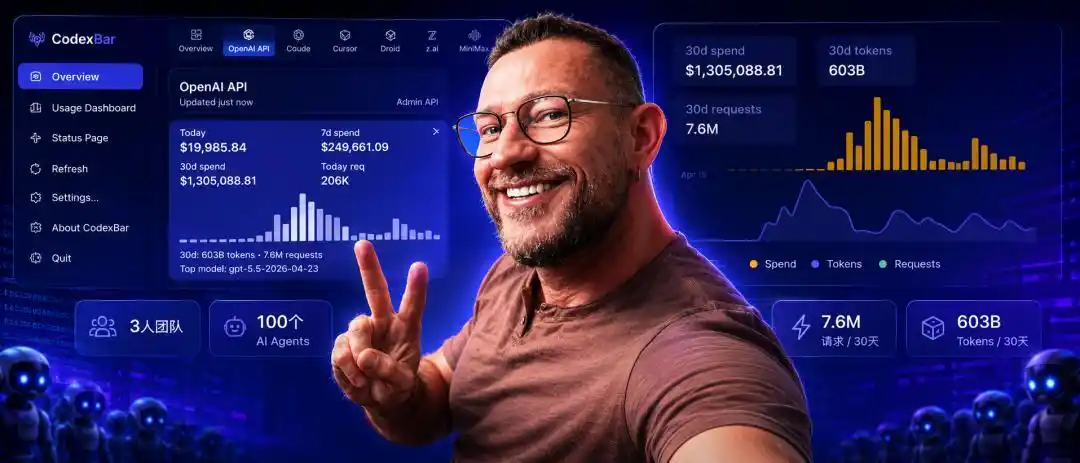
3 People with 100 AI Programmers, Burning Through $1.3 Million a Month! OpenAI: I'll Foot the Bill

marsbitPublicado em 2026-05-17Última atualização em 2026-05-17

Resumo

In a striking demonstration of AI-powered development, Peter Steinberger (creator of OpenClaw) shared that his three-person team spent $1.3 million in one month to run approximately 100 AI agents (primarily Codex instances). OpenAI covered the cost. The expenditure consumed 6.03 trillion tokens across 7.6 million requests. Steinberger argues that, with "fast mode" disabled, the cost falls below that of a single engineer while providing significantly greater output. This "cloud programmer army" handles core but tedious software engineering tasks: reviewing pull requests, finding security vulnerabilities, deduplicating issues, fixing bugs, monitoring benchmarks, and even generating PRs after meetings. This shifts AI's role from merely writing code to maintaining the entire collaborative fabric of a project. Steinberger's tool, CodexBar (a macOS menu bar app), tracks usage and costs across various AI coding services, highlighting how token consumption is becoming a key metric—a new "means of production." The experiment poses a profound question: if token cost ceases to be a barrier, how will software development transform? As model prices fall, the capability for small teams to leverage large numbers of AI agents could become commonplace, fundamentally altering the scale and speed of development. The future, Steinberger suggests, is arriving rapidly.

Peter Steinberger

Editor: Solomon

[New Zhiyuan Report] 3 people, 100 AI agents, burning through $1.3 million a month — The father of OpenClaw has turned software development into an "AI assembly line," with OpenAI picking up the tab.

While others show off their pay stubs, he shows off the bill — $1.3 million a month!

That's nearly 9 million RMB per month. It's left netizens utterly dumbfounded.

OpenClaw father Peter Steinberger casually posted a screenshot on X.
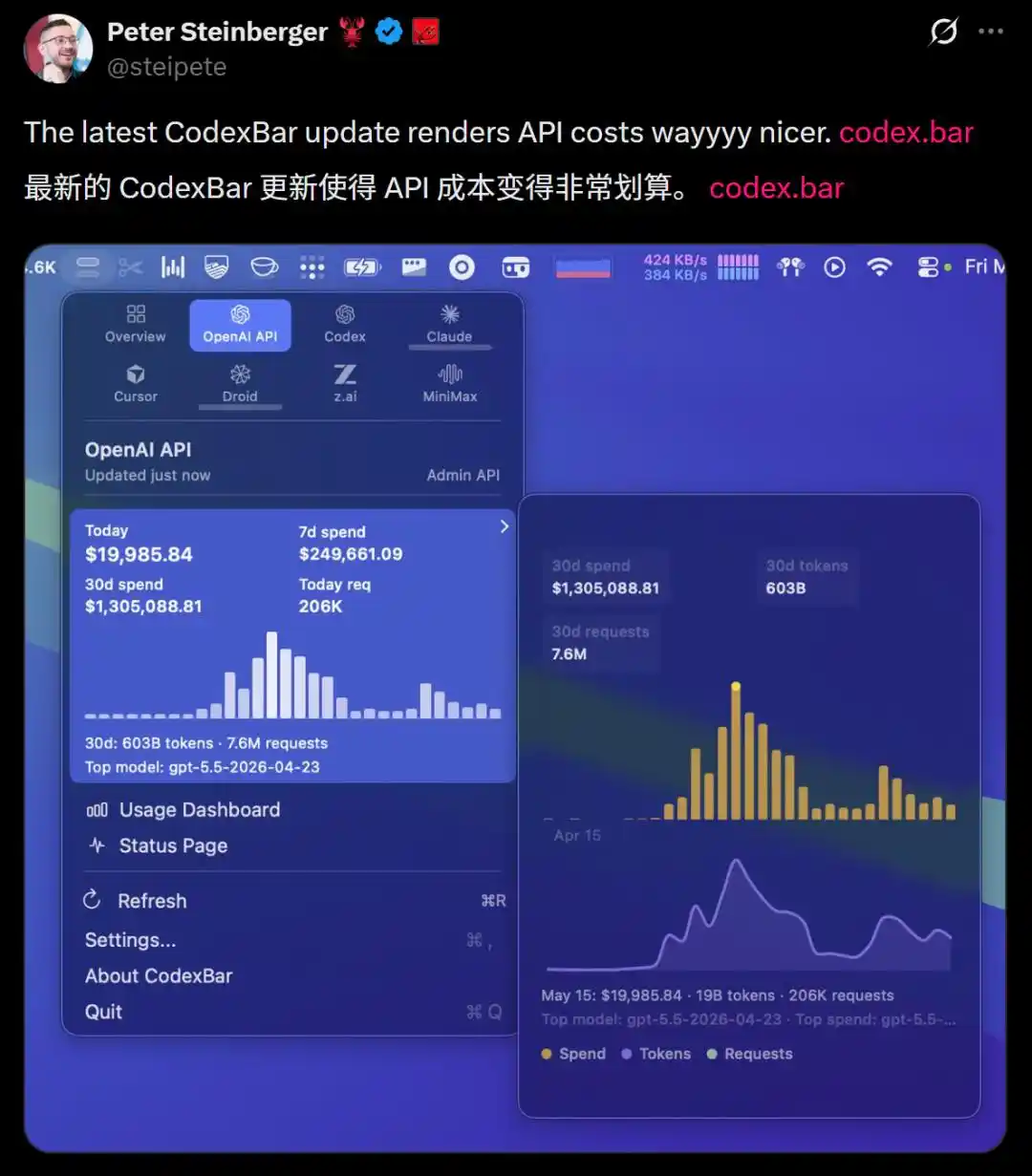
Peter Steinberger

But the numbers on the screenshot were anything but casual:

30-day spend: $1,305,088.81. Consumed 603 billion tokens. Made 7.6 million requests.

You read that right, 1.3 million U.S. dollars. And it's not a quarterly AI budget for some big tech company — it's the monthly usage of a three-person team.

Even more explosive: OpenAI is reimbursing this cost.

The comment section instantly went wild.

Some were amazed, some skeptical, some whipped out their calculators to figure out "how many programmers this equals."

Steinberger himself calmly responded: "With fast mode off, my cost is less than an engineer, and it really helps a lot more."

Translation: — It's genuinely cost-effective!

Other netizens were shocked by the $400k/month engineer — "The San Francisco job market is insane."
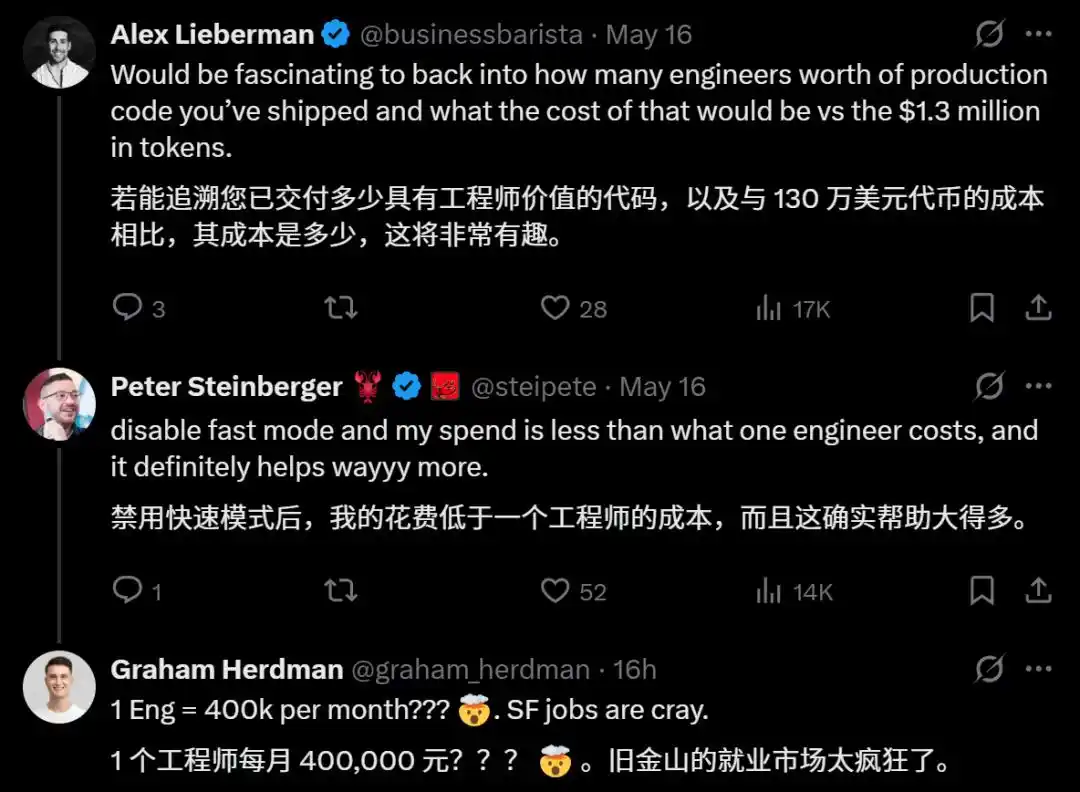
Netizen comment
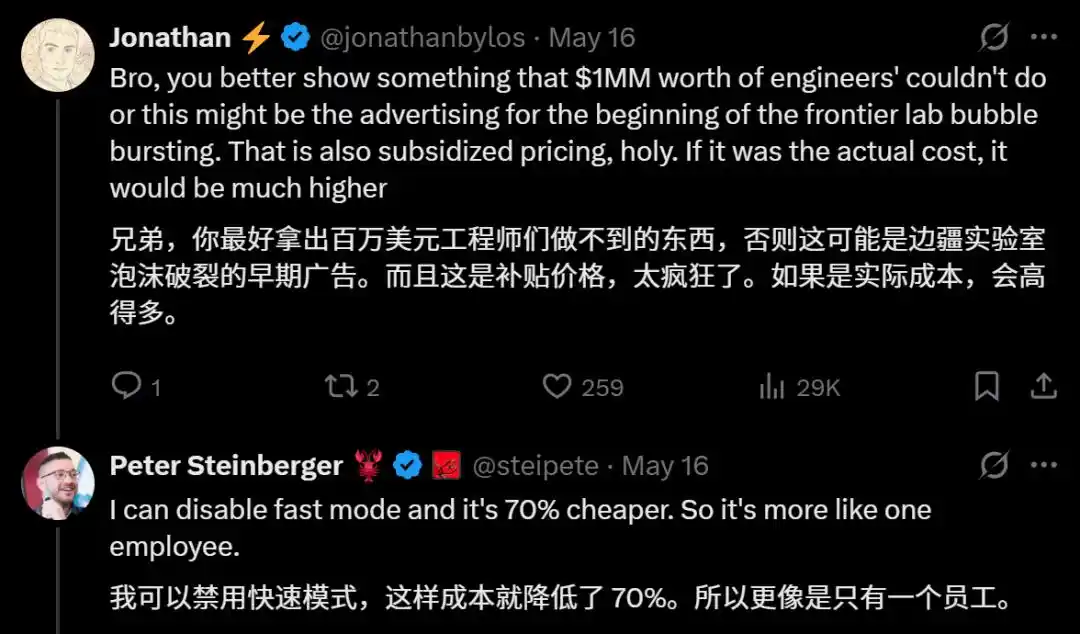
Netizen comment

Others were curious about where this massive token usage went.

Peter responded that most was used for OpenClaw development.
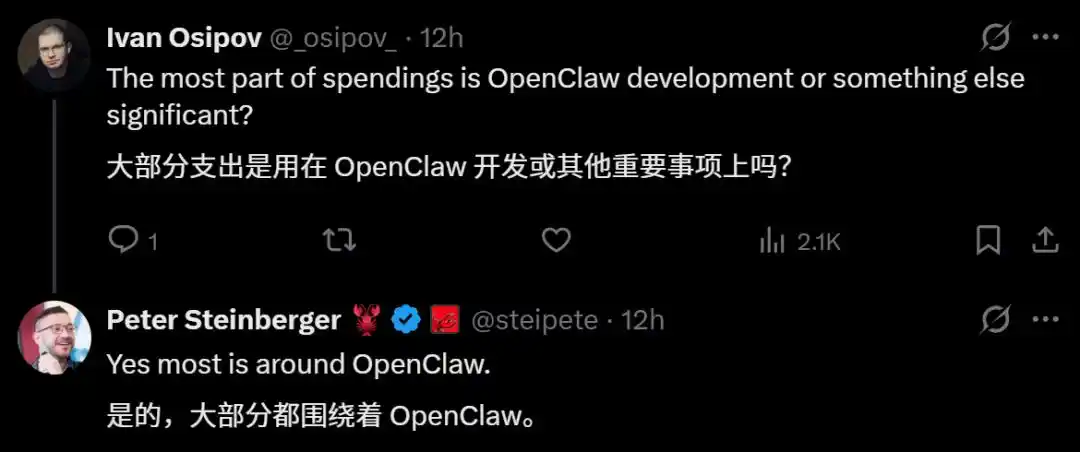
Netizen comment

A Cloud-Based Programmer Army

The most outrageous thing is that Pete's small team only has 3 people.

They have about 100 Codex instances running long-term in the cloud, handling the dirtiest, most grueling, most mind-numbing work in software engineering —

Reviewing PRs, finding security vulnerabilities, deduplicating issues, fixing bugs, monitoring benchmarks, posting to Discord upon discovering regressions, even opening PRs directly after listening to meetings.

Thus, AI isn't just "helping you write code," but is infiltrating every crevice of software collaboration.

This is terrifying.

Because what's truly expensive in software development is communication, comprehension, context switching, review, regression, fixes, waiting, and repetitive tasks.

In the past, a team spent a huge amount of time each day on these things that don't seem like "creation" but without which the project would rot.

Now, Peter has tossed all these processes to a bunch of AI agents at once.

This is AI starting to maintain the nervous system of an organization for you.
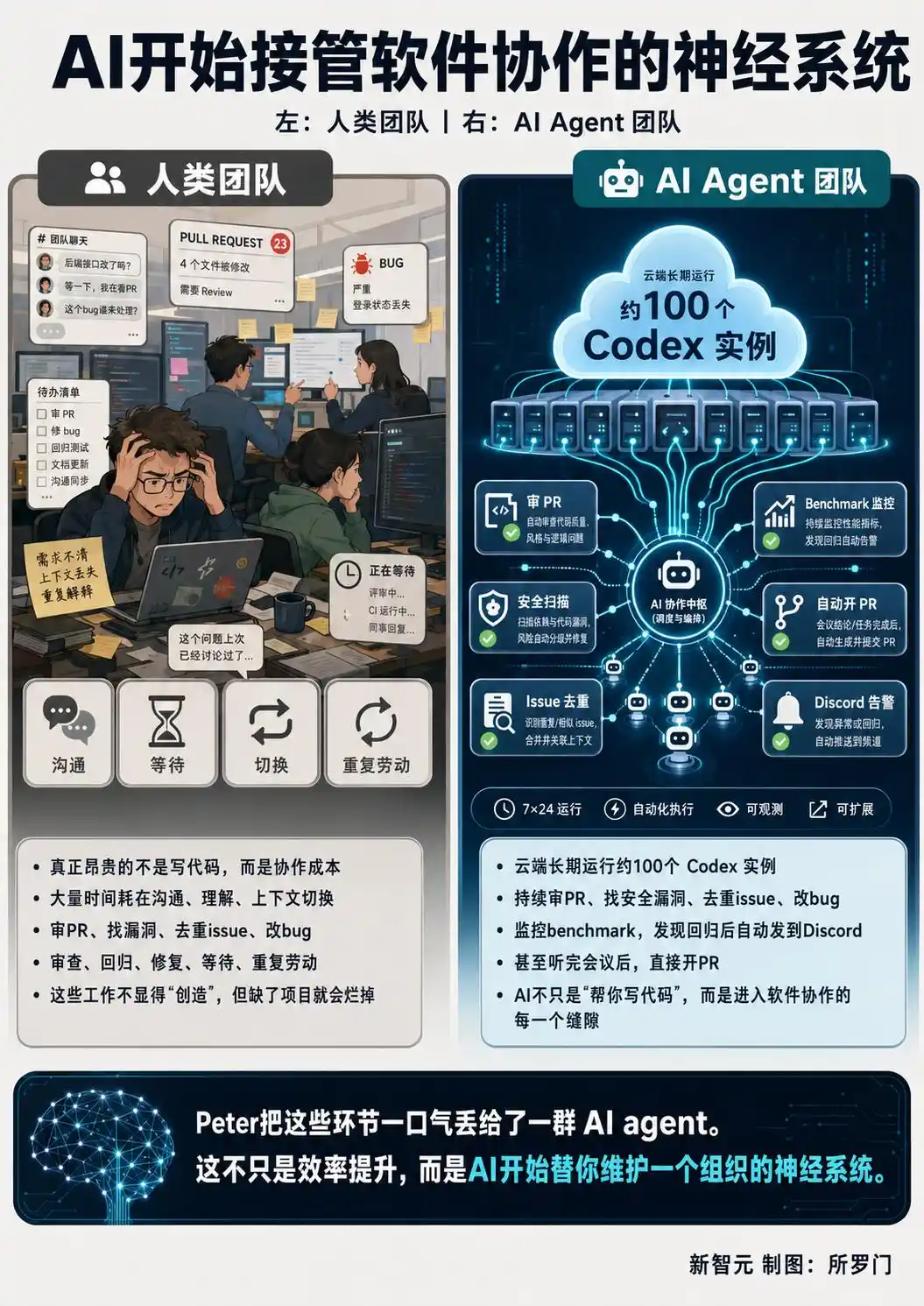
Illustration

There's another important detail in this screenshot: it's not the OpenAI backend, but CodexBar made by Peter.

CodexBar is a macOS menu bar tool for tracking usage windows, credits, costs, and reset times for various AI programming tools.

It supports a bunch of services like Codex, Claude, Cursor, Gemini, Copilot, etc.

What used to be in a programmer's menu bar? CPU, memory, battery, network speed.

Now there's one more thing: tokens. Tokens are becoming a new "means of production."

CodexBar

A Final Word

$1.3 million a month, 3 people, 100 AI agents.

Ponder this set of numbers — three living humans, leading a hundred digital employees who don't eat, sleep, or demand raises, doing the work of an entire engineering team.

Some felt invigorated after reading this: AI finally isn't just a decorative vase for chatting! Others felt a chill down their spine: Wait, so what do we coders do in the future?

But honestly, what keeps me up at night is Steinberger's casual remark: "I'm exploring what software development would look like if token cost wasn't an issue."
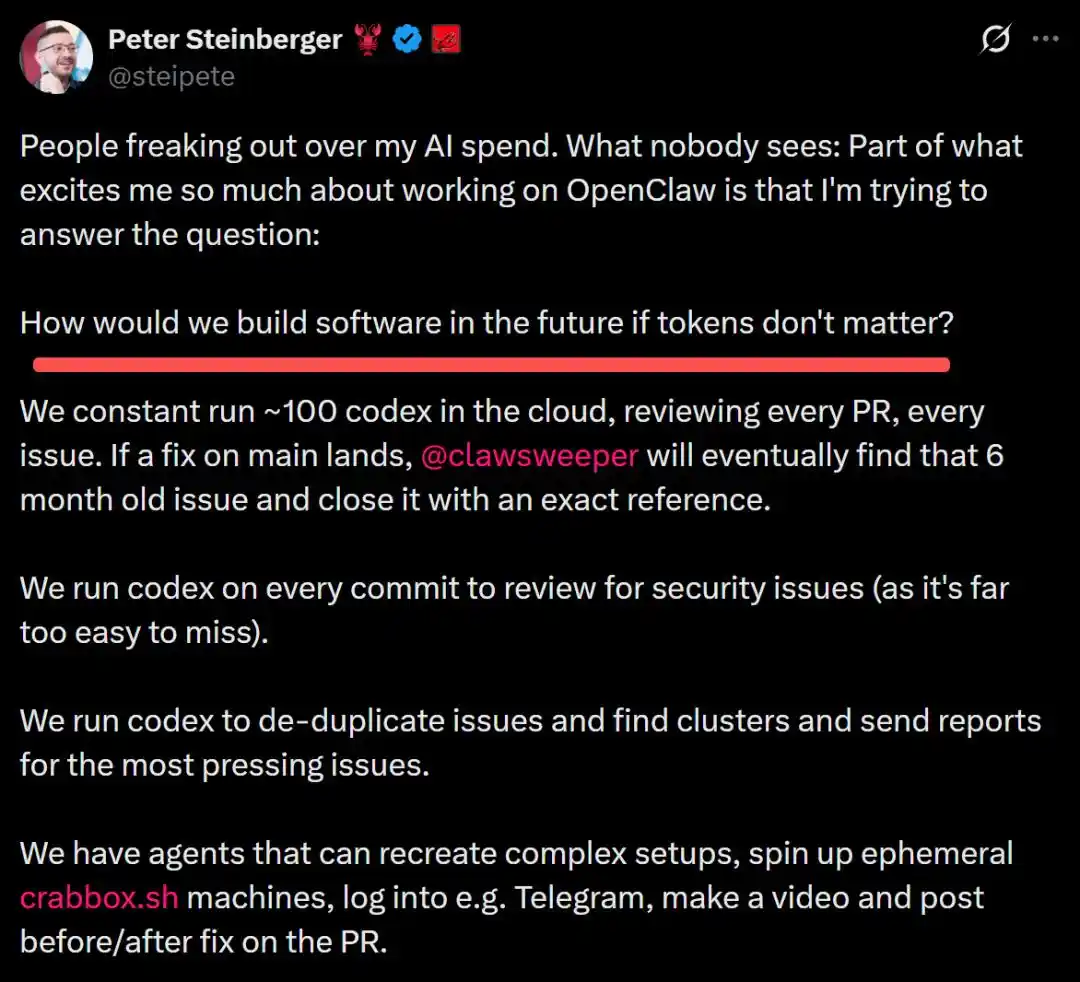
Peter Steinberger

Everyone, he said "if."

The problem is, this "if" is visibly turning into "when" at an astonishing speed.

The work that costs $1.3 million today, after one price cut for models, becomes $130k. Another cut, $13k.

On that day, having 100 AI agents working simultaneously is no longer a game exclusive to Silicon Valley big shots, but a basic operation for any three-person startup team.

Three young people in a garage, holding a hundred tireless AI programmers — this image, just thinking about it is absurd.

Peter Steinberger has revealed the bottom card.

On the card it says: The future is already knocking, and it doesn't plan to wait for you to be ready.

References:

https://the-decoder.com/for-1-3-million-a-month-openclaw-founder-peter-steinberger-runs-100-ai-agents-that-code-review-prs-and-find-bugs/

https://x.com/steipete/status/2055346265869721905

https://developers.openai.com/codex/speed

This article comes from the WeChat public account "New Zhiyuan", author: New Zhiyuan

Perguntas relacionadas

QHow much money did the three-person team spend on AI development in one month, and who covered the cost?

AThe three-person team spent $1,305,088.81 (approximately 1.3 million USD) in one month on AI development, and the cost was covered by OpenAI.

QWhat is the name of the tool Peter Steinberger created to track AI development costs and usage?

APeter Steinberger created a tool called CodexBar, a macOS menu bar application that tracks usage windows, credits, costs, and reset times for various AI programming tools like Codex, Claude, Cursor, Gemini, and Copilot.

QApproximately how many AI agents (instances) does Peter Steinberger's team run for development tasks?

APeter Steinberger's team runs approximately 100 AI Codex instances to perform various development tasks.

QWhat kinds of software development tasks do the AI agents in the article handle?

AThe AI agents handle tasks such as reviewing pull requests (PRs), finding security vulnerabilities, deduplicating issues, fixing bugs, monitoring benchmarks, reporting regressions to Discord, and even opening PRs after listening to meetings.

QWhat is the core implication Peter Steinberger highlights regarding the future of software development with AI?

APeter Steinberger highlights that the core implication is exploring what software development would look like if token cost were not a limiting factor, suggesting a future where small teams can leverage large numbers of AI agents as a standard practice, dramatically changing the development landscape.

Leituras Relacionadas

The Midlife Crisis of Crypto GPs: No PMF, No Next Check from LPs

The article "The Midlife Crisis of Crypto GPs: No PMF, No Next LP Check" analyzes the shifting crypto fundraising landscape. It argues the era of selling grand visions to LPs is over; GPs must now offer products with clear Product-Market Fit (PMF). The author categorizes crypto fundraising products into three types: Primary (VC funds), Liquid (trading strategies), and CeFi/DeFi Native Yield. This summary focuses on the Primary market. Key points include: * **Market Shift:** LPs are impatient, demand immediate returns, and are skeptical of future promises. The "easy money" narrative has faded. * **GP Value Erosion:** LP learning curves have shortened (aided by AI), reducing the value of a GP's basic "crypto knowledge." Superior judgment is now rare. * **Weakened LP Motivations:** Traditional reasons for LPs to invest in crypto VC funds (capturing industry beta, gaining access, leveraging GP judgment) have weakened due to new products like ETFs and increased LP sophistication. * **Surviving in Primary:** The primary market will likely persist for: 1) large funds in endowment mandates treating it as a lottery ticket, 2) family offices/HNWIs using proprietary capital, 3) a few funds with proven recent outperformance, and 4) funds with strong ecosystem "deal-making" capabilities. * **Conclusion:** For most GPs, rebuilding trust requires starting over in a niche, demonstrating alpha-generating ability, or providing concrete value/services to LPs.

marsbitHá 1h

The Midlife Crisis of Crypto GPs: No PMF, No Next Check from LPs

marsbitHá 1h

Crypto GPs' Midlife Crisis: No PMF, No LP's Next Check

The article "The Midlife Crisis of Crypto GPs: No PMF, No LP's Next Check" analyzes the shifting crypto fundraising landscape. It argues that the era of LPs funding vague "vision" is over; GPs must now offer products with clear Product-Market Fit (PMF) to secure capital. The market has matured. LPs, disillusioned by the last cycle's failures and wary of long lock-up periods, now demand tangible, near-term returns rather than speculative narratives. The proliferation of accessible crypto ETFs and other liquid products has reduced the need for VC blind pools as an entry point. The author categorizes crypto fundraising products into three types: Primary (VC funds, with blind pools or clear pipelines), Liquid (alpha/beta, directional/market-neutral strategies), and CeFi/DeFi Native Yield (crypto-specific mechanisms like staking, farming). Focusing on the Primary market, the piece details why traditional LP rationales for investing in crypto VCs have weakened: easier beta access via ETFs, diminished "access" and "judgement" premiums as LPs build internal teams, and a widespread lack of proven superior returns from GPs. Ultimately, only specific players are likely to remain at the primary VC table: large funds with access to patient endowment capital, family offices/HNWIs investing proprietary capital, the few funds with demonstrable excess returns from the last cycle, and those with clear "deal-making" or ecosystem resource advantages. For others, the path forward is to rebuild trust by proving alpha-generation capability in a niche or providing concrete, valuable services.

链捕手Há 1h

Crypto GPs' Midlife Crisis: No PMF, No LP's Next Check

链捕手Há 1h

The Age of Decoupling Has Arrived: Bitcoin is No Longer the Sole Compass of Crypto

The era of the cryptocurrency market moving in lockstep with Bitcoin is ending, as the industry splits into two distinct asset categories: endogenous and exogenous. Endogenous assets, like Bitcoin, derive value purely from the crypto market's cycles. Their narratives swing between being "interstellar money" in bull markets and "digital collectibles" in bear markets. Exogenous assets, however, are nominally crypto but operate with independent value drivers. Examples include: * **Venice:** An AI inference service using tokens for payments; its consumer-AI business model is decoupled from crypto price swings. * **Figure:** A fintech lender using blockchain to speed up loan approvals; its core value is in credit, not crypto. * **Stablecoin firms like BVNK:** Acquired by traditional finance giants (Mastercard, Stripe), their growth is tied to payment infrastructure, not market cycles. Hybrid projects like **Hyperliquid** (a decentralized exchange) show a shift, with a growing share of non-crypto trading (e.g., prediction markets). This divergence is fundamental. Endogenous assets remain highly correlated to Bitcoin, similar to gold miners to gold. Exogenous assets are evolving to have their own fundamentals, like the weak correlation between gold and the S&P 500. This changes investment analysis. Evaluating exogenous assets requires traditional fundamental research—assessing user bases, unit economics, and moats—more akin to fintech investing than charting Bitcoin. Promising exogenous sectors include: on-chain exchanges/brokers, AI-crypto fusion, privacy-focused digital banks, lending (institutional/private credit), stablecoins/real-world asset tokenization, payment rails, and non-financial crypto-consumer products. Currently, investing via equity is often safer than via tokens, as token value accrual mechanisms need further regulatory and industry development (e.g., the CLARITY Act). Nonetheless, the core trend is clear: crypto market drivers are diversifying from a single factor (Bitcoin) to multiple fundamentals, ending the era of uniform market moves.

marsbitHá 2h

The Age of Decoupling Has Arrived: Bitcoin is No Longer the Sole Compass of Crypto

marsbitHá 2h

Trading

Spot
Futuros

Artigos em Destaque

Como comprar BILL

Bem-vindo à HTX.com!Tornámos a compra de Billions Network (BILL) simples e conveniente.Segue o nosso guia passo a passo para iniciar a tua jornada no mundo das criptos.Passo 1: cria a tua conta HTXUtiliza o teu e-mail ou número de telefone para te inscreveres numa conta gratuita na HTX.Desfruta de um processo de inscrição sem complicações e desbloqueia todas as funcionalidades.Obter a minha contaPasso 2: vai para Comprar Cripto e escolhe o teu método de pagamentoCartão de crédito/débito: usa o teu visa ou mastercard para comprar Billions Network (BILL) instantaneamente.Saldo: usa os fundos da tua conta HTX para transacionar sem problemas.Terceiros: adicionamos métodos de pagamento populares, como Google Pay e Apple Pay, para aumentar a conveniência.P2P: transaciona diretamente com outros utilizadores na HTX.Mercado de balcão (OTC): oferecemos serviços personalizados e taxas de câmbio competitivas para os traders.Passo 3: armazena teu Billions Network (BILL)Depois de comprar o teu Billions Network (BILL), armazena-o na tua conta HTX.Alternativamente, podes enviá-lo para outro lugar através de transferência blockchain ou usá-lo para transacionar outras criptomoedas.Passo 4: transaciona Billions Network (BILL)Transaciona facilmente Billions Network (BILL) no mercado à vista da HTX.Acede simplesmente à tua conta, seleciona o teu par de trading, executa as tuas transações e monitoriza em tempo real.Oferecemos uma experiência de fácil utilização tanto para principiantes como para traders experientes.

149 Visualizações TotaisPublicado em {updateTime}Atualizado em 2026.06.01

Como comprar BILL

Discussões

Bem-vindo à Comunidade HTX. Aqui, pode manter-se informado sobre os mais recentes desenvolvimentos da plataforma e obter acesso a análises profissionais de mercado. As opiniões dos utilizadores sobre o preço de BILL (BILL) são apresentadas abaixo.

活动图片