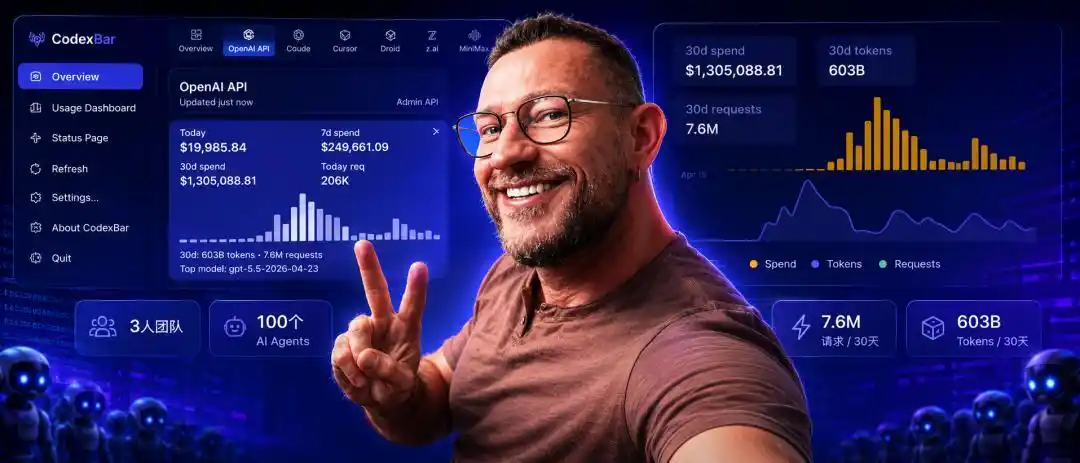
3 People with 100 AI Programmers, Burning Through $1.3 Million a Month! OpenAI: I'll Foot the Bill

marsbitPublicado em 2026-05-17Última atualização em 2026-05-17

Resumo

In a striking demonstration of AI-powered development, Peter Steinberger (creator of OpenClaw) shared that his three-person team spent $1.3 million in one month to run approximately 100 AI agents (primarily Codex instances). OpenAI covered the cost. The expenditure consumed 6.03 trillion tokens across 7.6 million requests. Steinberger argues that, with "fast mode" disabled, the cost falls below that of a single engineer while providing significantly greater output. This "cloud programmer army" handles core but tedious software engineering tasks: reviewing pull requests, finding security vulnerabilities, deduplicating issues, fixing bugs, monitoring benchmarks, and even generating PRs after meetings. This shifts AI's role from merely writing code to maintaining the entire collaborative fabric of a project. Steinberger's tool, CodexBar (a macOS menu bar app), tracks usage and costs across various AI coding services, highlighting how token consumption is becoming a key metric—a new "means of production." The experiment poses a profound question: if token cost ceases to be a barrier, how will software development transform? As model prices fall, the capability for small teams to leverage large numbers of AI agents could become commonplace, fundamentally altering the scale and speed of development. The future, Steinberger suggests, is arriving rapidly.

Peter Steinberger

Editor: Solomon

[New Zhiyuan Report] 3 people, 100 AI agents, burning through $1.3 million a month — The father of OpenClaw has turned software development into an "AI assembly line," with OpenAI picking up the tab.

While others show off their pay stubs, he shows off the bill — $1.3 million a month!

That's nearly 9 million RMB per month. It's left netizens utterly dumbfounded.

OpenClaw father Peter Steinberger casually posted a screenshot on X.
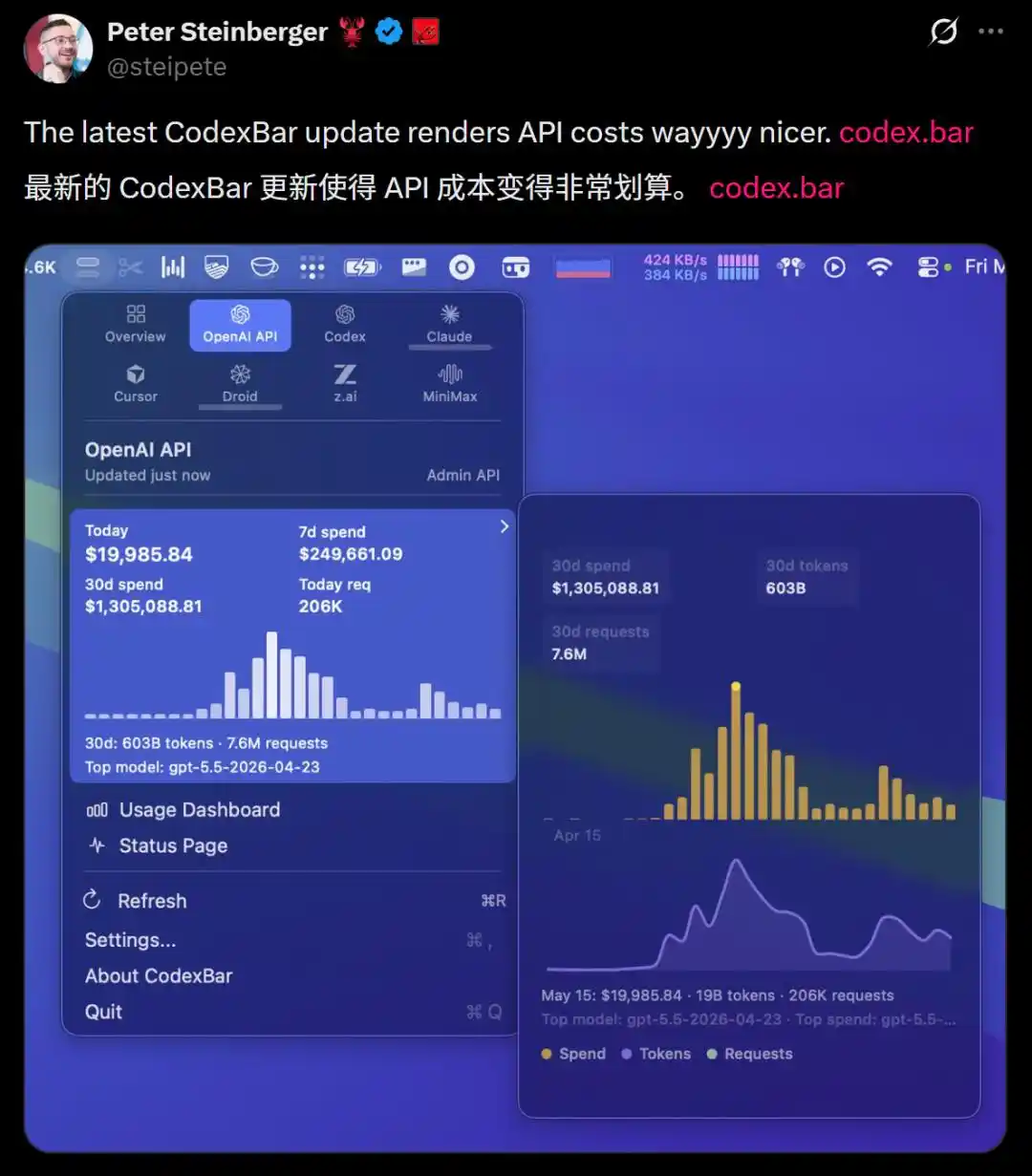
Peter Steinberger

But the numbers on the screenshot were anything but casual:

30-day spend: $1,305,088.81. Consumed 603 billion tokens. Made 7.6 million requests.

You read that right, 1.3 million U.S. dollars. And it's not a quarterly AI budget for some big tech company — it's the monthly usage of a three-person team.

Even more explosive: OpenAI is reimbursing this cost.

The comment section instantly went wild.

Some were amazed, some skeptical, some whipped out their calculators to figure out "how many programmers this equals."

Steinberger himself calmly responded: "With fast mode off, my cost is less than an engineer, and it really helps a lot more."

Translation: — It's genuinely cost-effective!

Other netizens were shocked by the $400k/month engineer — "The San Francisco job market is insane."
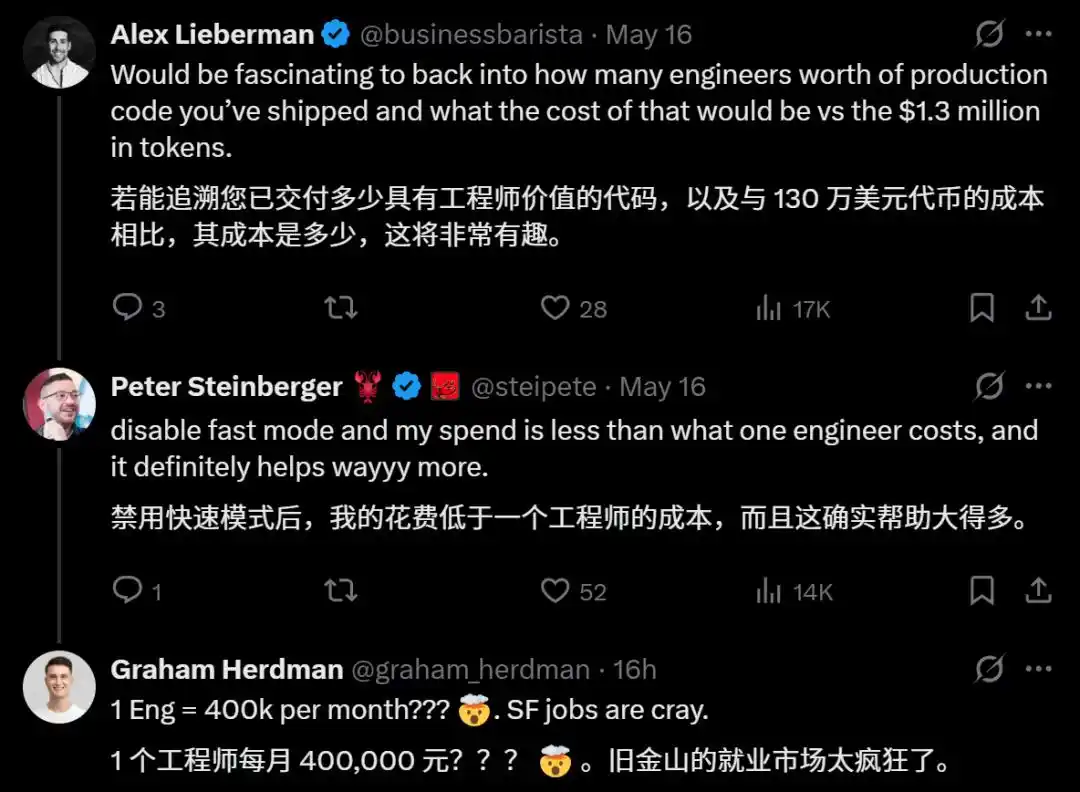
Netizen comment
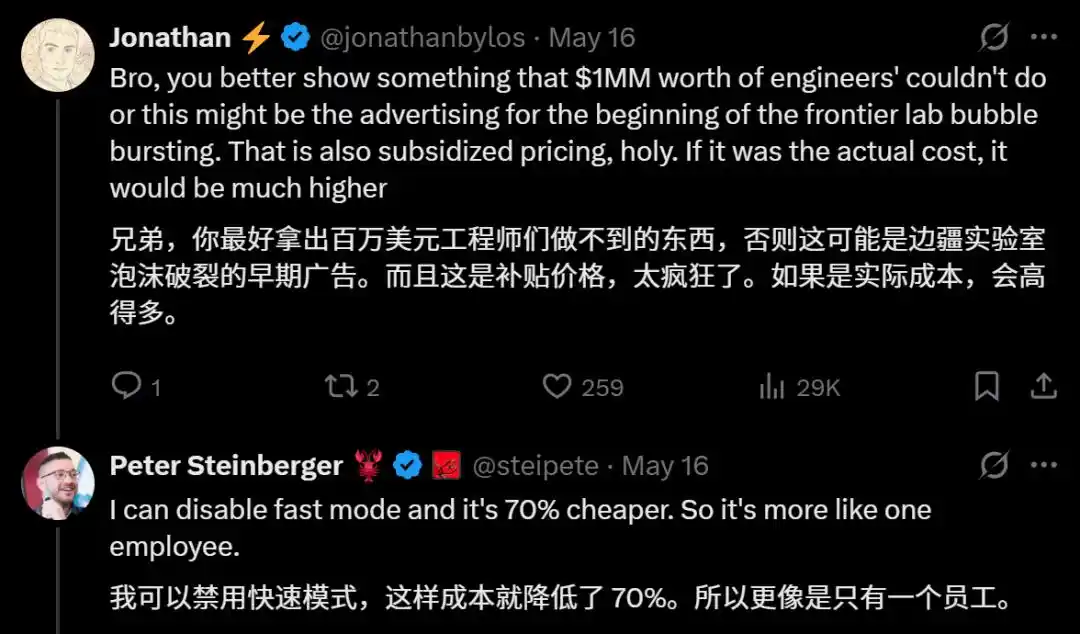
Netizen comment

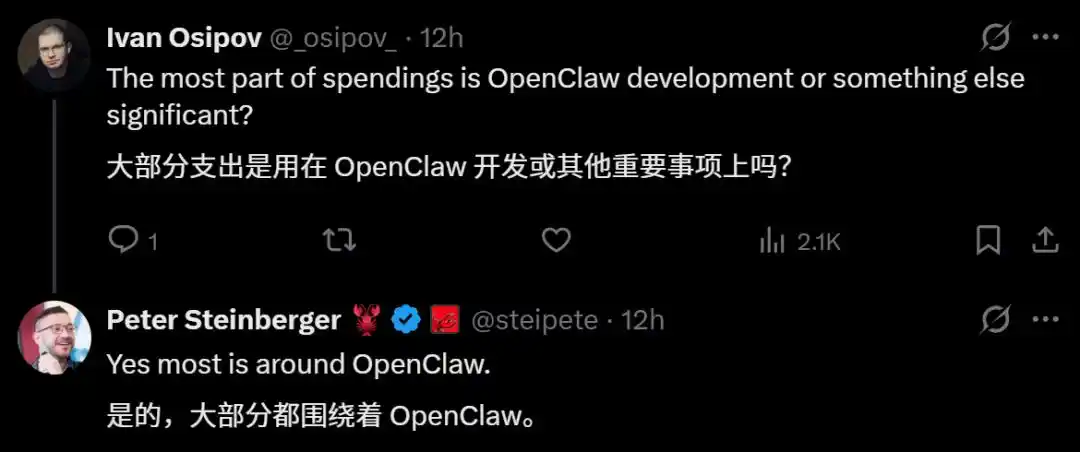
Others were curious about where this massive token usage went.

Peter responded that most was used for OpenClaw development.
Netizen comment

A Cloud-Based Programmer Army

The most outrageous thing is that Pete's small team only has 3 people.

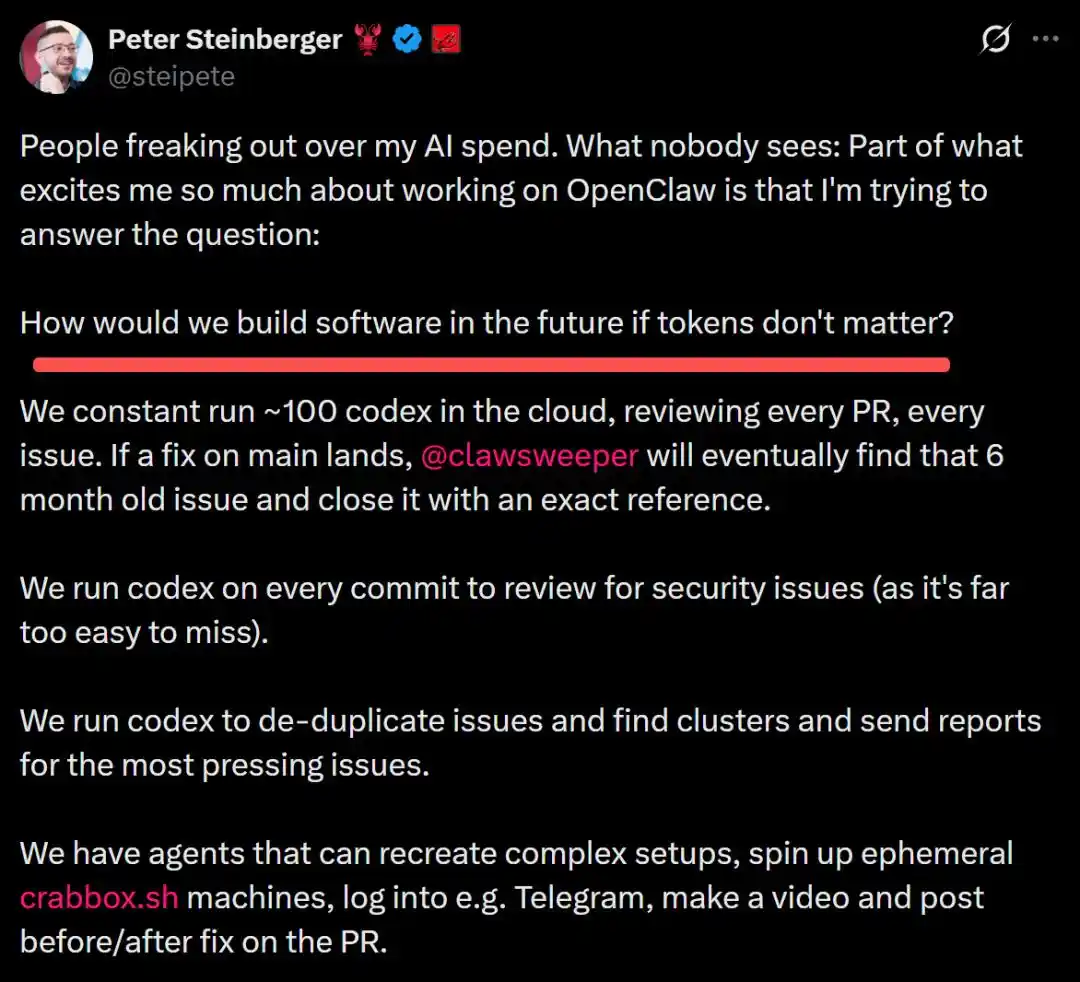
They have about 100 Codex instances running long-term in the cloud, handling the dirtiest, most grueling, most mind-numbing work in software engineering —

Reviewing PRs, finding security vulnerabilities, deduplicating issues, fixing bugs, monitoring benchmarks, posting to Discord upon discovering regressions, even opening PRs directly after listening to meetings.

Thus, AI isn't just "helping you write code," but is infiltrating every crevice of software collaboration.

This is terrifying.

Because what's truly expensive in software development is communication, comprehension, context switching, review, regression, fixes, waiting, and repetitive tasks.

In the past, a team spent a huge amount of time each day on these things that don't seem like "creation" but without which the project would rot.

Now, Peter has tossed all these processes to a bunch of AI agents at once.

This is AI starting to maintain the nervous system of an organization for you.

Illustration

There's another important detail in this screenshot: it's not the OpenAI backend, but CodexBar made by Peter.

CodexBar is a macOS menu bar tool for tracking usage windows, credits, costs, and reset times for various AI programming tools.

It supports a bunch of services like Codex, Claude, Cursor, Gemini, Copilot, etc.

What used to be in a programmer's menu bar? CPU, memory, battery, network speed.

Now there's one more thing: tokens. Tokens are becoming a new "means of production."

CodexBar

A Final Word

$1.3 million a month, 3 people, 100 AI agents.

Ponder this set of numbers — three living humans, leading a hundred digital employees who don't eat, sleep, or demand raises, doing the work of an entire engineering team.

Some felt invigorated after reading this: AI finally isn't just a decorative vase for chatting! Others felt a chill down their spine: Wait, so what do we coders do in the future?

But honestly, what keeps me up at night is Steinberger's casual remark: "I'm exploring what software development would look like if token cost wasn't an issue."
Peter Steinberger

Everyone, he said "if."

The problem is, this "if" is visibly turning into "when" at an astonishing speed.

The work that costs $1.3 million today, after one price cut for models, becomes $130k. Another cut, $13k.

On that day, having 100 AI agents working simultaneously is no longer a game exclusive to Silicon Valley big shots, but a basic operation for any three-person startup team.

Three young people in a garage, holding a hundred tireless AI programmers — this image, just thinking about it is absurd.

Peter Steinberger has revealed the bottom card.

On the card it says: The future is already knocking, and it doesn't plan to wait for you to be ready.

References:

https://the-decoder.com/for-1-3-million-a-month-openclaw-founder-peter-steinberger-runs-100-ai-agents-that-code-review-prs-and-find-bugs/

https://x.com/steipete/status/2055346265869721905

https://developers.openai.com/codex/speed

This article comes from the WeChat public account "New Zhiyuan", author: New Zhiyuan

Perguntas relacionadas

QHow much money did the three-person team spend on AI development in one month, and who covered the cost?

AThe three-person team spent $1,305,088.81 (approximately 1.3 million USD) in one month on AI development, and the cost was covered by OpenAI.

QWhat is the name of the tool Peter Steinberger created to track AI development costs and usage?

APeter Steinberger created a tool called CodexBar, a macOS menu bar application that tracks usage windows, credits, costs, and reset times for various AI programming tools like Codex, Claude, Cursor, Gemini, and Copilot.

QApproximately how many AI agents (instances) does Peter Steinberger's team run for development tasks?

APeter Steinberger's team runs approximately 100 AI Codex instances to perform various development tasks.

QWhat kinds of software development tasks do the AI agents in the article handle?

AThe AI agents handle tasks such as reviewing pull requests (PRs), finding security vulnerabilities, deduplicating issues, fixing bugs, monitoring benchmarks, reporting regressions to Discord, and even opening PRs after listening to meetings.

QWhat is the core implication Peter Steinberger highlights regarding the future of software development with AI?

APeter Steinberger highlights that the core implication is exploring what software development would look like if token cost were not a limiting factor, suggesting a future where small teams can leverage large numbers of AI agents as a standard practice, dramatically changing the development landscape.

Leituras Relacionadas

Anthropic's IPO Launch: Commercial Miracle or Valuation Bubble?

Anthropic has confidentially filed for an IPO, led by Morgan Stanley and Goldman Sachs, potentially going public by October. Following its latest $650 billion funding round, its pre-IPO valuation stands at $965 billion, with projections reaching up to $2 trillion at listing, which would make it the highest-valued private company ever. The article, written by Fu Sheng, addresses skepticism that this represents an AI bubble akin to the 2000 dot-com crash. It argues the current situation differs fundamentally. Unlike the internet bubble era, which relied on speculative narratives with little revenue, Anthropic's valuation is backed by unprecedented, measurable financial performance. Key data points include: * **Revenue Growth:** ARR skyrocketed from $10 billion in early 2025 to $470 billion by May 2026, targeting $100 billion by year-end—a growth curve unmatched in business history. * **Profitability:** It achieved operating profitability in Q2 2026 with an estimated $5.6 billion profit. * **Efficiency:** With ~3,000 employees and ~$470 billion ARR, its revenue per employee exceeds $10 million. Products like Claude Code, launched less than a year ago, already generate $25 billion in annualized revenue. * **Enterprise Adoption:** It boasts a strong enterprise client base, with 8 of the Fortune 10 and over 1,000 large firms spending over $1 million annually on Claude. The valuation is framed using a traditional SaaS model (e.g., a 10x Price-to-Sales multiple on $100 billion revenue). The author contends the core question for analysts has shifted from "How big could this be?" to "How much is it earning and will earn next quarter?" The discussion extends beyond Anthropic to a broader paradigm shift: the transition from a "carbon-based" to a "silicon-based" economy. Companies are increasingly prioritizing investment in compute and AI capabilities over human resources, as these directly scale productivity and competitive advantage. Anthropic's IPO is thus positioned not just as a corporate milestone, but as a price anchor for this new economic era.

链捕手Há 2h

Anthropic's IPO Launch: Commercial Miracle or Valuation Bubble?

链捕手Há 2h

Near Returns to the AI Stage: Transformation into a Public Chain Due to 'Payroll Difficulties,' Agent and Privacy Emerge as New Growth Narratives

NEAR Returns to AI Origins: From Payroll Struggles to Blockchain, Now Focusing on AI Agents and Privacy NEAR Protocol's journey began not with grand blockchain ambitions, but from a practical hurdle: its AI startup founders, including Transformer paper co-author Illia Polosukhin, couldn't efficiently pay international developers in 2017. This led them to pivot and build a high-performance, scalable blockchain. After years navigating various crypto narratives like sharding and cross-chain interoperability, NEAR is now leveraging its AI roots to re-enter the AI arena. A key driver is its "NEAR Intents" layer, which abstracts complex cross-chain transactions. Users simply state their goal (e.g., swap BTC for ETH), and a solver network finds the optimal route. This system has processed over $20B in cross-chain volume, generating significant fee revenue. A major growth area is private transactions via "Confidential Intents/Swaps," which hide trade details until settlement to protect against MEV and front-running. Remarkably, private swaps recently accounted for over 40% of NEAR's transaction volume, highlighting strong demand but also potential regulatory scrutiny. With its AI-founder pedigree, NEAR is positioning itself at the intersection of blockchain, AI agents, and privacy, aiming to become infrastructure for the emerging agent economy while navigating the challenges of its rapid adoption.

marsbitHá 4h

Near Returns to the AI Stage: Transformation into a Public Chain Due to 'Payroll Difficulties,' Agent and Privacy Emerge as New Growth Narratives

marsbitHá 4h

Trading

Spot
Futuros

Artigos em Destaque

Como comprar BILL

Bem-vindo à HTX.com!Tornámos a compra de Billions Network (BILL) simples e conveniente.Segue o nosso guia passo a passo para iniciar a tua jornada no mundo das criptos.Passo 1: cria a tua conta HTXUtiliza o teu e-mail ou número de telefone para te inscreveres numa conta gratuita na HTX.Desfruta de um processo de inscrição sem complicações e desbloqueia todas as funcionalidades.Obter a minha contaPasso 2: vai para Comprar Cripto e escolhe o teu método de pagamentoCartão de crédito/débito: usa o teu visa ou mastercard para comprar Billions Network (BILL) instantaneamente.Saldo: usa os fundos da tua conta HTX para transacionar sem problemas.Terceiros: adicionamos métodos de pagamento populares, como Google Pay e Apple Pay, para aumentar a conveniência.P2P: transaciona diretamente com outros utilizadores na HTX.Mercado de balcão (OTC): oferecemos serviços personalizados e taxas de câmbio competitivas para os traders.Passo 3: armazena teu Billions Network (BILL)Depois de comprar o teu Billions Network (BILL), armazena-o na tua conta HTX.Alternativamente, podes enviá-lo para outro lugar através de transferência blockchain ou usá-lo para transacionar outras criptomoedas.Passo 4: transaciona Billions Network (BILL)Transaciona facilmente Billions Network (BILL) no mercado à vista da HTX.Acede simplesmente à tua conta, seleciona o teu par de trading, executa as tuas transações e monitoriza em tempo real.Oferecemos uma experiência de fácil utilização tanto para principiantes como para traders experientes.

242 Visualizações TotaisPublicado em {updateTime}Atualizado em 2026.06.02

Como comprar BILL

Discussões

Bem-vindo à Comunidade HTX. Aqui, pode manter-se informado sobre os mais recentes desenvolvimentos da plataforma e obter acesso a análises profissionais de mercado. As opiniões dos utilizadores sobre o preço de BILL (BILL) são apresentadas abaixo.

活动图片













