South Korean Investors Shift To Crypto-Related Stocks Amid Stablecoin Push – Report

bitcoinistPublicado em 2025-08-12Última atualização em 2025-08-12

Resumo

South Korean retail investors have recently shifted their focus when investing in overseas stocks, moving from US big tech stocks...

Trusted Editorial content, reviewed by leading industry experts and seasoned editors. Ad Disclosure

South Korean retail investors have recently shifted their focus when investing in overseas stocks, moving from US big tech stocks to crypto-related equities amid growing global interest in the sector.

South Korean Investors Turn To Crypto Stocks

Over the past few months, South Korean individuals investing in overseas stocks have shifted from US big tech equities to crypto-linked stocks, recent data showed, with a focus on stablecoin-related companies.

Citing data from the Korean Center for International Finance (KCIF), Yonhap News Agency reported that the percentage of crypto-linked equities in the top 50 net-bought stocks by local retail investors increased from 8.5% in January to 36.5% in June before dropping to 31.4% last month.

Meanwhile, net purchases of the top seven US big tech stocks declined nearly 74% from a monthly average of $1.68 billion between January and April to $440 million in May, further dropping to $260 million in July.

According to the report, South Korean investors became net sellers of overseas stocks in May and June but returned to net buying in July with $499 million in purchases. Nonetheless, the new momentum was considerably weaker compared to the $3.8 billion monthly average buying between January and April.

“Since June, the domestic stock market has outperformed overseas markets, while the local currency has strengthened, prompting individual investors to withdraw their investments from foreign markets,” Yonhap News Agency noted, citing the KCIF report.

On Monday, Bloomberg also highlighted that South Korean retail investors have flocked to BitMine Immersion Technologies over the past month, as investors “continue to be drawn to the kind of high-risk, high-reward opportunities on offer in crypto.”

The news media outlet reported that local retail investors have poured $259 million into Bitmine stocks since the start of July. According to Korea Securities Depository data, this made the company the most purchased foreign security stock during that period.

Notably, BitMine is a Bitcoin and Ethereum Network Company “with a focus on the accumulation of Crypto for long-term investment.” It recently became the largest ETH treasury in the world and the third-largest crypto treasury globally, with its holdings surpassing 1.15 million ETH, valued at $4.96 billion at current prices.

Retail Shift Fueled By Stablecoin Momentum

According to the KCIF report, the surge in crypto-related equities, and particularly stocks related to stablecoins, follows the passage of landmark crypto legislation in the US. President Donald Trump signed the Guiding and Establishing National Innovation for US Stablecoins (GENIUS) Act into law last month, setting a framework for much-needed stablecoin regulation and innovation in the country.

Amid the US push, stablecoins have also seen growing momentum in several jurisdictions, including South Korea. In June, a member of the Democratic Party of Korea (DPK) proposed a comprehensive legislation to establish a more structured regulatory framework for crypto assets in the country, which included a licensing system for stablecoin issuers.

In July, South Korea’s ruling and opposition parties also proposed rival bills to establish a regulatory framework for digital assets pegged to the Korean Won (KRW) to advance the ongoing efforts to institutionalize the sector.

As reported by Bitcoinist, the banking sector is preparing for the upcoming legislation, studying two legalization scenarios, as it remains unclear whether non-bank entities will be allowed to be stablecoin issuers.

The financial institutions are also considering a business model in which banks establish a joint venture to collectively issue stablecoins, and have reportedly contacted various non-bank companies to prepare for the legalization and issuance of KRW-pegged digital assets.
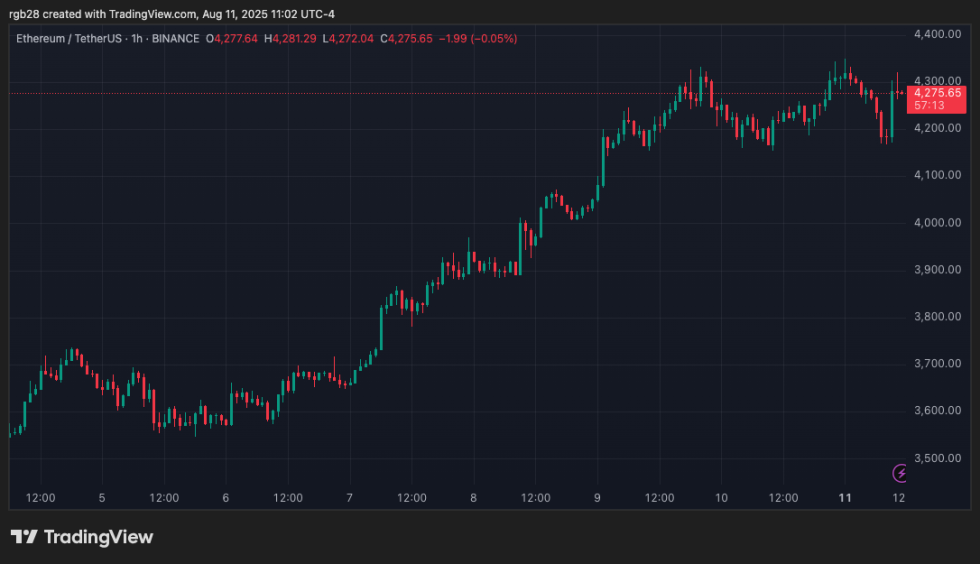
crypto, ETH, ETHUSDT, Ethereum

Ethereum (ETH) trades at $4,275 in the one-week chart. Source: ETHUSDT on TradingView
Featured Image from Unsplash.com, Chart from TradingView.com
Editorial Process for bitcoinist is centered on delivering thoroughly researched, accurate, and unbiased content. We uphold strict sourcing standards, and each page undergoes diligent review by our team of top technology experts and seasoned editors. This process ensures the integrity, relevance, and value of our content for our readers.

Rubmar is a crypto enthusiast who likes learning and improving constantly. She enjoys reporting on the latest news and developments in the crypto industry. Rubmar also enjoys scrapbooking, crafting, simulation games, and watching football.

Leituras Relacionadas

Claude Science Completes Two Years' Work in a Few Weeks, Is 10x Research Acceleration Really Here?

Claude Science, a new AI workbench from Anthropic, is being tested by scientists, reportedly accelerating specific research workflows by up to 10x. A neuro-scientist at the Allen Institute completed a lengthy literature review in weeks instead of nearly two years using the tool, which automates tasks like citation verification. The platform is an integrated environment for macOS and Linux, connecting to local or remote computing resources. It streamlines the fragmented research process—literature analysis, computation, visualization, and drafting—into a single, auditable workflow. A key feature is its emphasis on reproducibility: every chart generated includes the exact code, environment, and history used to create it. Claude Science uses a multi-agent system. A coordinator manages over 60 pre-configured skills for life sciences (genomics, proteomics, etc.) and can spawn specialized agents. A dedicated reviewer agent checks citations and calculations for accuracy, creating a form of internal AI peer review. The system operates with a human-in-the-loop, requiring user approval for major steps. Initial applications are in life sciences. Examples include target identification for biotech company Manifold Bio and germline variant analysis for glioma research at UCSF, completing analyses in roughly one-tenth the previous time. The approach contrasts with competitors: Google focuses on proprietary models like AlphaFold, while OpenAI is advancing models' scientific reasoning with benchmarks like GeneBench-Pro. Claude Science differentiates by automating and integrating the practical research pipeline, not just the model's intelligence, aiming to make AI-aided science more reproducible and integrated into daily lab work.

marsbitHá 3m

Claude Science Completes Two Years' Work in a Few Weeks, Is 10x Research Acceleration Really Here?

marsbitHá 3m

The Invisible Force in Bitcoin's Bear Market: Accelerating On-Chain Payments and Institutional Adoption

Amidst ongoing Bitcoin price volatility, the quiet acceleration of on-chain payments and tokenized trading holds significant importance for investors and policymakers, especially with legislation like the CLARITY Act on the horizon. Major traditional financial institutions adopting these technologies are driving crucial discussions on compliance, security, and transparency, which are vital for broader market adoption. Key developments are shaping this evolution. First, blockchain traceability is moving beyond a simple "public vs. private" debate. New frameworks aim to standardize how financial data from immutable ledgers is analyzed and interpreted, making it as crucial as standardized financial reporting for building institutional trust. Second, while traditional finance supports clear digital asset regulation, they emphasize that an asset's economic function should dictate its regulatory treatment, advocating for robust consumer protections over broad exemptions. Furthermore, the growth of on-chain deposits at regulated institutions signals a shift. Major banks are leveraging blockchain not to replace but to upgrade existing services—like deposits and cross-border settlements—with benefits like 24/7 operations and programmable treasury management. This trend focuses more on modernizing financial infrastructure than creating speculative assets. Despite market turbulence, these underlying advancements in on-chain infrastructure point toward a more robust foundation for the industry's future.

Foresight NewsHá 51m

The Invisible Force in Bitcoin's Bear Market: Accelerating On-Chain Payments and Institutional Adoption

Foresight NewsHá 51m

Trading

Spot
活动图片