The White House Just Shook Up Crypto Policy — But Who Is Patrick Witt?

bitcoinistPublicado em 2025-08-11Última atualização em 2025-08-11

Resumo

Bo Hines’ abrupt exit over the weekend left a vacuum at the top of the White House’s crypto apparatus. But...

Trusted Editorial content, reviewed by leading industry experts and seasoned editors. Ad Disclosure

Bo Hines’ abrupt exit over the weekend left a vacuum at the top of the White House’s crypto apparatus. But the Trump administration moved quickly. Patrick Witt is stepping in to run point on crypto policy from the West Wing as Executive Director of the President’s Council of Advisors for Digital Assets, while continuing to serve as Acting Director of the Pentagon’s Office of Strategic Capital (OSC).

Witt is not a Twitter-native crypto influencer; he’s a policy hand with one foot in national security and the other in crypto strategy. The Defense Department lists him as Acting Director of OSC, the investment office stood up to channel credit into critical technologies.

Who Is Crypto’s New Leader In The White House?

If you want to know how Patrick Witt thinks about Bitcoin, there’s only one place to look: his on-stage interview at the Bitcoin Policy Summit in late June—his sole public appearance to date in which he directly discussed Bitcoin and crypto. In that conversation, Witt moved the Strategic Bitcoin Reserve (SBR) from slogan to mechanics. “We’ve already taken some steps with the SBR,” he said. “How do we follow that up with the accumulation plan?”

Witt’s rationale for an SBR was framed as statecraft, not speculation. “Bitcoin and the digital assets ecosystem is an engine for economic growth,” he argued, adding that the administration “want[s] to be the crypto capital of the world.” He called digital assets “a tool of modern statecraft,” warning that if the United States doesn’t “actively [shape] and influence what that new construct looks like” for the next-generation financial system, it risks ceding advantage.

Crucially, Witt tied the reserve to an organized policy pipeline rather than a one-off announcement. Alongside the GENIUS Act and CLARITY, he referenced “the [now released] report on the interagency activities,” then returned to the SBR’s operational next step—“the accumulation plan.”

Why is Witt the person saying this? Because his second hat is executional. As Acting Director of the Pentagon’s Office of Strategic Capital (OSC), he described a federally backed credit window designed to rebuild industrial capacity and compete in strategic technologies. When he joined, OSC “had $984 million of capital to lend,” later expanding to “$5 billion where we currently sit,” with potential—pending legislation—to “grow to $200 billion.”

Demand already ran hot: the first notice of funding drew “$9 billion worth of requests,” eight to nine times the initial pool. Asked what might intersect with Bitcoin, Witt was careful but plain: OSC would target “enabling infrastructure… potentially more on the energy side, compute power. We want compute and energy to be domestic, secure and abundant.” Pair that with an SBR accumulation plan and a clear picture emerges: sovereign balance-sheet exposure to Bitcoin alongside public credit that lowers the cost of the physical inputs miners and broader crypto infrastructure consume.

Witt also made the hierarchy explicit. “We recognize the difference in the space… Bitcoin definitely has primacy for us,” he said, even as the White House pushes broader digital-asset policy. The request to industry was equally direct: be “a trusted partner and an objective resource,” bring research and credible projects, and accept that real legislation demands “horse trading and compromise.” That’s the practical context for any SBR rollout: the West Wing will need private-sector expertise to harden custody, automate execution, and publish transparent reporting that markets can trust.

Bitcoin Softwar Thesis Playing Out?

This interview also lands squarely in a national-security conversation many in Bitcoin already know: Major Jason Lowery’s “Softwar” thesis. Lowery argues that proof-of-work is a non-kinetic form of power projection that secures property in cyberspace—an energy-grounded deterrence mechanism. Witt never cites Lowery, but his vocabulary rhymes with it: Bitcoin as “statecraft,” domestic “mining” as priority, capital markets as a national-security asset, and public credit aimed at energy and compute.

It’s why some community reaction highlighted his dual roles—White House crypto lead and OSC chief—and urged, “If you haven’t read ‘Software’ [sic] by Major Jason Lowery, you might want to give it a go.” Whether or not the administration embraces Softwar’s strongest claims, Witt’s only public remarks suggest the reserve is being treated as strategic infrastructure, not a talking point.

Strip it down, and the signal is clean. The White House seems to have made a strategic pivot: it’s a strategic pivot. Trump’s Bitcoin and crypto plans are steered by someone who views it not as an asset class but as critical infrastructure to be controlled. Bo Hines got replaced by a Pentagon-linked strategist.

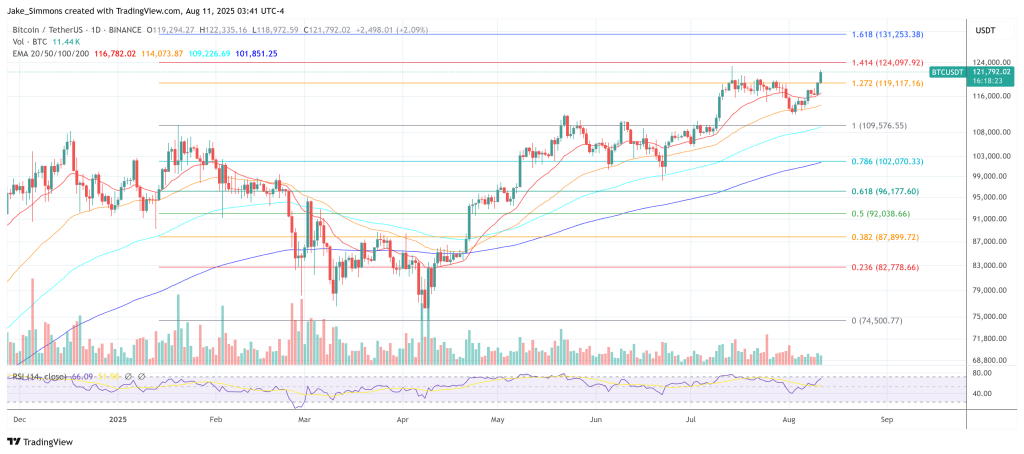
At press time, BTC traded at $121,792.
Bitcoin price
BTC surges above 1.272 Fib, 1-day chart | Source: BTCUSDT on TradingView.com
Featured image created with DALL.E, chart from TradingView.com
Editorial Process for bitcoinist is centered on delivering thoroughly researched, accurate, and unbiased content. We uphold strict sourcing standards, and each page undergoes diligent review by our team of top technology experts and seasoned editors. This process ensures the integrity, relevance, and value of our content for our readers.

Jake Simmons has been a Bitcoin enthusiast since 2016. Ever since he heard about Bitcoin, he has been studying the topic every day and trying to share his knowledge with others. His goal is to contribute to Bitcoin's financial revolution, which will replace the fiat money system. Besides BTC and crypto, Jake studied Business Informatics at a university. After graduation in 2017, he has been working in the blockchain and crypto sector. You can follow Jake on Twitter at @realJakeSimmons.

Criptomoedas em alta

Leituras Relacionadas

The Largest Upgrade Since The Merge? How Glamsterdam Will Affect Ethereum and Regular Users?

The upcoming Glamsterdam upgrade, scheduled for late 2026, is considered Ethereum's most significant change since The Merge. It focuses on fundamentally restructuring Ethereum's block production, transaction execution, and gas pricing to enable major scalability improvements while preserving decentralization. The upgrade centers on three key innovations: * **Enshrined PBS (ePBS)**: Moves the Proposer-Builder Separation mechanism into the protocol's core, eliminating reliance on external relays. This reorganizes the block pipeline, extending the time window for processing execution payloads, which is crucial for safely increasing block capacity. * **Block-Level Access Lists (BALs)**: Attaches a "map" to each block, declaring in advance which state data its transactions will access. This enables potential parallel transaction processing and faster node synchronization, breaking a key performance bottleneck. * **Gas Repricing**: Introduces a more accurate resource pricing model by separating computation costs from state storage costs. This discourages uncontrolled state growth by making operations that create permanent data (like new accounts) more accurately reflect their long-term network burden. Together, these changes aim to solve the core challenges of increasing Ethereum's throughput (e.g., raising the Gas Limit) without overburdening node hardware or increasing centralization risks. They prepare the infrastructure for higher capacity, targeting a credible post-upgrade capacity of up to 200 million Gas. For users, the impact will be nuanced: * General transaction fees may become lower and more stable as block space increases. * Simple transfers could see cost reductions, while state-intensive operations (like contract deployment) may become relatively more expensive due to the new gas model. * Gas fee estimations by wallets will become more accurate. * L2 networks could benefit long-term from increased data blob capacity. * Standardized logs for all ETH transfers (EIP-7708) will improve tracking for wallets and exchanges. Ultimately, Glamsterdam represents a foundational shift, not a simple block size increase. It seeks to expand Ethereum's capacity by re-engineering its underlying mechanics, maintaining its commitment to decentralization while enabling significant performance gains.

marsbitHá 2h

The Largest Upgrade Since The Merge? How Glamsterdam Will Affect Ethereum and Regular Users?

marsbitHá 2h

Circle CEO Responds to the OUSD Challenge: Stablecoin is a Winner-Takes-All Business, and We Won't Slow Down

In response to questions about the OUSD stablecoin initiative, Circle CEO Jeremy Allaire argues that the stablecoin market is a "winner-take-most" platform business driven by powerful network effects, and Circle has no plans to slow down. He outlines three key drivers behind USDC's dominant position: 1. **Protocol/Software Layer Network Effects**: The value of a stablecoin network grows as more developers and services integrate it, creating compounding utility and user preference. Circle has spent nearly a decade building this ecosystem with USDC, now accelerated by mainstream adoption and enhanced by software stacks like CCTP and Gateway for interoperability. 2. **Liquidity Network Effects**: Liquidity begets more liquidity. USDC has achieved top-tier global liquidity—ranking among the top three digital assets alongside BTC and USDT—through nearly a decade of building deep primary and secondary market access across regions and venues. 3. **Regulatory and Policy Integration**: Establishing a global stablecoin requires deep regulatory engagement, licensing, and compliance across key markets—a significant, long-term investment where Circle is a leader. Allaire cites Artemis data showing USDC facilitated 80% of all dollar stablecoin on-chain transaction volume in Q1 2026, with USDT at 20% and all others negligible. He addresses OUSD's purported advantages: "free" minting/burning is often not sustainable in practice; redistributing all revenue can starve essential infrastructure investment; and large consortium models historically struggle with inefficiency and slow execution, unlike focused strategic partnerships. He reaffirms Circle's strong ongoing partnership with Coinbase on USDC and notes Circle collaborates with dozens of other stablecoin issuers through its expanding platform (Arc, CCTP, CPN, etc.). While welcoming OUSD to the ecosystem, Allaire asserts that Circle's vast, trusted network and continued investment make USDC the foundational digital dollar infrastructure for the world.

链捕手Há 2h

Circle CEO Responds to the OUSD Challenge: Stablecoin is a Winner-Takes-All Business, and We Won't Slow Down

链捕手Há 2h

Q2 Crypto Market Review: Did Bitcoin Rise for 'Nothing'? Did Money Flow to AI and On-Chain?

Q2 2026 Crypto Market Recap: Bitcoin's Gains Erased Amid Shift to AI and On-Chain Activity The second quarter of 2026 saw a significant reversal for the cryptocurrency market. Bitcoin gave back all its April gains, ending Q2 down approximately 11%, while major stock indices posted strong gains. This divergence was driven by a hawkish shift in Fed rate expectations, capital rotation into AI stocks, and weakening liquidity channels into crypto. Key demand pillars deteriorated simultaneously. Spot Bitcoin ETFs recorded net outflows of $4.08 billion for the quarter, with outflows dominating June. Crypto treasury entity Strategy's bitcoin accumulation slowed markedly, and the total stablecoin market cap contracted by ~$4.2 billion. This created a tighter liquidity environment. Exchange data reflected the downturn. Spot trading volumes fell 28% quarter-over-quarter. The market underwent significant deleveraging, with $8.35 billion in long liquidations for BTC and ETH, primarily in late May/early June. Open interest and order book liquidity also declined. Despite the bearish price action, structural developments point to an expanding on-chain ecosystem. These include the rise of tokenized stocks with full legal rights, the growth of RWA (real-world asset) perpetual contracts for trading stocks and commodities 24/7, and the use of crypto markets for price discovery ahead of major events like the SpaceX IPO. On-chain vaults are also emerging as a core layer for institutional capital allocation.

Foresight NewsHá 2h

Q2 Crypto Market Review: Did Bitcoin Rise for 'Nothing'? Did Money Flow to AI and On-Chain?

Foresight NewsHá 2h

Trading

Spot

Artigos em Destaque

Como comprar HOUSE

Bem-vindo à HTX.com!Tornámos a compra de Housecoin (HOUSE) simples e conveniente.Segue o nosso guia passo a passo para iniciar a tua jornada no mundo das criptos.Passo 1: cria a tua conta HTXUtiliza o teu e-mail ou número de telefone para te inscreveres numa conta gratuita na HTX.Desfruta de um processo de inscrição sem complicações e desbloqueia todas as funcionalidades.Obter a minha contaPasso 2: vai para Comprar Cripto e escolhe o teu método de pagamentoCartão de crédito/débito: usa o teu visa ou mastercard para comprar Housecoin (HOUSE) instantaneamente.Saldo: usa os fundos da tua conta HTX para transacionar sem problemas.Terceiros: adicionamos métodos de pagamento populares, como Google Pay e Apple Pay, para aumentar a conveniência.P2P: transaciona diretamente com outros utilizadores na HTX.Mercado de balcão (OTC): oferecemos serviços personalizados e taxas de câmbio competitivas para os traders.Passo 3: armazena teu Housecoin (HOUSE)Depois de comprar o teu Housecoin (HOUSE), armazena-o na tua conta HTX.Alternativamente, podes enviá-lo para outro lugar através de transferência blockchain ou usá-lo para transacionar outras criptomoedas.Passo 4: transaciona Housecoin (HOUSE)Transaciona facilmente Housecoin (HOUSE) no mercado à vista da HTX.Acede simplesmente à tua conta, seleciona o teu par de trading, executa as tuas transações e monitoriza em tempo real.Oferecemos uma experiência de fácil utilização tanto para principiantes como para traders experientes.

295 Visualizações TotaisPublicado em {updateTime}Atualizado em 2026.06.02

Como comprar HOUSE

Discussões

Bem-vindo à Comunidade HTX. Aqui, pode manter-se informado sobre os mais recentes desenvolvimentos da plataforma e obter acesso a análises profissionais de mercado. As opiniões dos utilizadores sobre o preço de HOUSE (HOUSE) são apresentadas abaixo.

活动图片