Analyst Foresees BTC Breaking Past $150K – $HYPER Hits $8.3M Amid Scaling Demand

bitcoinistPublicado em 2025-08-11Última atualização em 2025-08-11

Resumo

Macroeconomist Lyn Alden believes $BTC has what it takes to hit $150K or ‘much higher’ this cycle. But when $BTC...

Trusted Editorial content, reviewed by leading industry experts and seasoned editors. Ad Disclosure

Macroeconomist Lyn Alden believes $BTC has what it takes to hit $150K or ‘much higher’ this cycle.

But when $BTC attracts increased demand, there’s often a hitch: The Bitcoin network becomes congested, slowing transactions and driving up fees.

Fear not. Bitcoin Hyper is preparing to boost the network’s reliability this quarter. And the timing of the Bitcoin Layer 2 network’s launch, perhaps, couldn’t be any better.

Alden Predicts $BTC to Climb Like Big-Tech Giants

In a recent Cryptoslate interview, Alden explained how $BTC – currently valued at $121K – might experience a longer, less extreme cycle. One of which is similar to big-tech giants, as opposed to typical crypto volatility.

‘If you look at what used to be called FANG stocks, and now it’s the Mag7 stocks, basically large-cap U.S. tech stocks, they kept grinding up longer than people thought,’ she explained.

She added that they sometimes face corrections or choppy years, but resume climbing once momentum rebuilds. Then, that $BTC could follow the same path.

‘I think Bitcoin could resemble that model to some extent. Maybe it’s still more volatile than that, but I do think we should expect maybe longer and less extreme cycles on average,’ continued Alden.

Alden then dismissed concerns that Bitcoin treasury companies could trigger a market-wide collapse. As an example, she explained how Microstrategy (which holds 628,791 $BTC worth $74.21B) has relatively low leverage compared to its Bitcoin holdings.

Because the company buys $BTC through a mix of internal cash and external financing, it avoids aggressive debt positions that could cause a large-scale sell-off if prices fall sharply.

Still, she says we’ll like see many altcoin treasury companies fail, with even Bitcoin ones heading to a downturn due to poor management.

Such a warning stems from the fact that excessive leverage and poor management can force treasuries to liquidate holdings during downturns.

Nevertheless, if Alden’s outlook proves correct, $BTC could be set for a steadier, more sustained climb to rosy pursuits.

Suppose this environment surfaces, Bitcoin Hyper’s mission to keep the network efficient and affordable during peak demand could prove more essential than ever.

Bitcoin Hyper Layer 2 to Boost Bitcoin’s Programmability

The Bitcoin Hyper Layer 2 solution is being built to fix Bitcoin’s bottlenecks.

By processing transactions off-chain while securing them to Bitcoin’s mainchain, it’ll boast higher throughput and lower costs. Therefore, you’ll be able to send $BTC quickly and cheaply during heavy network load.

Powered by the Solana Virtual Machine (SVM), it’ll also bring smart contract capabilities to Bitcoin. By doing so, developers will be able to build DeFi protocols and dApps directly on the network.

It’ll leverage a Canonical Bridge to process transactions through the SVM. This way, it can mint equivalent wrapped $BTC on the Layer 2 network for use in DeFi and dApps. But don’t worry, you’ll still be able to redeem your $BTC on the mainnet whenever you wish.
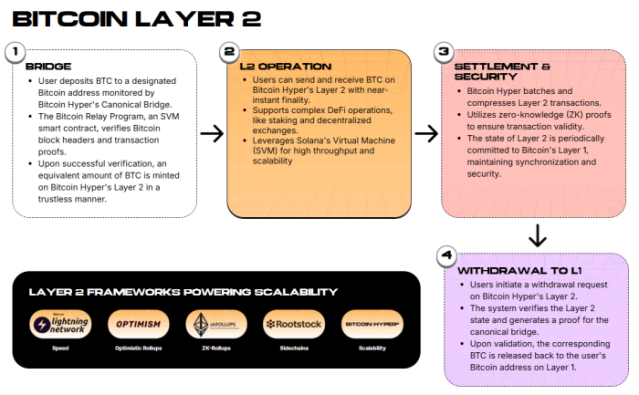
How the Bitcoin Hyper Layer 2 works
Source: Bitcoin Hyper

Additionally, Bitcoin Hyper will integrate Zero-Knowledge Proofs (ZKPs) to verify transactions quickly and securely without overloading Bitcoin’s base layer. This’ll make it suitable for high-volume payments, cross-border transfers, and on-chain applications.

Read more about what Bitcoin Hyper is and what it plans to do in our guide.

And then there’s the Layer 2 network’s native token, $HYPER, which offers additional perks: reduced transaction fees, governance rights, and staking rewards at a 130% APY.

Since its presale launch on May 16, 2025, $HYPER has already raised over $8.3M, backed by major whale buys independently investing $74.9K, $54.1K, and $53.9K.

Given this strong investor confidence, it’s no wonder that it’s poised to be the next crypto to explode.

Verdict – Alden’s $BTC Outlook Enhances Bitcoin’s Hyper’s Relevance

Alden’s outlook frames $BTC experiencing steady, sustained gains as opposed to volatile spikes and crashes.

Say her prediction proves correct, the Bitcoin network’s demand could remain high for an extended period. In turn, this would make scalability solutions increasingly important.

This is where Bitcoin Hyper shines bright. By combining off-chain transaction processing, Solana-level performance, and smart contract capabilities, it’s a clear answer to Bitcoin’s programmability challenges – especially if $BTC continues to rise, like Alden foresees.

To get the most out of the Layer 2, consider scooping up some $HYPER, available on presale for just $0.012625.

Once Bitcoin Hyper officially launches on mainnet, it’s anticipated to jump to $0.32 this year. So, why not purchase $HYPER now at $0.012625 for possible gains surpassing 2,400%?

This isn’t investment advice. Always DYOR and never invest more than you’d be sad to lose.

Editorial Process for bitcoinist is centered on delivering thoroughly researched, accurate, and unbiased content. We uphold strict sourcing standards, and each page undergoes diligent review by our team of top technology experts and seasoned editors. This process ensures the integrity, relevance, and value of our content for our readers.

Leah is a British journalist with a BA in Journalism, Media, and Communications and nearly a decade of content writing experience. Over the last four years, her focus has primarily been on Web3 technologies, driven by her genuine enthusiasm for decentralization and the latest technological advancements. She has contributed to leading crypto and NFT publications – Cointelegraph, Coinbound, Crypto News, NFT Plazas, Bitcolumnist, Techreport, and NFT Lately – which has elevated her to a senior role in crypto journalism. Whether crafting breaking news or in-depth reviews, she strives to engage her readers with the latest insights and information. Her articles often span the hottest cryptos, exchanges, and evolving regulations. As part of her ploy to attract crypto newbies into Web3, she explains even the most complex topics in an easily understandable and engaging way. Further underscoring her dynamic journalism background, she has written for various sectors, including software testing (TEST Magazine), travel (Travel Off Path), and music (Mixmag). When she's not deep into a crypto rabbit hole, she's probably island-hopping (with the Galapagos and Hainan being her go-to's). Or perhaps sketching chalk pencil drawings while listening to the Pixies, her all-time favorite band.

Leituras Relacionadas

The Largest Upgrade Since The Merge? How Glamsterdam Will Affect Ethereum and Regular Users?

The upcoming Glamsterdam upgrade, scheduled for late 2026, is considered Ethereum's most significant change since The Merge. It focuses on fundamentally restructuring Ethereum's block production, transaction execution, and gas pricing to enable major scalability improvements while preserving decentralization. The upgrade centers on three key innovations: * **Enshrined PBS (ePBS)**: Moves the Proposer-Builder Separation mechanism into the protocol's core, eliminating reliance on external relays. This reorganizes the block pipeline, extending the time window for processing execution payloads, which is crucial for safely increasing block capacity. * **Block-Level Access Lists (BALs)**: Attaches a "map" to each block, declaring in advance which state data its transactions will access. This enables potential parallel transaction processing and faster node synchronization, breaking a key performance bottleneck. * **Gas Repricing**: Introduces a more accurate resource pricing model by separating computation costs from state storage costs. This discourages uncontrolled state growth by making operations that create permanent data (like new accounts) more accurately reflect their long-term network burden. Together, these changes aim to solve the core challenges of increasing Ethereum's throughput (e.g., raising the Gas Limit) without overburdening node hardware or increasing centralization risks. They prepare the infrastructure for higher capacity, targeting a credible post-upgrade capacity of up to 200 million Gas. For users, the impact will be nuanced: * General transaction fees may become lower and more stable as block space increases. * Simple transfers could see cost reductions, while state-intensive operations (like contract deployment) may become relatively more expensive due to the new gas model. * Gas fee estimations by wallets will become more accurate. * L2 networks could benefit long-term from increased data blob capacity. * Standardized logs for all ETH transfers (EIP-7708) will improve tracking for wallets and exchanges. Ultimately, Glamsterdam represents a foundational shift, not a simple block size increase. It seeks to expand Ethereum's capacity by re-engineering its underlying mechanics, maintaining its commitment to decentralization while enabling significant performance gains.

marsbitHá 2h

The Largest Upgrade Since The Merge? How Glamsterdam Will Affect Ethereum and Regular Users?

marsbitHá 2h

Circle CEO Responds to the OUSD Challenge: Stablecoin is a Winner-Takes-All Business, and We Won't Slow Down

In response to questions about the OUSD stablecoin initiative, Circle CEO Jeremy Allaire argues that the stablecoin market is a "winner-take-most" platform business driven by powerful network effects, and Circle has no plans to slow down. He outlines three key drivers behind USDC's dominant position: 1. **Protocol/Software Layer Network Effects**: The value of a stablecoin network grows as more developers and services integrate it, creating compounding utility and user preference. Circle has spent nearly a decade building this ecosystem with USDC, now accelerated by mainstream adoption and enhanced by software stacks like CCTP and Gateway for interoperability. 2. **Liquidity Network Effects**: Liquidity begets more liquidity. USDC has achieved top-tier global liquidity—ranking among the top three digital assets alongside BTC and USDT—through nearly a decade of building deep primary and secondary market access across regions and venues. 3. **Regulatory and Policy Integration**: Establishing a global stablecoin requires deep regulatory engagement, licensing, and compliance across key markets—a significant, long-term investment where Circle is a leader. Allaire cites Artemis data showing USDC facilitated 80% of all dollar stablecoin on-chain transaction volume in Q1 2026, with USDT at 20% and all others negligible. He addresses OUSD's purported advantages: "free" minting/burning is often not sustainable in practice; redistributing all revenue can starve essential infrastructure investment; and large consortium models historically struggle with inefficiency and slow execution, unlike focused strategic partnerships. He reaffirms Circle's strong ongoing partnership with Coinbase on USDC and notes Circle collaborates with dozens of other stablecoin issuers through its expanding platform (Arc, CCTP, CPN, etc.). While welcoming OUSD to the ecosystem, Allaire asserts that Circle's vast, trusted network and continued investment make USDC the foundational digital dollar infrastructure for the world.

链捕手Há 2h

Circle CEO Responds to the OUSD Challenge: Stablecoin is a Winner-Takes-All Business, and We Won't Slow Down

链捕手Há 2h

Q2 Crypto Market Review: Did Bitcoin Rise for 'Nothing'? Did Money Flow to AI and On-Chain?

Q2 2026 Crypto Market Recap: Bitcoin's Gains Erased Amid Shift to AI and On-Chain Activity The second quarter of 2026 saw a significant reversal for the cryptocurrency market. Bitcoin gave back all its April gains, ending Q2 down approximately 11%, while major stock indices posted strong gains. This divergence was driven by a hawkish shift in Fed rate expectations, capital rotation into AI stocks, and weakening liquidity channels into crypto. Key demand pillars deteriorated simultaneously. Spot Bitcoin ETFs recorded net outflows of $4.08 billion for the quarter, with outflows dominating June. Crypto treasury entity Strategy's bitcoin accumulation slowed markedly, and the total stablecoin market cap contracted by ~$4.2 billion. This created a tighter liquidity environment. Exchange data reflected the downturn. Spot trading volumes fell 28% quarter-over-quarter. The market underwent significant deleveraging, with $8.35 billion in long liquidations for BTC and ETH, primarily in late May/early June. Open interest and order book liquidity also declined. Despite the bearish price action, structural developments point to an expanding on-chain ecosystem. These include the rise of tokenized stocks with full legal rights, the growth of RWA (real-world asset) perpetual contracts for trading stocks and commodities 24/7, and the use of crypto markets for price discovery ahead of major events like the SpaceX IPO. On-chain vaults are also emerging as a core layer for institutional capital allocation.

Foresight NewsHá 2h

Q2 Crypto Market Review: Did Bitcoin Rise for 'Nothing'? Did Money Flow to AI and On-Chain?

Foresight NewsHá 2h

Trading

Spot
活动图片