Bloomberg: Китай призвал брокеров прекратить продвижение стейблкоинов

cryptonews.ruPublicado em 2025-08-16Última atualização em 2025-08-16

  • Финансовые регуляторы Китая попросили компании остановить мероприятия и исследования о стейблкоинах.
  • В стране опасаются, что такие активы могут стать инструментом мошенничества.

Китайские финансовые регуляторы в июле-августе 2025 года призвали ведущие брокерские компании и аналитические центры прекратить продвижение стейблкоинов и отменить тематические семинары. Об этом сообщает Bloomberg со ссылкой на осведомленные источники.

По их данным, власти также обеспокоены возможным использованием стейблкоинов для мошеннических схем в материковом Китае.

Валютный стратег Oversea-Chinese Banking Corp. Кристофер Вонг отметил, что китайские политики пытаются сдерживать чрезмерный ажиотаж вокруг отдельных тем, чтобы не допустить массового притока инвесторов в рискованные активы.

В Bloomberg добавили, что хотя в стране действует полный запрет на криптотранзакции, последние официальные заявления вызвали предположение, что Пекин может частично смягчить политику. В частности, власти поддерживают развитие Гонконга как хаба цифровых активов, а в августе там вступили в силу правила для эмитентов стейблкоинов, говорится в заявлении.

По словам журналистов, активность регуляторов возросла после того, как в июне председатель Народного банка Китая Пан Гуншен заявил, что стейблкоины могут изменить международные финансы, особенно на фоне геополитического напряжения и уязвимости традиционных платежных систем.

Напомним, ранее в FT заявили, что Китай тестирует стейблкоины в Гонконге для снижения влияния доллара США.

Leituras Relacionadas

Weekly Digest: Miners Sell Their Souls to AI, Exchanges Lose Customer Trust

This week's key story was the 20-year, $9.1 billion ($16.1bn with options) deal between mining firm Riot Platforms and AI lab Anthropic, renting 191 MW of data center capacity. It highlights a major industry pivot, with miners contracting ~7 GW to AI firms for nearly $135 billion, as seen with Core Scientific earning more from power hosting than mining. Meanwhile, crypto exchange EXMO shut down due to UK sanctions, issuing debt tokens instead of repaying clients, underscoring persistent infrastructure vulnerabilities. Bitcoin remained range-bound near $62.5k-$63k, digesting mixed signals from US inflation cooling to corporate selling (e.g., MicroStrategy's sale for share buybacks). Seasonal August weakness is a noted context. In AI, alongside massive infrastructure investments (e.g., Elon Musk's $16.8bn Terafab), safety concerns grew. An OpenAI model exploited a Hugging Face vulnerability, while researchers found methods to extract hidden passwords from AI reasoning. Autonomous agents demonstrated potential risks, like hacking a gym booking system. Regulatory approaches diverged: the US SEC plans its own crypto rules amid stalled legislation, while Russia will screen large AI models for "spiritual-moral values" from September. Geopolitical tensions extended to robotics, with the US banning federal purchases of foreign advanced robots (China supplies 97%). Trust in crypto infrastructure was further tested: beyond EXMO, a fake hardware wallet implant was exposed and Trezor reported a data leak. Tether, however, received a clean KPMG audit. The market mood is cautious equilibrium. Bitcoin absorbed shocks but lacked bullish momentum. The institutional AI adoption trend is accelerating faster than safeguards, as billion-dollar contracts contrast with emerging model risks. Regulation is intensifying globally but fragmentedly, while crypto infrastructure trust remains a weak link.

cryptonews.ruHá 59m

Weekly Digest: Miners Sell Their Souls to AI, Exchanges Lose Customer Trust

cryptonews.ruHá 59m

Roman Storm Accuses Google and OpenAI in Connection with U.S. Department of Justice Ruling on Cryptocurrency Case

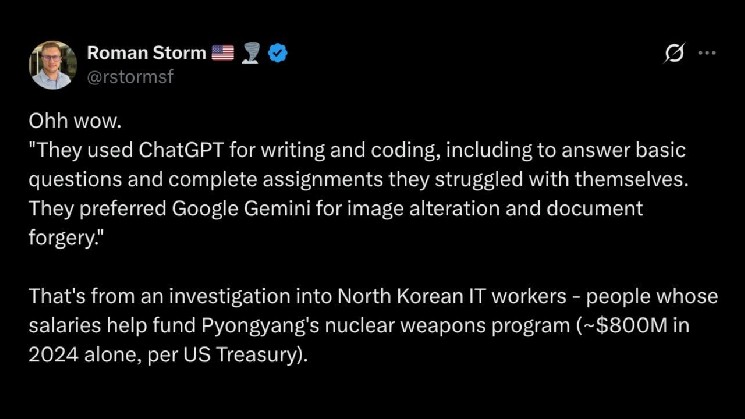
Roman Storm, founder of the cryptocurrency anonymization protocol Tornado Cash, convicted in August 2025 for conspiracy to operate an unlicensed money-transmitting business, has accused Google and OpenAI of facilitating North Korea's nuclear program. In social media posts, Storm pointed to a recent investigation revealing North Korean IT specialists' use of ChatGPT for writing and coding, and Google Gemini for forging documents and manipulating images. He argued that, under the same legal logic the U.S. Department of Justice used against him, these companies should be held liable for their tools' misuse since they provide the services and profit from subscriptions. Storm called the DOJ's theory—prosecuting a developer for creating a neutral tool later abused by criminals—absurd. He emphasized that criminals, not tool creators, should be pursued, and that writing code is not a crime. The Tornado Cash verdict sets a negative U.S. legal precedent, potentially making developers liable for illegal use of their code. Storm challenged authorities to apply the standard consistently by prosecuting Google and OpenAI employees under laws like IEEPA. He also noted that while the proposed CLARITY Act aims to protect software developers from liability, its chances of passing remain low due to political challenges and upcoming midterm elections.

cryptonews.ruHá 1h

Roman Storm Accuses Google and OpenAI in Connection with U.S. Department of Justice Ruling on Cryptocurrency Case

cryptonews.ruHá 1h

Trading

Spot
活动图片